
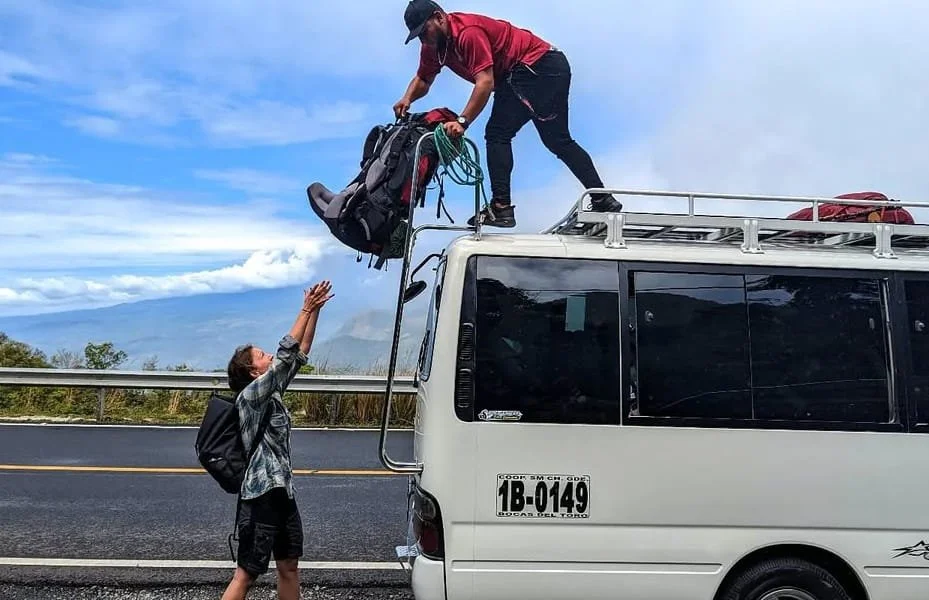
One of the pleasant surprises for many travelers in Panama is just how much of the country you can explore without renting a car. Panama has a surprisingly extensive public transportation network, and for budget travelers, backpackers and anyone who doesn't want to deal with driving, buses are often the easiest way to get around. The important thing to understand, however, is that “reliable” in Panama doesn't necessarily mean perfectly punctual. Public transportation is generally inexpensive, frequent and functional, but you need to allow yourself some flexibility.
Panama City has the most developed system
If you're staying in Panama City, public transportation is particularly useful. The city has both the Metro and the MiBus bus network, and the two systems work together to cover a large portion of the metropolitan area.
MiBus currently operates more than 1,400 buses and a large network of routes, carrying hundreds of thousands of passengers every day. In the first eight months of 2026 alone, MiBus recorded more than 103 million passenger boardings.
The Metro is generally the more predictable option when you're traveling along its routes because it isn't sitting in Panama City's notoriously heavy road traffic. Buses, on the other hand, can be affected by congestion, accidents, road construction and the sheer number of cars on the streets.
MiBus also has electronic fleet management that allows the company to monitor buses in real time and make operational adjustments when buses fall behind schedule.
For a visitor, the practical lesson is simple: if the Metro goes where you need to go, use it. If not, the bus network can fill in the gaps.
Long distance buses are a different story
Once you leave Panama City, public transportation becomes less like an urban transit system and more like a network of intercity buses.
This is actually one of the great things about traveling around Panama. Major destinations are connected by buses, and you don't necessarily need to book an expensive private shuttle every time you move to another town.
David, Boquete, Santiago, Chitré, Las Tablas, Penonomé and many other places are connected by regular bus services. From David, you can then connect to smaller destinations throughout Chiriquí.
The big difference is that you shouldn't expect every bus to operate like a Swiss railway.
A bus might leave at a slightly different time than you expected. A journey can take longer because of traffic, road conditions or stops along the way. Sometimes a bus doesn't leave until it has enough passengers. In rural areas, schedules can also be considerably more informal than what travelers from Europe or North America are accustomed to.
But that doesn't necessarily make the system unreliable.
It means you have to understand how the system works.
Panama's buses are often more reliable than they look
One of the funniest things about traveling through Panama is that the bus terminal can look chaotic to someone seeing it for the first time.
There may be several buses going in the same general direction. Someone is shouting a destination. A driver or assistant is calling out towns. People are getting on and off. And you're standing there wondering whether you've accidentally wandered into a transportation system designed entirely by improvisation.
Then you realize that it works.
Panamanians use these buses every day. The network exists because people need to get to work, school, family, farms and businesses. It isn't primarily designed for tourists, which is actually one of its advantages. You're using the same transportation system that local people depend on.
The trick is to ask questions.
If you're unsure where to go, ask several people. Ask the driver. Ask someone at the terminal. Say the name of your destination clearly. In smaller towns, people are often very accustomed to helping travelers figure out which bus they need.
Don't plan your entire trip around the exact minute
This is probably the most important advice for anyone traveling around Panama by public transportation.
If Google Maps says your bus journey will take four hours and twelve minutes, don't build a 45-minute international flight connection around that prediction.
Give yourself a cushion.
For example, if you need to get from Panama City to David and then catch another bus, don't plan your connection as though the first bus is guaranteed to arrive at precisely 2:17 PM.
Traffic can be unpredictable. A bus may make additional stops. Rain can slow things down. Construction can cause delays. And sometimes the simplest explanation is that things just took longer than expected.
This doesn't mean you should expect disaster every time you board a bus. It simply means Panama operates on a slightly more flexible concept of time than a high-speed European rail network.
The famous Panama City to David bus
For backpackers traveling west, the Panama City to David bus is particularly useful.
It is an overnight option for travelers who want to save the cost of a hotel and arrive in western Panama in the morning. The journey is long, but it can be a very practical way to move across the country.
There is usually a stop along the way where passengers can get something to eat, and it's worth having a sweatshirt or light jacket because buses can sometimes be surprisingly cold from the air conditioning.
It's also smart to travel with a fully charged phone and preferably a power bank. And keep your passport with you rather than buried inside your luggage, because there can be immigration or identification checks during long-distance travel.
The journey isn't glamorous, but it gets the job done.
And that's really the story of public transportation throughout much of Panama.
Rural Panama requires more patience
The farther you get from the major cities, the more important flexibility becomes.
In a place like Boquete, buses are relatively straightforward. In smaller villages, however, there may be fewer departures and less information available online.
This is where asking locals becomes much more useful than staring at an app.
You may discover that the bus you were looking for doesn't actually appear on the website you found. Or that locals know the bus by a completely different name. Or that there is a particular place where you need to stand to flag it down.
This can sound intimidating, but it is actually part of the adventure.
You don't need to understand the entire transportation system before you arrive. You just need to figure out your next bus.
Then you figure out the one after that.
Traffic is the biggest enemy in Panama City
If public transportation in Panama has one major enemy, it isn't necessarily the buses themselves.
It's traffic.
Panama City can have significant congestion, particularly during morning and afternoon commuting periods. A bus can be perfectly operational and still arrive later than expected because it is sitting in traffic with everybody else.
MiBus has continued making route and scheduling adjustments to improve operations, and the system transported more than 88 million passengers during the first seven months of 2026.
There have also been periods when MiBus has adjusted certain services because of operating costs and demand, so checking current route information is worthwhile when your journey depends on a particular bus.
Is public transportation safe?
Generally, millions of people use Panama's public transportation system every day, but travelers should use normal big-city precautions, particularly in Panama City.
Keep your phone and wallet secure, don't leave bags unattended and pay attention to your surroundings. Canada's travel advice also notes that public transportation has improved but can sometimes be unreliable, and recommends protecting belongings when using buses.
For long-distance travel, keep important documents and valuables with you rather than putting everything into the luggage compartment.
The same common sense you'd use on a crowded bus in almost any major city applies here.
The great advantage is the price
Perhaps the biggest reason backpackers continue to use Panama's public transportation is simple: it is usually remarkably affordable compared with private transportation.
You can travel substantial distances across the country without spending anything close to what you would pay for a private transfer or rental car.
That makes Panama particularly attractive to independent travelers.
Instead of spending your travel budget on transportation, you can put it toward accommodation, diving, hiking, wildlife tours, coffee tours, food, islands and the occasional cold beer.
So, how reliable is it?
The honest answer is pretty reliable, but don't confuse reliable with precise.
In Panama City, the Metro is generally the easiest way to avoid traffic when your destination is near a station. MiBus provides extensive coverage beyond the Metro, although bus journeys can be affected by traffic and operational changes.
For intercity travel, buses are an established and widely used way of getting around the country. They're affordable, frequent on major routes and capable of getting you to many places that tourists might assume require a rental car.
In smaller towns and rural areas, however, schedules can become less predictable and information can be harder to find online.
So don't arrive in Panama expecting German railway precision.
Instead, think of the system as cheap, extensive and generally dependable, with a little bit of Latin American flexibility built into the timetable.
If you're traveling through Panama with an open schedule, public transportation can be one of the best ways to experience the country. You sit beside local passengers, watch the landscape change outside the window, stop in towns you might otherwise never see and occasionally have absolutely no idea why the bus has stopped.
And then, sooner or later, it starts moving again.
That's Panama.