
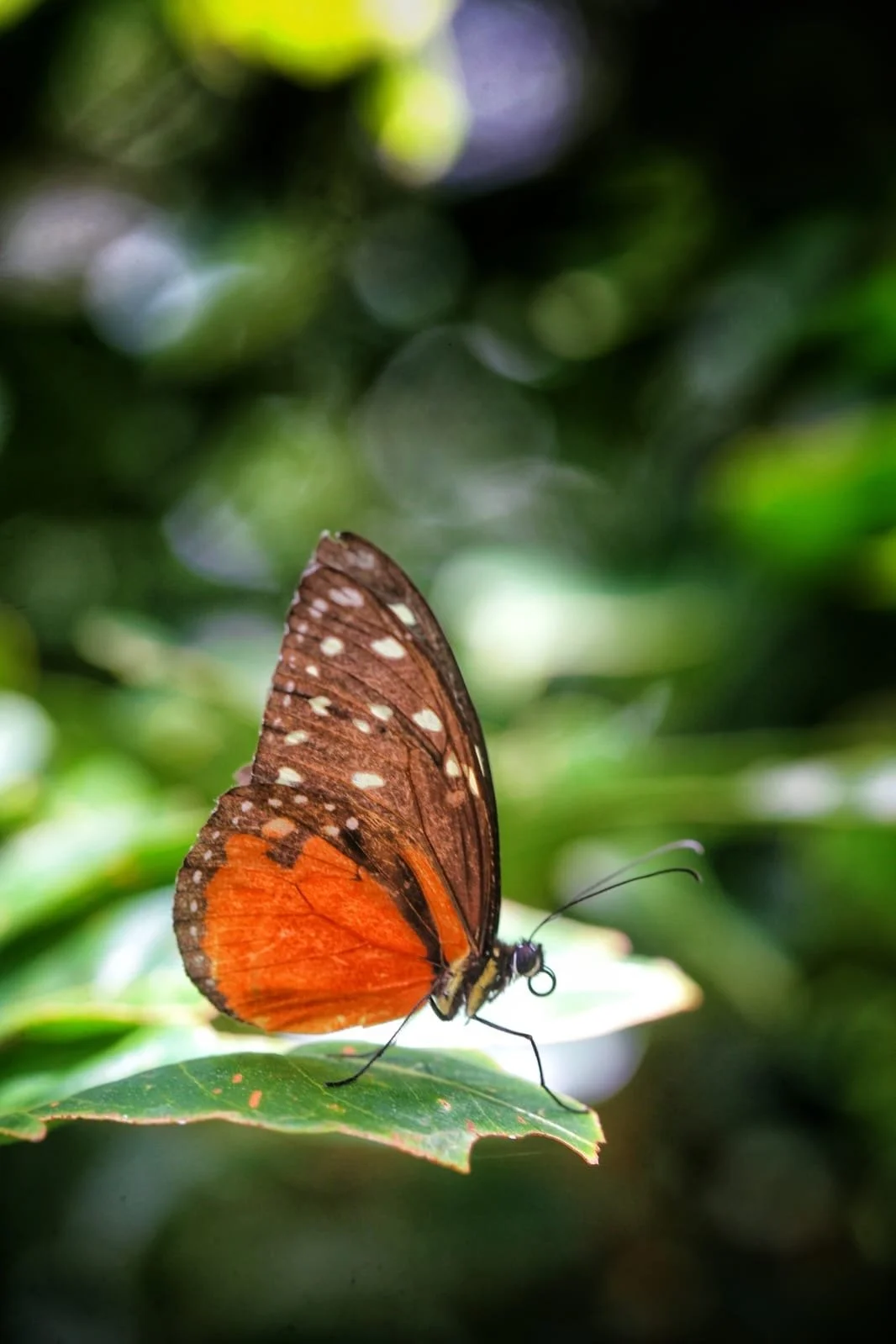
Panama is one of those countries where you can be walking down a jungle trail and suddenly have something spectacular flutter across your path. Butterflies are everywhere in Panama, from tiny blue and orange species that disappear almost as quickly as they arrive to enormous butterflies with wings that look like they belong in a science fiction movie. The country’s location is a big part of the reason. Panama sits between North and South America, acting as a biological bridge between the two continents, and its combination of rainforest, mountains, wetlands, dry forest and Caribbean and Pacific environments gives butterflies an incredible variety of places to live. A recent survey of just three areas of central Panama recorded 308 species in only 20 days of fieldwork.
For a tourist, one of the easiest mistakes is to think that seeing a butterfly simply means seeing a pretty insect. Once you start paying attention, you realize that Panama's butterflies come in an amazing range of shapes, colours, sizes and behaviours. There are more than 1,500 species reported from Panama, although exact totals vary depending on classification and how species are counted. That is an extraordinary amount of diversity for a relatively small country.
The Blue Morpho
If there is one butterfly that almost every visitor hopes to see in Panama, it is the famous blue Morpho. This is the butterfly that can make somebody who has never cared about insects suddenly stop in the middle of a jungle trail. When a Morpho opens its wings in the sunlight, the brilliant electric blue can seem almost artificial. Then it closes its wings and suddenly becomes much harder to see.
The amazing blue colour is not simply blue pigment. The microscopic structure of the scales on the wings reflects light in a way that produces the intense blue appearance. The wings themselves contain brown pigmentation, but the tiny structures on the scales are responsible for the spectacular blue flash.
Morphos are particularly impressive because of the way they move through the forest. Instead of constantly sitting on flowers like some butterflies, they can appear as a sudden flash of blue flying along a trail before disappearing around the vegetation. Seeing one at close range is one of those small jungle experiences that people tend to remember long after their trip is over.
And there is some fascinating science happening in Panama involving these butterflies. Researchers with the Smithsonian Tropical Research Institute recently studied how high temperatures during development can alter the microscopic structures responsible for the Morpho's brilliant blue iridescence.
Owl Butterflies
Another butterfly that can amaze visitors is the owl butterfly, particularly the large Caligo species. These are big butterflies with enormous eyespots on their hind wings that resemble the eyes of an owl. When they are sitting with their wings closed, they can look surprisingly like a piece of bark or a dead leaf. When they suddenly move, you realize that what looked like part of the forest was actually a giant butterfly.
The eyespots are one of the great examples of how tropical butterflies can use camouflage and deception. A tourist who is not looking carefully can walk straight past one without noticing it. Owl butterflies are among the larger butterflies you can encounter in Panama, which makes them especially impressive when they fly past your head on a jungle trail.
The Pale Owl, Caligo telamonius, is among the commonly reported butterflies in Panama.
Glasswing Butterflies
Glasswings are almost the opposite of the Morpho. Instead of enormous colourful wings, they have delicate wings with large transparent sections. Their wings can look as though somebody has cut pieces out of them.
These butterflies are particularly fascinating because they demonstrate just how strange tropical insects can be. A glasswing drifting through vegetation can almost disappear against the background. They are generally associated with forest environments and are among the butterflies that make you realize that camouflage does not always mean brown or green.
For somebody taking photographs, glasswings can also be a fun challenge because their transparent wings can be difficult to capture properly.
Heliconius and the Longwings
Panama is also home to many spectacular Heliconius butterflies, commonly called longwings. These butterflies often have combinations of black, orange, yellow, red and sometimes blue that make them immediately recognizable.
Some Heliconius species were recorded during the recent central Panama survey, including several forms of Heliconius erato, Hecale Longwing, and other related species.
The really interesting thing about these butterflies is that their bright colours are not just decoration. Many Heliconius butterflies are distasteful to predators, and their colour patterns can form part of a warning system. Several species can also resemble one another, creating some wonderfully complicated examples of butterfly mimicry.
To a tourist, however, you don't need to understand all of the genetics and evolutionary biology to appreciate them. A black butterfly with bright red or orange markings slowly moving through the jungle is simply spectacular.
The 88 Butterflies
Then there are the butterflies that look as though somebody has painted numbers onto their wings. Several species in Panama belong to groups commonly called eighty-eight butterflies because of markings on the underside of their wings that can resemble the numbers 88.
These are especially fun for visitors because the name gives you something specific to look for. Once you know about them, you start checking butterflies that land with their wings closed to see whether you can find the mysterious markings.
Cracker Butterflies
The cracker butterflies are another fascinating group. Species such as the Variable Cracker can be found in Panama, and they have an unusual trick that makes them particularly memorable.
Some cracker butterflies can produce a surprisingly loud clicking or cracking sound with their wings when they fly close to another butterfly or animal. The sound is unusual enough that the name suddenly makes sense.
The Variable Cracker, Hamadryas feronia, is among the commonly reported butterflies in Panama.
They are also masters of camouflage. When sitting on tree trunks, their mottled wing patterns can make them surprisingly difficult to spot.
Swallowtails
Panama also has several beautiful swallowtail butterflies. These are the butterflies that tend to fit the classic image people have in their heads when they hear the word butterfly: relatively large wings, strong colours and, in many species, distinctive tails projecting from the hind wings.
Some can be predominantly black with dramatic yellow markings, while others have combinations of blue, red and yellow. Because they are often relatively large and noticeable, swallowtails can be particularly rewarding for someone who is just beginning to pay attention to butterflies.
They also demonstrate one of the basic characteristics that makes tropical butterfly watching so addictive. You may think you have learned what one species looks like, only to discover several others with remarkably similar patterns.
White Peacocks and Banded Peacocks
Not every spectacular butterfly in Panama is enormous or brightly coloured. The White Peacock and Banded Peacock are examples of butterflies that combine beautiful patterns with relatively common sightings.
The Banded Peacock, Anartia fatima, is one of the commonly reported butterflies in Panama and was also particularly abundant in the central Panama research survey.
These are the kinds of butterflies you may start noticing around open areas, gardens, roadsides and forest edges. They are a reminder that you don't necessarily need to hike deep into untouched rainforest to see interesting butterflies.
Metalmarks
One group that can surprise serious butterfly watchers is the metalmarks. These are generally smaller than the big showy butterflies that tourists immediately notice, but many have incredibly intricate patterns.
They can have metallic-looking spots, tiny flashes of colour and beautifully patterned wings. They are easy to overlook because they don't have the size of a Morpho or an owl butterfly, but once you start looking closely, they can be some of the most interesting butterflies in the forest.
This is one reason Panama is such a rewarding place for people who become interested in butterflies during their vacation. At first you notice the big blue butterflies. Then you start noticing the orange ones. Then the tiny blue ones. Then suddenly you're crouched beside a leaf trying to photograph something the size of your fingernail.
The Tiny Blue Butterflies
Panama also has huge numbers of smaller butterflies, including blues and hairstreaks. These can be considerably harder to identify than the big tropical showpieces, but they can be incredibly beautiful when seen close up.
Some have metallic blue wings, while others have tiny tails, orange spots or complicated patterns that you would never notice unless you stopped and looked carefully. They are particularly good examples of why carrying a camera with a decent zoom or macro capability can transform a jungle walk.
Where Should Tourists Look?
You don't necessarily need to visit a specialised butterfly garden to see butterflies in Panama. Forest trails, gardens, open clearings, riversides, roadsides and forest edges can all be productive.
One particularly famous destination for butterfly watching is Pipeline Road near Gamboa. The Smithsonian Tropical Research Institute has even published a field guide featuring 120 of the most commonly observed butterflies along the trail, which gives you an idea of just how much variety can be encountered in this area.
But one of the great things about butterfly watching in Panama is that you can encounter them almost anywhere. Even Panama City has surprisingly interesting butterfly habitat. A recent study around three central Panama locations recorded hundreds of species, while research around the Amador Causeway documented dozens of butterfly species despite the highly developed surroundings.
Which Butterflies Will Impress a Tourist the Most?
If you are visiting Panama and aren't already a serious butterfly enthusiast, the ones most likely to make you stop and say "Wow!" are probably the blue Morpho, the enormous owl butterflies, the transparent glasswings, the colourful Heliconius longwings, the striking swallowtails and the bizarre patterned cracker butterflies.
But there is another side to butterfly watching that makes Panama particularly special. The longer you spend in the jungle, the less interested you become in simply finding the biggest and brightest butterfly. You begin noticing tiny species hiding underneath leaves, butterflies pretending to be dead leaves, species that resemble other butterflies, metallic flashes that last only a second and insects that you would have walked past completely if you hadn't slowed down.
That is really the secret to seeing butterflies in Panama. Don't walk through the jungle looking for butterflies. Walk slowly enough that the butterflies have a chance to reveal themselves.
And once you start doing that, you may discover that the most amazing butterfly of your trip isn't necessarily the biggest or the bluest one. It might be the tiny, bizarre little species that landed beside you for ten seconds and then disappeared into the rainforest.