
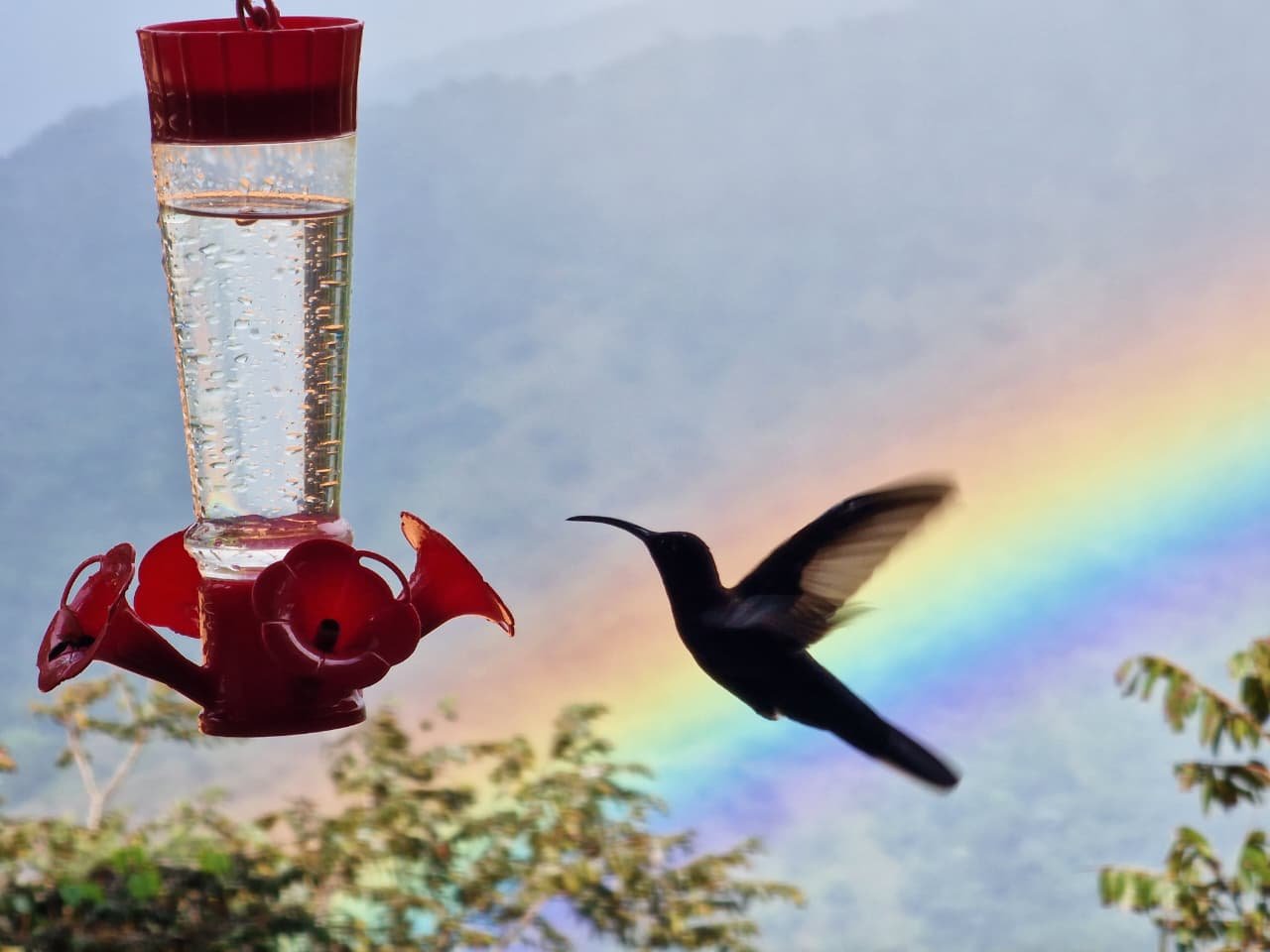
Chiriquí is one of the best places in Panama to see hummingbirds, and what makes the province particularly interesting is the incredible variety packed into a relatively small area. From the warm lowlands around David and the forests of the Fortuna area to the cool highlands around Boquete, Volcán and the slopes of Volcán Barú, the change in elevation creates a series of different habitats, each with its own collection of hummingbirds. Bird lists for the Chiriquí highlands contain well over a dozen hummingbird species, while broader Chiriquí checklists contain considerably more.
One of the most spectacular is the Violet Sabrewing, a large, powerful hummingbird that looks almost oversized compared with many of its relatives. The male has brilliant violet plumage and broad wings, and it is one of those hummingbirds that can make you stop what you are doing when it suddenly appears. It is regularly recorded in the Chiriquí highlands and has been documented around places such as Cerro Punta and the cloud forests around Volcán.
Another highland specialty is the Volcano Hummingbird, a tiny bird associated with the high elevations of the region. Despite its diminutive size, it is remarkably adapted to life in cool mountain environments. Chiriquí is also home to the Scintillant Hummingbird, another very small highland species. These tiny hummingbirds are particularly interesting because they are part of a group adapted to the colder conditions found around the mountains. Both species are included on Chiriquí bird lists.
The Fiery-throated Hummingbird is another spectacular bird of the mountains. As its name suggests, its throat can appear brilliantly colored, and it is associated with the higher elevations of the Chiriquí region. The highlands also produce the White-throated Mountain-gem, Purple-throated Mountain-gem and White-bellied Mountain-gem, giving birdwatchers an opportunity to see several closely related mountain hummingbirds in the same general region.
Then there is the Talamanca Hummingbird, a particularly interesting highland bird. It occurs in the mountain regions of western Panama and is associated with forest edges and clearings around the highlands of Volcán Barú. It is one of the birds that reminds you that Chiriquí's hummingbird diversity isn't simply a collection of widespread tropical species. Some of these birds are strongly associated with the unique mountain environment of western Panama and neighboring Costa Rica.
The Black-bellied Hummingbird is another special bird of the Chiriquí highlands. Its dark underside makes it quite distinctive, and it is considered a Chiriquí highland endemic in birding literature. Seeing one can therefore be considerably more exciting for a serious birdwatcher than simply seeing another common hummingbird at a feeder.
One of the most charming little birds is the Snowcap. The name gives away the feature that makes the males so memorable: a tiny white cap contrasting with the rest of the bird's colorful plumage. Snowcaps are not among the hummingbirds you are guaranteed to see everywhere, but Chiriquí is one of the places where birdwatchers specifically look for them. They are listed from the Chiriquí highlands and are considered a relatively uncommon sight.
The Violet-headed Hummingbird is another beautiful possibility. It is a small bird with a striking violet-colored head, and records exist from the Chiriquí highlands. The Crowned Woodnymph is somewhat more widespread and is another attractive hummingbird that can turn up around forest edges, gardens and feeders. Birding reports from the region describe it as one of the more commonly encountered hummingbirds at some locations.
The Green-crowned Brilliant is larger and more robust than some of the tiny highland species. It has brilliant green plumage and is another species associated with the forests and higher elevations of western Panama. The Green Violetear, meanwhile, is a noisy, energetic hummingbird that can be found in the highlands. If you are sitting somewhere around Boquete and suddenly hear a hummingbird making a surprisingly loud commotion, there is a reasonable chance you are dealing with one of the violetears. Chiriquí checklists include both Green Violetear and Green-crowned Brilliant.
The Stripe-tailed Hummingbird is another attractive species of the Chiriquí mountains. Its name refers to the distinctive pattern in its tail, giving birdwatchers a useful identification clue. It is listed as a common species in some Chiriquí birding areas. The Snowy-bellied Hummingbird and Rufous-tailed Hummingbird are also found in the province, with the Rufous-tailed being one of the more widespread hummingbirds you may encounter around gardens, feeders and forest edges.
There are also some considerably less obvious species hiding in the forests. Chiriquí records include several hermits, including the Green Hermit, Long-billed Hermit and Stripe-throated Hermit, as well as the Green-fronted Lancebill and Purple-crowned Fairy. These birds demonstrate just how different hummingbirds can be from one another. Not every hummingbird is the stereotypical tiny jewel hovering around a feeder. Hermits, for example, often have longer, curved bills and different feeding behaviors, and some spend much of their time in forest vegetation rather than sitting prominently on a feeder.
Another fascinating group found in Chiriquí includes the Bronze-tailed Plumeleteer, White-vented Plumeleteer and Garden Emerald. The Bronze-tailed Plumeleteer is particularly recognizable because of its striking reddish feet, something birdwatchers can use when trying to separate it from other hummingbirds. It has been described as fairly common at some feeders in the region.
There are even some extremely special birds for dedicated birdwatchers. The Violet-capped Hummingbird and Black-bellied Hummingbird are among the species associated with the Chiriquí highlands, while the wider western Panama region also has other localized hummingbirds. The variety changes considerably depending on whether you are in the warmer lowlands, mid elevation forests or the high mountain environment around Volcán Barú.
This is what makes hummingbird watching in Chiriquí so much fun. You don't necessarily have to travel enormous distances to find completely different birds. Drive upward from the warmer valleys toward Boquete and then continue toward the highlands and cloud forests, and the hummingbird community begins to change with the elevation. A garden hummingbird at a lower elevation can be replaced by a mountain gem, a Volcano Hummingbird, a Fiery-throated Hummingbird or another highland specialist farther up the mountain.
And you don't always need expensive binoculars or a professional birding guide to appreciate them. Hummingbirds are among the easiest tropical birds to notice because they are constantly moving, hovering, chasing one another and visiting flowers. Put yourself somewhere with flowering plants, forest edges or a hummingbird feeder, sit quietly for a while and eventually the tiny helicopters usually arrive. Sometimes they are gone in two seconds. Sometimes one will hover directly in front of your face as if it is checking you out.
For visitors staying around Boquete, Volcán, Cerro Punta, Fortuna and the surrounding Chiriquí mountains, hummingbirds can become one of the unexpected highlights of the trip. Chiriquí has a remarkable combination of tropical forest, cloud forest, mountain valleys and high elevation habitats, and each one contributes something different to the hummingbird spectacle. With species ranging from enormous Violet Sabrewings to unbelievably tiny Scintillant and Volcano Hummingbirds, Chiriquí offers a miniature birding adventure where some of the most spectacular animals in the forest weigh only a few grams.