
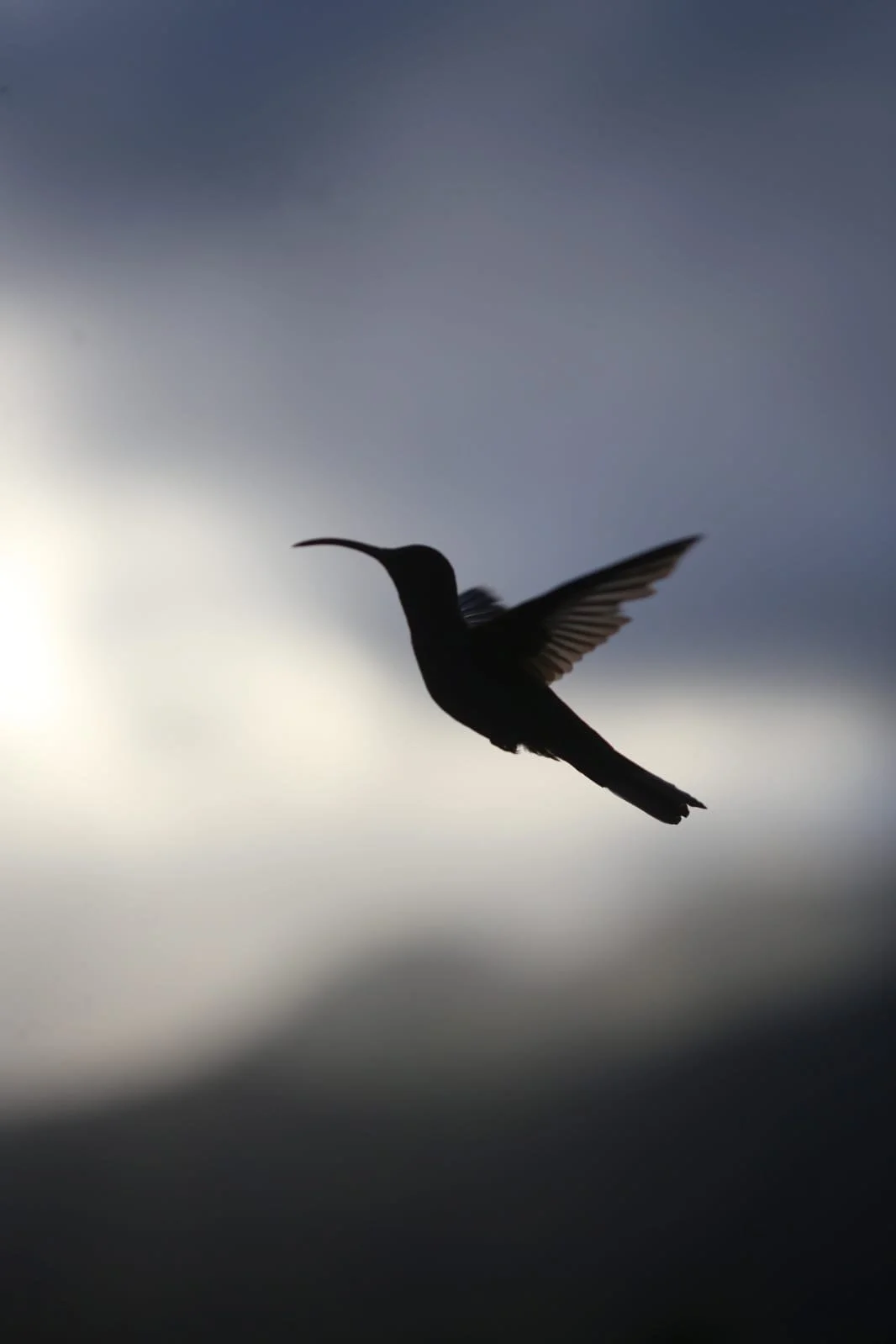
The Violet Sabrewing of Panama: The Majestic Hummingbird That Welcomes You to Lost and Found Hostel
There are hummingbirds in Panama that look like tiny flying jewels. There are green hummingbirds, blue hummingbirds, red throated hummingbirds and birds so small that they can disappear between flowers before you have even realized they were there. And then there is the Violet Sabrewing.
The Violet Sabrewing, Campylopterus hemileucurus, is different. It is big. It is powerful. It is spectacular. And when the light catches a male at exactly the right angle, the bird can appear to have been painted in impossible shades of violet, purple and blue. At roughly 13 to 15 centimetres long, it is one of the largest hummingbirds found in Central America, making it considerably more substantial than the tiny hummingbirds most people imagine when they hear the word hummingbird.
And if you are staying at Lost and Found Hostel, there is an especially good chance that your introduction to the place will involve one of these magnificent birds.
Instead of arriving at a conventional hotel, checking in at a reception desk and immediately being handed a room key, you can arrive in the middle of the mountains, surrounded by rainforest and cloud forest, with hummingbirds buzzing around the feeders. And among them can be the magnificent Violet Sabrewing. For many guests, it is one of those moments when they realize that Lost and Found is not simply a place to sleep. You have arrived somewhere where the wildlife is part of the experience.
The hummingbird that doesn't look like a normal hummingbird
Most people have a mental picture of a hummingbird as something tiny. You imagine a little bird no bigger than your thumb, hovering beside a flower and disappearing almost instantly.
The Violet Sabrewing can completely destroy that mental picture.
When one first appears, the reaction is often something along the lines of, "That's a hummingbird?"
Yes.
It is a hummingbird, just a rather impressive one.
The male has a substantial body, broad wings, a long curved black bill and extraordinary violet plumage. The species is found from southern Mexico through Central America and into western Panama, with the western Panamanian mountains providing some of the habitat where this spectacular bird can be found.
The sheer size of the Violet Sabrewing makes it particularly easy to notice around a feeder. While smaller hummingbirds can appear almost insect-like as they zip around, the Violet Sabrewing has a much more powerful presence. When it comes flying toward you, you know something substantial is approaching.
And then it lands.
Suddenly, the purple bird that looked almost black in the shadows catches the light and becomes an explosion of violet.
The incredible colour of the male
The male Violet Sabrewing is the showstopper.
His body is predominantly deep violet, with greenish areas around the wings, and the feathers have the remarkable iridescence that makes hummingbirds look almost unreal.
The interesting thing about iridescent feathers is that the colour can change dramatically depending on the angle of the light. A bird sitting in the shade may look almost black. Turn your head, the bird turns its head, sunlight catches the feathers and suddenly you are looking at brilliant purple.
It can happen in a fraction of a second.
One moment you are looking at a dark bird.
The next moment it looks like somebody switched on a neon light.
This is one of the reasons photographs sometimes fail to capture what it is actually like to see a Violet Sabrewing in person. A photograph freezes one particular angle. In real life, the bird is constantly moving, and the colours change as the feathers reflect the surrounding light.
In the cloud forest, with sunlight filtering through leaves and mist moving through the trees, the effect can be extraordinary.
The females look completely different
If you are sitting around the Lost and Found feeders and see a spectacular purple male followed by a much greener bird, you might initially assume you are looking at two different species.
You may actually be looking at a male and female Violet Sabrewing.
Females are much less dramatically coloured. They have greenish upperparts and paler underparts, with violet colouring around the throat and distinctive white areas toward the outer portion of the tail.
This is a great reminder that identifying birds isn't always as simple as memorizing one colour.
The male says, "Look at me!"
The female says, "I'd rather not be noticed."
And in the forest, that difference makes sense. The spectacular male's brilliant plumage is useful for attracting attention, while the more subdued female has much better camouflage when she is moving through vegetation.
Why is it called a Sabrewing?
The name sounds appropriately dramatic.
Sabrewing refers to the unusual structure of the bird's wings, particularly the modified outer wing feathers of the males. When you watch one flying, you can understand why somebody decided that a regular name like "purple hummingbird" wasn't quite enough.
These birds have a powerful style of flight.
They hover.
They accelerate.
They turn.
They chase.
They stop.
They can appear almost stationary one second and then be several metres away the next.
And despite their relatively large size, they still possess the extraordinary flying abilities that make hummingbirds so fascinating.
They are little flying machines
Hummingbirds are among the most specialized flying animals on Earth.
They can hover in front of flowers while extracting nectar with their long tongues. They can move rapidly in different directions and make incredibly precise adjustments in flight.
The Violet Sabrewing combines those abilities with the strength of a relatively large hummingbird.
Watching one feed is almost hypnotic.
The bird approaches a flower or feeder.
It hovers.
The wings become a blur.
The bill goes into the food source.
A few seconds later, it pulls away and disappears.
And then you realize that you have been standing there staring at it for five minutes.
This is exactly why hummingbird watching can become addictive.
The sound gives them away
Sometimes you don't see a Violet Sabrewing first.
You hear it.
In a quiet forest, the movement of a large hummingbird can be surprisingly noticeable. There is a deeper, more substantial buzzing associated with the powerful wingbeats of these large birds.
You might be sitting around the Lost and Found hummingbird area talking to another traveler when suddenly you hear something approaching.
Then a large purple hummingbird comes flying into view.
Someone stops talking.
Someone grabs a phone.
Someone else says, "What is that?"
And suddenly five people who had no intention of birdwatching are birdwatching.
That's the magic of the Violet Sabrewing.
The heavyweight at the hummingbird feeder
Hummingbirds may be tiny compared with many other birds, but they can have enormous personalities.
They are territorial.
They chase each other.
They defend food sources.
They establish favourite perches.
And they are not necessarily impressed by the fact that another bird has arrived to share their breakfast.
The Violet Sabrewing has an obvious physical advantage over many of the smaller hummingbirds visiting the same flowers and feeders. Its size alone can make other hummingbirds think twice before challenging it. Observations of the species note that its large size allows it to dominate at feeding areas, with smaller hummingbirds often leaving when one approaches.
So sitting beside a feeder can be surprisingly entertaining.
You aren't simply watching birds eat.
You are watching a miniature aerial society.
There are arrivals.
Departures.
Chases.
Arguments.
Territories.
And occasionally what looks like a tiny airborne bar fight.
Panama is perfect Violet Sabrewing country
The Violet Sabrewing is associated with humid mountain forests, forest edges and mature secondary forest. It also uses gardens and other areas where suitable flowering plants are available.
Western Panama is particularly interesting because of its mountains.
The landscape around Chiriquí changes dramatically with elevation. Warm lowlands transition into cooler mountain environments, and eventually into cloud forest. The higher you go, the more you encounter mist, moss covered trees, dense vegetation and an incredible variety of plants.
For a nectar feeding bird, this can be paradise.
Flowers provide energy.
Trees provide shelter.
Dense vegetation provides protection.
And the forest provides insects and spiders that supplement the bird's diet.
The result is an environment where a bird as spectacular as the Violet Sabrewing can thrive.
They aren't just nectar machines
It is easy to think of hummingbirds as birds that simply drink flower nectar all day.
They actually have a much more complicated diet.
Violet Sabrewings consume nectar, but they also take small insects and other arthropods.
This is particularly important because nectar provides energy but doesn't provide everything a growing bird needs.
So while you might see a Violet Sabrewing delicately drinking from a flower, remember that the same bird may also be hunting tiny insects in the surrounding vegetation.
The beautiful purple bird is also a predator.
A very small predator, admittedly.
But still a predator.
And they are important pollinators
Every time a Violet Sabrewing visits a flower, there is a possibility that it is carrying pollen from one flower to another.
The bird is therefore participating in the reproduction of the plants it visits.
This is one of the great relationships in tropical forests. The flowers provide food for the hummingbirds, while the hummingbirds help move pollen between flowers.
So when you see one feeding around the forest, you aren't simply watching a pretty bird having breakfast.
You are watching one small part of an enormous ecological system.
Imagine arriving at Lost and Found
Now imagine you've just made your way through the mountains toward Lost and Found Hostel.
You have left the city behind.
The road has climbed into the forest.
The air is cooler.
The vegetation is getting thicker.
You arrive at the hostel, put down your backpack and start looking around.
There are mountains.
There is rainforest.
There are trails.
There are hammocks.
And then someone points toward a feeder.
"Look."
You turn around.
And there it is.
A giant purple hummingbird.
At first it may look almost black because of the shade.
Then it moves.
The light catches its feathers.
Suddenly the bird becomes brilliant violet.
It hovers beside the feeder, wings beating so rapidly that they nearly disappear, then lands on a nearby perch.
You stand there thinking that you have been in Panama for approximately ten minutes and already the wildlife is showing off.
That is a pretty good check in.
You don't have to be a birdwatcher
One of the best things about having Violet Sabrewings around the hostel is that you don't have to be a serious birder to appreciate them.
You don't need a huge spotting scope.
You don't need a lifetime of bird identification experience.
You don't even need to know what family hummingbirds belong to.
You just need to look.
They are spectacular enough that almost anybody can appreciate them.
A backpacker who came to Panama for waterfalls may become interested in birds.
Someone who came for hiking may suddenly spend twenty minutes photographing hummingbirds.
A couple who had never owned binoculars may end up sitting around the feeder trying to identify the different species.
And somebody who thought birdwatching sounded boring may discover that watching a Violet Sabrewing chase another hummingbird around a feeder is actually pretty entertaining.
The perfect place to slow down
There is something particularly fitting about seeing these birds at Lost and Found.
The hostel is not a conventional city accommodation where the main attraction is the building itself.
The surrounding forest is part of the experience.
You wake up in the mountains.
You hear birds.
You walk outside and there is wildlife.
You can explore trails.
You can sit in a hammock.
You can watch hummingbirds.
And eventually you realize that you don't actually need to go anywhere for a while.
You can simply sit.
This is one of the great pleasures of being somewhere with abundant wildlife. You stop trying to make every minute productive.
You sit down.
You watch.
And eventually something amazing appears.
The Violet Sabrewing is part of a much bigger hummingbird world
Of course, the Violet Sabrewing isn't the only hummingbird you can encounter in the Chiriquí mountains.
That is part of what makes the area so interesting.
Depending on where you are and the elevation, you can encounter a variety of hummingbird species, each with its own appearance, behavior and personality.
But the Violet Sabrewing is difficult to ignore.
It is one of those birds that even people with no interest in bird identification remember.
You might forget the name of another hummingbird.
You probably won't forget the first time a giant purple hummingbird flew directly in front of you.
The Lost and Found welcome committee
There are hotels where you are greeted by a receptionist.
There are hotels where you are greeted by a welcome drink.
And then there is Lost and Found, where one of your first unofficial greetings can come from a magnificent Violet Sabrewing.
These birds have become one of the memorable wildlife experiences associated with the hostel, and the feeders give guests a remarkably convenient opportunity to observe them without having to embark on a dedicated birding expedition. The hostel's own birding material specifically highlights the frequent Violet Sabrewing visitors at its feeders.
And honestly, there is something pretty special about that.
You have just arrived at a jungle hostel in the mountains between Boquete and Bocas del Toro, and one of the first things you discover is that the forest is already busy.
The hummingbirds don't care that you have arrived.
They aren't waiting for your check in.
They have their own schedule.
They have their own territories.
They have flowers to visit and competitors to chase.
You are simply lucky enough to be watching.
A bird you may remember long after Panama
People often remember trips because of the big things.
The famous beaches.
The waterfalls.
The mountains.
The jungle.
The islands.
But sometimes it is something incredibly small that stays with you.
A hummingbird hovering three feet away.
A flash of purple in the trees.
A bird appearing beside your breakfast.
A strange buzzing sound followed by an explosion of violet.
The Violet Sabrewing is one of those animals.
It is spectacular enough to stop almost anyone in their tracks, but it is also completely at home in the forest. It doesn't perform for tourists. It isn't there because someone put it on an itinerary.
It is simply living its life in the mountains of Panama.
And at Lost and Found Hostel, guests have the extraordinary opportunity to experience that wildlife almost as soon as they arrive.
So when you check in, don't just look at the reception area.
Look toward the feeders.
Listen for the buzzing.
Watch the flowers.
And keep your camera ready.
Because somewhere nearby, there may be a magnificent Violet Sabrewing waiting to give you one of the most memorable welcomes you receive anywhere in Panama.The Violet Sabrewing of Panama: The Majestic Hummingbird That Welcomes You to Lost and Found Hostel
There are hummingbirds in Panama that look like tiny flying jewels. There are green hummingbirds, blue hummingbirds, red throated hummingbirds and birds so small that they can disappear between flowers before you have even realized they were there. And then there is the Violet Sabrewing.
The Violet Sabrewing, Campylopterus hemileucurus, is different. It is big. It is powerful. It is spectacular. And when the light catches a male at exactly the right angle, the bird can appear to have been painted in impossible shades of violet, purple and blue. At roughly 13 to 15 centimetres long, it is one of the largest hummingbirds found in Central America, making it considerably more substantial than the tiny hummingbirds most people imagine when they hear the word hummingbird.
And if you are staying at Lost and Found Hostel, there is an especially good chance that your introduction to the place will involve one of these magnificent birds.
Instead of arriving at a conventional hotel, checking in at a reception desk and immediately being handed a room key, you can arrive in the middle of the mountains, surrounded by rainforest and cloud forest, with hummingbirds buzzing around the feeders. And among them can be the magnificent Violet Sabrewing. For many guests, it is one of those moments when they realize that Lost and Found is not simply a place to sleep. You have arrived somewhere where the wildlife is part of the experience.
The hummingbird that doesn't look like a normal hummingbird
Most people have a mental picture of a hummingbird as something tiny. You imagine a little bird no bigger than your thumb, hovering beside a flower and disappearing almost instantly.
The Violet Sabrewing can completely destroy that mental picture.
When one first appears, the reaction is often something along the lines of, "That's a hummingbird?"
Yes.
It is a hummingbird, just a rather impressive one.
The male has a substantial body, broad wings, a long curved black bill and extraordinary violet plumage. The species is found from southern Mexico through Central America and into western Panama, with the western Panamanian mountains providing some of the habitat where this spectacular bird can be found.
The sheer size of the Violet Sabrewing makes it particularly easy to notice around a feeder. While smaller hummingbirds can appear almost insect-like as they zip around, the Violet Sabrewing has a much more powerful presence. When it comes flying toward you, you know something substantial is approaching.
And then it lands.
Suddenly, the purple bird that looked almost black in the shadows catches the light and becomes an explosion of violet.
The incredible colour of the male
The male Violet Sabrewing is the showstopper.
His body is predominantly deep violet, with greenish areas around the wings, and the feathers have the remarkable iridescence that makes hummingbirds look almost unreal.
The interesting thing about iridescent feathers is that the colour can change dramatically depending on the angle of the light. A bird sitting in the shade may look almost black. Turn your head, the bird turns its head, sunlight catches the feathers and suddenly you are looking at brilliant purple.
It can happen in a fraction of a second.
One moment you are looking at a dark bird.
The next moment it looks like somebody switched on a neon light.
This is one of the reasons photographs sometimes fail to capture what it is actually like to see a Violet Sabrewing in person. A photograph freezes one particular angle. In real life, the bird is constantly moving, and the colours change as the feathers reflect the surrounding light.
In the cloud forest, with sunlight filtering through leaves and mist moving through the trees, the effect can be extraordinary.
The females look completely different
If you are sitting around the Lost and Found feeders and see a spectacular purple male followed by a much greener bird, you might initially assume you are looking at two different species.
You may actually be looking at a male and female Violet Sabrewing.
Females are much less dramatically coloured. They have greenish upperparts and paler underparts, with violet colouring around the throat and distinctive white areas toward the outer portion of the tail.
This is a great reminder that identifying birds isn't always as simple as memorizing one colour.
The male says, "Look at me!"
The female says, "I'd rather not be noticed."
And in the forest, that difference makes sense. The spectacular male's brilliant plumage is useful for attracting attention, while the more subdued female has much better camouflage when she is moving through vegetation.
Why is it called a Sabrewing?
The name sounds appropriately dramatic.
Sabrewing refers to the unusual structure of the bird's wings, particularly the modified outer wing feathers of the males. When you watch one flying, you can understand why somebody decided that a regular name like "purple hummingbird" wasn't quite enough.
These birds have a powerful style of flight.
They hover.
They accelerate.
They turn.
They chase.
They stop.
They can appear almost stationary one second and then be several metres away the next.
And despite their relatively large size, they still possess the extraordinary flying abilities that make hummingbirds so fascinating.
They are little flying machines
Hummingbirds are among the most specialized flying animals on Earth.
They can hover in front of flowers while extracting nectar with their long tongues. They can move rapidly in different directions and make incredibly precise adjustments in flight.
The Violet Sabrewing combines those abilities with the strength of a relatively large hummingbird.
Watching one feed is almost hypnotic.
The bird approaches a flower or feeder.
It hovers.
The wings become a blur.
The bill goes into the food source.
A few seconds later, it pulls away and disappears.
And then you realize that you have been standing there staring at it for five minutes.
This is exactly why hummingbird watching can become addictive.
The sound gives them away
Sometimes you don't see a Violet Sabrewing first.
You hear it.
In a quiet forest, the movement of a large hummingbird can be surprisingly noticeable. There is a deeper, more substantial buzzing associated with the powerful wingbeats of these large birds.
You might be sitting around the Lost and Found hummingbird area talking to another traveler when suddenly you hear something approaching.
Then a large purple hummingbird comes flying into view.
Someone stops talking.
Someone grabs a phone.
Someone else says, "What is that?"
And suddenly five people who had no intention of birdwatching are birdwatching.
That's the magic of the Violet Sabrewing.
The heavyweight at the hummingbird feeder
Hummingbirds may be tiny compared with many other birds, but they can have enormous personalities.
They are territorial.
They chase each other.
They defend food sources.
They establish favourite perches.
And they are not necessarily impressed by the fact that another bird has arrived to share their breakfast.
The Violet Sabrewing has an obvious physical advantage over many of the smaller hummingbirds visiting the same flowers and feeders. Its size alone can make other hummingbirds think twice before challenging it. Observations of the species note that its large size allows it to dominate at feeding areas, with smaller hummingbirds often leaving when one approaches.
So sitting beside a feeder can be surprisingly entertaining.
You aren't simply watching birds eat.
You are watching a miniature aerial society.
There are arrivals.
Departures.
Chases.
Arguments.
Territories.
And occasionally what looks like a tiny airborne bar fight.
Panama is perfect Violet Sabrewing country
The Violet Sabrewing is associated with humid mountain forests, forest edges and mature secondary forest. It also uses gardens and other areas where suitable flowering plants are available.
Western Panama is particularly interesting because of its mountains.
The landscape around Chiriquí changes dramatically with elevation. Warm lowlands transition into cooler mountain environments, and eventually into cloud forest. The higher you go, the more you encounter mist, moss covered trees, dense vegetation and an incredible variety of plants.
For a nectar feeding bird, this can be paradise.
Flowers provide energy.
Trees provide shelter.
Dense vegetation provides protection.
And the forest provides insects and spiders that supplement the bird's diet.
The result is an environment where a bird as spectacular as the Violet Sabrewing can thrive.
They aren't just nectar machines
It is easy to think of hummingbirds as birds that simply drink flower nectar all day.
They actually have a much more complicated diet.
Violet Sabrewings consume nectar, but they also take small insects and other arthropods.
This is particularly important because nectar provides energy but doesn't provide everything a growing bird needs.
So while you might see a Violet Sabrewing delicately drinking from a flower, remember that the same bird may also be hunting tiny insects in the surrounding vegetation.
The beautiful purple bird is also a predator.
A very small predator, admittedly.
But still a predator.
And they are important pollinators
Every time a Violet Sabrewing visits a flower, there is a possibility that it is carrying pollen from one flower to another.
The bird is therefore participating in the reproduction of the plants it visits.
This is one of the great relationships in tropical forests. The flowers provide food for the hummingbirds, while the hummingbirds help move pollen between flowers.
So when you see one feeding around the forest, you aren't simply watching a pretty bird having breakfast.
You are watching one small part of an enormous ecological system.
Imagine arriving at Lost and Found
Now imagine you've just made your way through the mountains toward Lost and Found Hostel.
You have left the city behind.
The road has climbed into the forest.
The air is cooler.
The vegetation is getting thicker.
You arrive at the hostel, put down your backpack and start looking around.
There are mountains.
There is rainforest.
There are trails.
There are hammocks.
And then someone points toward a feeder.
"Look."
You turn around.
And there it is.
A giant purple hummingbird.
At first it may look almost black because of the shade.
Then it moves.
The light catches its feathers.
Suddenly the bird becomes brilliant violet.
It hovers beside the feeder, wings beating so rapidly that they nearly disappear, then lands on a nearby perch.
You stand there thinking that you have been in Panama for approximately ten minutes and already the wildlife is showing off.
That is a pretty good check in.
You don't have to be a birdwatcher
One of the best things about having Violet Sabrewings around the hostel is that you don't have to be a serious birder to appreciate them.
You don't need a huge spotting scope.
You don't need a lifetime of bird identification experience.
You don't even need to know what family hummingbirds belong to.
You just need to look.
They are spectacular enough that almost anybody can appreciate them.
A backpacker who came to Panama for waterfalls may become interested in birds.
Someone who came for hiking may suddenly spend twenty minutes photographing hummingbirds.
A couple who had never owned binoculars may end up sitting around the feeder trying to identify the different species.
And somebody who thought birdwatching sounded boring may discover that watching a Violet Sabrewing chase another hummingbird around a feeder is actually pretty entertaining.
The perfect place to slow down
There is something particularly fitting about seeing these birds at Lost and Found.
The hostel is not a conventional city accommodation where the main attraction is the building itself.
The surrounding forest is part of the experience.
You wake up in the mountains.
You hear birds.
You walk outside and there is wildlife.
You can explore trails.
You can sit in a hammock.
You can watch hummingbirds.
And eventually you realize that you don't actually need to go anywhere for a while.
You can simply sit.
This is one of the great pleasures of being somewhere with abundant wildlife. You stop trying to make every minute productive.
You sit down.
You watch.
And eventually something amazing appears.
The Violet Sabrewing is part of a much bigger hummingbird world
Of course, the Violet Sabrewing isn't the only hummingbird you can encounter in the Chiriquí mountains.
That is part of what makes the area so interesting.
Depending on where you are and the elevation, you can encounter a variety of hummingbird species, each with its own appearance, behavior and personality.
But the Violet Sabrewing is difficult to ignore.
It is one of those birds that even people with no interest in bird identification remember.
You might forget the name of another hummingbird.
You probably won't forget the first time a giant purple hummingbird flew directly in front of you.
The Lost and Found welcome committee
There are hotels where you are greeted by a receptionist.
There are hotels where you are greeted by a welcome drink.
And then there is Lost and Found, where one of your first unofficial greetings can come from a magnificent Violet Sabrewing.
These birds have become one of the memorable wildlife experiences associated with the hostel, and the feeders give guests a remarkably convenient opportunity to observe them without having to embark on a dedicated birding expedition. The hostel's own birding material specifically highlights the frequent Violet Sabrewing visitors at its feeders.
And honestly, there is something pretty special about that.
You have just arrived at a jungle hostel in the mountains between Boquete and Bocas del Toro, and one of the first things you discover is that the forest is already busy.
The hummingbirds don't care that you have arrived.
They aren't waiting for your check in.
They have their own schedule.
They have their own territories.
They have flowers to visit and competitors to chase.
You are simply lucky enough to be watching.
A bird you may remember long after Panama
People often remember trips because of the big things.
The famous beaches.
The waterfalls.
The mountains.
The jungle.
The islands.
But sometimes it is something incredibly small that stays with you.
A hummingbird hovering three feet away.
A flash of purple in the trees.
A bird appearing beside your breakfast.
A strange buzzing sound followed by an explosion of violet.
The Violet Sabrewing is one of those animals.
It is spectacular enough to stop almost anyone in their tracks, but it is also completely at home in the forest. It doesn't perform for tourists. It isn't there because someone put it on an itinerary.
It is simply living its life in the mountains of Panama.
And at Lost and Found Hostel, guests have the extraordinary opportunity to experience that wildlife almost as soon as they arrive.
So when you check in, don't just look at the reception area.
Look toward the feeders.
Listen for the buzzing.
Watch the flowers.
And keep your camera ready.
Because somewhere nearby, there may be a magnificent Violet Sabrewing waiting to give you one of the most memorable welcomes you receive anywhere in Panama.The Violet Sabrewing of Panama: The Majestic Hummingbird That Welcomes You to Lost and Found Hostel
There are hummingbirds in Panama that look like tiny flying jewels. There are green hummingbirds, blue hummingbirds, red throated hummingbirds and birds so small that they can disappear between flowers before you have even realized they were there. And then there is the Violet Sabrewing.
The Violet Sabrewing, Campylopterus hemileucurus, is different. It is big. It is powerful. It is spectacular. And when the light catches a male at exactly the right angle, the bird can appear to have been painted in impossible shades of violet, purple and blue. At roughly 13 to 15 centimetres long, it is one of the largest hummingbirds found in Central America, making it considerably more substantial than the tiny hummingbirds most people imagine when they hear the word hummingbird.
And if you are staying at Lost and Found Hostel, there is an especially good chance that your introduction to the place will involve one of these magnificent birds.
Instead of arriving at a conventional hotel, checking in at a reception desk and immediately being handed a room key, you can arrive in the middle of the mountains, surrounded by rainforest and cloud forest, with hummingbirds buzzing around the feeders. And among them can be the magnificent Violet Sabrewing. For many guests, it is one of those moments when they realize that Lost and Found is not simply a place to sleep. You have arrived somewhere where the wildlife is part of the experience.
The hummingbird that doesn't look like a normal hummingbird
Most people have a mental picture of a hummingbird as something tiny. You imagine a little bird no bigger than your thumb, hovering beside a flower and disappearing almost instantly.
The Violet Sabrewing can completely destroy that mental picture.
When one first appears, the reaction is often something along the lines of, "That's a hummingbird?"
Yes.
It is a hummingbird, just a rather impressive one.
The male has a substantial body, broad wings, a long curved black bill and extraordinary violet plumage. The species is found from southern Mexico through Central America and into western Panama, with the western Panamanian mountains providing some of the habitat where this spectacular bird can be found.
The sheer size of the Violet Sabrewing makes it particularly easy to notice around a feeder. While smaller hummingbirds can appear almost insect-like as they zip around, the Violet Sabrewing has a much more powerful presence. When it comes flying toward you, you know something substantial is approaching.
And then it lands.
Suddenly, the purple bird that looked almost black in the shadows catches the light and becomes an explosion of violet.
The incredible colour of the male
The male Violet Sabrewing is the showstopper.
His body is predominantly deep violet, with greenish areas around the wings, and the feathers have the remarkable iridescence that makes hummingbirds look almost unreal.
The interesting thing about iridescent feathers is that the colour can change dramatically depending on the angle of the light. A bird sitting in the shade may look almost black. Turn your head, the bird turns its head, sunlight catches the feathers and suddenly you are looking at brilliant purple.
It can happen in a fraction of a second.
One moment you are looking at a dark bird.
The next moment it looks like somebody switched on a neon light.
This is one of the reasons photographs sometimes fail to capture what it is actually like to see a Violet Sabrewing in person. A photograph freezes one particular angle. In real life, the bird is constantly moving, and the colours change as the feathers reflect the surrounding light.
In the cloud forest, with sunlight filtering through leaves and mist moving through the trees, the effect can be extraordinary.
The females look completely different
If you are sitting around the Lost and Found feeders and see a spectacular purple male followed by a much greener bird, you might initially assume you are looking at two different species.
You may actually be looking at a male and female Violet Sabrewing.
Females are much less dramatically coloured. They have greenish upperparts and paler underparts, with violet colouring around the throat and distinctive white areas toward the outer portion of the tail.
This is a great reminder that identifying birds isn't always as simple as memorizing one colour.
The male says, "Look at me!"
The female says, "I'd rather not be noticed."
And in the forest, that difference makes sense. The spectacular male's brilliant plumage is useful for attracting attention, while the more subdued female has much better camouflage when she is moving through vegetation.
Why is it called a Sabrewing?
The name sounds appropriately dramatic.
Sabrewing refers to the unusual structure of the bird's wings, particularly the modified outer wing feathers of the males. When you watch one flying, you can understand why somebody decided that a regular name like "purple hummingbird" wasn't quite enough.
These birds have a powerful style of flight.
They hover.
They accelerate.
They turn.
They chase.
They stop.
They can appear almost stationary one second and then be several metres away the next.
And despite their relatively large size, they still possess the extraordinary flying abilities that make hummingbirds so fascinating.
They are little flying machines
Hummingbirds are among the most specialized flying animals on Earth.
They can hover in front of flowers while extracting nectar with their long tongues. They can move rapidly in different directions and make incredibly precise adjustments in flight.
The Violet Sabrewing combines those abilities with the strength of a relatively large hummingbird.
Watching one feed is almost hypnotic.
The bird approaches a flower or feeder.
It hovers.
The wings become a blur.
The bill goes into the food source.
A few seconds later, it pulls away and disappears.
And then you realize that you have been standing there staring at it for five minutes.
This is exactly why hummingbird watching can become addictive.
The sound gives them away
Sometimes you don't see a Violet Sabrewing first.
You hear it.
In a quiet forest, the movement of a large hummingbird can be surprisingly noticeable. There is a deeper, more substantial buzzing associated with the powerful wingbeats of these large birds.
You might be sitting around the Lost and Found hummingbird area talking to another traveler when suddenly you hear something approaching.
Then a large purple hummingbird comes flying into view.
Someone stops talking.
Someone grabs a phone.
Someone else says, "What is that?"
And suddenly five people who had no intention of birdwatching are birdwatching.
That's the magic of the Violet Sabrewing.
The heavyweight at the hummingbird feeder
Hummingbirds may be tiny compared with many other birds, but they can have enormous personalities.
They are territorial.
They chase each other.
They defend food sources.
They establish favourite perches.
And they are not necessarily impressed by the fact that another bird has arrived to share their breakfast.
The Violet Sabrewing has an obvious physical advantage over many of the smaller hummingbirds visiting the same flowers and feeders. Its size alone can make other hummingbirds think twice before challenging it. Observations of the species note that its large size allows it to dominate at feeding areas, with smaller hummingbirds often leaving when one approaches.
So sitting beside a feeder can be surprisingly entertaining.
You aren't simply watching birds eat.
You are watching a miniature aerial society.
There are arrivals.
Departures.
Chases.
Arguments.
Territories.
And occasionally what looks like a tiny airborne bar fight.
Panama is perfect Violet Sabrewing country
The Violet Sabrewing is associated with humid mountain forests, forest edges and mature secondary forest. It also uses gardens and other areas where suitable flowering plants are available.
Western Panama is particularly interesting because of its mountains.
The landscape around Chiriquí changes dramatically with elevation. Warm lowlands transition into cooler mountain environments, and eventually into cloud forest. The higher you go, the more you encounter mist, moss covered trees, dense vegetation and an incredible variety of plants.
For a nectar feeding bird, this can be paradise.
Flowers provide energy.
Trees provide shelter.
Dense vegetation provides protection.
And the forest provides insects and spiders that supplement the bird's diet.
The result is an environment where a bird as spectacular as the Violet Sabrewing can thrive.
They aren't just nectar machines
It is easy to think of hummingbirds as birds that simply drink flower nectar all day.
They actually have a much more complicated diet.
Violet Sabrewings consume nectar, but they also take small insects and other arthropods.
This is particularly important because nectar provides energy but doesn't provide everything a growing bird needs.
So while you might see a Violet Sabrewing delicately drinking from a flower, remember that the same bird may also be hunting tiny insects in the surrounding vegetation.
The beautiful purple bird is also a predator.
A very small predator, admittedly.
But still a predator.
And they are important pollinators
Every time a Violet Sabrewing visits a flower, there is a possibility that it is carrying pollen from one flower to another.
The bird is therefore participating in the reproduction of the plants it visits.
This is one of the great relationships in tropical forests. The flowers provide food for the hummingbirds, while the hummingbirds help move pollen between flowers.
So when you see one feeding around the forest, you aren't simply watching a pretty bird having breakfast.
You are watching one small part of an enormous ecological system.
Imagine arriving at Lost and Found
Now imagine you've just made your way through the mountains toward Lost and Found Hostel.
You have left the city behind.
The road has climbed into the forest.
The air is cooler.
The vegetation is getting thicker.
You arrive at the hostel, put down your backpack and start looking around.
There are mountains.
There is rainforest.
There are trails.
There are hammocks.
And then someone points toward a feeder.
"Look."
You turn around.
And there it is.
A giant purple hummingbird.
At first it may look almost black because of the shade.
Then it moves.
The light catches its feathers.
Suddenly the bird becomes brilliant violet.
It hovers beside the feeder, wings beating so rapidly that they nearly disappear, then lands on a nearby perch.
You stand there thinking that you have been in Panama for approximately ten minutes and already the wildlife is showing off.
That is a pretty good check in.
You don't have to be a birdwatcher
One of the best things about having Violet Sabrewings around the hostel is that you don't have to be a serious birder to appreciate them.
You don't need a huge spotting scope.
You don't need a lifetime of bird identification experience.
You don't even need to know what family hummingbirds belong to.
You just need to look.
They are spectacular enough that almost anybody can appreciate them.
A backpacker who came to Panama for waterfalls may become interested in birds.
Someone who came for hiking may suddenly spend twenty minutes photographing hummingbirds.
A couple who had never owned binoculars may end up sitting around the feeder trying to identify the different species.
And somebody who thought birdwatching sounded boring may discover that watching a Violet Sabrewing chase another hummingbird around a feeder is actually pretty entertaining.
The perfect place to slow down
There is something particularly fitting about seeing these birds at Lost and Found.
The hostel is not a conventional city accommodation where the main attraction is the building itself.
The surrounding forest is part of the experience.
You wake up in the mountains.
You hear birds.
You walk outside and there is wildlife.
You can explore trails.
You can sit in a hammock.
You can watch hummingbirds.
And eventually you realize that you don't actually need to go anywhere for a while.
You can simply sit.
This is one of the great pleasures of being somewhere with abundant wildlife. You stop trying to make every minute productive.
You sit down.
You watch.
And eventually something amazing appears.
The Violet Sabrewing is part of a much bigger hummingbird world
Of course, the Violet Sabrewing isn't the only hummingbird you can encounter in the Chiriquí mountains.
That is part of what makes the area so interesting.
Depending on where you are and the elevation, you can encounter a variety of hummingbird species, each with its own appearance, behavior and personality.
But the Violet Sabrewing is difficult to ignore.
It is one of those birds that even people with no interest in bird identification remember.
You might forget the name of another hummingbird.
You probably won't forget the first time a giant purple hummingbird flew directly in front of you.
The Lost and Found welcome committee
There are hotels where you are greeted by a receptionist.
There are hotels where you are greeted by a welcome drink.
And then there is Lost and Found, where one of your first unofficial greetings can come from a magnificent Violet Sabrewing.
These birds have become one of the memorable wildlife experiences associated with the hostel, and the feeders give guests a remarkably convenient opportunity to observe them without having to embark on a dedicated birding expedition. The hostel's own birding material specifically highlights the frequent Violet Sabrewing visitors at its feeders.
And honestly, there is something pretty special about that.
You have just arrived at a jungle hostel in the mountains between Boquete and Bocas del Toro, and one of the first things you discover is that the forest is already busy.
The hummingbirds don't care that you have arrived.
They aren't waiting for your check in.
They have their own schedule.
They have their own territories.
They have flowers to visit and competitors to chase.
You are simply lucky enough to be watching.
A bird you may remember long after Panama
People often remember trips because of the big things.
The famous beaches.
The waterfalls.
The mountains.
The jungle.
The islands.
But sometimes it is something incredibly small that stays with you.
A hummingbird hovering three feet away.
A flash of purple in the trees.
A bird appearing beside your breakfast.
A strange buzzing sound followed by an explosion of violet.
The Violet Sabrewing is one of those animals.
It is spectacular enough to stop almost anyone in their tracks, but it is also completely at home in the forest. It doesn't perform for tourists. It isn't there because someone put it on an itinerary.
It is simply living its life in the mountains of Panama.
And at Lost and Found Hostel, guests have the extraordinary opportunity to experience that wildlife almost as soon as they arrive.
So when you check in, don't just look at the reception area.
Look toward the feeders.
Listen for the buzzing.
Watch the flowers.
And keep your camera ready.
Because somewhere nearby, there may be a magnificent Violet Sabrewing waiting to give you one of the most memorable welcomes you receive anywhere in Panama.