
Panama City and Bocas del Toro are two completely different worlds. Panama City is skyscrapers, traffic, restaurants, nightlife and the Panama Canal. Bocas del Toro is Caribbean islands, wooden houses, jungle, beaches, water taxis and the feeling that somebody accidentally left a tropical paradise sitting just off the coast.
The good news is that getting between them is relatively straightforward. The less good news is that there isn't one perfect way to do it. You can fly, take an overnight bus and boat, drive yourself, or combine buses and boats in several different ways. The best option depends on whether your priority is speed, money, comfort, flexibility or the adventure itself.
The important thing to understand is that Bocas del Toro is an archipelago. If you are going to Bocas Town on Isla Colon, you can fly directly there. If you travel overland, you first have to reach the mainland port area around Almirante and then cross the water by boat. That final boat ride is part of the adventure and is one reason the journey feels much more exotic than simply taking a bus between two Panamanian cities.
Flying from Panama City to Bocas del Toro
For most travellers, flying is the easiest option by a considerable margin. Air Panama operates direct flights from Panama City's Albrook Airport to Bocas del Toro Airport on Isla Colon, and the scheduled flight time is about one hour. Current schedules show several departures on many days, although schedules can change and flights can be affected by weather or airport conditions.
The biggest advantage is obvious: you save an enormous amount of time.
Instead of spending most of a day travelling overland, you can have breakfast in Panama City, go to Albrook Airport and be walking around Bocas Town later that morning.
This is particularly attractive if you only have a limited amount of time in Panama. Spending ten or twelve hours travelling to Bocas makes much less sense if you only have five or six days for the entire country.
Flying is also much easier if you have luggage. You don't have to worry about changing buses, finding the correct dock, transferring your bags between vehicles and making sure you haven't missed the last boat.
There is, however, one major disadvantage.
It costs considerably more than going overland.
Airfare varies considerably depending on when you book, the date and demand. Current travel information puts the flight anywhere from roughly the tens of dollars into the $100 plus range each way, with some fares considerably higher when booking close to departure.
There is also another small consideration. The flight leaves from Albrook, not Tocumen International Airport. If you have just arrived in Panama on an international flight at Tocumen, you need to get across the city to Albrook before flying to Bocas.
So flying is best for people who value time and convenience more than saving every possible dollar.
Taking the overnight bus and boat
For backpackers, this is probably the classic budget option.
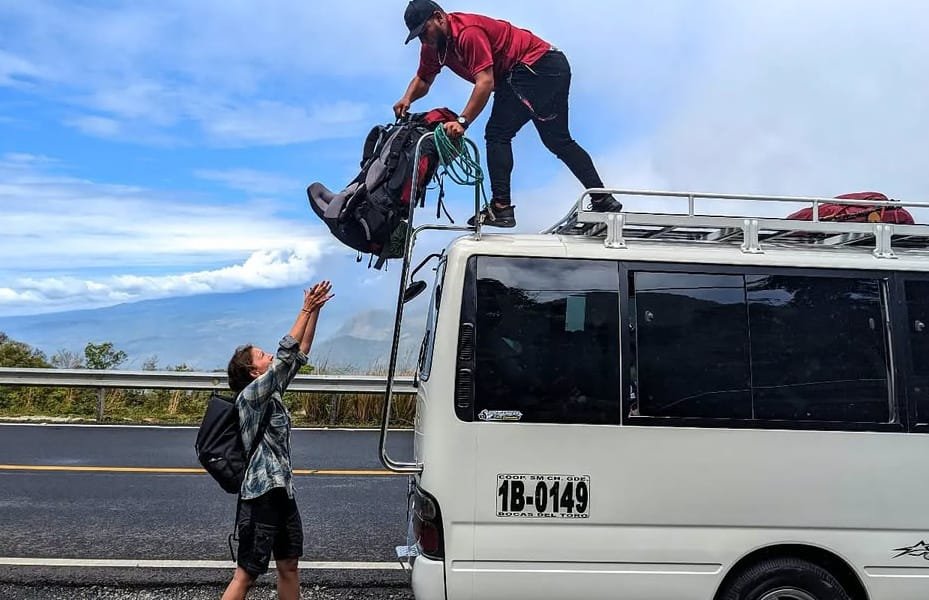
You take a long distance bus from Panama City toward the Bocas del Toro mainland, normally travelling toward Almirante, and then take a boat across to Isla Colon.
The overland journey takes roughly ten hours before you even consider the final boat connection, although exact times depend on the service, traffic and connections. Current route information puts the combined bus and boat journey around ten to eleven hours in favourable circumstances, while other routing options can take longer.
The biggest advantage is price.
The overland option can be dramatically cheaper than flying. Current estimates put the bus and boat combination around the $30 to $40 range for many travellers, although prices and the exact combination can vary.
For someone backpacking Central America on a budget, that difference can be significant.
The other advantage is that you can turn the journey into part of the adventure.
You leave Panama City at night, sleep, or at least attempt to sleep, on the bus, wake up somewhere in western Panama and eventually end up on a boat heading across the Caribbean toward Bocas.
There is something satisfying about that.
You actually watch Panama change.
The skyscrapers disappear. The urban landscape gives way to mountains and countryside. Eventually the Caribbean appears.
The disadvantage is that it is a long journey.
And there is no polite way to describe an overnight bus as being as comfortable as a bed.
Some people sleep perfectly well on buses. Others spend ten hours discovering that their neck can apparently bend at angles previously thought impossible.
You also need to pay attention to the connection at the end. Getting to the mainland is only part of the journey. You still have to get to the dock and cross to Isla Colon.
The final boat from the mainland
This is where the journey becomes very Bocas.
Once you reach the mainland around Almirante, you cross to Isla Colon by boat. There are regular water transport services connecting the mainland and Bocas, and water taxis are a standard part of travelling around the archipelago.
The boat ride is not particularly long compared with the bus journey, but it completely changes the feeling of the trip.
One minute you're standing beside buses and luggage on the mainland.
The next you're bouncing across Caribbean water with Bocas appearing ahead of you.
That final crossing is one of the reasons I actually like the overland journey.
You don't simply arrive in Bocas.
You enter Bocas.
One thing to watch carefully is the timing. Boat services do not operate around the clock, so arriving very late at Almirante can create a problem. Current ferry information shows scheduled services between Almirante and Isla Colon, while other smaller water taxis operate on the route as well.
This means you shouldn't treat the bus arrival time and the boat departure as two completely unrelated things.
If you arrive too late, you could find yourself on the mainland wondering why you didn't check the boat schedule first.
Driving from Panama City to Bocas del Toro
Driving is another possibility, and it can make sense for people travelling as a group or wanting to explore western Panama along the way.
The road journey to the Almirante area is roughly ten hours depending on traffic and stops, after which you leave the car on the mainland and continue by boat. Bocas itself is an island destination, so you cannot simply drive directly into Bocas Town.
The advantage of driving is freedom.
You can leave when you want.
You can stop wherever you want.
You can take detours.
You can spend a night somewhere along the way.
You can explore places that would be inconvenient to reach by public transportation.
This becomes particularly attractive if you aren't simply travelling from Panama City to Bocas. If you're doing a larger Panama road trip, having a vehicle can give you much more flexibility.
The disadvantage is that you have to deal with the drive yourself.
Ten hours behind the wheel is a long day. You also have to figure out where to leave the vehicle while you're on the islands, and then pay for your own fuel and possibly parking.
For a solo traveller, driving generally makes much less financial sense than taking the bus.
For four people sharing the costs, however, the calculation can look very different.
Taking a shuttle
Another possibility is using a tourist shuttle or private transfer.
This can be a useful middle ground between public buses and driving yourself. You aren't responsible for navigating the roads, but you also aren't dealing with the full public bus experience.
The downside is cost.
A shuttle is usually more expensive than the public bus, and you lose some of the freedom you would have with your own vehicle.
For travellers who don't want to fly but also don't particularly enjoy figuring out several public transportation connections, however, it can be a very good compromise.
The exact availability of shuttle services changes, so this is one option where it is worth checking the current departure arrangements before committing to your itinerary.
What about going through David?
There is another route that makes sense for travellers who are already planning to visit western Panama.
You can travel from Panama City to David and then continue toward Bocas del Toro.
This is obviously not the most efficient way to get from Panama City to Bocas if Bocas is your only destination. It adds another stage to the journey.
But if your Panama itinerary is something like Panama City → Santa Catalina → Boquete → Lost and Found → Bocas, then the geography starts making much more sense.
In that situation, you aren't really travelling "from Panama City to Bocas."
You're travelling across Panama.
And that can be a much better trip.
One of the great mistakes travellers make is trying to optimize every journey as though they are trying to win a transportation competition.
Sometimes the best route is the one that lets you see more of the country.
So which option is actually best?
If time is your priority, fly.
The direct flight is about an hour, and you avoid the long overland journey entirely.
If money is your priority, take the bus and boat.
It takes much longer, but it can save a substantial amount of money.
If you want freedom, drive.
This is particularly worthwhile if you're travelling with several people or planning to explore western Panama before reaching Bocas.
If you hate complicated transportation, fly.
There is something very satisfying about getting on one aircraft in Panama City and getting off approximately an hour later in Bocas.
If you are backpacking Central America, take the bus and boat.
You will save money, meet other travellers and experience the transition from mainland Panama to the Caribbean.
And if you have plenty of time, don't be afraid of the long route.
One of the great things about travelling around Panama is that the journey can be part of the experience. You don't always need to find the fastest possible way between two dots on a map.
The option I would choose
If I had only a few days in Panama, I would fly.
Bocas is too good to sacrifice an entire day of vacation simply because the bus is cheaper.
But if I were backpacking Central America with a flexible schedule and watching my budget, I'd probably take the overnight bus and boat at least once.
There is something about arriving in Bocas by water that makes the destination feel more special.
You leave the mainland behind.
The water opens up.
The islands appear.
Palm trees start replacing highways.
The buildings become more Caribbean.
And suddenly you understand why people make the journey in the first place.
The important thing is to choose the method that matches your kind of trip. Panama City to Bocas is not simply a question of finding the cheapest or fastest transportation. It is a choice between comfort, time, money and adventure.
And fortunately, Panama gives you all four choices.