
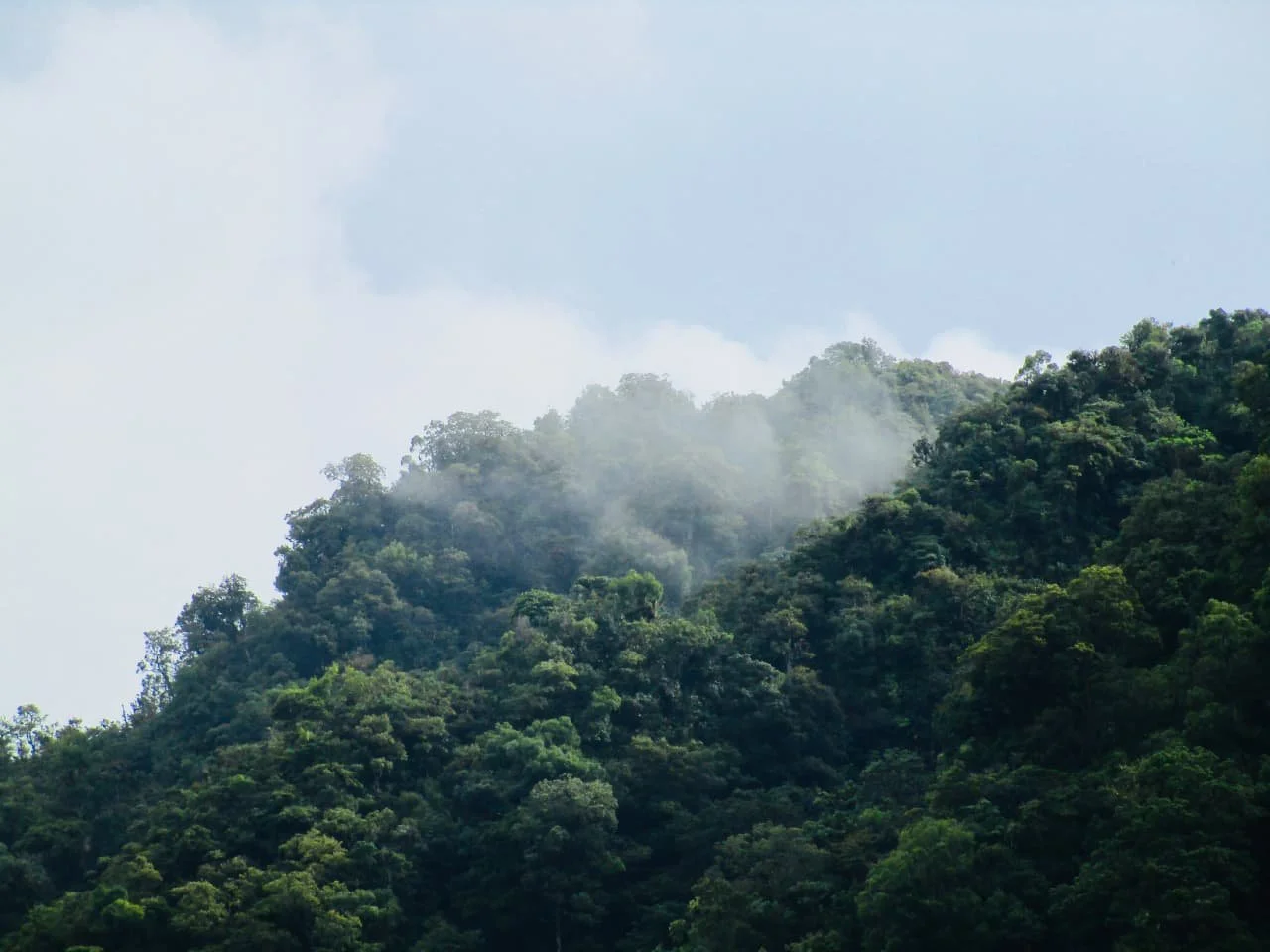
Panama has a reputation for being a tropical paradise, and it absolutely is. But there is another side to all that jungle, rainforest, rivers, mangroves and Caribbean coastline. Panama is home to an extraordinary collection of animals that can hurt you, and a handful that can potentially kill you.
That sounds alarming, but there is an important distinction between dangerous animals and animals that are actually likely to hurt a visitor. Most of Panama's wildlife wants absolutely nothing to do with you. A jaguar does not lie awake at night dreaming about backpackers. A sloth isn't secretly waiting for the perfect opportunity to attack. Even most snakes would much rather disappear into the vegetation than have anything to do with a six foot tall noisy primate wearing a daypack.
The real danger generally comes from animals that are accidentally stepped on, grabbed, cornered or approached too closely. And in Panama, some of the most serious risks come from creatures that are so well camouflaged you may not even realize they are there.
The Fer de Lance Is the One to Take Seriously
If there is one animal in Panama that deserves genuine respect, it is the fer de lance, commonly called the terciopelo in Panama. Its scientific name is Bothrops asper, and it is a highly venomous pit viper found throughout much of Central America and northern South America. It is particularly important because it is found in a wide variety of lowland habitats and can occur surprisingly close to human settlements.
This is not the snake you want to discover by accidentally stepping on it while walking through the jungle.
The fer de lance is beautifully camouflaged. Its pattern can disappear remarkably well against leaves, soil and forest debris. A person walking through thick vegetation can therefore be much closer to one than they realize.
That is why simply looking where you are putting your feet is one of the best pieces of jungle safety advice in Panama.
Don't reach underneath logs.
Don't put your hands into holes.
Don't grab vegetation blindly.
And don't step over something that looks suspicious without checking what is on the other side.
The good news is that snake encounters are still relatively uncommon for most tourists. You can spend weeks travelling through Panama without seeing a venomous snake at all. But if you are hiking regularly, particularly in remote or heavily vegetated areas, you should understand that they are part of the environment.
Coral Snakes Are Beautiful and Dangerous
Panama also has several species of coral snakes. They are usually much less likely to be encountered than the fer de lance, but they possess highly potent venom and should never be handled.
The classic warning about coral snakes is the colourful banding. Their bright red, yellow and black patterns can make them look almost artificial.
This is one of those cases where beautiful does not mean safe.
Coral snakes are generally secretive, and that means most visitors will never see one. But if you do encounter one, admire it from a distance and leave it alone.
And forget the idea that you should pick up an interesting snake to figure out whether it is venomous.
In Panama, that is an impressively bad way to spend your afternoon.
Bushmasters Are the Jungle's Heavyweight Snakes
The bushmaster is another snake worth knowing about. Bushmasters belong to the genus Lachesis and are among the largest venomous snakes in the Americas.
They are much less commonly encountered than the fer de lance, which is one reason most tourists never see one. They tend to be associated with more remote forest environments.
If you are deep in the jungle, however, the possibility becomes more relevant.
Again, the rule is wonderfully simple.
Don't touch snakes.
You don't need to identify them.
You don't need to photograph them from three inches away.
You don't need to determine whether they are poisonous or venomous.
You simply need to give them space.
Caimans and Crocodiles
Panama has crocodilians, including caimans and crocodiles, and they are one of the animals people should take seriously around waterways.
Coiba National Park is a particularly dramatic example. The island has hundreds of crocodiles living in its rivers and wandering onto beaches. Smithsonian Magazine has described Coiba's crocodiles, sharks and venomous snakes as part of the formidable wildlife that historically helped make the island an extremely difficult place to escape from.
You don't need to be terrified every time you see a river in Panama. Millions of people live around and use waterways safely.
But a tropical river is not automatically a swimming pool.
This becomes particularly important during the rainy season when rivers can rise quickly, currents become stronger and water visibility decreases.
If locals tell you not to swim somewhere, there is probably a reason.
And if you see a crocodile or caiman, don't get closer because you think it looks sleepy.
It is a crocodile.
Sleepy is part of the business model.
Sharks
Panama's two coastlines mean that sharks are naturally part of the country's marine environment.
Sharks are particularly associated with some of Panama's offshore waters, including the waters around Coiba and other Pacific islands. The waters around Coiba historically gained a reputation for sharks, along with the island's crocodiles and venomous snakes.
But there is an important reality check here.
Seeing a shark does not mean you are about to be attacked.
Sharks are important marine predators, and most encounters with humans end with the shark swimming away.
The sensible approach is simply to respect normal ocean safety. Pay attention to local advice, avoid swimming in conditions or locations where you have been told not to swim, and don't treat wildlife encounters as an invitation to chase an animal for a photograph.
Stingrays
Stingrays are another marine animal worth knowing about, particularly in shallow coastal water.
The problem is not that stingrays are hunting humans.
They aren't.
The problem is that a person walking through shallow water can accidentally step on a ray buried beneath the sand.
That is why the classic stingray shuffle is useful in appropriate shallow sandy environments. Rather than taking large steps, gently shuffle your feet along the bottom so you are more likely to alert a ray before putting your full weight on it.
It is a much better strategy than discovering there was something under your foot after you've already stepped on it.
Scorpions
Panama has scorpions, and anyone spending time in the jungle will eventually encounter one.
Scorpions are particularly common in places where insects are plentiful, and tropical forests provide them with an excellent supply of food.
Some species have medically significant venom, although the danger varies considerably between species.
The important thing for travellers is not to panic when you see one.
A scorpion crawling across a wall isn't necessarily interested in you.
But don't pick it up.
And if you are staying in rustic accommodation or camping, shaking out shoes, clothes and sleeping gear before using them is a sensible habit.
You may feel slightly ridiculous doing it.
You will feel much less ridiculous if you discover something with eight legs was hiding inside your shoe.
Spiders
Panama has an enormous variety of spiders, and some are genuinely impressive.
The good news is that most spiders are harmless to humans.
The bad news, at least if you dislike spiders, is that some of them are enormous.
Panama is home to tarantulas, orb weavers and many other spectacular species. The Smithsonian Tropical Research Institute has documented the remarkable diversity of spiders in Panama, including banana spiders and other unusual groups.
The famous golden orb weavers can build enormous webs across trails, sometimes stretching between trees.
They look terrifying when you walk into one.
The spider is usually much more frightened than you are.
The important thing is not to confuse big with dangerous. Some of Panama's largest spiders are far less medically significant than some much smaller creatures.
The Poison Dart Frogs
Panama's poison dart frogs are one of the country's most famous animals, and they are a fascinating example of why wildlife should be admired rather than handled.
Some poison frogs have highly toxic skin, although the toxicity of different species varies and the chemistry can be influenced by diet. Scientists have found that certain poison frogs acquire toxins through their food rather than simply manufacturing the compounds themselves.
And this leads to one of the most important rules for wildlife watching in Panama:
Don't touch the frogs.
They are tiny.
They are colourful.
They are incredibly photogenic.
And that does not mean they are toys.
For most visitors, the danger is actually minimal because simply seeing a poison dart frog does not mean you are being poisoned. The problem comes from inappropriate handling and exposure.
Look.
Photograph.
Admire.
Move on.
The Really Dangerous Animal: The Mosquito
Here is where the conversation gets interesting.
If you ask someone to name Panama's most dangerous animal, they will probably say snake, crocodile, shark or jaguar.
But mosquitoes deserve considerably more respect.
Mosquitoes can transmit serious diseases, and they are much more likely to interact with humans than a jaguar or bushmaster ever will. Globally, mosquitoes are responsible for vastly more human deaths through disease transmission than large predators such as sharks.
In Panama, mosquito borne diseases are therefore a much more practical concern for travellers than being eaten by a crocodile.
This is one reason insect repellent is one of the most useful things you can carry when travelling through tropical Panama.
The mosquito is not impressive.
It doesn't roar.
It doesn't have fangs.
It doesn't appear in wildlife documentaries looking terrifying.
It just quietly lands on you while you're drinking a beer.
And that can be enough.
Fire Ants and Other Stinging Insects
You should also keep an eye out for ants, wasps and other insects.
Some tropical ants can deliver extremely painful bites or stings. Wasps can become particularly unpleasant if you accidentally disturb a nest.
The important thing is to watch where you put your hands.
This becomes especially relevant when hiking, climbing around rocks, moving branches or exploring abandoned structures.
The jungle is full of animals that have absolutely no interest in fighting you.
But if you put your hand directly on their home, they may reconsider that position.
Jaguars and Pumas
Panama has big cats, including jaguars and pumas.
That sounds terrifying until you understand how difficult they are to actually encounter.
A jaguar generally wants to avoid humans. They are elusive, solitary animals and seeing one in the wild is considered a remarkable wildlife experience.
Pumas are similarly elusive.
In other words, if you are hiking through Panama and wondering whether a jaguar is watching you, there is a reasonable possibility that something actually is.
You just probably aren't going to see it.
That is one of the great mysteries of Panama's rainforest.
You can find tracks.
You can find camera trap photographs.
You can hear stories.
You can find evidence that large predators are nearby.
But the animal itself remains invisible.
For a wildlife lover, that's actually part of the magic.
Monkeys Are Not Always Innocent
Monkeys are generally not among Panama's most dangerous animals, but visitors sometimes forget that a wild monkey is not a pet.
Do not feed monkeys.
Do not attempt to touch them.
Don't corner them for photographs.
And don't assume that because an animal looks cute it cannot hurt you.
A monkey has teeth.
A monkey has claws.
And a monkey has considerably more experience climbing trees than you do.
Keep your distance and let them go about their business.
So What Should You Actually Be Worried About?
The list of scary animals in Panama is long.
Fer de lance.
Coral snakes.
Bushmasters.
Crocodiles.
Caimans.
Sharks.
Stingrays.
Scorpions.
Spiders.
Wasps.
Mosquitoes.
Big cats.
Poison frogs.
And plenty of other creatures that don't appreciate being stepped on.
But here's the important part.
Panama is not a dangerous place to visit because of its wildlife.
In fact, one of the great pleasures of travelling through Panama is being able to experience an ecosystem where so much wildlife still exists.
The trick is understanding that you're visiting their environment.
Walk on established trails where appropriate.
Use a flashlight at night.
Watch where you put your feet and hands.
Wear appropriate footwear in jungle environments.
Don't handle wildlife.
Don't swim in questionable rivers.
Listen to local advice.
Use insect repellent.
And don't turn every wildlife encounter into a competition to see how close you can get.
The goal isn't to prove that you can stand three feet from a venomous snake.
The goal is to see the snake, realize how incredibly lucky you are to have encountered it, take your photograph from a sensible distance and continue walking.
Because that's the funny thing about Panama.
The most dangerous animals are often the ones you never see.
And the animals you do see are usually the reason you came here in the first place.