
Panama’s Lost and Found Hostel is more than a place to sleep — it’s a living gateway into one of Central America’s most overlooked cloud forest ecosystems. Perched high in the mountains within the protected lands of the Fortuna Forest Reserve, the hostel sits directly on the continental divide separating Bocas del Toro from Chiriquí. This geographic position creates a remarkable natural boundary where weather systems, wildlife, and forest types collide in dramatic fashion.
What makes hiking here so special is the microclimate. Moist Caribbean air rises over the divide, cools, and condenses into thick mist that blankets the forest in constant humidity. Within minutes of stepping onto the trails, you feel the difference — cooler temperatures, moss-covered branches, and an atmosphere that feels ancient and alive. It’s a world apart from nearby towns like Boquete, where cultivated landscapes and coffee farms dominate the scenery. Here, nature remains dense, wild, and largely untouched.
The trail network surrounding the hostel leads hikers through layers of cloud forest that seem to shift with elevation. Ferns grow waist-high, orchids cling to branches, and the forest floor pulses with life. Bird calls echo through the mist while the distant rush of water hints at hidden streams deeper in the jungle. Each step feels immersive, as if the forest is slowly revealing itself rather than being simply walked through.
One of the most memorable hikes leads to a dramatic lookout point on the Pacific side of the divide. On clear mornings, hikers are rewarded with sweeping views that stretch far beyond the mountains to the distant shimmer of the Pacific Ocean. Standing at this viewpoint, you experience the rare sensation of seeing how Panama’s narrow geography connects two vast bodies of water while standing in complete wilderness.
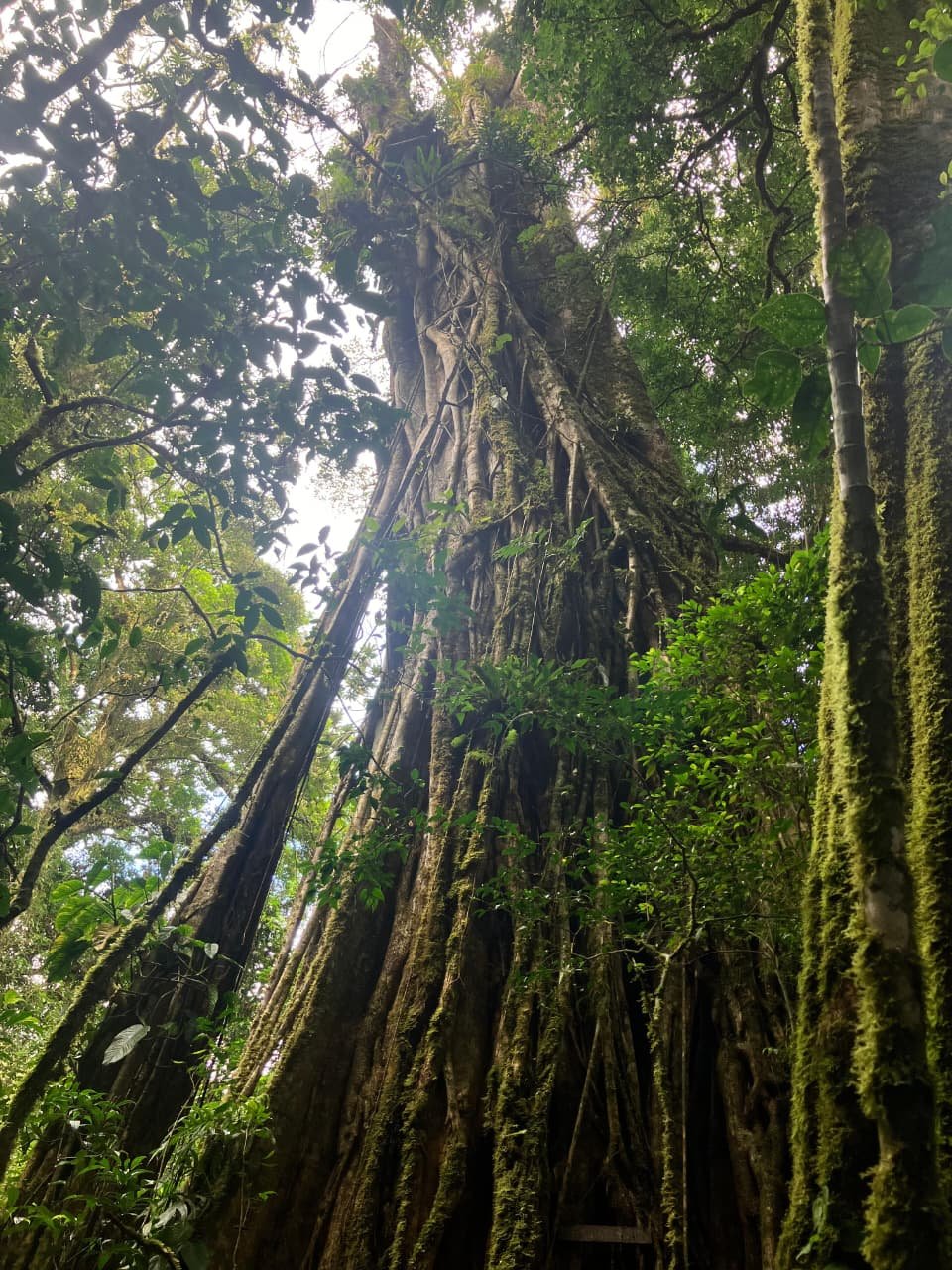
The forest itself is defined by its towering giants, and none are more impressive than the massive strangler fig trees scattered along the trails. These enormous living structures twist around their host trees in sculptural formations of roots and trunks, creating natural cathedrals within the jungle. Standing beside one, you immediately grasp the scale and age of the ecosystem — a reminder that this forest has been evolving undisturbed for centuries.
Hidden within the dense vegetation lies another highlight: a secluded river winding quietly through the jungle. Reached by descending deeper into the forest, the river reveals clear freshwater pools shaded by thick canopy. The water is cool and pristine, flowing over smooth stones in a setting that feels entirely undiscovered. It’s the kind of place where time slows, and the only sounds are birds, insects, and moving water.
What truly sets this region apart is how few travelers ever experience it. Despite being located between two well-known destinations, the forest remains one of Panama’s least visited protected areas. The absence of crowds allows wildlife to thrive and preserves a sense of exploration that is increasingly rare in modern travel.
The Fortuna Forest Reserve is strictly protected, with limited development and strong conservation measures that safeguard biodiversity. This protection maintains critical watershed functions for Panama’s hydroelectric system and preserves habitat for species that rely on intact cloud forest environments. The result is a landscape that feels authentic rather than curated.
Hiking here also reveals how dramatically ecosystems can shift across short distances. On one side of the divide, the forest absorbs Caribbean moisture; on the other, conditions begin transitioning toward Pacific influence. This environmental contrast makes the area a living classroom in tropical ecology and climate interaction.
For travelers seeking a deeper connection to nature — the kind you’ve been building around your own jungle hosting experience in Panama — this place offers something rare: immersion without commercialization. The trails around Lost and Found are not just scenic routes but pathways into one of the country’s most unique ecological crossroads.
To hike here is to witness Panama at its wildest — a meeting point of oceans, climates, and forests where giant trees stand watch over misty valleys and hidden rivers flow unseen. It is a destination defined not by crowds or convenience, but by discovery, preservation, and the quiet power of untouched nature.