
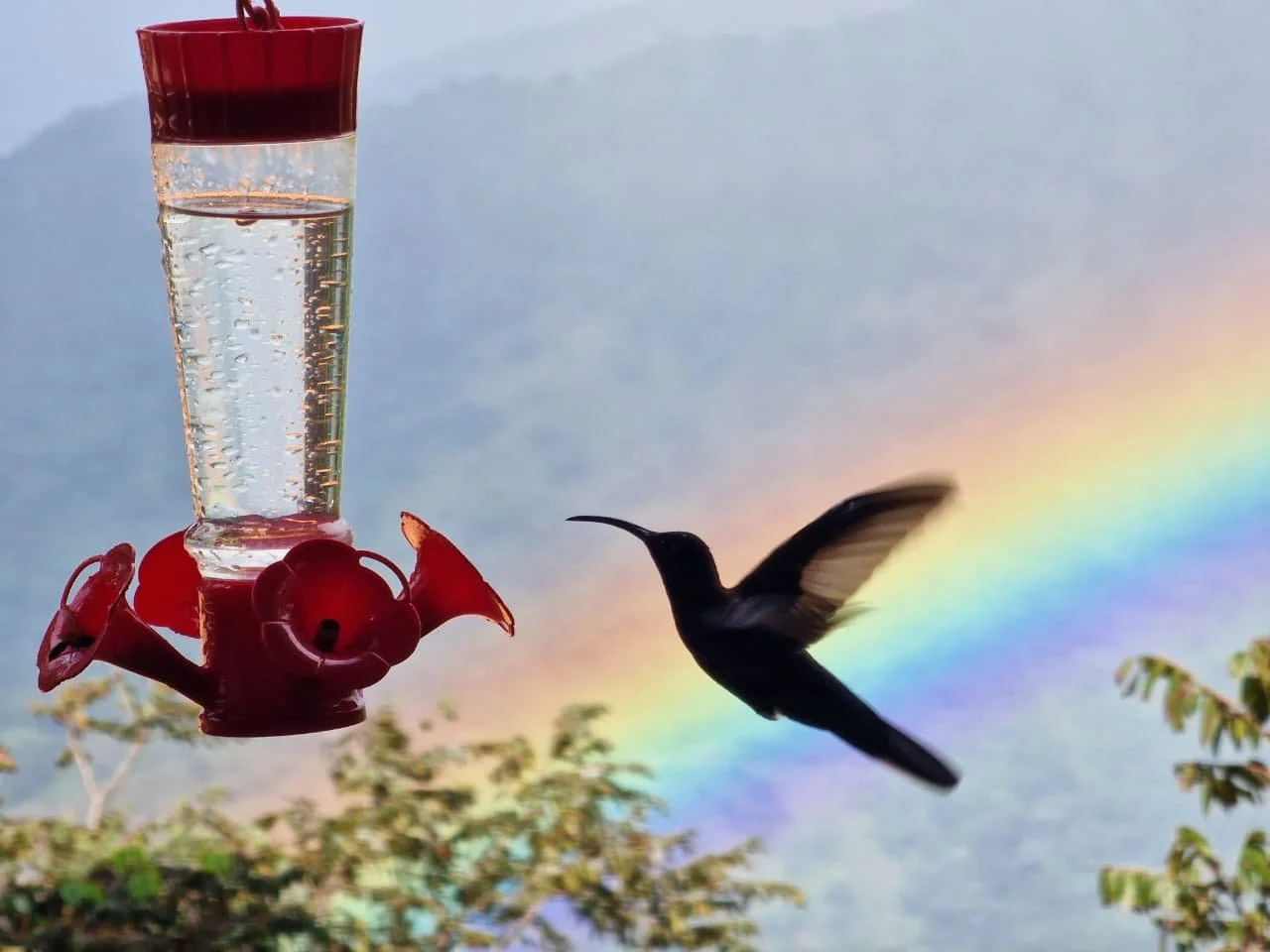
Panama is a dream for birdwatchers because it compresses an extraordinary range of habitats into a small space — Caribbean lowlands, Pacific mangroves, cloud forests, and highland ridges. For visiting birders, the thrill isn’t just the number of species, but the chance to see iconic “target birds” that people travel across continents to find. Around Boquete — where your Lost and Found crowd heads into the jungle trails — many of these coveted species are within reach on early morning hikes.
Resplendent Quetzal
Few birds inspire more awe than the Resplendent Quetzal. With shimmering green plumage and flowing tail feathers, it looks almost unreal. Birders scan fruiting trees in high-elevation cloud forest, especially near Boquete and Volcán, hoping for that unforgettable flash of emerald in the mist.
The quetzal is not only beautiful but culturally significant across Central America. Seeing one often feels like a reward for patience, quiet movement, and a willingness to wake before sunrise when the forest is most alive.
Harpy Eagle
The powerful Harpy Eagle is Panama’s national bird and one of the world’s largest raptors. Spotting one in the wild is rare and deeply memorable. These eagles dominate the rainforest canopy, and sightings in eastern Panama or protected reserves instantly elevate any birding trip.
For birders, the Harpy represents wilderness itself — a top predator that signals a healthy forest ecosystem. Even hearing stories of a recent sighting gets binoculars up fast.
Three-wattled Bellbird
The strange and spectacular Three-wattled Bellbird is famous for its metallic, far-carrying call and dangling facial wattles. During migration periods, birders in Panama’s highlands listen carefully for its distinctive ringing note echoing through the forest.
Its appearance is so unusual that first-time observers often need a moment to process what they’re seeing. It’s one of those species that turns a quiet forest walk into a story you’ll retell for years.
Snowcap Hummingbird
Tiny but dazzling, the Snowcap Hummingbird is a prized sighting for hummingbird lovers. Males display a bright white crown that contrasts sharply with deep purple body feathers.
Because of its size and quick movements, spotting a Snowcap requires sharp eyes and patience around flowering plants. Many birders consider it one of the most charming birds in Panama’s forests.
Keel-billed Toucan
The unmistakable Keel-billed Toucan often becomes a favorite even for non-birders. Its rainbow-colored bill and playful movements make it a highlight of lowland forest birding.
Toucans are surprisingly social and vocal, so hearing their calls often leads to a rewarding sighting. In many parts of Panama, they symbolize the richness of tropical wildlife.
Golden-hooded Tanager
Color explodes in the form of the Golden-hooded Tanager. With a brilliant golden head and electric blue body, it looks like a living jewel.
Mixed flocks moving through forest edges often include tanagers, and spotting this species adds a burst of color to any checklist.
Rufous Motmot
The elegant Rufous Motmot moves quietly through shaded forest understory. Its long tail and calm posture give it a regal presence.
Motmots are beloved by birders for their behavior as much as their appearance. Watching one sit motionless before gliding deeper into the forest feels almost cinematic.
Panama’s appeal for birdwatchers comes from how many iconic species can be seen within short travel distances. A birder might search cloud forests in the morning and explore lowland rainforest later the same day.
Regions around Boquete are especially valued for highland specialties, while Caribbean and eastern forests offer a different set of targets. This geographic diversity keeps birders constantly scanning, listening, and learning.
Trails near your Lost and Found area give visitors direct access to forest habitats where many sought-after species live. Early morning hikes — when mist lifts and birds become active — often produce the most memorable encounters.
Birdwatching in Panama is not only about ticking species off a list. It’s about immersion — humidity in the air, layered forest sounds, and the anticipation that the next movement in the canopy could be something extraordinary.
Many birders describe Panama as a place where skill meets luck. Knowledge of calls and habitat helps, but some of the best sightings happen unexpectedly, rewarding patience and curiosity.
For visiting backpackers who come for hiking, waterfalls, and jungle views, birdwatching often becomes an unexpected highlight. Even casual observers find themselves captivated by movement in the canopy.
Guided walks can dramatically increase sightings because local guides recognize calls and subtle movements most visitors miss. A single experienced guide can transform an ordinary walk into a remarkable wildlife experience.
Panama continues to grow as a global birding destination because it offers both accessibility and biodiversity. Roads, trails, and protected areas make remote-feeling wildlife surprisingly reachable.
For serious birdwatchers, the country represents opportunity — rare species, dramatic landscapes, and new discoveries on every trail. For travelers, it offers a deeper way to connect with nature.
And for those waking before dawn in the Boquete highlands, coffee in hand and binoculars ready, the forest promises something special — maybe a flash of green, a ringing call, or a silhouette perched in morning light.
In Panama, birdwatching isn’t just an activity. It’s a treasure hunt guided by sound, color, and patience — and the next coveted sighting might be waiting just beyond the next bend in the trail.