
Panama is a small country with an enormous diversity of wildlife, and monkeys are among its most charismatic and accessible creatures. Because the country forms a natural bridge between North and South America, it hosts several species that are rare elsewhere in Central America. For travelers seeking memorable wildlife experiences, observing monkeys offers a unique window into Panama’s forests, coasts, and islands.
Monkeys in Panama occupy almost every ecosystem, from mangrove-lined coasts to highland cloud forests. Each species has distinct behaviors, social structures, and habitats, which means that understanding where to go and what to look for greatly improves the chances of sightings.
Many travelers underestimate how abundant monkeys are in Panama. While sightings require patience, knowing which species inhabit which forests allows for targeted exploration. The soundscape of the forest — calls, rustling leaves, and sudden splashes — often hints at their presence even before the monkeys are visible.
Five primate species are commonly recognized in Panama: the mantled howler, the white-faced capuchin, Geoffroy’s tamarin, the Central American spider monkey, and the Panamanian night monkey. Each offers a different experience for wildlife enthusiasts.
Mantled Howler Monkey
The mantled howler monkey is arguably Panama’s most famous primate. Its deep, resonant calls can carry for kilometers and are often the first sign of their presence in the forest. This vocalization is used to mark territory, communicate with group members, and reduce physical conflict.
These monkeys are generally slow-moving and spend much of their day resting and digesting leaves. They feed primarily on foliage, supplemented with fruit and flowers, which makes them less energetic than other monkey species.
Mantled howlers inhabit lowland rainforests, riverine forests, and some coastal forests. They are adaptable to fragmented habitats if sufficient trees remain, but large, contiguous forests remain ideal for healthy populations.
Soberanía National Park, near the Panama Canal, is one of the most reliable locations to see them. Visitors walking along Pipeline Road at dawn or dusk often hear howlers before spotting them. Observing a family group resting in the trees, occasionally moving to feed, gives a sense of their slow and deliberate lifestyle.
Howler monkeys often coexist with capuchins, but they maintain distinct vertical layers in the forest. Howlers are usually higher or mid-canopy dwellers, while capuchins actively explore lower branches and edges.
Conservation-wise, mantled howlers face threats from deforestation and hunting, though hunting is rare in Panama. Their vocal nature and adaptability make them resilient in protected areas but vulnerable in unprotected forests.
White-Faced Capuchin Monkey
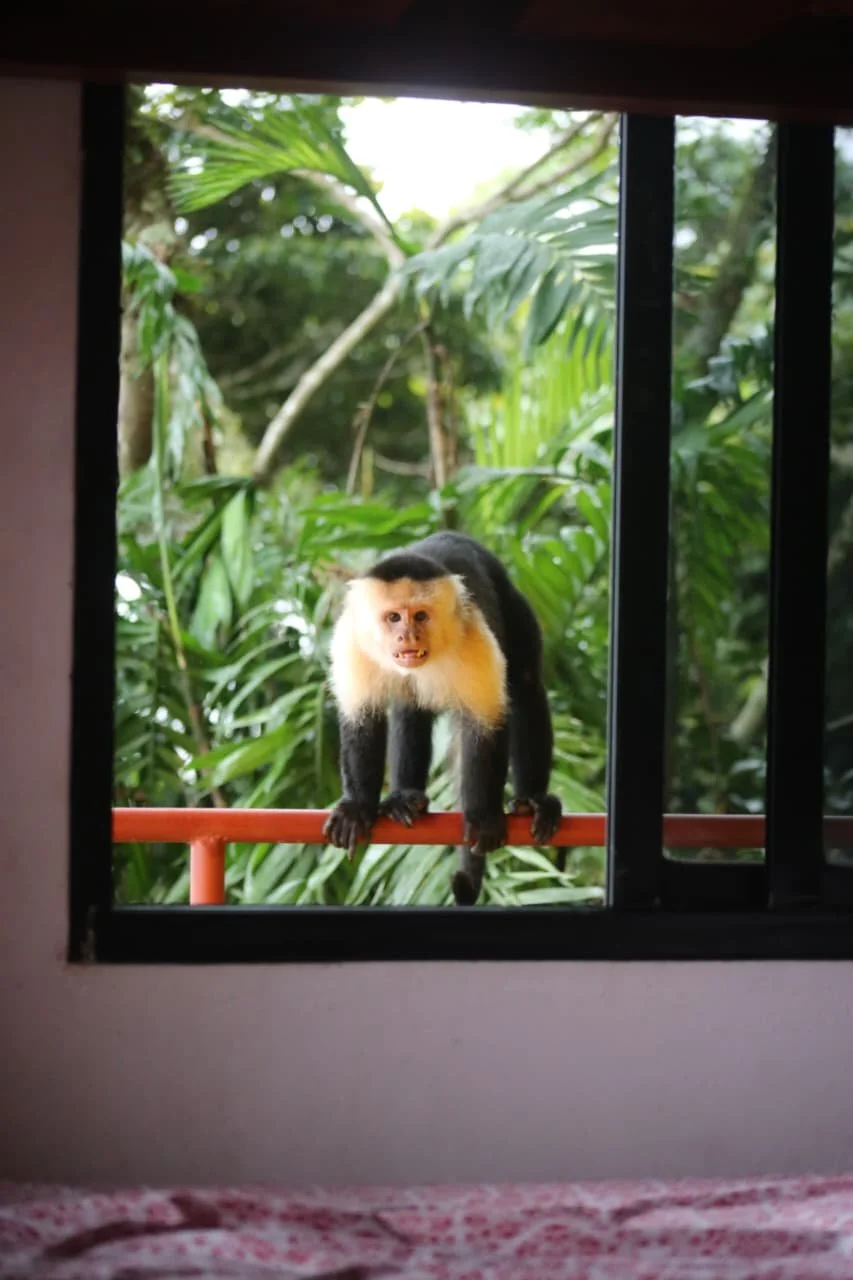
White-faced capuchins are the most widespread monkeys in Panama. They are smaller and much more energetic than howlers, moving quickly through the canopy in search of fruit, insects, and small vertebrates. Their curiosity often brings them closer to humans, particularly in areas with ecotourism.
Capuchins have complex social structures, with hierarchies that dictate access to food and resting sites. Watching their interactions — grooming, playing, and foraging — provides fascinating insight into primate social dynamics.
These monkeys are extremely versatile in their habitat preferences. They are found in primary forests, secondary forests, and even mangroves and plantation edges. Their flexibility in diet and habitat contributes to their wide distribution across the country.
Travelers can reliably see white-faced capuchins in Coiba National Park, Bastimentos Island, and Soberanía National Park. On islands, they often interact with other wildlife, including birds and lizards, demonstrating their opportunistic foraging behavior.
Capuchins are also known for tool use and problem-solving. Observing them in the wild can reveal behaviors such as opening fruit or manipulating branches — a remarkable display of intelligence for a small primate.
Conservation-wise, capuchins are generally stable in protected areas but vulnerable to habitat fragmentation. Their adaptability allows them to survive near human settlements, but long-term survival depends on forest conservation.
Geoffroy’s Tamarin
Geoffroy’s tamarin is Panama’s smallest monkey, and its diminutive size and agility make it a challenge to spot. Weighing only a few pounds, tamarins live in family groups and move rapidly through dense branches.
Tamarins have long tails, small faces, and expressive markings. They are mostly frugivorous but also eat insects, nectar, and small vertebrates, which makes them key players in seed dispersal and insect population control.
These monkeys prefer secondary forest, forest edges, and areas with dense undergrowth. Unlike howlers or capuchins, they thrive in smaller forest fragments and can sometimes be seen near agricultural land.
For travelers, tamarin sightings are most common in Metropolitan Natural Park in Panama City, as well as parts of Darién National Park. Binoculars are highly recommended because of their rapid movement and small size.
Tamarins communicate with a series of chirps, trills, and whistles. Observing their interactions reveals their high social cohesion and group coordination.
Conservation efforts for tamarins focus on protecting habitat corridors that allow these small monkeys to move safely between forest fragments. They are sensitive to human disturbance, making protected areas essential.
Central American Spider Monkey
The Central American spider monkey is one of Panama’s most elegant primates. With extremely long limbs and a prehensile tail, these monkeys glide through the upper canopy with incredible agility.
Spider monkeys require large, continuous tracts of forest. They are highly frugivorous and spend most of their time moving between feeding sites. Their social groups are fluid, splitting into smaller subgroups to forage efficiently.
Sightings are challenging but possible in remote protected areas such as Coiba National Park, Darien National Park, and parts of the Azuero Peninsula. Travelers often need guides to navigate trails and locate feeding sites.
Spider monkeys are critically important to forest regeneration. By dispersing seeds over long distances, they maintain tree diversity and help ensure ecosystem resilience.
These primates are sensitive to hunting and habitat fragmentation. Unlike tamarins or capuchins, they cannot survive in small, fragmented patches, making conservation of large forest reserves vital.
Observing spider monkeys in the wild is a highlight for experienced wildlife travelers. Their fluid movement and expressive behavior make them stand out from other species.
Panamanian Night Monkey
The Panamanian night monkey is Panama’s only nocturnal monkey. It is elusive, quiet, and active after sunset, making it the hardest primate to see.
Night monkeys have large eyes adapted to low-light environments. They live in small family groups, feeding primarily on fruit, nectar, and insects during the night.
Best viewing opportunities require guided night walks in protected forests. Areas such as Barro Colorado Island in the Canal Zone and parts of Darien National Park occasionally provide sightings.
Because they are nocturnal, encounters are always brief and require patience. Their soft calls and sudden movement make spotting them an achievement.
Night monkeys are extremely sensitive to disturbance. Ethical wildlife viewing guidelines emphasize quiet observation, minimal use of lights, and maintaining distance.
Habitats and Ecosystem Diversity
Panama’s primates are distributed according to habitat type. Howlers and capuchins dominate lowland rainforest and riverine areas. Tamarins occupy smaller forests and edges. Spider monkeys require intact canopy over wide ranges, and night monkeys inhabit dense understory and mid-canopy layers.
Mangrove areas, particularly along the Caribbean coast, support capuchins and tamarins. Islands such as Coiba provide opportunities to see both capuchins and howlers in relatively untouched forest.
Highland forests, including Boquete and Volcán, host groups of capuchins and sometimes howlers, but spider monkeys are rare due to elevation and forest fragmentation.
How to Maximize Monkey Sightings
Timing matters. Early morning or late afternoon are typically the best periods for diurnal monkeys. Observers should remain quiet and use binoculars.
Guided tours significantly increase success rates. Experienced guides know group territories, calling patterns, and feeding behavior.
Patience is essential. Monkeys are wild and move unpredictably. Observers often spend hours tracking movements.
Learning calls is useful. Each species has distinctive vocalizations: howlers are loud and guttural, tamarins high-pitched, capuchins varied and expressive, and night monkeys soft and nocturnal.
Ethical viewing is critical. Avoid feeding, chasing, or attempting close contact. Responsible tourism preserves natural behavior and protects both humans and animals.
Conservation and Ecotourism
Protected areas have become refuges for Panama’s monkeys. National parks, reserves, and private reserves maintain corridors and intact canopy critical for survival.
Ecotourism provides financial incentives for local communities to maintain habitats. Lodges and tour operators emphasize education, trail maintenance, and respectful wildlife viewing.
Travelers staying in eco-lodges such as Lost and Found Hostel often have access to local forest trails where monkeys and other wildlife can be observed with minimal disturbance.
By visiting protected areas and choosing responsible operators, travelers support conservation while enjoying rich wildlife experiences.
Social Behavior and Group Dynamics
Understanding primate social structures enhances observation. Howlers live in cohesive groups with established hierarchies. Capuchins are curious and interactive, often exploring the forest floor for food. Tamarins stay in small family groups with coordinated activity. Spider monkeys split and merge depending on resource availability. Night monkeys maintain tight family units for protection.
Observers who understand social behavior can predict movements, identify leaders, and witness feeding or play behaviors more effectively.
Monkey Calls and Communication
Each species communicates differently. Howlers rely on loud calls to claim territory. Capuchins use vocalizations, gestures, and facial expressions to communicate. Tamarins chirp in coordination. Spider monkeys use soft calls to maintain group cohesion in tall canopy. Night monkeys employ subtle calls at night for family communication.
For travelers, learning to recognize calls before visual sightings can make encounters far more rewarding.
Seasonal Movements and Feeding Patterns
Fruiting seasons impact monkey distribution. Capuchins and spider monkeys follow fruit availability, moving between trees. Howlers are more folivorous, so they remain relatively stationary. Tamarins and night monkeys adjust activity based on food abundance.
Observing during peak fruiting seasons increases the likelihood of seeing active groups engaged in foraging and social behavior.
Urban and Fragmented Forests
Some species, particularly capuchins and tamarins, can survive near human settlements. They often exploit fruit trees or gardens, providing opportunities for observation near towns and small lodges.
However, urban encounters come with risks: road traffic, hunting, and human feeding can create conflict or health issues for monkeys.
Islands and Special Habitats
Coiba Island provides a unique environment. Here, capuchins and howlers occupy dense island forest with little human disturbance. The absence of large predators allows monkeys to exhibit more relaxed behavior, making them ideal for photography and observation.
Similarly, Bastimentos and other Caribbean islands support tamarins and capuchins in protected coastal rainforest.
---
Night-Time Observation
For night monkeys, guided night walks are necessary. Using dim lights and quiet observation techniques increases the chance of sightings without disturbing their natural behavior.
Nocturnal observation requires patience and a willingness to adjust to slower movement patterns compared to diurnal monkeys.
Combining Monkey Observation with Other Wildlife
Monkey-watching often overlaps with birding, reptile observation, and rainforest exploration. Many forest trails in Panama allow travelers to see diverse wildlife alongside primates, creating a richer ecological experience.
Panama’s monkeys provide an incredible lens through which to explore the country’s forests. From the slow-moving howlers to the agile spider monkeys, each species represents a piece of Panama’s ecological richness. By observing monkeys responsibly, travelers support conservation and gain unforgettable insights into rainforest life.
Encounters with these primates are not just about the animals themselves but about understanding the connections between species, forest health, and human stewardship of the environment.
Through patience, respect, and knowledge, seeing Panama’s monkeys becomes one of the most rewarding aspects of visiting this biodiversity hotspot.