
Most people come to Panama for the obvious reasons—tropical islands, jungle hikes, the engineering feat of the canal. But there’s a different version of the country that only shows up after dark. It’s quieter, harder to access, and far more subtle. And in the cloud forests above Boquete, that’s where things get interesting.
This is where you might come across one of the rainforest’s most unusual animals: the kinkajou.
Known scientifically as Potos flavus, the kinkajou is one of those species that doesn’t quite fit expectations. At first glance, most people assume it’s a monkey. It climbs, it lives high in the canopy, and it has a long tail that curls around branches. But it’s not a primate at all—it belongs to the same family as raccoons and coatis. Evolution just gave it a completely different lifestyle.
Physically, kinkajous are built for the canopy. They have dense, golden-brown fur, a rounded face with large forward-facing eyes, and small ears that are easy to miss in low light. Their most distinctive feature is their fully prehensile tail, which acts like an extra hand. They use it for balance, for anchoring themselves while feeding, and sometimes just hanging while they reach for fruit or flowers.
They’re also incredibly flexible. Kinkajous can rotate their ankles to run headfirst down trees—something that looks unnatural the first time you see it. Combined with their slow, deliberate movements, it gives them a controlled, almost calculated way of navigating the forest.
Diet is another thing that sets them apart. Kinkajous are primarily frugivores, meaning fruit makes up most of what they eat. But they’re also drawn to nectar and honey, which is where their nickname “honey bear” comes from. Their long, narrow tongue—stretching several inches—lets them reach deep into flowers and beehives. In the process, they end up pollinating plants and spreading seeds, playing a quiet but important role in maintaining the forest.
Despite all of this, kinkajous are rarely seen.
They are strictly nocturnal and spend their days hidden in tree hollows or dense vegetation. At night, they move through the canopy with almost no sound. They don’t travel in large, noisy groups, and they don’t rely on calls that would give away their position. If you see one, it’s usually because you were looking carefully—not because it made itself obvious.
To make things more confusing, kinkajous are often mistaken for another animal: the olingo, specifically species like Bassaricyon gabbii.
Olingos are closely related to kinkajous, and the resemblance is strong enough to fool even experienced travelers. Both are small, tree-dwelling mammals with similar fur coloring and nocturnal habits. But there are a few key differences.
Olingos tend to have a slimmer build and a more pointed face, giving them a slightly fox-like appearance. Their tails are long but not prehensile, so they don’t wrap them around branches like kinkajous do. Behaviorally, olingos are often more active and a bit quicker in their movements, while kinkajous move more slowly and deliberately.
In low light, though, telling them apart isn’t always easy—especially when all you’re seeing is a silhouette and a pair of reflective eyes high in the trees.
That’s part of what makes spotting either one feel like a real find.
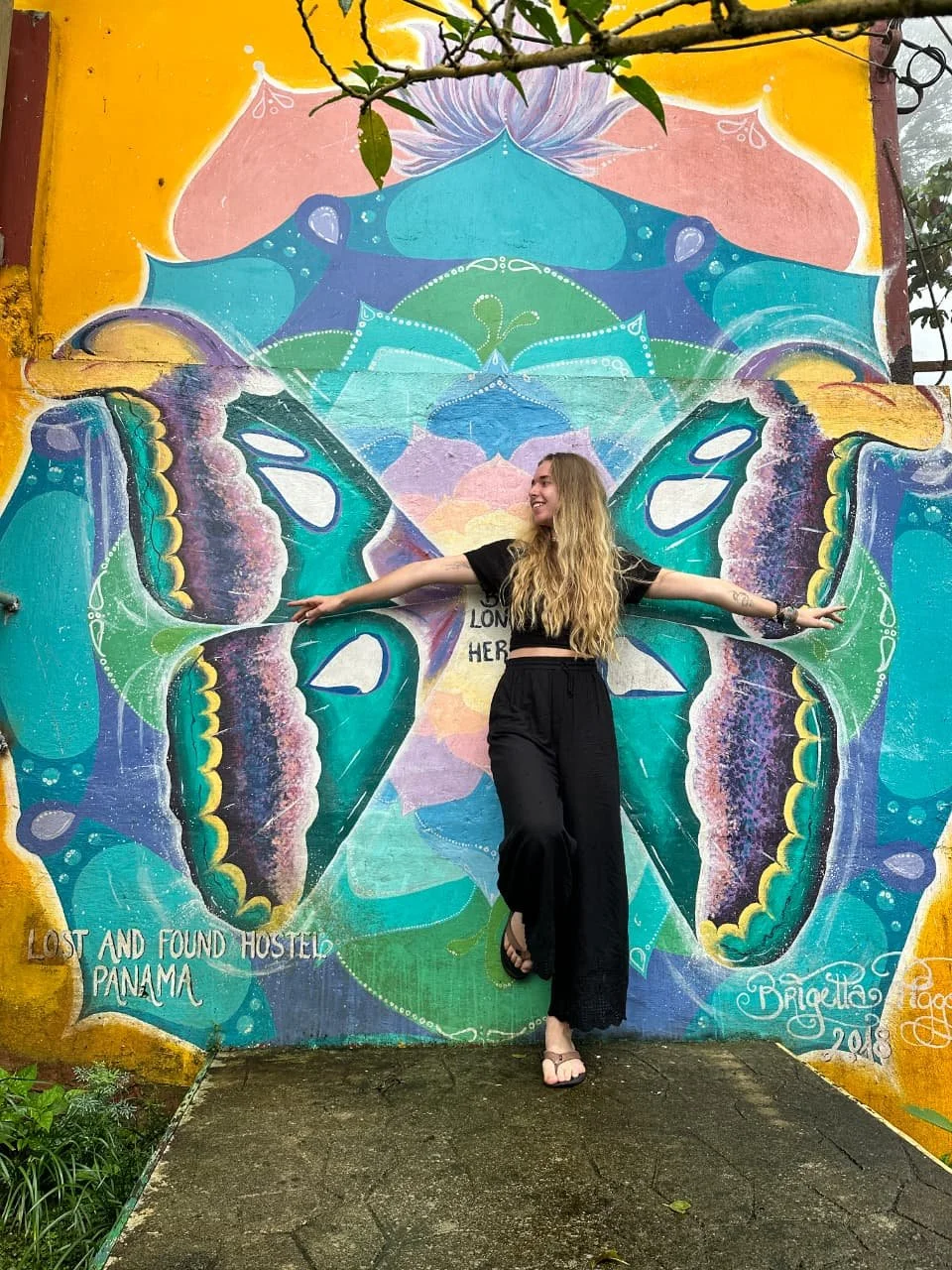
One of the better places to have a shot at seeing them is Lost and Found Hostel. The hostel is set in a remote section of cloud forest, surrounded by thick jungle and far removed from city lights. That kind of environment matters. With less disturbance, nocturnal animals are more active and more willing to move through areas that overlap with human spaces.
Kinkajous are sometimes spotted right around the hostel grounds. Guests sitting outside at night have noticed movement above them—subtle at first, then clearer once a light hits the right angle. A tail wrapped around a branch is usually the giveaway. Olingos, on the other hand, might move faster through the same trees, making shorter, quicker passes.
The hostel’s night walk is another good opportunity. These guided walks move slowly through the forest with headlamps, focusing on spotting wildlife in the canopy as well as along the trail. It’s not about covering distance—it’s about observation.
Most sightings start the same way: eye shine. A reflection in the dark that doesn’t belong to leaves or insects. From there, it’s a matter of patience—watching for movement, trying to pick out shape and behavior. Is the tail wrapping? Is it moving slowly or darting between branches? That’s when you start figuring out what you’re actually looking at.
Even if you don’t see a kinkajou, the experience changes how you see the forest. You realize how much activity happens overhead, completely unnoticed during the day. The canopy isn’t empty—it’s just hidden.
And that’s really the point.
The kinkajou isn’t rare because it doesn’t exist—it’s rare because most people don’t spend time looking in the right way, at the right time, in the right place.
In the cloud forests of Panama, if you slow down and pay attention, there’s a good chance the forest will show you something most people miss.
Kinkajous After Dark: One of Panama’s Strangest Night Encounters