
Few birds capture the imagination quite like toucans. With their oversized, vividly colored bills and playful personalities, they seem almost too surreal to be real. In Panama, these iconic birds are not just a rare sight, they are a defining part of the rainforest experience. The country is home to several species of toucans and their close relatives, each with its own look, behavior, and preferred habitat. From the famous lowland giants to the lesser known mountain dwellers, Panama offers a complete toucan showcase for anyone willing to look up into the canopy.
The most recognizable of them all is the keel billed toucan, often called the rainbow billed toucan. Its enormous beak glows with greens, oranges, reds, and blues, making it one of the most colorful birds in the Americas. Despite its size, the bill is lightweight and surprisingly delicate, made of keratin with a honeycomb structure inside. These toucans are most commonly found in lowland rainforests, forest edges, and even near rural villages. One of the best places to see them is Soberanía National Park, especially along Pipeline Road, where they often travel in small groups, hopping between branches and tossing fruit into the air before swallowing it whole.
Closely related but slightly more understated is the yellow throated toucan, also known as the chestnut mandibled toucan. Larger and a bit more serious in appearance, it has a mostly dark bill with a splash of yellow and chestnut tones. Its deep, frog like croaking call echoes through the forest long before you see it. This species prefers mature rainforest and is also common in Soberanía, as well as deeper jungle regions like Darién National Park, where the forests are vast and less disturbed.
In the foothills and mid elevation forests, you might encounter one of Panama’s most elegant species, the collared aracari. Aracaris are part of the toucan family but tend to be smaller, slimmer, and more social. The collared aracari is striking, with a yellow chest crossed by a black and red band and a sleek, curved bill. Unlike larger toucans, they are often seen in lively groups, moving quickly through the canopy in search of fruit. They are commonly spotted in areas like Metropolitan Natural Park, making them one of the easiest toucan relatives to see without leaving the city.
Another fascinating member of the family is the fiery billed aracari, found primarily in western Panama near the Costa Rican border. This species is slightly more localized, but its bill, bright orange and red, makes it stand out dramatically against the green forest. It thrives in lowland and foothill forests, especially in Chiriquí Province. Areas around Golfo de Chiriquí National Park and nearby mainland forests offer some of the best chances to spot this vibrant bird.
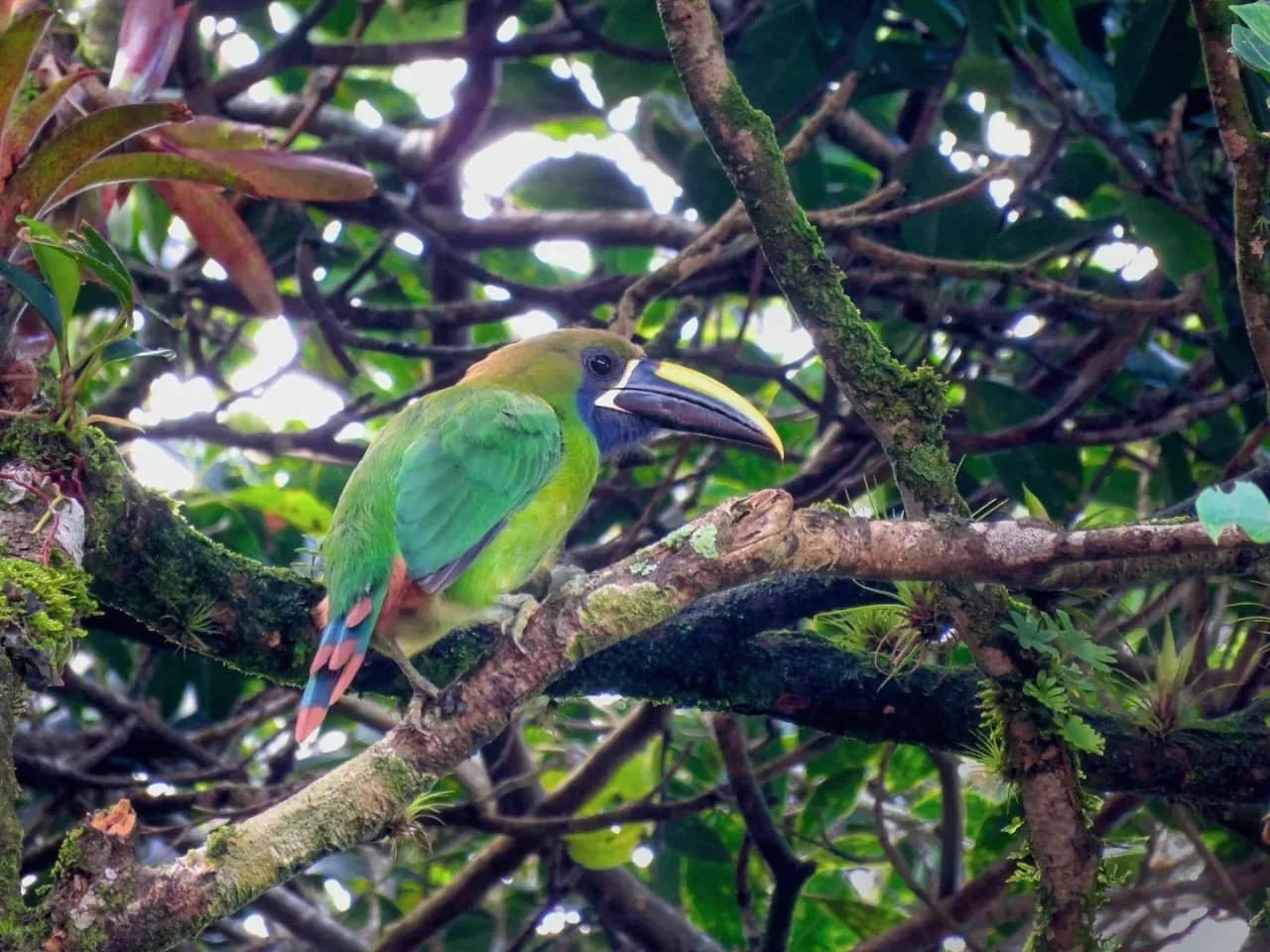
For those willing to head into higher elevations, Panama hides an even rarer treasure, the emerald toucanet. Smaller than the typical toucan, this species trades bright rainbow colors for a more subtle but equally beautiful palette of deep green plumage with hints of blue and chestnut. It lives in cloud forests and montane regions, where the air is cooler and the vegetation dense with moss and orchids. Birders often seek them in the highlands around Volcán Barú National Park and Boquete, where early mornings offer the best chance of a sighting.
There is also the yellow eared toucanet, a lesser known and more elusive species that inhabits humid foothill forests. It blends into the greenery with its predominantly green body, but a flash of yellow near the ear gives it away. These birds are quieter and harder to find, rewarding patient observers who spend time scanning fruiting trees deep in the forest.
Toucans are not just visually stunning, they are also incredibly important to the ecosystem. As fruit eaters, they act as major seed dispersers, helping regenerate forests by spreading seeds over large distances. Their feeding behavior is entertaining to watch, they pluck fruit with precision, toss it back with a quick flick of the head, and swallow it whole. Despite their bulky appearance, they are agile fliers, capable of navigating dense forest with ease.
Their social behavior adds to their charm. Many species travel in small groups, communicating with croaks, clicks, and rattling calls. At night, some toucans even sleep together in tree cavities, tucking their large bills under their wings to conserve space, a surprisingly cozy image for such flamboyant birds.
One of the most remarkable aspects of seeing toucans in Panama is how accessible they are. Within minutes of leaving Panama City, you can find yourself in forest habitats where these birds are active. Whether you are exploring national parks, hiking jungle trails, or simply relaxing near a lodge surrounded by trees, there is always a chance a toucan will appear overhead, announcing itself with a call or a sudden burst of color.
Timing can make a difference as well. Early morning and late afternoon are when toucans are most active, moving between feeding areas and calling to one another. Listening is just as important as looking, their distinctive vocalizations often reveal their presence long before you see them.
In the end, Panama’s toucans are more than just beautiful birds, they are symbols of the tropical wilderness itself. Each species, from the bold keel billed toucan to the subtle emerald toucanet, offers a different glimpse into the richness of the forest. Seeing one in the wild is always a moment of excitement, but seeing several species across different regions of the country turns a simple trip into a true adventure.
In Panama, the rainforest does not just surround you, it comes alive above you, in flashes of color and echoing calls, where toucans rule the treetops like living works of art.
Rainbow Beaks of the Jungle, Discovering Every Kind of Toucan in Panama and Where to Find Them