
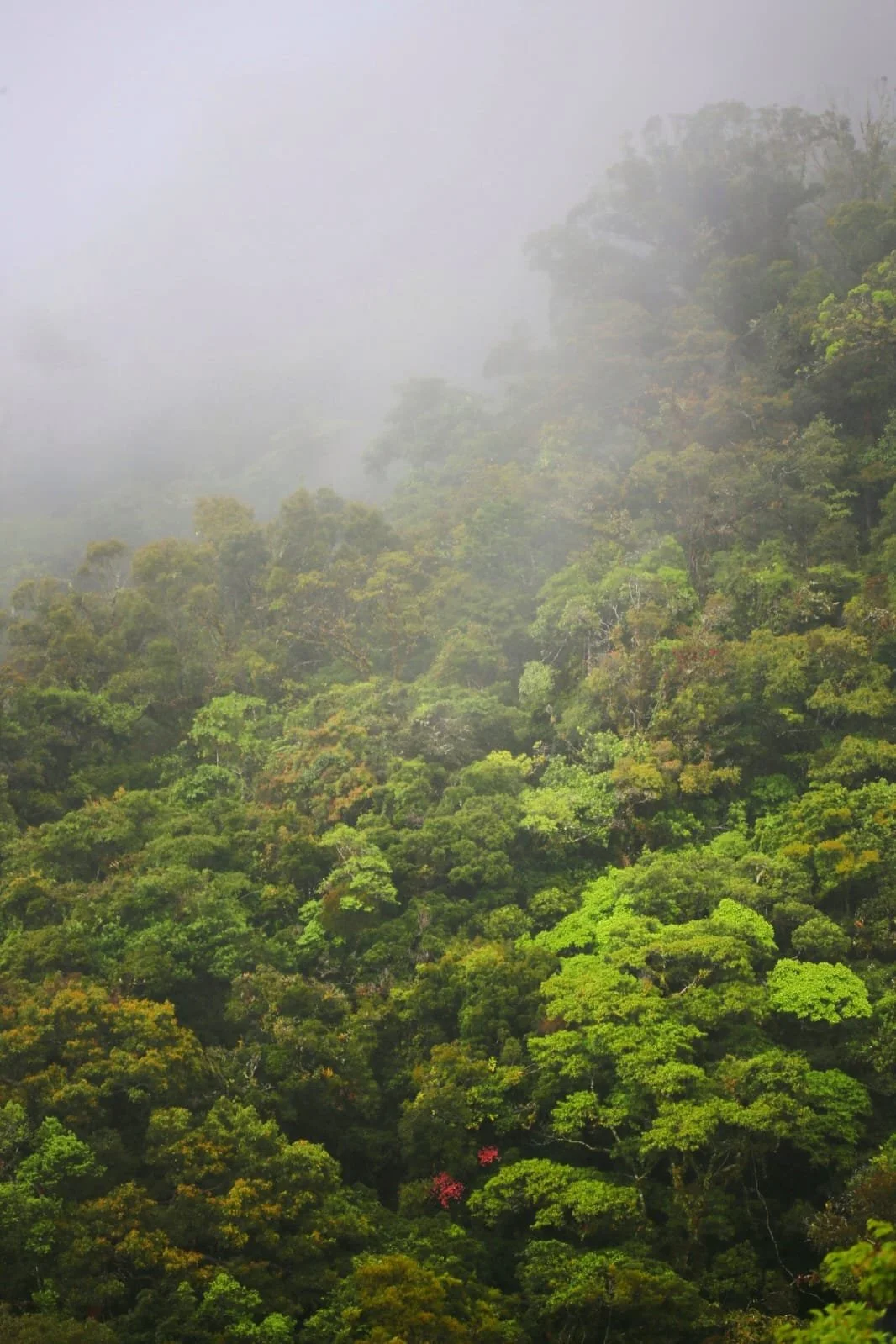
In the high, mist-drenched mountains of Panama, especially in places like Boquete, the forest doesn’t just grow on the ground and into the sky, it grows sideways, downward, upward, and outward in every direction at once. One of the quiet forces holding this entire ecosystem together is something most people barely notice at first glance: moss.
At a distance, it looks like decoration. Up close, it is a living, breathing layer of the forest itself.
A forest that drinks from the air
Cloud forests are defined by one simple but extraordinary condition: they are often inside the clouds.
In these environments, moisture doesn’t just fall as rain. It moves through the air as mist, fog, and suspended droplets that constantly coat every surface. Trees, rocks, fallen logs, and even soil are almost always damp.
Moss thrives in this world because it does not need soil in the way most plants do. It absorbs water directly through its surface, pulling moisture straight from the air.
In the cloud forests of Panama, moss is not an accessory to the ecosystem. It is part of the infrastructure of moisture itself.
What moss actually does in the forest
Moss is often mistaken for something passive, but in reality it is highly active in shaping the environment around it.
It: Stores water like a sponge
Regulates humidity at micro levels
Helps prevent soil erosion on steep slopes
Creates habitat for insects and microorganisms
Slowly builds organic matter over time
In cloud forests near Boquete, moss acts like a living cushion that holds moisture in place, allowing entire ecosystems to function on steep, unstable terrain.
Without moss, much of the cloud forest would simply not retain enough water to sustain its complexity.
The feeling of walking through moss-covered forest
One of the most striking experiences in Panama’s highland forests is the sensation of being inside a completely soft environment.
Trees are wrapped in thick green layers. Branches disappear under velvet-like coatings. Fallen logs look like they are melting back into the earth, covered in dense mats of green growth.
Even rocks become unrecognizable, transformed into rounded, moss-covered forms that look almost organic.
In Panama, this creates a forest that feels less like a collection of objects and more like a continuous surface of living material.
Moss as a water system
Moss does not just exist in humid environments, it actively manages water.
Each tiny structure within moss acts like a micro reservoir. When fog passes through the forest, moss captures moisture and holds it in place. When rain falls, it slows water runoff, releasing it gradually into the soil.
This is especially important on steep mountain slopes, where uncontrolled water flow would otherwise lead to rapid erosion.
In cloud forest regions like Boquete, moss effectively becomes part of the forest’s water regulation system, controlling how moisture moves through the landscape.
A hidden world inside moss
If you look closely at moss in Panama’s cloud forests, you are not just looking at a plant, but an entire miniature ecosystem.
Within its dense structure live: Tiny insects
Micro worms
Fungal networks
Bacteria
Protozoa and microscopic life
To these organisms, moss is a forest within a forest. It provides shelter, moisture, and stable temperature conditions in an otherwise fluctuating environment.
This hidden layer of life is one of the least visible but most active parts of the ecosystem in Panama.
Moss and the trees: a symbiotic relationship
In cloud forests, moss often grows directly on trees, forming thick coatings on trunks, branches, and roots.
This is not harmful to the trees in most cases. Instead, it creates a layered relationship where moss benefits from elevation and moisture exposure, while trees benefit from moisture retention and temperature regulation.
Over time, moss layers can become so thick that they change the texture and appearance of entire trees, making them look ancient, soft-edged, and almost sculptural.
Why cloud forest moss feels different
Not all moss is the same. The moss in cloud forests has a unique character because of constant exposure to fog and low-level light.
It tends to be: Denser
More saturated in color
Thicker in growth layers
Constantly moist to the touch
Slow-growing but highly persistent
In places like Panama’s highland forests, this creates an environment where everything feels softened, as if the landscape itself has been filtered through water and time.
Moss as a time marker of the forest
Because moss grows slowly, its presence often reflects long-term environmental stability.
Thick moss coverage usually indicates: Consistent humidity over long periods
Minimal disturbance from human activity
Stable cloud cover patterns
Healthy forest ecosystems
In this sense, moss is not just decoration. It is a living record of environmental conditions over time.
The sound and silence of moss forests
One of the most unusual aspects of moss-covered cloud forests is how they affect sound.
Moss absorbs noise. It dampens echoes, softens footsteps, and reduces sharp acoustic reflections. The result is a forest that feels quieter than expected, even when full of life.
Walking through moss-heavy regions in Boquete, you often notice how sounds feel absorbed rather than reflected, creating an almost padded silence.
Final picture, the green skin of the mountains
In the cloud forests of Panama, moss is not just a plant layer. It is a living membrane that wraps the entire ecosystem in moisture, softness, and stability.
It holds water in the air and on the ground. It creates homes for microscopic life. It protects slopes from erosion. It transforms trees, rocks, and fallen logs into living surfaces.
And it turns the forest into something that feels less like a collection of separate objects and more like a single breathing organism.
In places like Boquete, you are not just walking through a forest.
You are walking across a living, green skin that has been quietly growing, absorbing, and reshaping the mountains for centuries.