
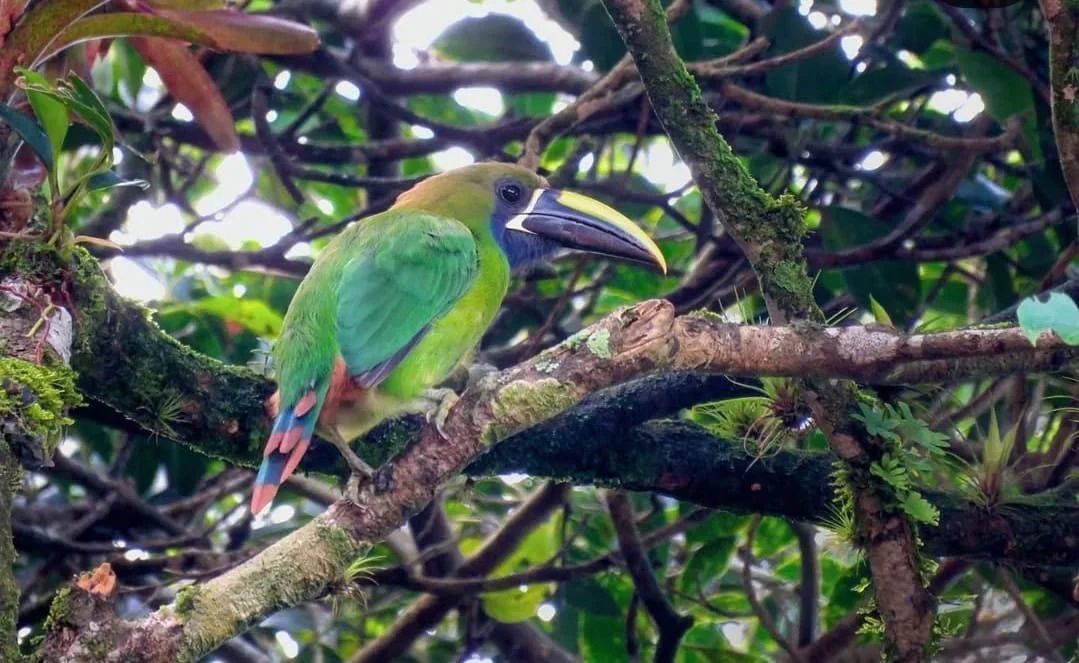
Deep in the cloud forests of western Panama, one of the most striking birds you can encounter is the emerald toucanet. Small compared to its famous toucan relatives but just as charismatic, this forest dweller is a flash of green, blue, and yellow that moves through the canopy like living jewelry. For travelers staying in places like the Lost and Found Hostel area, encounters with these birds are not rare at all. In fact, they are one of the signature wildlife experiences of the surrounding highland jungle.
The emerald toucanet belongs to the toucan family, but unlike the large toucans that many people picture, it is smaller, more agile, and often travels in pairs or small groups rather than large flocks. Its body is mostly a rich green, which allows it to blend into the dense forest canopy. However, it has vivid accents of blue around the head, a bright yellow chest patch, and a thick, slightly curved bill that often shows a gradient of dark tones. When sunlight breaks through the misty forest, these colors can suddenly appear in the treetops like flashes of neon.
One of the best places in Panama to see emerald toucanets is in the cloud forest ecosystem surrounding Lost and Found Hostel near the Fortuna region. This area sits at a higher elevation compared to coastal rainforest, which creates a cooler, misty environment filled with moss, orchids, and dense vegetation. The mix of altitude and humidity creates ideal conditions for a wide range of bird species, and emerald toucanets are among the most noticeable. Early morning walks along forest trails or simply sitting quietly near the lodge area can often lead to sightings.
Unlike some birds that prefer deep, isolated parts of the jungle, emerald toucanets are relatively adaptable and can be seen moving along forest edges, fruiting trees, and secondary growth areas. They are especially attracted to fruiting trees, where they feed on berries, small fruits, and occasionally insects. If you are staying in the Lost and Found area, you may notice them hopping between branches in short bursts, often pausing briefly before moving again in quick, agile motions.
However, spotting them visually is only part of the experience. Recognizing their sound is often the key to finding them in the first place. Emerald toucanets have a distinctive vocal pattern that can be described as a series of high pitched, repetitive, croaking or rattling calls. It is not a melodious song like some tropical birds, but rather a rhythmic, slightly mechanical sounding call that echoes through the forest. It often comes in short bursts, repeated at intervals, and can carry surprisingly far through dense vegetation.
When you hear them, it often sounds like a fast sequence of “krrk krrk krrk” or “kek kek kek” notes, sometimes rising and falling slightly in pitch. These calls are used for communication between pairs or small groups as they move through the canopy. If you pause and listen carefully, you may notice that the sound seems to shift location quickly, which reflects how rapidly the birds move between branches.
One of the most effective ways to find emerald toucanets is to simply stop walking when you hear their calls and scan the upper canopy. Many visitors make the mistake of looking at eye level or lower, but these birds spend most of their time in the upper layers of the forest. Their green coloration makes them surprisingly difficult to spot unless they move or catch light. Watching for fruiting trees or areas with visible clusters of activity increases your chances significantly.
Around the Lost and Found Hostel region, especially in the surrounding Fortuna forest area, early morning and late afternoon are the best times for sightings. During these hours, bird activity increases as they feed and move between roosting areas. The cooler temperatures also make the forest more active overall, with toucanets often calling more frequently as they communicate across distances.
Another interesting behavior is their social interaction. Emerald toucanets are often seen in pairs, and these pairs can stay together long term. You may notice two birds moving in close coordination, feeding in the same tree or calling back and forth. This pairing behavior adds a dynamic element to their presence, making encounters feel more intentional and less random.
For travelers, encountering an emerald toucanet in this environment often becomes one of the most memorable wildlife moments of their trip. The combination of misty cloud forest, quiet jungle trails, and sudden bursts of color and sound creates a sense of discovery that feels almost cinematic. Unlike zoo or sanctuary settings, these are wild encounters, where the birds appear briefly and then disappear back into the canopy.
In the broader ecosystem of Panama, emerald toucanets play an important ecological role. As fruit eaters, they help disperse seeds across the forest, contributing to regeneration and plant diversity. Their movement between trees effectively connects different parts of the forest in subtle but important ways.
Ultimately, the emerald toucanet is one of those species that rewards patience and attention. You do not always see it immediately, but once you learn its call and understand its habits, the forest becomes more alive with possibility. Around places like Lost and Found Hostel, where nature is literally right outside your door, these birds become part of the daily rhythm of the jungle.
In the end, spotting an emerald toucanet is not just about checking a bird off a list. It is about learning to listen to the forest, recognizing its signals, and allowing yourself to slow down long enough to notice a flash of green moving through the mist above.