
The Country Where the Light Rules Everything
One of the strangest and most beautiful things about Panama is how consistent the rhythm of daylight feels throughout the entire year.
Travelers arriving from northern countries often expect dramatic seasonal swings like they are used to back home. In places like Canada, summer evenings seem endless while winter darkness arrives before people even finish work. Entire emotional states revolve around sunlight.
Panama does not really play that game.
Because the country sits so close to the equator, sunrise and sunset barely shift compared to most of North America or Europe. The changes happen, but subtly. Instead of massive seasonal extremes, Panama lives inside a remarkably stable cycle of tropical light year round.
And honestly, many travelers find this oddly comforting.
The sun usually rises somewhere around the 6 AM hour throughout most of the year and sets roughly around the 6 PM hour as well. Depending on the month, sunrise may drift slightly earlier or later, and sunset shifts modestly too, but the difference is surprisingly small.
There are no giant nine or ten PM summer sunsets like northern countries experience.
There are also no brutally early winter nights swallowing entire afternoons.
Instead Panama exists in this almost balanced tropical rhythm where daylight feels dependable, stable, and deeply tied to daily life itself.
People wake early. Businesses often start early. The heat builds quickly. Evenings arrive consistently.
After a while, travelers stop checking sunset times entirely because their body simply adapts to the tropical schedule.
Morning comes fast in Panama.
Especially because nature itself refuses to stay quiet.
Long before sunrise, insects hum through the darkness. Roosters begin their emotional breakdowns sometime around the middle of the night. Birds gradually awaken. By dawn, entire forests explode with sound.
And then the light arrives.
Tropical sunrise in Panama feels sudden compared to northern countries. There is often very little lingering twilight. Darkness begins fading, the sky softens into pale blue and orange, and suddenly the world is fully awake.
The speed surprises many visitors.
One moment it feels like deep night. Then suddenly sunlight pours across jungle hills, beaches, rooftops, islands, and mountain valleys with incredible intensity.
Because Panama’s atmosphere is often humid and filled with moisture, sunrise colors can become astonishing. Pink clouds hover above misty hills. Gold light spills through rainforest fog. Caribbean mornings sometimes glow silver blue while the Pacific side burns orange beneath scattered clouds.
And the best part is that these moments happen constantly.
Not once in a while.
Constantly.
Panama produces incredible skies so routinely that locals sometimes barely react anymore while backpackers stand motionless taking photographs like they just witnessed divine intervention.
Sunsets work differently depending on which coast you stand on.
This is one of the fascinating geographical quirks of Panama. The country bends horizontally east to west in a way that creates unusual coastlines and lighting conditions. Some areas face perfect Pacific sunsets while others greet the sunrise over Caribbean waters.
And certain places became legendary among travelers because the sunsets feel almost unreal there.
Las Lajas is one of those places.
Las Lajas feels endless.
The beach stretches for enormous distances with wide open sand and huge Pacific skies that seem to swallow the horizon whole. During sunset, the entire atmosphere changes. The heat softens slightly. Long shadows stretch across wet sand. Pelicans drift low over waves while the sky slowly begins turning gold, orange, pink, and deep crimson.
What makes Las Lajas special is the sheer openness. Nothing blocks the horizon. The Pacific absorbs the entire sky while clouds reflect impossible colors across huge distances. Sometimes thunderstorms build far offshore while sunlight explodes beneath them in glowing orange bands.
Travelers staying there often plan quick evening walks and accidentally remain on the beach for hours staring silently at the sky.
Then there is Santa Catalina.
Santa Catalina sunsets feel wilder somehow.
The town itself already carries a slightly untamed atmosphere. Surfers, fishermen, backpackers, dive boats, dusty roads, salt air, and jungle hills all collide together there. At sunset, the Pacific turns molten gold while islands offshore darken into silhouettes against the horizon.
The ocean reflects everything.
Clouds catch fire. Fishing boats drift slowly across glowing water. Palm trees turn black against orange skies.
Some evenings in Santa Catalina genuinely feel cinematic. The kind of sunset where entire groups of backpackers stop talking mid conversation because the sky suddenly becomes too ridiculous to ignore.
And because the town’s pace is already slow and relaxed, people naturally gather to watch the light disappear together.
Cold beers appear. Surfboards lean against walls. Music drifts softly from bars. Everybody quietly watches the horizon burn.
But one of the most fascinating sunset experiences in Panama happens high in the mountains at Lost and Found Hostel.
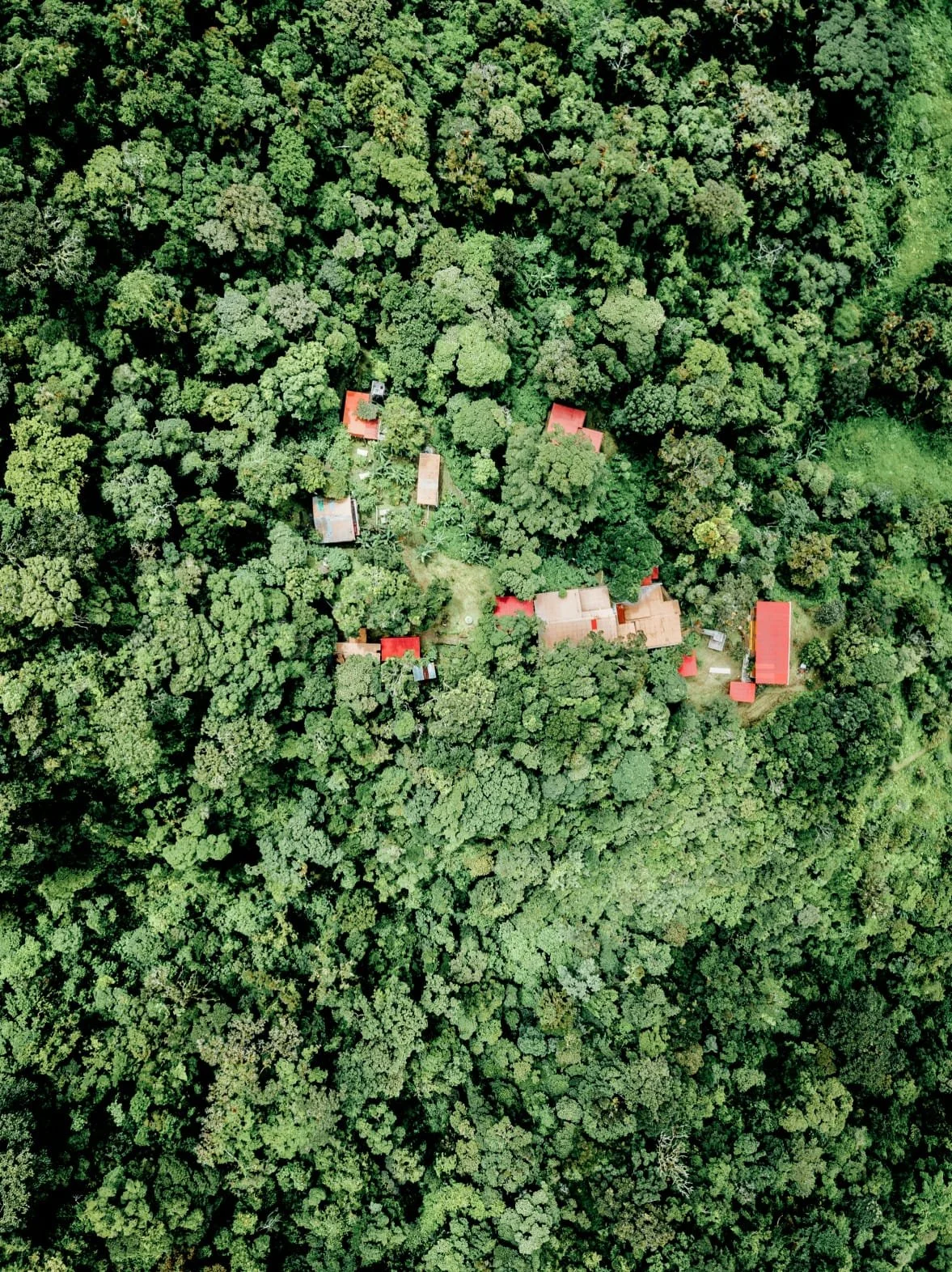
Lost and Found sits hidden within cloud forest jungle between Boquete and Bocas del Toro, surrounded by mist, steep green mountains, dense vegetation, and astonishing views. The hostel already feels surreal during daytime, suspended above valleys filled with rainforest noise and drifting fog.
Then sunset arrives.
The clouds begin glowing pink and gold beneath layers of jungle covered mountains. Mist moves slowly through valleys while distant ridges fade blue into the horizon. Sometimes the entire forest fills with soft glowing light while cicadas scream from the trees and birds disappear into darkness.
Unlike beach sunsets, which feel wide open and dramatic, mountain sunsets there feel intimate and atmospheric. The clouds themselves become part of the show. Some evenings visibility disappears entirely into fog while tiny breaks suddenly reveal glowing valleys below.
Travelers often end up sitting silently on hostel decks much longer than intended simply watching the light shift minute by minute through the mountains.
And then there is sunrise from the summit of Volcán Barú.
For many travelers, this becomes one of the single most unforgettable experiences in all of Panama.
Volcán Barú is the country’s highest peak, rising above the surrounding mountains at over 3400 meters. On clear mornings, the summit offers one of the rarest geographical views in the world:
Seeing both the Pacific Ocean and Caribbean Sea at the same time.
Most people begin climbing during the middle of the night. Around midnight or one in the morning, exhausted groups of hikers and backpackers start ascending through darkness wearing headlamps while cold wind pushes through volcanic slopes.
The hike is difficult. The road feels endless. Everybody questions their decisions eventually.
Then, after hours of climbing through darkness and exhaustion, the eastern sky slowly begins changing color.
First pale grey. Then blue. Then soft orange.
Clouds beneath the summit begin glowing while mountain ridges emerge from darkness one by one. Wind sweeps across the volcanic peak while travelers stand wrapped in jackets watching sunlight slowly spill across all of western Panama.
And suddenly the entire landscape appears.
The Pacific shines in one direction. The Caribbean glimmers faintly in the other. Cloud forests, valleys, farms, rivers, and distant hills unfold beneath rising sunlight.
Some mornings the summit stays hidden in fog and clouds.
Other mornings the visibility becomes almost impossibly clear.
But even when conditions are rough, there is something unforgettable about watching sunrise from the roof of Panama itself after climbing through cold volcanic darkness all night.
One thing travelers gradually realize in Panama is how deeply daily life revolves around light and weather.
Because daylight stays relatively stable all year, people become highly sensitive to smaller environmental shifts instead. Rainfall patterns matter enormously. Clouds matter. Humidity matters. The quality of sunlight itself changes between dry season and rainy season.
During dry season, sunsets often appear sharper and clearer with dramatic orange skies and brilliant visibility.
During rainy season, the atmosphere becomes moodier and more unpredictable. Giant thunderclouds tower over oceans while sudden breaks in storms create glowing purple and pink skies unlike anything travelers expected.
And somehow, nearly every region of Panama develops its own version of beautiful light.
Caribbean mornings. Pacific sunsets. Cloud forest mist. Golden farmland evenings. Jungle dawns filled with bird calls. Island horizons glowing beneath tropical storms.
The country constantly changes color.
Perhaps that is why so many travelers become emotionally attached to sunrise and sunset in Panama.
Not because the times change dramatically throughout the year.
But because the light itself feels alive there.
Warm. Heavy. Tropical. Wild.
A kind of light that makes oceans glow, mountains float above clouds, and backpackers stop mid sentence just to stare quietly at the horizon for a while.