
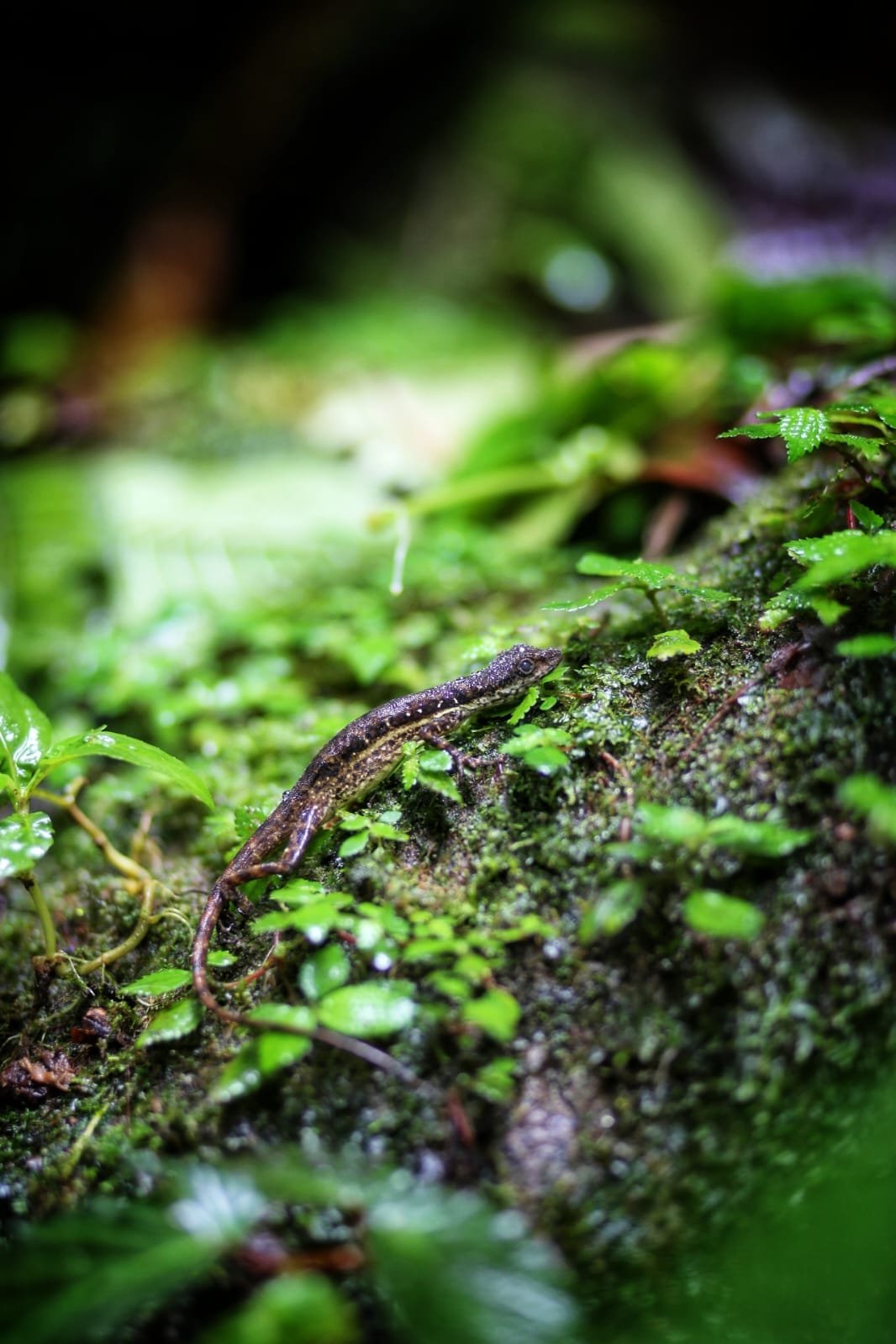
There are few places on Earth where nature feels as alive, strange, and mysterious as the rainforests of Panama. During the daytime the jungle already feels overwhelming enough. Birds scream from the canopy. Cicadas buzz so loudly they sound electrical. Heat rises from wet soil. Giant leaves drip constantly with moisture. Everything grows, crawls, climbs, or flowers with almost aggressive intensity.
But at night, Panama’s forests become something else entirely.
Darkness transforms the jungle into a hidden world most people never truly experience. The air cools slightly. Mist gathers over streams. Tiny reflections appear in flashlight beams. Every branch seems alive with movement. Frogs begin calling from invisible hiding places while insects create a wall of sound so dense it feels physical.
And somewhere among those dripping leaves and rainforest streams live some of the strangest creatures in the entire animal kingdom: glass frogs.
The first time most people see a glass frog, they usually think something is wrong with their eyes. The frog looks impossible. It is small and bright green like an ordinary tropical tree frog at first glance, but then the flashlight catches it at the right angle and suddenly its body appears partly transparent. You can see through it. Tiny bones, pale organs, and sometimes even a faintly beating heart become visible beneath translucent skin.
It feels less like seeing a normal frog and more like discovering some tiny rainforest ghost.
Glass frogs are among the most bizarre amphibians on Earth, yet they remain surprisingly unknown compared to more famous tropical animals like sloths, toucans, or poison dart frogs. They are not large. They are not loud. They do not attack or threaten anything. Instead, they live quiet hidden lives beside jungle streams, almost invisible unless someone knows exactly where to look.
And that invisibility is exactly the point.
Unlike poison dart frogs, which advertise themselves with brilliant warning colours, glass frogs survive through camouflage and subtlety. Their strange transparency helps blur the outline of their body against leaves, making them much harder for predators to detect. In the rainforest, survival often depends on remaining unnoticed, and glass frogs have evolved one of the most extraordinary camouflage systems nature has ever produced.
Scientists classify glass frogs within the family Centrolenidae, a group containing dozens of species spread across Central and South America. Panama contains several species thanks to its ideal tropical conditions. The country’s geography creates a paradise for amphibians. Heavy rainfall, dense vegetation, cool mountain streams, humid lowland jungles, and cloud forests all combine to form perfect frog habitat.
Panama is especially important biologically because it acts as a natural bridge between North and South America. Species from both continents overlap there, creating incredible biodiversity in a relatively small area. Mountains isolate populations. Rivers divide forests. Islands create separate evolutionary pathways. Over millions of years this produced astonishing diversity in plants and animals, including frogs.
For glass frogs, water is everything.
Most species depend on clean flowing streams deep inside forests. They are almost always associated with moving water because their entire reproductive cycle revolves around it. The frogs spend much of their lives perched on vegetation hanging above streams where moisture remains high and predators are slightly easier to avoid.
These forests are humid beyond what many visitors expect. Clothes never fully dry. Moss grows on rocks, trees, fences, and rooftops. Rain may fall suddenly even beneath blue skies. The air itself feels wet. For amphibians, this constant moisture is critical because their skin absorbs water directly from the environment.
A healthy rainforest stream at night is one of the great hidden spectacles of Panama. Under flashlight beams the forest suddenly reveals countless tiny lives invisible during the daytime. Spiders glimmer like jewels. Insects leap across leaves. Small frogs appear perched delicately over black water. The jungle no longer feels like scenery. It feels like an active breathing organism.
Among the most famous species in Panama is Fleischmann’s glass frog, a small lime green species with yellowish eyes and a nearly transparent underside. From above it looks almost cartoonishly cute. From below it becomes deeply strange. Light passes through parts of the body, revealing internal anatomy in ways that feel unsettling and beautiful at the same time.
Scientists studying these frogs made an even more astonishing discovery in recent years. Certain glass frogs appear capable of hiding most of their red blood cells inside the liver while resting during the day. This reduces visible blood circulation and allows the frog to become dramatically more transparent.
Think about how strange that really is.
Most animals cannot simply “hide” their blood. Yet these tiny rainforest frogs evolved a system that allows them to almost disappear visually while sleeping beneath leaves during daylight hours. Their transparency is not accidental or decorative. It is survival technology developed through millions of years of evolution.
In Panama’s forests, survival is a constant challenge. Birds hunt from above. Snakes search branches at night. Spiders wait in ambush. Insects parasitize eggs. Fish eat tadpoles. Even slight mistakes can mean death for such tiny animals. Every adaptation matters.
Glass frogs are usually nocturnal, which means they become active mainly after sunset. During the day they remain hidden beneath leaves where their pale green coloration blends almost perfectly with vegetation. At night the males emerge and begin calling beside streams.
Their calls are surprisingly delicate compared to the thunderous jungle around them. Tiny chirps, whistles, or metallic sounding peeps repeat steadily from hidden positions in the darkness. To human ears the rainforest can sound chaotic, but for frogs those calls are critical communication signals guiding reproduction and territory.
One of the most fascinating aspects of glass frog behaviour is parenting.
Many frog species lay eggs and disappear immediately afterward, leaving the young to survive alone. Glass frogs often do the opposite. Male glass frogs commonly guard their eggs for extended periods of time, protecting them from predators, parasites, fungus, dehydration, and insects.
The eggs are laid on leaves hanging directly above water. They look like tiny clusters of transparent jelly attached carefully to vegetation. The male remains nearby, sometimes for days or weeks, ensuring the eggs survive long enough to hatch.
Eventually the tadpoles hatch and drop directly into the stream below where they continue developing in the water.
This entire process unfolds in miniature above rainforest streams every single night across Panama, usually without any human ever noticing.
Travellers lucky enough to witness it often describe the experience as dreamlike. Imagine kneeling beside a jungle stream in total darkness while rain drips steadily around you. A guide points to the underside of a leaf and suddenly you notice a tiny translucent frog sitting beside eggs glowing in your flashlight beam. Water rushes beneath you. Insects circle constantly. The forest hums with life.
It feels ancient and untouched, like stepping briefly into a secret world humans were never really meant to see.
Glass frogs also reveal something important about tropical rainforests that many people misunderstand. Jungles are not just giant animals and dramatic scenery. Much of rainforest life exists on tiny scales. Entire ecosystems operate within a few square metres of leaves, moss, branches, and stream banks.
A single rainforest leaf might contain ants, fungi, insect eggs, spiders, mites, water droplets, frog eggs, and microorganisms all interacting together in ways invisible to casual observers. Glass frogs are part of this hidden microscopic drama constantly unfolding beneath the jungle canopy.
Their transparent bodies somehow make them feel even more connected to this delicate hidden world. They look unfinished, fragile, almost temporary, as if made from rainwater and leaves rather than flesh and bone.
But despite their delicate appearance, glass frogs are highly specialized survivors. They have endured countless environmental changes over millions of years. Their camouflage, reproductive behaviour, nocturnal habits, and dependence on rainforest streams all represent finely tuned adaptations.
Unfortunately, these same specializations also make them vulnerable.
Amphibians worldwide are facing enormous challenges. Habitat destruction remains one of the greatest threats in Panama and across Central America. Remove rainforest cover, pollute streams, or alter humidity patterns, and frog populations can collapse quickly. Amphibians absorb chemicals directly through their skin, making them especially sensitive to pollution and environmental disturbance.
One of the most devastating threats has been chytrid fungus, a deadly disease that has spread through amphibian populations globally. In parts of Central America entire frog communities disappeared within surprisingly short periods after the fungus arrived. Scientists described once noisy forests becoming eerily silent as amphibian populations crashed.
For countries like Panama, this became a major conservation crisis. Researchers and wildlife organizations launched rescue programs to save vulnerable species before extinction occurred. Some frogs were even brought into specialized breeding facilities because scientists feared they might vanish completely in the wild.
Glass frogs are not only beautiful creatures. They are ecological indicators. Healthy frog populations often signal healthy ecosystems. When frogs disappear, it usually means deeper environmental problems are developing as well.
Despite these dangers, Panama still remains one of the richest places in the world for amphibian diversity. Remote forests continue sheltering species that science barely understands. Researchers still discover new frogs, insects, reptiles, and plants throughout the region.
And travellers continue becoming fascinated by glass frogs precisely because they seem so impossible.
Online photographs of glass frogs constantly spread across social media because people refuse to believe they are real. Some viewers are amazed. Others feel uncomfortable seeing internal organs visible through skin. Many compare them to aliens or living glass sculptures. Yet once people see them in the wild, the reaction changes completely.
In their natural environment, glass frogs do not feel grotesque. They feel elegant.
Their transparency makes sense beneath rainforest leaves dripping with water. Their pale green bodies seem perfectly designed for moonlit jungle streams. They belong there completely.
Wildlife photographers often become obsessed with them. Photographing glass frogs is notoriously difficult. Conditions are wet, dark, muddy, and humid enough to fog lenses constantly. The frogs are tiny and move unpredictably. Mosquitoes attack nonstop. Yet photographers endure all of it because capturing a perfect image of a translucent frog glowing softly in the jungle darkness feels extraordinary.
Guides in Panama’s rainforests know this too. Many night tours revolve almost entirely around finding amphibians. Tourists equipped with headlamps and rubber boots carefully follow trails listening for frog calls beside streams. Every discovered frog becomes an event. People crouch silently around tiny leaves staring into the hidden miniature universe of the rainforest.
And that is perhaps the most fascinating thing about glass frogs.
They force people to slow down.
You cannot appreciate them from far away. You cannot rush past them. They are too small, too delicate, too hidden. To truly notice a glass frog requires patience and attention to tiny details most humans normally ignore.
In a world increasingly dominated by speed, screens, noise, and cities, glass frogs feel like reminders of another reality entirely. A quieter one. A slower one. A world where survival depends on blending into leaves above rainforest streams while tropical storms rumble through the darkness.
Somewhere tonight in Panama, beneath giant jungle trees soaked by warm rain, a tiny transparent frog is probably sitting motionless under a leaf while its heart beats visibly through its chest. Around it the rainforest roars with life. Rivers flow toward the oceans. Insects scream in the darkness. Mist drifts through branches.
And almost nobody knows that one of the strangest little animals on Earth is there at all.