
Few creatures in the tropical forests of Central America create the same reaction as the sudden appearance of a blue morpho butterfly.
One moment the forest feels green, humid, and shadowy beneath the jungle canopy. Then suddenly a brilliant flash of electric blue drifts through the air like a living piece of tropical sky. Travelers stop mid-conversation. Cameras come out instantly. People point upward in disbelief.
For many visitors to Panama, seeing a blue morpho butterfly becomes one of the most unforgettable moments of their trip.
And fascinatingly, the butterfly often feels almost unreal in person.
Photos rarely capture the strange shimmering intensity of the color. The blue seems to appear and disappear as the butterfly moves through sunlight and shade, flashing brightly one second and then nearly vanishing into brown camouflage the next.
The famous blue morpho belongs to the genus Morpho butterfly, a group of large tropical butterflies found across parts of Central and South America. Several species exist, but all share the astonishing iridescent blue coloration that made them famous around the world.
What surprises many people is that the blue color is not actually created by blue pigment.
Instead, the wings contain microscopic structures that reflect and refract light in highly specialized ways. Scientists call this structural coloration. Tiny scales on the butterfly’s wings manipulate light so that certain wavelengths bounce back intensely while others disappear.
In other words, the butterfly does not simply “have” blue wings in the normal sense.
Its wings are physically engineered by evolution to create one of nature’s most extraordinary optical illusions.
This is why the color changes constantly depending on angle and lighting. Sometimes the butterfly glows like neon. Other times it almost disappears completely.
And when multiple morphos drift through a rainforest trail at once, the effect can feel almost supernatural.
In Panama, blue morphos are especially common in humid tropical regions with dense vegetation, secondary forest, gardens, river valleys, and jungle edges. Travelers often encounter them in places like:
Bocas del Toro
Boquete
El Valle de Antón
Santa Catalina
Gamboa
and countless jungle trails throughout the country.
Interestingly, they often appear most active during sunny moments after rain, drifting lazily through openings in the forest where sunlight reaches the understory.
Their flight style is unmistakable.
Unlike smaller butterflies that flutter quickly and erratically, blue morphos move slowly and dramatically through the air with deep wingbeats. The flashing blue appears with every movement, creating an almost hypnotic effect.
Many travelers become slightly obsessed with spotting them after their first encounter.
And one especially memorable place where travelers frequently notice blue morphos floating through the property is Lost and Found Hostel.
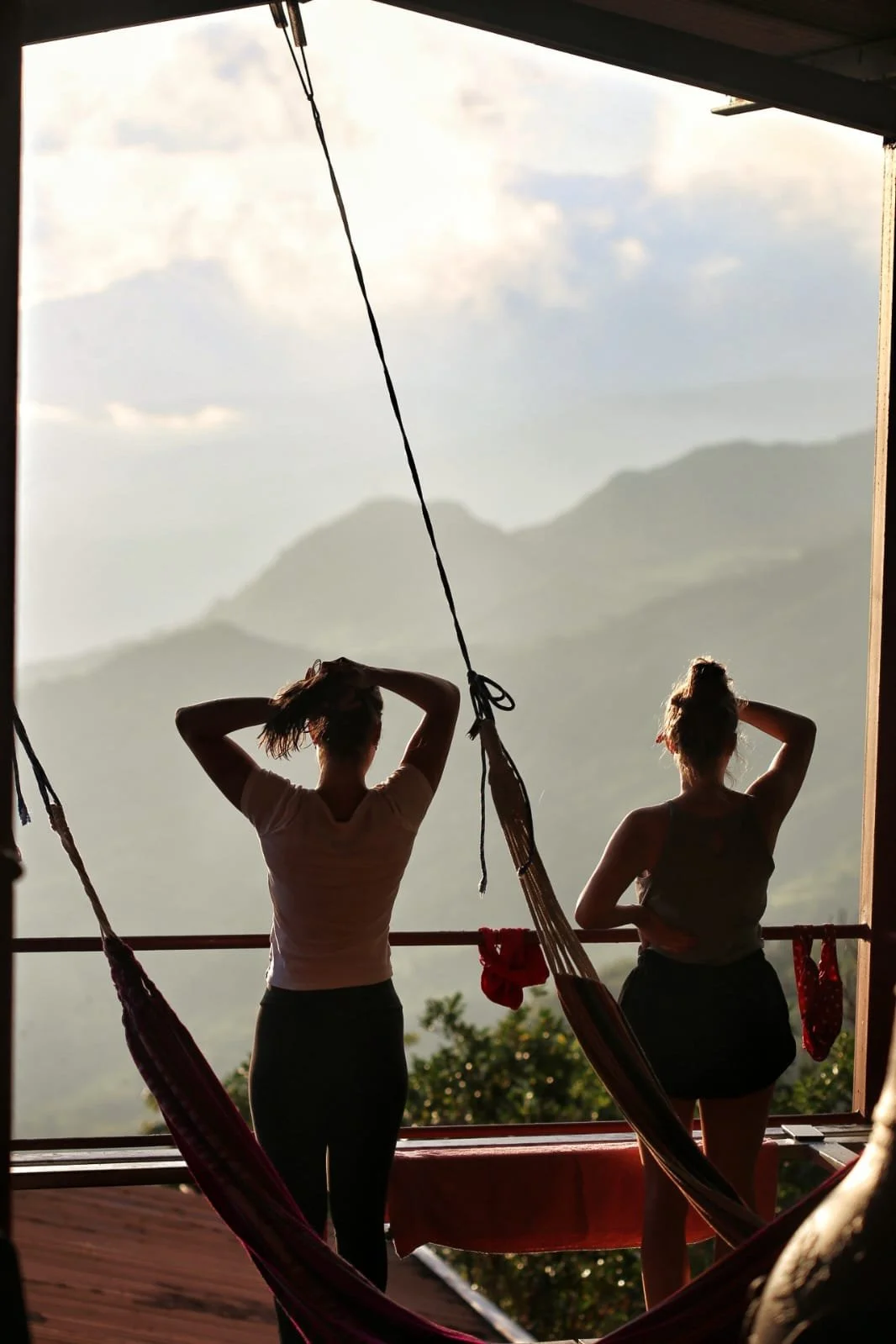
Because the hostel sits surrounded by lush cloud forest and dense tropical vegetation, blue morphos often drift through the open-air common areas, trails, and surrounding jungle paths. Guests drinking coffee or relaxing in hammocks sometimes suddenly see flashes of bright metallic blue passing silently through the trees nearby.
The atmosphere there almost feels designed for morpho butterflies, misty mountain forest, filtered sunlight, humid greenery, and quiet jungle trails.
For many backpackers staying there, the butterflies become part of the memory of the hostel itself.
What makes the blue morpho even more fascinating is its extraordinary lifecycle.
Like all butterflies, the morpho undergoes complete metamorphosis, one of the most astonishing biological transformations in the natural world.
The cycle begins with eggs.
Female blue morphos lay tiny pale eggs on host plants that caterpillars will later feed upon. After hatching, the butterfly enters its larval stage as a caterpillar.
And this stage looks nothing like the graceful adult butterfly people recognize.
Blue morpho caterpillars are thick-bodied, reddish-brown creatures covered with strange hairs and defensive structures. They look more like tiny fantasy creatures than future butterflies.
During this stage, the caterpillar’s primary goal is simple, eat constantly.
For days or weeks, it feeds aggressively on leaves, storing energy for the transformation ahead. Like many caterpillars, it sheds its skin multiple times as it grows larger.
This stage is also extremely dangerous.
Birds, lizards, spiders, ants, and parasitic insects constantly hunt caterpillars in tropical forests. Very few survive all the way into adulthood.
After reaching sufficient size, the caterpillar enters one of nature’s strangest phases, the chrysalis.
The caterpillar attaches itself to a branch or leaf and forms a protective casing around its body. Inside this chrysalis, something almost unbelievable happens.
The caterpillar’s body begins dissolving.
Specialized cells survive and reorganize into an entirely new structure. Wings form. Antennae develop. Legs transform. Organs restructure.
The animal effectively rebuilds itself into a completely different organism.
Scientists still consider metamorphosis one of the most extraordinary biological processes in nature.
Eventually the adult butterfly emerges slowly from the chrysalis with soft folded wings. At first it cannot fly. The butterfly pumps fluid through veins in its wings, expanding and hardening them gradually before taking flight for the first time.
And suddenly the strange crawling caterpillar becomes one of the most visually stunning insects on Earth.
Adult blue morphos actually spend much of their lives avoiding attention despite their dramatic coloration.
When the wings close, the underside appears brown with circular eye-like patterns that help camouflage the butterfly against bark and leaves. Predators suddenly lose sight of the brilliant blue flash.
This constant alternation between dazzling visibility and camouflage is one reason the butterfly feels so mesmerizing in motion.
The blue morpho also plays an important role in tropical ecosystems.
Butterflies help pollinate plants while also serving as food for birds, reptiles, spiders, monkeys, and other forest animals. Their presence often indicates relatively healthy forest environments with strong biodiversity.
And because morphos depend on tropical forests, they also remind people how ecologically valuable these environments truly are.
One of the fascinating emotional effects of blue morphos is how they change the way travelers experience the jungle itself.
Many first-time visitors to tropical forests initially focus on large animals, monkeys, sloths, toucans, snakes, or colorful frogs. But over time, people begin noticing smaller details:
butterflies drifting through sunlight
leafcutter ants crossing trails
tiny orchids growing on branches
hummingbirds flashing between flowers
insects camouflaged against bark
The forest becomes more intricate and alive.
Blue morphos often become the gateway into that deeper awareness.
And unlike many tropical animals that remain hidden, morphos sometimes appear suddenly and openly in human spaces, floating through gardens, hostel courtyards, forest cafés, or jungle lodges with astonishing elegance.
There is something emotionally powerful about seeing them unexpectedly.
They move slowly enough to feel dreamlike.
Almost unreal.
Like living fragments of blue light moving through the forest.
Many travelers in Panama later remember surprisingly small moments involving morpho butterflies:
seeing one cross a jungle trail at sunset
watching several drift through misty forest after rain
spotting flashes of blue from a hammock
seeing one land briefly near a hostel path
noticing them floating silently through the gardens around Lost and Found Hostel
And perhaps that is part of why the blue morpho became so iconic throughout tropical America.
It is not merely beautiful.
It represents the feeling of the tropical forest itself, mysterious, vivid, fragile, ancient, unpredictable, and astonishingly alive.