
At first glance, Panama does not look like a country that should contain major climate variation. It is narrow, relatively small, and located entirely within the tropics. Many people imagine Panama as uniformly hot, humid, and jungle covered from one end to the other.
Then they actually travel through it.
And suddenly the country starts feeling strangely inconsistent.
One day you are sweating through oppressive tropical humidity in Panama City while thunderstorms explode over the Pacific coast. A few days later you are sleeping under blankets in the cool mountain air of Boquete. Then you move toward the Caribbean side and find yourself inside a completely different weather system where rain seems to arrive almost daily even during Panama’s so called dry season.
For such a physically small country, Panama possesses an astonishing amount of climate diversity.
The reason lies in a combination of geography, mountains, ocean currents, trade winds, elevation, and the country’s unusual position connecting two continents and two oceans simultaneously.
Panama is essentially a climatic collision zone.
The first major factor is elevation.
Most people underestimate how mountainous Panama actually is. While the country contains lowland tropical areas and coastlines, a spine of mountains and highlands runs through much of western and central Panama. Elevation changes climate dramatically and quickly.
Temperature generally decreases as altitude increases. In Panama’s mountains, this effect becomes very noticeable. Coastal lowlands may feel brutally hot and humid while mountain towns only a few hours away experience cool mornings, mist, and temperatures that surprise visitors expecting nonstop tropical heat.
For example, areas around Volcán Barú can become genuinely cold at night, especially at higher elevations. Barú itself rises over 3,400 meters above sea level, high enough to create conditions completely different from Panama’s coastal regions.
Meanwhile, lower Caribbean zones remain intensely humid and warm nearly year round.
This rapid elevation change compresses multiple climate zones into short geographic distances.
The mountains do more than lower temperatures.
They also shape rainfall patterns dramatically.
Panama sits directly in the path of moisture laden trade winds moving westward across the Caribbean Sea. When these warm humid air masses collide with Panama’s mountains, the air is forced upward. As air rises, it cools and condenses into clouds and rain.
This process is called orographic rainfall, and it helps explain why some parts of Panama are incredibly wet.
The Caribbean side of Panama generally receives far more rainfall than many Pacific regions because Caribbean moisture gets trapped against the mountains. Areas in Bocas del Toro Province, for example, can feel almost permanently damp. Rain showers occur frequently even during periods considered relatively dry elsewhere in the country.
This constant moisture supports dense rainforest, cloud forests, massive biodiversity, and lush vegetation that seems to grow explosively.
By contrast, parts of Panama’s Pacific side fall into rain shadows created by the mountains. After moisture falls on Caribbean slopes, drier air sometimes descends onto Pacific regions. This contributes to noticeably drier climates in certain Pacific areas, especially in regions like the Azuero Peninsula.
The difference becomes visually obvious.
Some Caribbean forests appear intensely green, thick, and dripping with moisture year round while parts of the Pacific side contain dry forests, open grasslands, and landscapes that can look surprisingly brown during dry season.
Then there are the oceans themselves.
Panama is one of the few countries where the Pacific Ocean and Caribbean Sea sit extremely close together geographically, yet these bodies of water behave differently climatically.
The Pacific side experiences more defined wet and dry seasons. During dry season, particularly from roughly December through April, Pacific regions can become sunny, dusty, and extremely hot.
The Caribbean side behaves less predictably.
Because of constant trade wind moisture from the Caribbean Sea, rainfall there remains more evenly distributed throughout the year. Even during Panama’s “dry season,” Caribbean regions may still experience regular rain.
This often surprises travelers visiting both coasts.
People leave sunny Pacific beaches expecting similar weather in the Caribbean islands and suddenly encounter gray skies, heavy humidity, and tropical rainstorms.
Ocean currents and atmospheric circulation patterns also influence Panama heavily because the country sits near the equator where tropical weather systems dominate. Warm ocean temperatures fuel intense humidity and powerful rainstorms. The tropical sun remains strong year round because seasonal daylight variation near the equator is relatively small.
That means Panama does not experience traditional four season patterns like temperate countries.
Instead, rainfall and elevation matter far more than temperature seasons.
Humidity itself also varies enormously between regions.
In low elevation tropical zones, especially near the Caribbean coast or dense rainforest, the air can feel overwhelmingly heavy. Sweat forms instantly. Clothing remains damp. Mold grows aggressively. Electronics sometimes struggle in the moisture.
Yet mountain regions like Boquete or Volcán can feel almost refreshing by comparison, with cooler nights, breezes, and lower humidity.
Cloud forests represent another extraordinary climatic phenomenon in Panama.
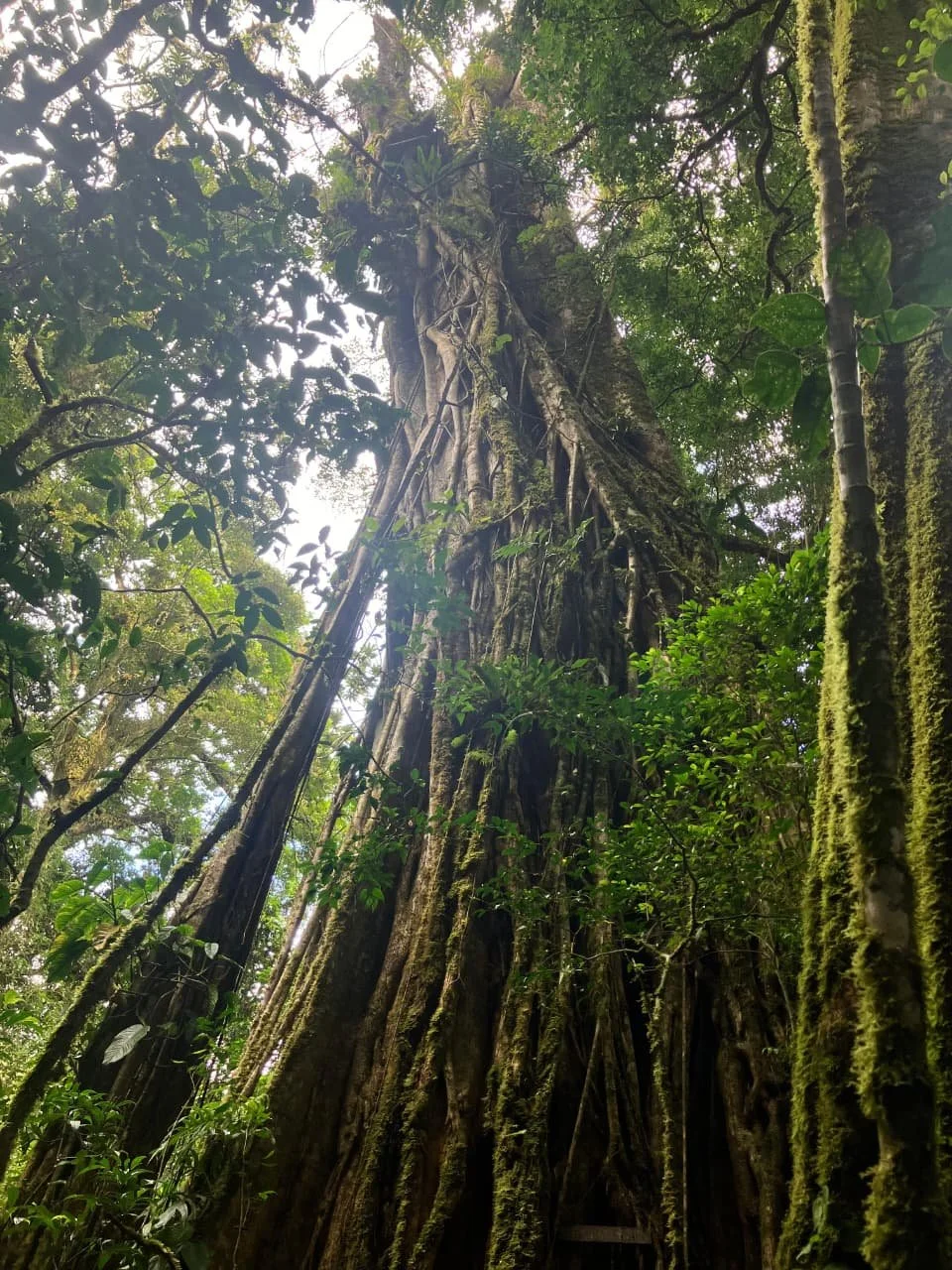
At certain elevations, forests become immersed in clouds and mist for large portions of the year. These ecosystems capture moisture directly from clouds themselves. Moss, orchids, bromeliads, and ferns thrive in these constantly damp conditions.
The forests around places like Lost and Found Hostel often feel otherworldly because clouds drift directly through the trees while temperatures remain dramatically cooler than the lowlands below.
These cloud forests support species that could never survive in Panama’s hotter coastal environments.
That biodiversity variation is another consequence of climate diversity.
Panama contains tropical dry forests, mangroves, cloud forests, lowland rainforest, mountain ecosystems, coral reef environments, and wetlands all within a relatively small territory. Different climates created different habitats, which helped make Panama one of the most biologically diverse countries in the world.
And then there is the rain itself.
Panama’s rainfall patterns are not subtle.
Tropical downpours can become astonishingly intense. During rainy season, storms may build rapidly in the afternoon before unleashing enormous amounts of water in short periods. Streets flood. Rivers rise quickly. Thunder shakes buildings. Then suddenly the storm passes and sunlight returns.
Travelers often underestimate how dramatically weather can shift within a single day.
One reason Panama’s climate diversity feels so surprising is because many countries with similar climate variation are geographically huge. In Panama, however, you can sometimes move between completely different weather systems within only a few hours of driving.
You can leave humid Pacific heat in the morning, climb into cool mountain mist by afternoon, and reach rainy Caribbean coastline conditions shortly afterward.
The country compresses enormous environmental diversity into a narrow strip of land.
And perhaps that geographic compression explains Panama itself overall.
It is a country where oceans, continents, climates, ecosystems, and cultures all collide within surprisingly small distances.
That collision is exactly what makes the country feel so much larger and more varied than maps initially suggest.