
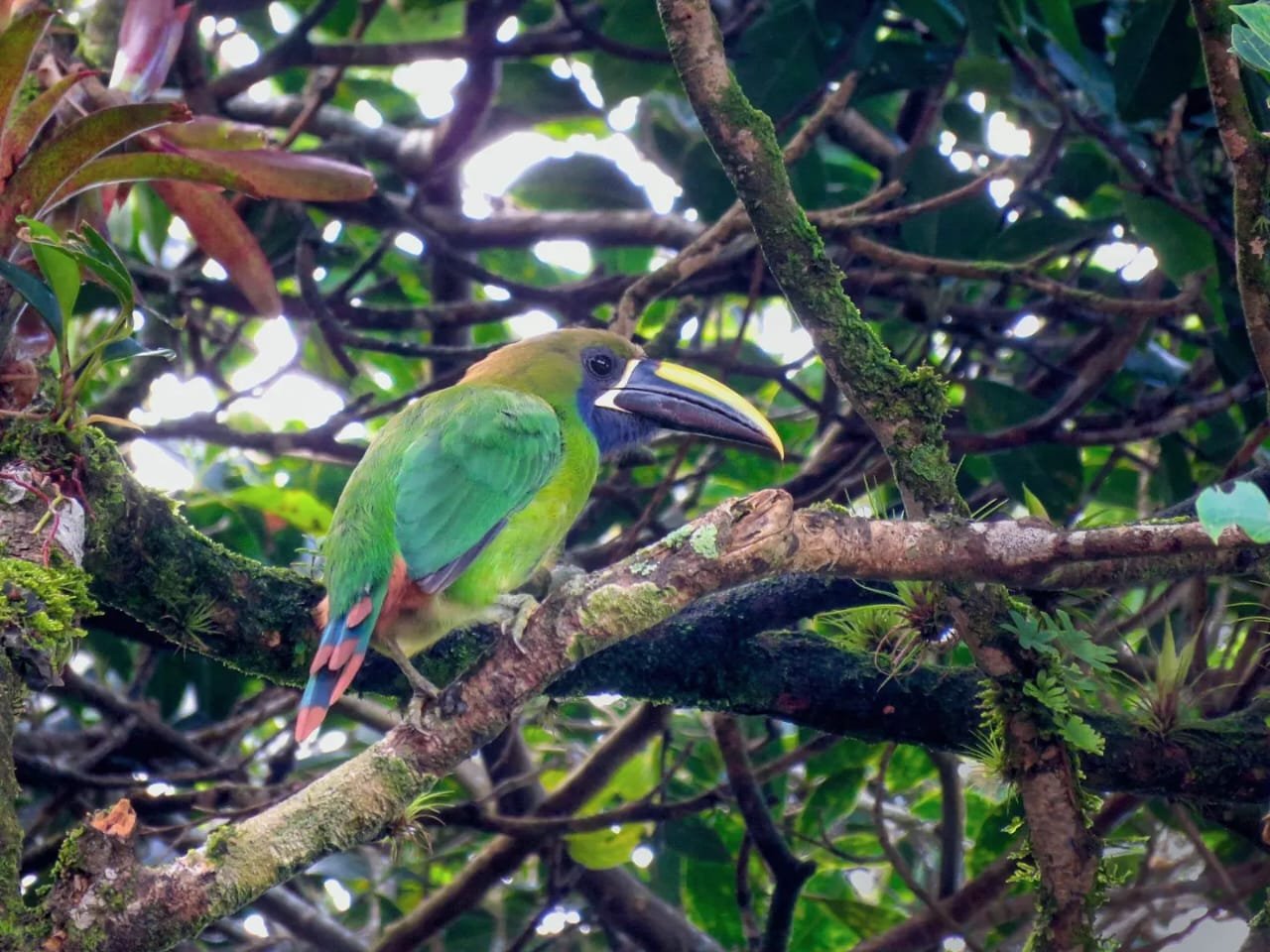
Few birds in the tropics are as instantly recognizable as the toucan. With its enormous rainbow colored bill, jet black body, and almost unreal proportions, it looks like something designed for a painting rather than something that evolved in a rainforest. Yet in Panama, toucans are not rare or mythical creatures. They are a real and often surprisingly common part of the forest canopy, especially if you know where and when to look.
Panama is one of the best countries in Central America for toucan sightings because of its unique geography. Sitting between North and South America, it acts as a biological bridge where species from both continents overlap. This creates an extraordinary level of biodiversity, and toucans are among the most visible symbols of that richness.
To understand where to see them in the wild, it helps to understand how they live, how they move through the forest, and why Panama’s ecosystems are so perfect for them.
What Makes Toucans So Unique
Toucans belong to a bird family known for oversized, colorful bills that appear almost exaggerated in shape. In Panama, the most commonly encountered species include the Keel billed toucan and the Collared aracari, both of which are strikingly colorful and highly social birds.
Despite its size, the toucan’s bill is surprisingly light. It is built from a thin keratin shell supported by a hollow internal structure, which reduces weight while still allowing strength and precision. This adaptation helps toucans reach fruit on delicate branches that might not support heavier animals.
Toucans are primarily fruit eaters, but they are opportunistic feeders. Their diet can also include insects, eggs, and small vertebrates when available. This flexibility allows them to survive in a wide range of forest conditions across Panama.
Ecologically, they are extremely important because they act as seed dispersers. As they eat fruit and move through the canopy, they spread seeds across large distances, helping regenerate forests and maintain biodiversity. In many ways, toucans are essential gardeners of the rainforest.
The Sound of a Toucan Before You See It
One of the most reliable ways to detect toucans is by sound.
Their calls are deep, hollow, and somewhat frog like or barking in tone. They do not sing like smaller birds. Instead, they communicate with loud croaks and calls that echo through the forest canopy.
In dense rainforest, sound often travels farther than sight. This means toucans are frequently heard before they are seen. A sudden series of croaking calls above the trees is often the first clue that a toucan is nearby.
Once you hear them, it becomes a game of patience. You scan the canopy, waiting for movement or color to reveal their position.
Best Places to See Toucans in Panama
Toucans are widely distributed throughout Panama, but some habitats offer much higher chances of sightings. The key is mature forest with fruiting trees and sufficient canopy cover.
Below are the most reliable regions for seeing them in the wild.
Soberanía National Park A Birdwatching Hotspot
One of the best places in the country to see toucans is Soberanía National Park.
Located just outside Panama City along the Panama Canal corridor, this protected rainforest is one of the most studied bird habitats in Central America. It contains a mix of primary and secondary tropical forest, making it ideal for a wide variety of bird species, including toucans.
Early morning is the most productive time. As the forest becomes active, toucans move through the canopy feeding on fruiting trees. They are often seen in pairs or small groups and can sometimes be observed sitting in exposed branches or flying between treetops.
Because of its accessibility and biodiversity, Soberanía is considered one of the most reliable places in Panama for toucan sightings.
Pipeline Road One of the World’s Famous Birding Routes
Inside Soberanía lies Pipeline Road, one of the most famous birdwatching routes in the world.
This long forest track passes through untouched rainforest and is known for its exceptional bird diversity. Toucans are frequently spotted here, especially during early morning hours when mixed flocks move through the canopy.
Visitors often see toucans flying across the road, feeding in fruiting trees, or resting in tall emergent branches above the forest trail.
For bird enthusiasts, this is one of the most productive toucan viewing areas in all of Panama.
Boquete and the Chiriquí Highlands
The highland region of western Panama is another excellent area for toucan sightings.
Around Boquete, cloud forest edges and forest patches provide ideal conditions for species like the Collared aracari.
Unlike deep lowland rainforest toucans that stay high in dense canopy, highland toucans are sometimes easier to observe at mid canopy level or even near forest edges.
Morning hours are particularly good because birds descend to feed before retreating into the canopy as the day warms.
The cooler climate and misty environment of the highlands also create dramatic viewing conditions, especially when toucans appear through drifting fog or low cloud cover.
Darién National Park The Wild Stronghold
For the most pristine toucan habitat in Panama, the Darién region is unmatched.
Darién National Park is one of the largest and most biologically rich rainforest areas in Central America. It is remote, largely untouched, and home to vast expanses of primary jungle.
Toucans are abundant here, but sightings can be more challenging due to the density of the forest. When they do appear, it is often in pristine canopy environments far from human disturbance.
This region represents the purest form of toucan habitat in Panama and offers some of the most authentic rainforest wildlife experiences in the country.
Canal Corridor Forests Surprisingly Reliable Sightings
One of the most interesting aspects of Panama is that toucans are not limited to remote wilderness areas.
Even in forest corridors near the Panama Canal, toucans are frequently observed moving between tall trees in protected green zones.
These areas combine secondary forest growth with preserved rainforest patches, creating suitable conditions for fruiting trees and canopy travel routes.
As a result, even short visits to canal region forests can produce toucan sightings without deep jungle travel.
Best Time of Day and Season
Timing is crucial for seeing toucans.
The best time of day is early morning or late afternoon when birds are actively feeding.
During midday heat, toucans usually rest high in the canopy and become much harder to observe.
Seasonally, fruit availability plays a major role. When trees are fruiting heavily, toucans gather in larger numbers and become easier to find.
After rainy periods, feeding activity often increases as forests produce more fruit.
How to Spot Toucans in the Wild
Even though toucans are large birds, they can be surprisingly difficult to see because they spend most of their time high in the canopy.
Helpful signs include:
Loud croaking calls echoing above the forest
Sudden movement in treetop fruiting trees
Bright flashes of yellow orange or green between branches
Silhouettes perched on exposed dead trees
Small groups of birds moving together through canopy
Patience is essential. Often the best sightings come after standing quietly in one place and observing the treetops for movement.
Why Toucans Are Ecologically Important
Toucans play a vital role in Panama’s ecosystems.
As fruit eaters and seed dispersers, they help regenerate forests by moving seeds across long distances. Many tree species depend on toucans to spread their seeds to new areas where they can grow.
Without toucans and other frugivorous birds, tropical forests would regenerate more slowly and lose some of their biodiversity over time.
They are not just colorful animals in the canopy. They are essential workers in the life cycle of the rainforest.
The Moment a Toucan Appears...
Seeing a toucan in the wild is one of the most memorable experiences in Panama’s natural world.
Whether it is a sudden flash of color above the canopy in Soberanía, a distant silhouette moving through misty branches in Boquete, or a brief glimpse deep in the wilderness of Darién, the moment always feels special.
For a few seconds, the forest seems to pause. The oversized bill cuts through green leaves. The bird calls out with its deep echoing sound. And then it disappears again into the canopy.
That brief encounter is what makes toucans so unforgettable.
In Panama, they are never far away. You just have to listen, look up, and wait for the forest to reveal them.