
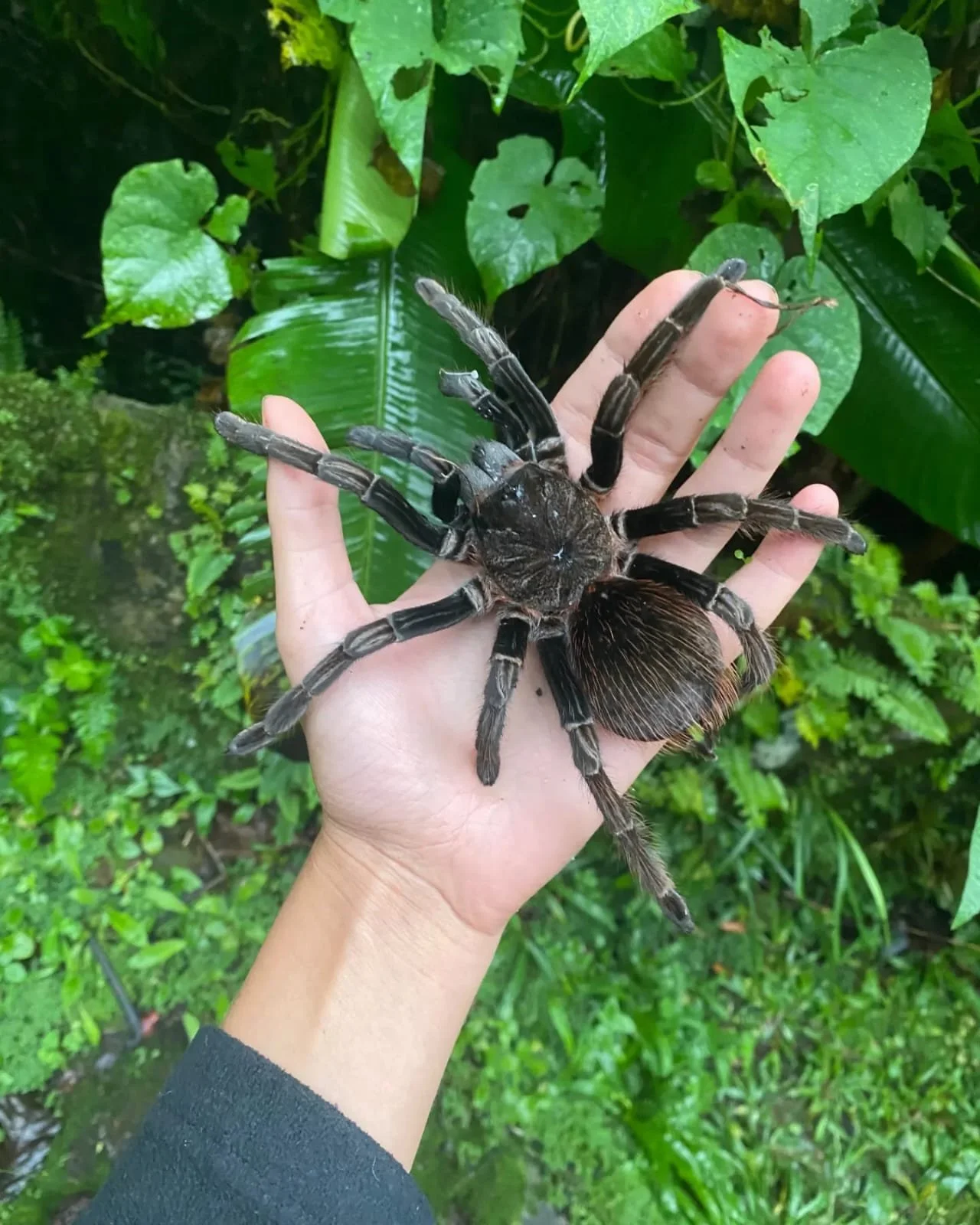
Panama sits in one of the most biologically intense corridors on Earth, a narrow land bridge where North and South American fauna meet, mix, and diversify. This geographic position has created an extraordinary concentration of biodiversity across nearly every group of organisms, and tarantulas are no exception. In fact, Panama is home to a surprisingly rich variety of tarantula species spanning multiple genera, each adapted to very specific ecological niches ranging from deep rainforest soils to tree canopies, from dry forest edges to mist soaked cloud forests in the highlands.
What makes tarantulas in Panama particularly fascinating is not just the number of species, but how hidden they are. Most people living in or traveling through Panama rarely see them directly, yet they are widespread and ecologically significant. They occupy a parallel nocturnal ecosystem that becomes active when the forest floor quiets down, playing a key role in insect control and nutrient cycling. Understanding them requires shifting perspective away from daylight observation and into the slow, humid, and almost silent world of the night jungle.
The ecological importance of tarantulas in Panama’s ecosystems
Tarantulas are apex invertebrate predators in many tropical environments, and in Panama they help regulate some of the densest insect populations in the world. Their diet is broad and opportunistic, consisting primarily of crickets, beetles, cockroaches, moths, grasshoppers, and occasionally small vertebrates such as frogs, lizards, or even tiny rodents in rare cases. This predatory role is essential in maintaining balance in rainforest ecosystems where insect reproduction rates are extremely high due to constant warmth and humidity.
In Panama’s lowland rainforests, tarantulas are part of the leaf litter community, operating at ground level where decomposition and predation cycles are most active. They reduce the population pressure of fast breeding insects and in doing so indirectly support plant regeneration, since fewer herbivorous insects are available to damage seedlings and understory vegetation. In cloud forests and high elevation environments, where decomposition is slower and temperatures cooler, tarantulas adapt their hunting strategies to match lower prey density and different insect species adapted to cooler climates.
Their ecological presence is often underestimated because they are cryptic and nocturnal. A single hectare of intact rainforest in Panama can host multiple tarantula species, but they may be almost completely invisible during daylight hours.
The main ecological groups of tarantulas in Panama
Tarantulas in Panama are not a single uniform group but rather a collection of evolutionary strategies that can be broadly divided into three major ecological categories. These are ground dwelling burrowers, arboreal tree dwelling species, and transitional edge habitat species that are able to adapt to disturbed or human influenced environments. Each group shows distinct differences in body structure, behavior, hunting strategy, and defensive adaptation.
Ground dwelling tarantulas the burrow specialists of the forest floor
The most commonly encountered ecological group in Panama consists of ground dwelling tarantulas, primarily from genera such as Sericopelma and Aphonopelma. These spiders are heavily adapted to a fossorial lifestyle, meaning they live in self constructed burrows in soil rather than on vegetation or in open environments. Their burrows are lined with silk, which serves multiple functions including structural reinforcement, moisture retention, and vibration detection.
A typical burrow consists of a vertical or slightly angled tunnel that can extend deep into the soil depending on moisture levels and substrate type. The entrance is often concealed with a thin layer of silk, soil particles, and leaf litter, making it nearly invisible even when one is directly walking over it. These tarantulas rarely leave their burrows except to hunt or mate, and even then their movements are usually limited to short distances around the entrance.
One of the most recognizable species complexes in this group includes zebra patterned tarantulas, often associated with Aphonopelma seemanni in nearby regions and closely related populations in Panama. These tarantulas are characterized by striking pale bands on their legs that contrast with darker body coloration. Despite their visual appeal, they are extremely reclusive and spend the vast majority of their lives underground.
Behaviorally, ground dwelling tarantulas rely heavily on ambush predation. They detect prey through vibrations transmitted through soil and silk threads. When an insect passes near the burrow entrance, the tarantula rapidly emerges, captures the prey, and retreats back into the tunnel to consume it safely. This strategy minimizes exposure to predators such as birds, coatis, and larger arthropods.
During heavy rains, especially in lowland rainforest zones, these tarantulas may temporarily relocate or adjust burrow structure to avoid flooding, which can occasionally lead to increased surface sightings during wet seasons.
Arboreal tarantulas the tree dwelling hunters of vertical forests
Arboreal tarantulas represent a completely different evolutionary strategy compared to their ground dwelling relatives. Instead of burrowing into soil, these species live in trees, hollow trunks, bromeliads, and natural cavities in the forest canopy and mid level vegetation. In Panama, important arboreal genera include Psalmopoeus and Avicularia, both of which show adaptations for climbing, rapid movement, and life in vertically structured environments.
Psalmopoeus species are particularly notable for their speed and agility. Unlike many ground dwelling tarantulas that rely on retreat and concealment, these arboreal hunters are capable of rapid bursts of movement across bark and branches. They construct silk lined retreats inside tree hollows or under bark layers, which serve as both shelter and sensory networks. The silk is highly sensitive to vibration, allowing the spider to detect prey or threats approaching from outside the retreat.
Avicularia species, often referred to as pinktoe tarantulas due to coloration at the tips of their legs, are more commonly associated with humid rainforest environments. They tend to occupy higher moisture zones within the forest where moss, epiphytes, and dense foliage provide stable microclimates. These tarantulas are often seen at night resting on exposed branches or hunting across leaf surfaces, making them one of the more visually encountered groups in ecotourism regions.
Unlike ground dwelling species, arboreal tarantulas rely less on soil vibration and more on visual and tactile cues in their environment. Their hunting strategy involves quick strikes followed by immediate retreat to a secure silk shelter.
Tarantulas of Panama’s cloud forests and high elevation zones
In Panama’s mountainous regions such as Chiriquí, Boquete, Santa Fé, and surrounding high elevation forests, tarantulas exist in cooler, wetter, and more stable climatic conditions compared to lowland rainforests. These cloud forests are characterized by constant mist, dense moss coverage, and thick layers of organic material that retain moisture for long periods.
Species found in these environments are often ground dwelling and belong to genera such as Sericopelma. These tarantulas are robust, slow moving, and highly adapted to stable humidity conditions. Their burrows are often deeper and more insulated due to cooler surface temperatures and reduced soil evaporation. Unlike lowland species that may experience seasonal flooding or heat stress, cloud forest tarantulas experience relatively consistent environmental conditions year round.
Prey availability in these environments differs as well. Insects tend to be slower moving and less diverse than in lowland rainforests, which influences hunting strategies. Tarantulas here are extremely patient ambush predators, often remaining motionless for long periods near burrow entrances.
Because cloud forests are less densely populated by humans and often protected as conservation areas, these tarantulas are among the least disturbed populations in Panama, although also among the least frequently observed.
Lowland rainforest tarantulas the highest diversity and densest populations
The richest and most diverse tarantula communities in Panama are found in lowland rainforest regions, particularly in areas such as Darién, Soberanía National Park, and parts of Bocas del Toro province. These environments provide constant warmth, extremely high humidity, and dense structural complexity in vegetation layers, all of which create ideal conditions for tarantula diversification.
In these ecosystems, tarantulas occupy nearly every available ecological niche. Some remain strictly ground dwelling, others exploit fallen logs and root systems, while arboreal species dominate tree based microhabitats. This vertical stratification of habitat allows multiple tarantula species to coexist in relatively small geographic areas without direct competition.
Diversity is particularly high in transitional zones where forest edges meet disturbed land such as plantations or trails. These edge environments often support species that are more tolerant of human presence and environmental change. However, deeper interior forest areas tend to host more specialized and less frequently observed species.
Despite their abundance, most tarantulas in these regions remain unseen due to their nocturnal behavior and reliance on camouflage and concealment.
Behavior, defense mechanisms, and survival strategies
Tarantulas in Panama exhibit a wide range of behavioral adaptations designed to minimize risk and maximize survival in predator rich environments. The majority of species are not aggressive in the conventional sense but are instead defensive and avoidance oriented. Their primary strategy is to avoid confrontation whenever possible.
Ground dwelling species rely heavily on burrow defense. When threatened, they retreat into their tunnels and may block entrances with silk or debris. Many species also possess urticating hairs, which are tiny barbed structures that can be released into the air when the spider feels threatened. These hairs irritate the skin and mucous membranes of potential predators, creating a deterrent without requiring direct confrontation.
Arboreal species rely more on speed and escape. Their ability to move rapidly across vertical surfaces allows them to evade predators quickly by retreating into tree hollows or dense foliage. They also rely heavily on silk retreats, which function as both shelters and sensory systems.
Molting is one of the most vulnerable stages in a tarantula’s life cycle. During molting, the spider sheds its exoskeleton and remains soft and immobile for a period of time while its new exoskeleton hardens. During this phase, it is highly vulnerable to predation, which is why secure shelters are essential for survival.
Human encounters and perceptions in Panama
In regions with active ecotourism such as Bocas del Toro, Boquete, and parts of the Caribbean lowlands, human encounters with tarantulas are relatively common, especially at night. These encounters typically occur when tarantulas cross trails or are observed near lodge structures or jungle paths.
Despite their intimidating appearance, tarantulas in Panama are generally harmless to humans when left undisturbed. Their venom is adapted for small prey and is not considered medically dangerous to people. Most interactions are defensive responses rather than attempts at aggression.
Local perceptions vary widely. In rural areas, tarantulas are often considered part of the normal ecosystem and are neither feared nor targeted. In ecotourism regions, they are frequently appreciated as fascinating wildlife encounters that enhance the sense of jungle immersion.
Their presence is often an indicator of a healthy ecosystem, since tarantulas require stable prey populations and relatively intact habitat structure to thrive.
Final perspective the hidden architects of nocturnal Panama
Tarantulas in Panama represent one of the most successful and ecologically important groups of nocturnal predators in the country. They are distributed across nearly every major habitat type, from deep rainforest soils to canopy tree hollows, from cloud forest slopes to disturbed agricultural edges. Their diversity reflects the broader ecological richness of Panama itself, where continental collision and climatic variation have produced one of the most complex biological landscapes in the world.
What makes them especially fascinating is not just their diversity, but their invisibility. Most people moving through Panamanian landscapes will rarely notice them, yet they are constantly present, shaping insect populations and contributing to ecological balance in subtle but essential ways. They are silent, patient, and deeply embedded in the structure of the forest, functioning as both predators and indicators of environmental health.