
Walk into almost any rainforest in Panama and it will not be long before you hear something moving high above your head. Leaves begin to rustle. Branches sway back and forth. A shower of tiny twigs falls onto the forest floor. Suddenly a long tail appears dangling from the canopy, followed by a curious face peering down through the leaves. You have just entered the world of Panama's monkeys.
For many visitors, seeing monkeys in the wild becomes one of the highlights of their journey through Panama. Whether exploring the jungles of Bocas del Toro, hiking through the Fortuna Forest Reserve, visiting Coiba National Park, wandering Pipeline Road near Panama City, or trekking through Darién, the country's forests are alive with primates. Yet many travelers are surprised to learn that Panama is home to several very different monkey species, each with its own personality, behavior, diet, and way of surviving in the rainforest.
Among them, three stand out above the rest. The Spider Monkey, the White Faced Capuchin, and the Mantled Howler Monkey are Panama's largest and most familiar primates. Although they often live in the same forests, they lead remarkably different lives. Learning to tell them apart adds a whole new level of excitement to every jungle hike.
The first thing to understand is that these monkeys occupy different roles within the rainforest. They are not simply different versions of the same animal. Each species has evolved its own unique lifestyle over millions of years. One is an incredible acrobat capable of swinging effortlessly through the highest branches. Another is one of the most intelligent animals in the Americas, famous for using tools and solving problems. The third possesses a voice so powerful that it can be heard several kilometers away, making it one of the loudest land animals on Earth.
The Spider Monkey: The Acrobat of the Rainforest
If the jungle held its own Olympic Games, the Spider Monkey would dominate every gymnastics event.
Spider Monkeys are among the most athletic mammals in Central America. Their long arms, slender bodies, and incredibly powerful prehensile tails allow them to move through the forest canopy with breathtaking speed and precision. Watching one travel through the trees is like watching a circus performer who has spent a lifetime perfecting impossible tricks. They rarely descend to the ground, preferring instead to remain high above the forest floor where they can move safely between towering trees.
Their tail is perhaps their most remarkable feature. Unlike most animals, a Spider Monkey's tail functions almost like a fifth arm. The underside of the tail has a hairless gripping pad that allows the monkey to hang its entire body weight from a single branch. They can even suspend themselves upside down while reaching for fruit that would otherwise be impossible to access.
Their movements are fast, graceful, and almost weightless. They leap across enormous gaps between trees with astonishing confidence, often covering distances that would seem impossible. To anyone watching from below, they appear to fly.
Spider Monkeys primarily eat ripe fruit, making them incredibly important seed dispersers. As they travel through the forest consuming fruit from hundreds of different tree species, they help spread seeds throughout the jungle, ensuring the next generation of rainforest giants can grow. Without animals like Spider Monkeys, many tropical trees would struggle to reproduce.
Unlike some monkey species that are constantly vocal, Spider Monkeys are often surprisingly quiet. They communicate using soft sounds, facial expressions, and body language while moving through family groups that can contain dozens of individuals. They are highly social animals with complex relationships and surprisingly strong family bonds.
Because they require large, healthy forests with abundant fruit, Spider Monkeys are often considered indicators of a healthy rainforest. Unfortunately, this also makes them especially vulnerable to habitat destruction. Large untouched forests such as Darién National Park remain some of the best places to see them in Panama.
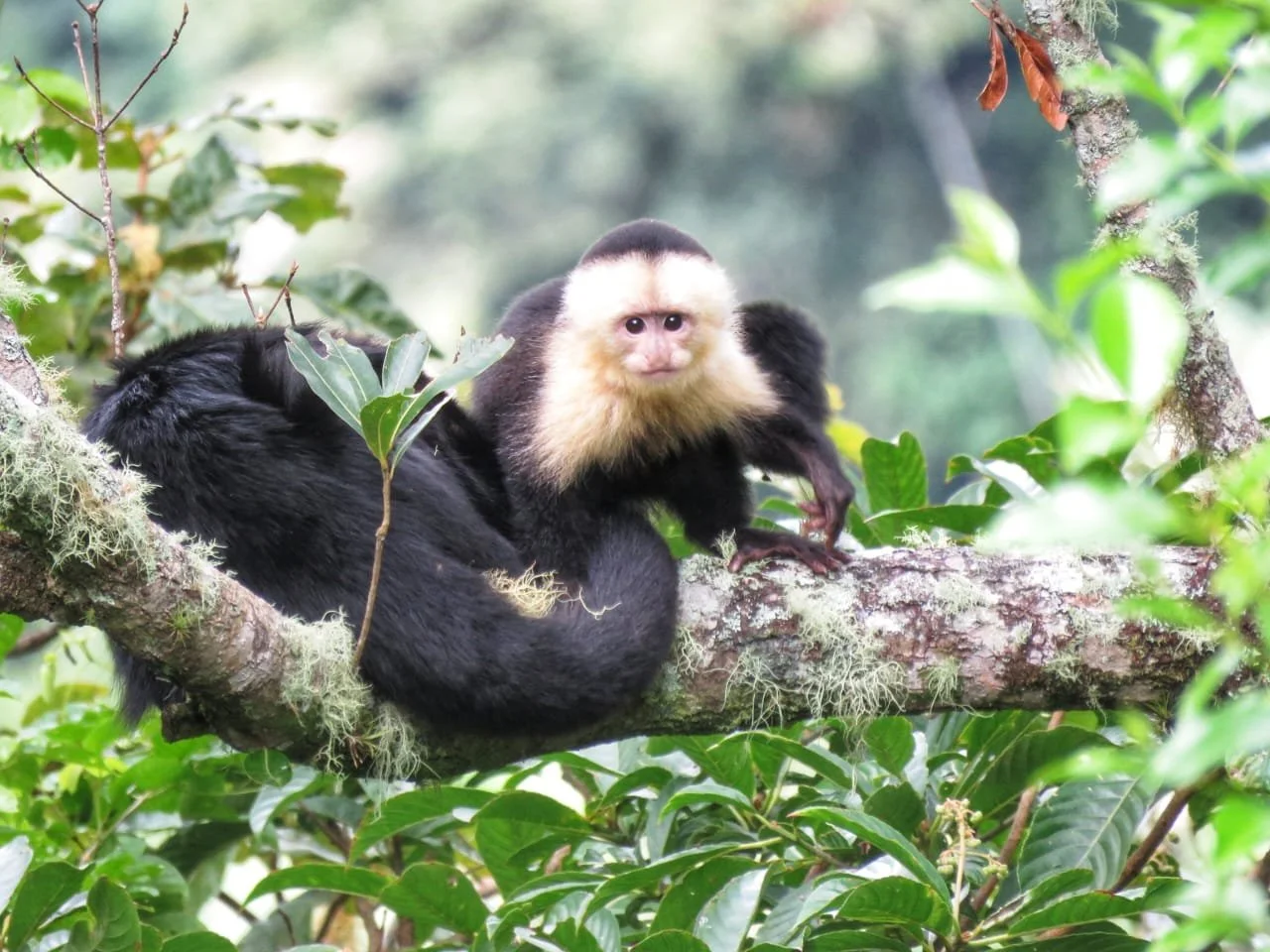
The White Faced Capuchin: The Genius of the Jungle
If Spider Monkeys are the athletes of the rainforest, White Faced Capuchins are undoubtedly its masterminds.
Capuchins possess remarkable intelligence that rivals some of the smartest primates in the world outside the great apes. Scientists have documented them using sticks to probe holes, rocks to crack open food, leaves as makeshift tools, and even rubbing certain plants onto their fur, possibly to repel insects.
Watching a troop of Capuchins is pure entertainment.
They are endlessly curious.
Everything deserves investigation.
A strange sound.
A colorful butterfly.
A backpack left unattended.
A tourist holding food.
Nothing escapes their attention.
Unlike the graceful Spider Monkey, Capuchins often move with frantic bursts of energy, constantly climbing, jumping, chasing one another, and searching every branch for something interesting to eat.
Their diet is incredibly varied. Fruits, insects, bird eggs, small frogs, crabs, shellfish, flowers, seeds, and even tiny reptiles all find their way onto the menu. This flexibility allows Capuchins to thrive in many different habitats across Panama.
Their expressive white faces make them instantly recognizable. Bright intelligent eyes constantly scan their surroundings while their nimble hands manipulate objects with remarkable dexterity. They are among the few New World monkeys capable of handling objects with almost human like precision.
Capuchins are also famous for their curiosity toward people. In national parks they may cautiously observe hikers from nearby branches, occasionally approaching surprisingly close before quickly retreating again. While these encounters are exciting, visitors should never feed them. Human food alters their natural behavior and can create long term problems for both monkeys and people.
The Mantled Howler Monkey: The Voice of the Forest
Long before you ever see a Howler Monkey, you will almost certainly hear one.
Their call is unforgettable.
Deep.
Powerful.
Almost prehistoric.
It begins as a low rumble before building into a roar that rolls across the forest like distant thunder. First time visitors often mistake the sound for a large predator or even machinery operating somewhere beyond the trees. In reality, the noise comes from a monkey weighing little more than eight kilograms.
Howler Monkeys possess an enlarged hyoid bone in their throat that acts as a natural amplifier, allowing their calls to travel up to five kilometers under the right conditions. This extraordinary adaptation helps neighboring groups avoid unnecessary confrontations by announcing ownership of their territory without physical fighting.
Fortunately for the monkeys, roaring requires much less energy than constant combat.
Howler Monkeys lead much slower lives than either Spider Monkeys or Capuchins.
While Capuchins seem permanently busy and Spider Monkeys constantly travel through the canopy, Howlers often spend long periods resting.
Their diet explains why.
Unlike fruit eating Spider Monkeys, Howlers consume large quantities of leaves. Leaves provide relatively little energy and require long digestion times. To conserve energy, Howler Monkeys spend many hours quietly sitting in the trees between feeding sessions.
This relaxed lifestyle often makes them the easiest monkeys for visitors to observe. Once you locate the source of their calls, you may find an entire family calmly relaxing in the branches above.
Their thick black fur and sturdy build give them a completely different appearance from the slender Spider Monkey or the compact Capuchin. They seem powerful rather than agile, moving deliberately through the trees instead of racing across them.
Comparing Panama's Three Great Monkeys
Seeing all three species during a single trip offers an incredible lesson in evolution.
Spider Monkeys are the aerial specialists. Everything about their bodies is designed for life high in the canopy. Long limbs, flexible shoulders, and powerful tails allow them to travel where few other mammals can follow.
Capuchins represent adaptability and intelligence. Their problem solving abilities, varied diet, and curiosity allow them to thrive in an astonishing variety of environments.
Howler Monkeys have perfected efficiency. Their leaf based diet and energy conserving lifestyle may seem less exciting at first glance, but their booming calls make them one of the rainforest's defining sounds.
Each has mastered a different strategy for surviving in the same forest.
Where Can You See Them?
Panama offers excellent opportunities to observe all three species.
The forests surrounding Bocas del Toro, especially on the mainland, support healthy populations of Capuchins and Howlers.
The Fortuna Forest Reserve protects important habitat where Howlers and White Faced Capuchins are regularly encountered, while lucky visitors may occasionally glimpse the more elusive Spider Monkey in suitable habitat.
Coiba National Park is famous for its unique population of Coiba Howler Monkeys and Coiba Capuchins, isolated on the island for thousands of years.
Pipeline Road and Soberanía National Park near Panama City provide some of the easiest wildlife viewing in the country.
For those seeking Spider Monkeys, the vast wilderness of Darién National Park remains one of the finest destinations.
More Than Just Entertaining Animals
Monkeys are not simply fun animals for tourists to photograph. They are among the rainforest's most important gardeners.
Every day they disperse thousands of seeds throughout the forest, helping regenerate trees and maintain the astonishing biodiversity that makes Panama famous. Some tree species depend almost entirely on monkeys to carry their seeds far enough away from the parent tree to survive.
Without monkeys, the rainforest itself would begin to change.
Their health reflects the health of the forest.
Where monkeys flourish, the ecosystem is usually thriving.
Watching Them Responsibly
The greatest monkey encounters happen when people simply observe quietly.
Speak softly.
Avoid sudden movements.
Never feed wild monkeys.
Resist the temptation to imitate their calls or throw food to attract them closer.
Instead, allow them to continue behaving naturally.
Often curiosity gets the better of them, and they will approach on their own terms.
Those moments are far more rewarding than any interaction created by feeding wildlife.
Three Monkeys, Three Personalities, One Extraordinary Rainforest
Spider Monkeys, White Faced Capuchins, and Mantled Howler Monkeys could hardly be more different. One swings through the treetops with breathtaking athleticism, another constantly invents clever ways to solve problems, while the third fills the rainforest with a roar powerful enough to echo across entire valleys. Yet together they represent the incredible diversity of Panama's forests.
For travelers, spotting one monkey is exciting. Seeing all three transforms an ordinary jungle walk into an unforgettable wildlife experience. Every rustling branch becomes a possibility, every distant roar an invitation to look deeper into the canopy, and every glimpse of a long tail disappearing through the leaves a reminder that Panama's rainforests remain among the richest and most vibrant ecosystems on Earth. Here, high above the forest floor, three extraordinary primates continue to live lives as different as they are fascinating, each playing a vital role in keeping one of the world's most beautiful jungles alive.