
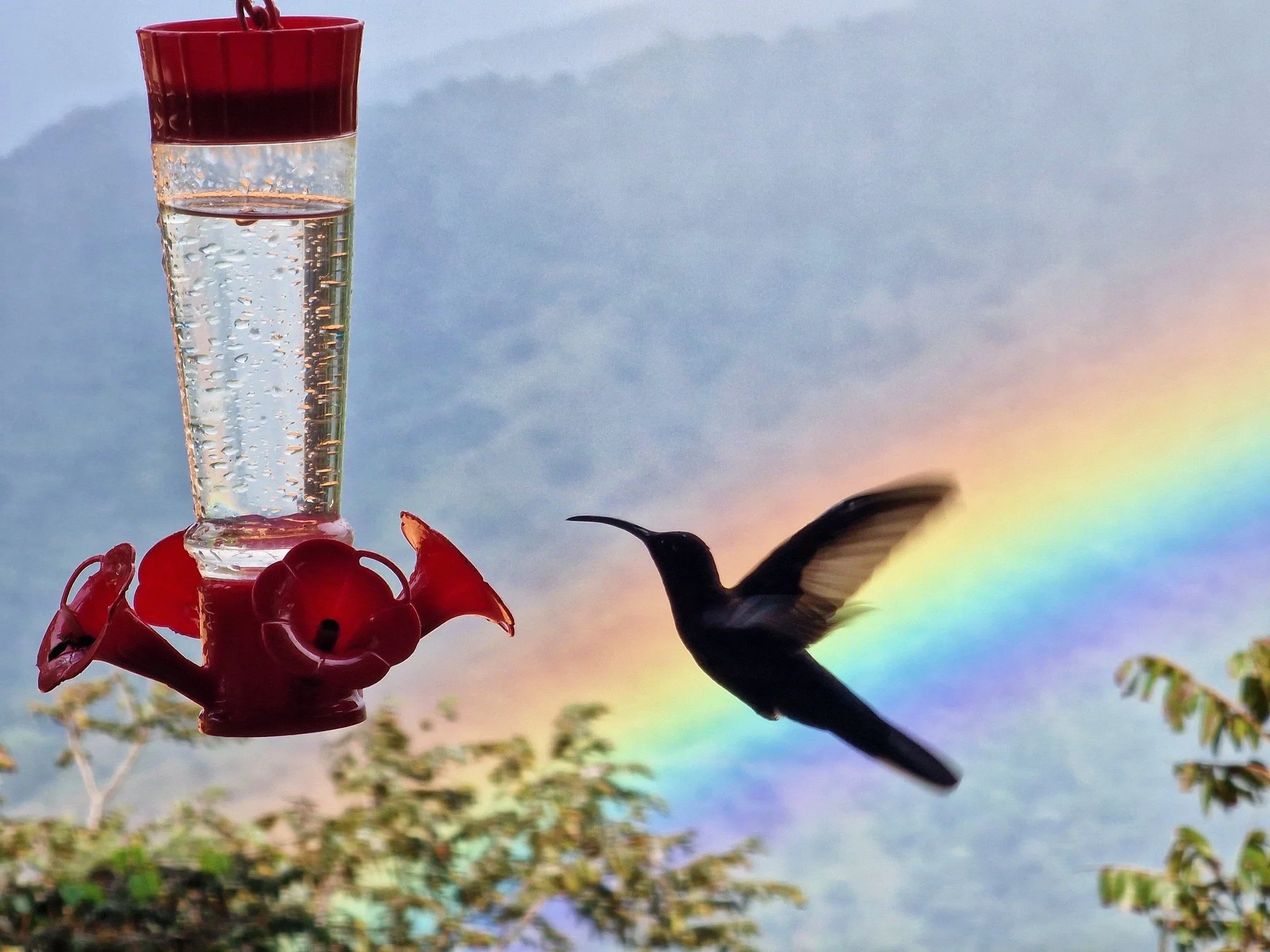
Imagine standing quietly on a misty mountain trail just before sunrise. The rainforest is still wrapped in darkness, and for a few moments the world seems completely silent. Then, almost imperceptibly at first, a single bird begins to sing. Another answers from somewhere deeper in the forest. Within minutes, the jungle erupts into one of nature's greatest concerts. Dozens of species call at once. Hummingbirds begin darting between flowers like tiny flying jewels. A toucan glides overhead with wings that barely make a sound. Somewhere high above the canopy, an eagle surveys an endless sea of green. This is not a scene from a wildlife documentary. It is an ordinary morning in Panama.
For birdwatchers, Panama is not simply another destination. It is one of the greatest birding countries on Earth.
Remarkably, this narrow strip of land, barely 772 kilometres from one end to the other, is home to more than 1,000 recorded bird species. That is more bird species than are found in all of Canada and the United States combined. It is more than most countries several times Panama's size. Whether you are an experienced ornithologist carrying a spotting scope and notebook or someone who simply enjoys watching colourful birds outside a cabin window, Panama offers experiences that remain unforgettable long after the trip ends.
The country's incredible diversity begins with its geography.
Panama forms the bridge between North and South America, creating one of the world's greatest biological crossroads. Millions of years ago, when the Isthmus of Panama emerged from the sea, it connected two continents that had evolved separately for tens of millions of years. Birds from the north began moving south. South American species expanded northward. Today, Panama sits directly where these two great faunas overlap, producing an astonishing variety found almost nowhere else.
Even more remarkable is the variety of habitats packed into such a small country.
Within a few hours' drive, you can travel from mangrove forests to cloud forests, from Caribbean coral islands to Pacific mudflats, from humid lowland rainforest to cool volcanic highlands. Each habitat supports its own unique birdlife, meaning every new destination feels like entering an entirely different world.
Perhaps no bird captures the imagination more than the Harpy Eagle, Panama's national bird and one of the largest and most powerful eagles on Earth. With talons larger than a grizzly bear's claws and the strength to capture monkeys and sloths from the forest canopy, the Harpy Eagle has become a symbol of Panama's wild forests. Although seeing one in the wild requires exceptional luck, simply knowing these magnificent predators still soar above Panama's rainforests adds an undeniable sense of excitement to every jungle hike.
For many birdwatchers, however, the ultimate prize is the Resplendent Quetzal.
High in Panama's cloud forests, particularly around Boquete, Cerro Punta, and the slopes of Volcán Barú, this legendary bird glows with emerald green feathers that shimmer almost impossibly in the mountain light. Males grow spectacular flowing tail feathers during the breeding season, making them one of the most beautiful birds anywhere in the world. Spotting a quetzal often becomes the defining moment of an entire journey.
Then there are the toucans.
Panama is blessed with several species, each more striking than the last. The familiar Keel-billed Toucan, with its enormous rainbow coloured bill, seems almost too colourful to be real. Chestnut-mandibled Toucans echo through the rainforest with deep croaking calls, while smaller aracaris add even more colour to the canopy.
Hummingbirds deserve an article of their own.
More than 50 species occur in Panama, ranging from tiny woodstars barely larger than a bumblebee to magnificent mountain gems flashing brilliant greens, blues, purples, and fiery oranges. Many lodges maintain flowering gardens where dozens of hummingbirds feed only metres away from visitors, creating unforgettable photographic opportunities.
One of Panama's greatest surprises is how easy birdwatching can be.
You do not always need to undertake exhausting expeditions into remote wilderness.
Some of the country's finest birding begins right outside your accommodation.
Enjoy breakfast on a terrace in Boquete, and colourful tanagers, honeycreepers, and hummingbirds may visit nearby flowers.
Relax at an eco lodge in the lowlands, and toucans, oropendolas, and parrots may fly overhead before you've finished your morning coffee.
Even Panama City has remarkable birding. Just minutes from the skyscrapers lies the famous Metropolitan Natural Park, where sloths climb trees beside hiking trails while trogons, motmots, woodpeckers, flycatchers, and dozens of tropical species live within sight of one of Latin America's most modern skylines. Very few capital cities on Earth can offer rainforest birdwatching during the morning and fine dining in the evening.
One of the country's greatest treasures is the legendary Pipeline Road inside Soberanía National Park.
Among birdwatchers, these names inspire almost mythical respect.
The road was originally built during construction of the Panama Canal but has since become one of the most celebrated birding locations on Earth. On a good morning, experienced guides regularly identify well over 150 species before lunchtime. Mixed feeding flocks move through the forest like travelling festivals of colour, with antbirds, woodcreepers, tanagers, flycatchers, and foliage gleaners all feeding together. Tinamous quietly walk across the trail, trogons perch motionless above the path, and if fortune smiles, even elusive forest raptors may appear overhead.
The highlands offer an entirely different experience.
Boquete, Cerro Punta, and Volcán Barú provide cool mountain air, moss-covered forests, orchids hanging from ancient trees, and birds found nowhere in Panama's lowlands. Here, birdwatchers search for quetzals, silky flycatchers, flame-throated warblers, black guans, and volcano hummingbirds while walking through forests often shrouded in drifting cloud.
The Caribbean side presents yet another world.
Bocas del Toro combines rainforest with mangroves, beaches, coral reefs, and islands where seabirds mix with tropical forest species. Green ibises stalk quiet streams, kingfishers patrol the mangroves, and colourful parrots cross the sky each morning.
On the Pacific coast, vast mudflats become one of the world's greatest staging grounds for migratory shorebirds. Every year, hundreds of thousands of sandpipers, plovers, whimbrels, dowitchers, and other migrants arrive after astonishing journeys from North America. Watching flocks rise together in perfect synchrony resembles witnessing a living cloud.
Migration itself transforms Panama.
Twice each year, the country becomes one of the planet's busiest aerial highways.
Perhaps the greatest spectacle occurs with raptors.
During autumn migration, hundreds of thousands of hawks, vultures, falcons, and kites stream southward through Panama. On exceptional days, observers have counted astonishing numbers of migrating birds of prey circling overhead in enormous spiralling columns before continuing south. It is one of the greatest wildlife migrations on Earth, yet surprisingly few travellers know it exists.
Photography enthusiasts quickly discover another reason Panama has become world famous.
Birds here are often remarkably approachable.
Many eco lodges maintain carefully designed feeding stations and flowering gardens that attract hummingbirds, tanagers, honeycreepers, and euphonias throughout the day. With patience, photographers can capture extraordinary images without disturbing wildlife.
But perhaps the greatest pleasure of birdwatching in Panama is that it slows you down.
Modern life encourages constant movement.
Birdwatching demands the opposite.
You begin noticing details that most people walk straight past.
The rustle of leaves revealing an antbird.
A distant whistle announcing a trogon.
The sudden flash of blue as a morpho butterfly drifts across the trail before disappearing into the forest.
The forest becomes less about reaching the destination and more about appreciating every moment along the journey.
One fascinating aspect of Panama is how quickly a simple interest can become an obsession.
Visitors often arrive claiming they know nothing about birds.
By the second morning, they are pointing excitedly at hummingbirds.
By the third day, they recognise toucan calls.
By the end of the week, they are carrying binoculars everywhere.
Panama has that effect.
It reveals just enough to leave you wanting more.
For beginners, this is one of the easiest countries on Earth to start birdwatching. Excellent guides, accessible trails, comfortable eco lodges, and incredible biodiversity mean remarkable sightings are possible even without previous experience.
For experts, the appeal is equally strong. Rare endemics, regional specialties, migration events, and over a thousand recorded species provide enough challenges to keep even the world's most experienced birders returning year after year.
Perhaps the greatest compliment that can be paid to Panama is this.
Birdwatching here is never just about birds.
While searching for a quetzal, you might encounter white-faced capuchin monkeys swinging through the canopy.
While watching hummingbirds, a sloth may quietly descend a nearby tree.
During an early morning walk, you may discover poison dart frogs, orchids, butterflies, coatis, agoutis, leaf-cutter ants carrying tiny green banners across the forest floor, or even the distant roar of howler monkeys echoing through the valley.
Every bird becomes part of a much larger story.
A story of rainforests that still breathe with life.
A story of migration routes that connect continents.
A story of mountains, rivers, coastlines, and islands where evolution has painted the skies with colours so vivid they seem almost impossible.
Panama is not simply a country with many birds.
It is a country where birds define the landscape itself.
Where dawn begins with a rainforest symphony.
Where emerald quetzals still glide through cloud forests.
Where toucans cross jungle clearings like flying works of art.
Where hummingbirds sparkle like living gemstones.
And where every walk into the forest carries the thrilling possibility that the next bird perched quietly in the trees could be one you have dreamed of seeing for your entire life.
For anyone who has ever lifted a pair of binoculars toward the treetops, Panama is more than a destination.
It is a pilgrimage.
And once you have heard the first chorus of a Panamanian dawn, watched mist lift from the rainforest canopy, and seen a flash of impossible colour disappear into the forest, you will understand why so many birdwatchers consider this extraordinary little country one of the finest places on Earth to look to the skies.