
Few birds on Earth capture the imagination quite like the toucan. With their enormous colorful bills, bright tropical feathers, strange prehistoric appearance, and loud personalities, toucans seem almost too incredible to be real. They are among the first animals many visitors hope to see when they arrive in Panama, and for good reason. Seeing a toucan flying through the rainforest canopy, landing on an ancient tree, and looking down with its enormous bill glowing in the sunlight is one of those unforgettable moments that defines a tropical adventure.
Panama is one of the best places in the world to experience toucans because this small country contains an extraordinary variety of habitats. From the hot lowland rainforests near the Caribbean coast to the misty cloud forests of Chiriquí, Panama provides homes for several species of toucans and their close relatives. The country’s unique geography, acting as a bridge between North and South America, has allowed incredible biodiversity to develop over millions of years. Species from different continents have mixed here, creating one of the richest ecosystems on the planet.
But Panama’s toucans are not just beautiful birds. They are important pieces of the rainforest ecosystem. They are seed dispersers, carrying the future of the forest inside their stomachs. When a toucan eats fruit and later moves through the jungle, it helps spread plants to new areas. In many ways, toucans are gardeners of the rainforest.
They are also storytellers. Their presence tells us that the forest is healthy, connected, and alive.
Panama’s toucans come in many forms. Some are large, dramatic birds with huge rainbow-colored bills. Others are smaller and more secretive, perfectly adapted to the mysterious world of cloud forests. Each species has its own personality, habitat, and role in the natural world.
The Keel Billed Toucan: Panama’s Famous Rainbow Bird
Keel billed toucan
When people imagine a toucan, they are usually picturing the keel billed toucan. This is the iconic tropical bird that appears on postcards, documentaries, and travel advertisements around the world. It is one of Panama’s most recognizable symbols.
The first thing that captures attention is the incredible bill. It looks almost impossible: a huge structure painted with brilliant shades of green, orange, red, yellow, and blue. The colors appear almost artificial, like a bird created by an artist rather than nature. Yet this extraordinary design evolved over millions of years and serves many purposes.
Despite its size, the bill is surprisingly lightweight. It is made from a structure of keratin with internal support that gives it strength without making it too heavy. Scientists believe it helps toucans reach fruit on thin branches, communicate with other birds, regulate body temperature, and attract mates.
The keel billed toucan has a mostly black body, a bright yellow chest, red feathers beneath the tail, and colorful skin around the eyes. When it sits on a branch surrounded by green leaves, it looks like a living piece of tropical artwork.
These toucans are found throughout much of Panama, including forests around the Panama Canal, Caribbean lowlands, western Panama, and many protected areas. They are often seen in places with abundant fruit trees.
Their call is unforgettable. Instead of a beautiful song, they produce strange repeated croaking sounds that echo through the forest. Many visitors hear a toucan before they ever see one.
Although fruit makes up most of their diet, keel billed toucans are opportunistic feeders. They may also eat insects, small reptiles, eggs, and other small animals when available. Their large bills allow them to access food sources that many other birds cannot reach.
One of their most fascinating behaviors happens at night when several toucans may gather together and sleep in a compact group. They can fold their tails forward over their backs, creating a remarkable sleeping position that helps them conserve space.
The Yellow Throated Toucan: The Giant of the Jungle Canopy
Yellow throated toucan
The yellow throated toucan is one of the largest and most impressive toucans found in Panama. This bird represents the true giants of the rainforest canopy.
With its enormous bill, dark body, and bright yellow throat and chest, it has a powerful appearance. It looks perfectly suited for life among the tallest trees of Panama’s ancient forests.
These toucans prefer humid tropical forests with large mature trees. They are especially associated with areas where the forest remains intact, including parts of Darién, Caribbean forests, and western Panama.
Seeing one high above the forest floor gives visitors a sense of how enormous Panama’s jungles really are. The canopy is an entire world above our heads, filled with movement, sounds, and hidden life.
Yellow throated toucans are important seed dispersers because they can consume larger fruits and transport seeds across wide areas. A single bird flying through the forest can help shape the future of the ecosystem.
They are also social animals, often traveling in pairs or small groups. When several appear together in the canopy, their bright colors moving among the trees create one of the most spectacular sights in the rainforest.
The Emerald Toucanet: Panama’s Jewel of the Cloud Forest
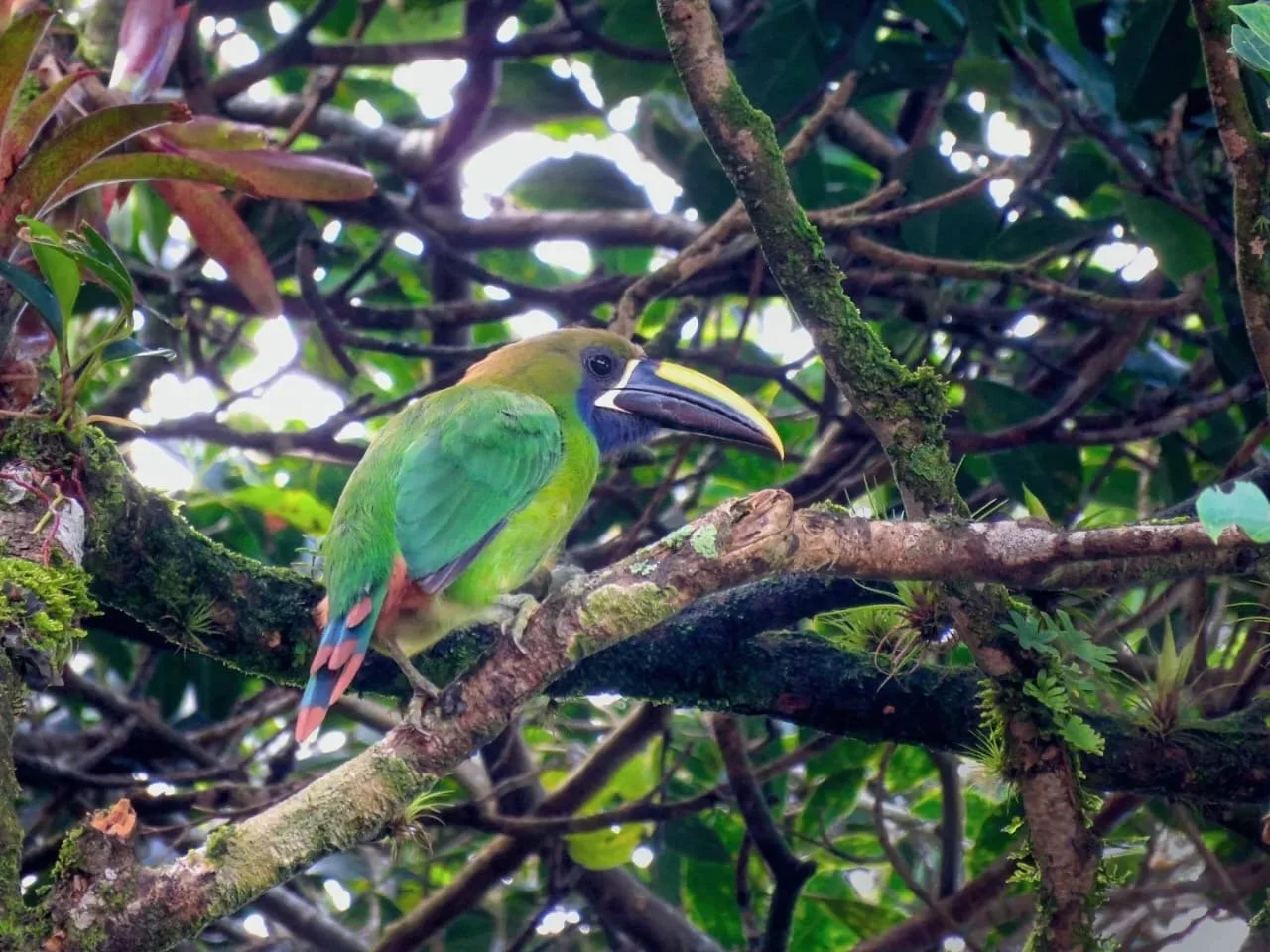
Northern emerald toucanet
While the large toucans steal attention with their dramatic colors and enormous bills, Panama’s smaller toucan relatives offer a completely different kind of magic.
The emerald toucanet is one of the true treasures of Panama’s highland forests. Instead of the black and yellow pattern of larger toucans, this bird is covered in shades of green that allow it to blend perfectly into the cloud forest environment.
It looks almost like a living emerald moving through the trees.
The emerald toucanet is especially associated with the mountain forests of western Panama, including areas around Boquete, Volcán, and the Fortuna Forest Reserve. These forests are some of the most unique ecosystems in the country, where clouds constantly move through the trees, moss covers branches, orchids grow everywhere, and biodiversity reaches incredible levels.
One of the most special places to encounter emerald toucanets is around Lost and Found Hostel. Located inside the cloud forest environment of the Fortuna area, surrounded by protected jungle and its own network of hiking trails, the hostel offers visitors the rare opportunity to see these beautiful birds in their natural habitat.
Guests often spot emerald toucanets while walking the trails, exploring viewpoints, relaxing near the restaurant, or simply looking into the forest around the property. Unlike a zoo or controlled birding attraction, these are completely wild birds moving freely through the cloud forest.
The experience can feel almost magical. A visitor may be hiking through misty jungle surrounded by giant trees, bromeliads, and dripping moss when suddenly a flash of green appears in the canopy. The bird lands nearby, revealing its colorful bill and curious personality.
The emerald toucanet is quieter than the larger toucans. It rewards patience. Often, visitors hear movement and soft calls before seeing the bird itself.
The presence of emerald toucanets around Lost and Found Hostel is also a reminder of the importance of protecting cloud forests. These ecosystems are fragile and contain countless species that depend on cool temperatures, constant moisture, and mature vegetation.
For many travelers, seeing an emerald toucanet becomes one of the highlights of their Panama experience because it represents the hidden side of nature. It is not the famous jungle celebrity everyone knows. It is a secret treasure revealed only to those who slow down and look carefully.
The Collared Aracari: The Toucan Wearing a Necklace
Collared aracari
Although smaller than true toucans, aracaris belong to the same family and share many of the same characteristics.
The collared aracari is one of Panama’s most charming rainforest birds. Its name comes from the dark collar-like marking around its neck, which gives it the appearance of wearing a natural necklace.
It has a colorful bill, yellow chest, and striking patterns of black and red. Unlike some larger toucans that spend much of their time high in the canopy, aracaris often move through lower vegetation and forest edges.
They are social birds and are often seen traveling in small groups. Their movements through the forest can be surprisingly fast and coordinated as they search for fruit.
Like other toucans, they depend on mature trees for nesting. They often use old tree cavities, including holes created by woodpeckers. This highlights why protecting large old forests is so important.
A rainforest without old trees loses not only scenery but entire communities of animals.
The Fiery Billed Aracari: A Flash of Tropical Color
Fiery billed aracari
The fiery billed aracari is another beautiful toucan relative found in western Panama.
Its name comes from its spectacular bill, which contains warm orange and reddish tones that seem to glow in the tropical sunlight. Combined with its yellow, black, and red feathers, it is one of the most attractive birds in the forest.
This species is associated with humid forests where fruit is abundant. Like other aracaris, it is social and often travels with companions.
For birdwatchers exploring western Panama, encountering a fiery billed aracari can be an unforgettable moment because these birds combine the beauty of a toucan with the more secretive lifestyle of smaller forest species.
The Best Places to See Toucans in Panama
One of the amazing things about Panama is that you do not always need to travel to extremely remote locations to see toucans. They can appear in many different environments.
The Panama Canal Rainforest
The forests around the Panama Canal are some of the easiest places to experience tropical wildlife. Protected areas such as Soberanía National Park contain excellent habitat for keel billed toucans, aracaris, and many other birds.
Chiriquí Highlands
The mountains of western Panama are a paradise for bird lovers. Around Boquete, Volcán, and Fortuna, visitors can search for emerald toucanets and other cloud forest species.
The combination of mountains, mist, and ancient forests creates one of the most beautiful birding environments in Central America.
Fortuna Forest Reserve
The Fortuna area is especially remarkable because it connects different ecosystems. Caribbean moisture, mountain forests, and tropical biodiversity meet here.
For visitors staying around Lost and Found Hostel, the surrounding jungle provides opportunities to experience toucans not as a rare attraction, but as part of everyday life in the forest.
Bocas del Toro
The islands and forests of Bocas del Toro provide another excellent habitat for toucans. The combination of rainforest and coastal ecosystems supports a huge variety of birds.
Darién
The Darién remains one of Central America’s wildest regions. Its enormous forests contain incredible biodiversity and some of Panama’s most impressive wildlife.
Why Toucans Matter
The beauty of toucans is obvious, but their importance goes much deeper.
They are forest builders.
Every fruit they eat and every seed they transport helps shape future generations of trees. Without seed dispersers, forests struggle to recover.
They also connect people with nature. Many visitors who may never have been interested in birds suddenly become fascinated after seeing their first toucan.
A single encounter can create a lifelong appreciation for conservation.
The Magic of Seeing a Toucan in Panama
There is something unforgettable about seeing a toucan in the wild.
Maybe you are walking through a rainforest trail and hear a strange call from above.
Maybe sunlight breaks through the canopy and reveals a huge colorful bill.
Maybe you are standing in a misty cloud forest near Fortuna and an emerald toucanet suddenly appears among the moss-covered trees.
For a few seconds, the modern world disappears.
You are simply standing in the same forest that has supported these birds for thousands of years.
Panama’s toucans are more than beautiful animals. They are symbols of the country’s incredible biodiversity, guardians of the rainforest, and reminders that some of Earth’s greatest wonders are still flying freely through the trees.
In Panama, the jungle is not just something you visit.
It is something that watches you back.