
Deep within the rainforests of Panama, beneath towering trees covered in orchids, mosses, and vines, a fascinating world of survival exists that most visitors never notice. While travelers often come to Panama searching for sloths resting in the canopy, monkeys moving through the trees, colorful frogs hiding among leaves, or tropical birds flying above the forest, some of the most impressive wildlife encounters happen much closer to the ground. Among the leaf litter, fallen branches, tree roots, and forest trails live some of the most specialized predators on Earth: spider hunting wasps. These incredible insects have evolved a unique lifestyle centered around one of nature's most feared creatures: spiders. Instead of avoiding spiders, spider hunting wasps actively search for them, battle them, and use their remarkable adaptations to overcome animals that are often larger, stronger, and equipped with their own powerful defenses.
Panama is one of the best places in the world to appreciate these remarkable insects because the country contains an extraordinary variety of habitats, from the humid Caribbean forests of Bocas del Toro to the cloud forests of Chiriquí, the ancient rainforests of Darién, the protected wilderness around the Panama Canal, and the tropical lowlands stretching across the country. All of these environments support enormous numbers of spiders, which creates the perfect conditions for spider hunting wasps to thrive. These wasps are not simply random insects flying through the jungle. They are highly specialized predators that have spent millions of years evolving behaviors, hunting techniques, and venom specifically designed for capturing spiders. Their story is one of the most fascinating examples of evolution in Panama's natural world.
Spider hunting wasps belong mainly to the family Pompilidae, a group commonly known as spider wasps or pompilid wasps. Unlike the familiar social wasps that build large colonies and defend their nests together, most spider hunting wasps are solitary hunters. A single female does everything herself. She searches the forest, locates a spider, captures it, prepares a nesting location, and provides food for her future offspring without help from workers or other members of a colony. This solitary lifestyle makes them very different from paper wasps and yellowjackets that many people recognize. A spider wasp is not interested in defending a large nest or protecting hundreds of relatives. Instead, its entire existence revolves around finding the right spider at the right time and successfully completing one of the most specialized hunting missions in the insect world.
The relationship between spider wasps and spiders is one of the most fascinating predator-prey relationships in nature because the wasp does not simply kill the spider and eat it immediately. The process is far more complicated. The adult female wasp usually feeds on nectar from flowers and plants, gaining the energy needed to fly and hunt. The spider she captures is intended for her offspring. After finding a suitable spider, she uses her specialized venom to immobilize it. The spider remains alive but unable to escape, allowing the wasp larva to have a fresh food source when it develops. This strategy may seem unusual, but it is an incredibly effective survival system that has been refined through millions of years of evolution.
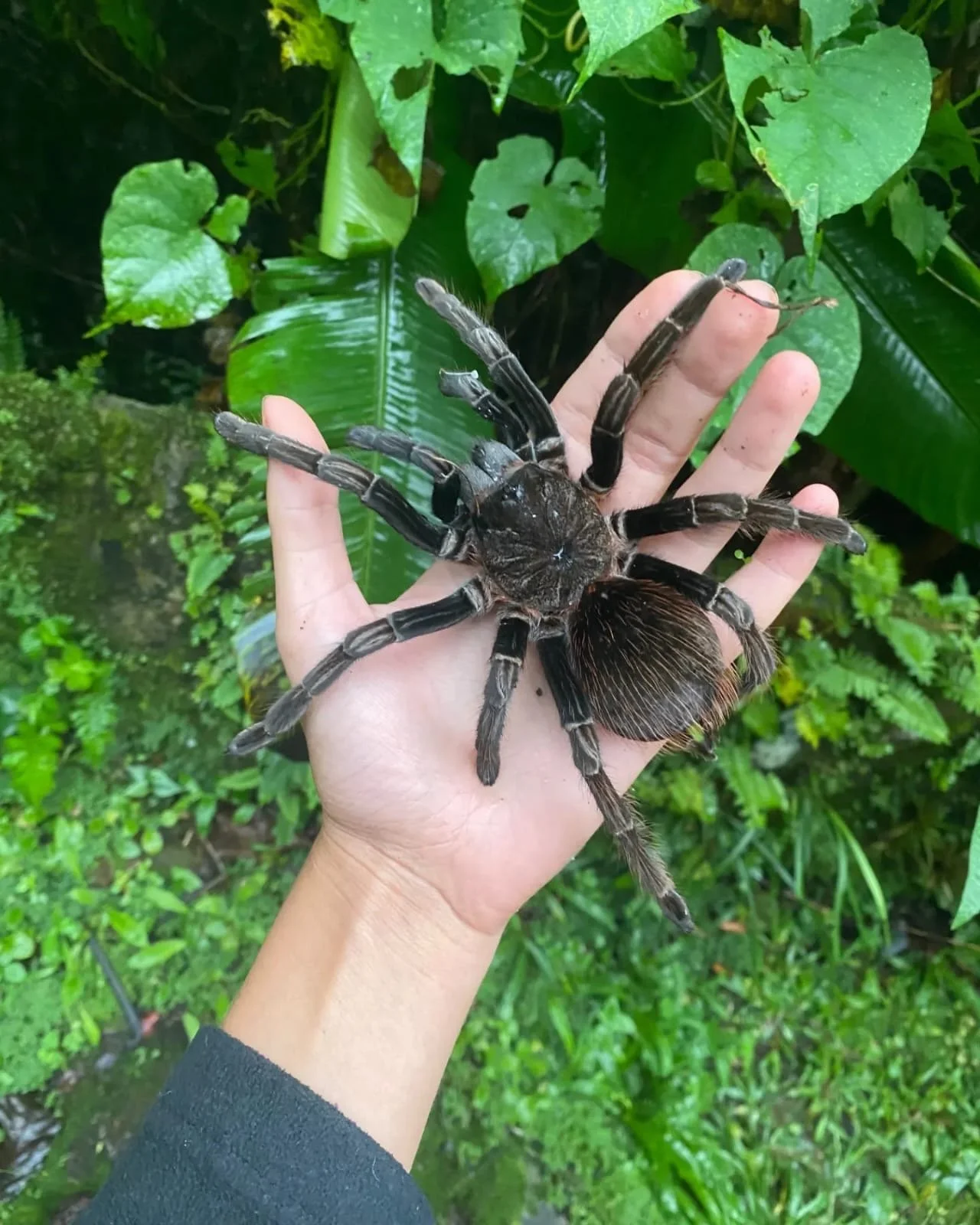
The forests of Panama provide the perfect environment for this behavior because spiders are everywhere. The incredible plant diversity of tropical ecosystems creates countless hiding places and hunting grounds for spiders. Some live inside curled leaves, others hide beneath bark, some build webs between plants, and others roam actively across the forest floor. Panama contains an enormous variety of spider species, from tiny jumping spiders that hunt visually during the day to large tarantulas that live in burrows or under fallen logs. Every one of these spiders represents a potential food source for specialized predators like spider hunting wasps.
When a spider hunting wasp begins its search, it becomes a remarkably focused hunter. It may walk across the forest floor, inspect vegetation, explore cracks in wood, or investigate areas where spiders are likely to hide. Many species have excellent vision and use their long legs to move quickly across difficult terrain. Their movements are often very different from other wasps that fly constantly around flowers or food sources. A spider wasp often appears to be exploring, almost like it is searching every possible hiding place. In reality, it is following an ancient hunting strategy passed down through countless generations.
The encounter between a spider wasp and its prey is one of the most dramatic events in the insect world. Spiders are not helpless victims. They are highly effective predators themselves, equipped with venom, sharp fangs, speed, camouflage, and specialized hunting abilities. Some spiders can move incredibly quickly, while others rely on surprise attacks or powerful defensive behaviors. The spider wasp must approach carefully and use precision rather than brute force. The wasp's greatest advantage is its ability to use specialized venom that affects the spider's nervous system. Instead of simply overpowering the spider, the wasp uses chemistry and timing to neutralize its opponent.
The venom of spider hunting wasps is one of their greatest evolutionary achievements. Many people assume venom exists only to kill prey, but in the case of spider wasps, the goal is often very different. The venom is designed to temporarily immobilize the spider while keeping it alive. This allows the wasp to transport prey that may weigh as much or more than itself. Carrying a large spider across the forest floor is an incredible physical challenge, and the wasp's ability to accomplish this demonstrates just how specialized these insects have become. The spider is essentially transformed from a dangerous predator into a carefully preserved food package for the next generation.
Among all spider hunting wasps, tarantula hawks are perhaps the most famous. These large members of the spider wasp group have gained legendary status because of their ability to hunt some of the largest spiders in the world. Panama's tropical forests provide habitat for several species and relatives of these impressive insects. A tarantula hawk can look intimidating because of its size, long legs, powerful wings, and dramatic coloration. Some have dark metallic bodies with bright orange wings, creating a striking appearance that immediately catches attention. However, despite their frightening reputation, tarantula hawks are generally not aggressive toward humans. Their incredible abilities evolved for hunting spiders, not for interacting with people.
The famous battle between a tarantula and a tarantula hawk represents one of nature's most impressive examples of predator versus predator. A female tarantula hawk searches the forest floor looking for a suitable tarantula. When she finds one, she must carefully approach an animal that is itself a highly capable hunter. The spider has powerful defenses, but the wasp has evolved specifically to overcome those defenses. After successfully immobilizing the spider, the wasp transports it to a location where it can complete the next stage of its life cycle. This interaction is not a sign of a cruel or unusual ecosystem. It is simply one of the many complex relationships that keep tropical forests functioning.
For travelers exploring Panama, spider hunting wasps can potentially be encountered in many different environments. The cloud forests around Boquete and the mountains of Chiriquí provide excellent habitat because of the high insect diversity and constant humidity. Rainforests around the Panama Canal offer opportunities to observe many species while hiking through protected areas. Bocas del Toro's lush tropical forests support countless insects and spiders. Rural trails, farms, gardens, and forest edges can also contain spider wasps because these adaptable predators follow their prey rather than depending on one specific habitat.
One of the most interesting things about observing spider wasps in Panama is realizing how different they are from the insects many people fear. A social wasp defending a nest may react aggressively because it is protecting a colony. A solitary spider hunting wasp usually has a completely different priority. It is focused on finding spiders, not interacting with humans. A person walking through the forest is generally not considered prey, competition, or a threat. Most encounters happen because humans happen to enter the same space where these insects are naturally living.
For hikers, backpackers, and nature lovers, seeing a spider wasp can actually be a highlight of exploring Panama's wilderness. These insects represent the hidden complexity of the rainforest. A simple walk along a jungle trail may reveal dozens of interactions that most people never notice. A leaf may contain a tiny spider. A fallen branch may hide a hunting insect. A patch of sunlight may attract a predator searching for prey. The rainforest is not just a collection of large animals that visitors come to photograph. It is a living network of millions of smaller interactions happening constantly.
Spider hunting wasps also demonstrate why protecting Panama's forests is so important. These insects depend on healthy ecosystems with abundant prey, diverse plants, and stable environmental conditions. When forests disappear, countless relationships between species are disrupted. Protecting rainforests does not only preserve famous animals like jaguars, monkeys, and birds. It also protects the smaller creatures that maintain the balance of the ecosystem. Spider wasps are one small but important part of the enormous biological system that makes Panama one of the most biodiverse countries on Earth.
The reputation of spider wasps often focuses on their painful stings, especially in the case of large species such as tarantula hawks. Their stings are famous among insect enthusiasts because they can be extremely painful, but these insects are not normally aggressive. The safest and simplest approach is the same as with all wildlife in Panama: observe from a respectful distance. The vast majority of encounters are peaceful because the insect has no reason to waste energy defending itself against a much larger animal that is not interfering with its mission.
What makes spider hunting wasps so fascinating is that they challenge the way people think about nature. Many people see wasps only as dangerous insects, but in reality they are incredibly sophisticated predators that play important roles in ecosystems. They regulate spider populations, participate in complex food webs, and demonstrate the extraordinary creativity of evolution. They are examples of how even the smallest creatures can have incredible abilities and important ecological roles.
For visitors traveling through Panama, discovering spider hunting wasps is another reminder that the country's natural wonders extend far beyond the animals that appear on postcards. The same forests that shelter sloths, toucans, frogs, and monkeys also contain these remarkable hunters quietly moving through the shadows. They are not monsters of the rainforest. They are highly specialized predators that have perfected one of nature's most unusual hunting strategies.
Panama's spider hunting wasps are a perfect symbol of the country's wild character. They represent mystery, adaptation, and the endless discoveries waiting inside tropical ecosystems. A visitor may come to Panama hoping to see colorful birds or large mammals, but sometimes the most memorable encounters happen when they stop and look closely at the small creatures moving beneath their feet. In the rainforest, every insect has a story, and the spider hunting wasps of Panama have one of the most fascinating stories of all.