
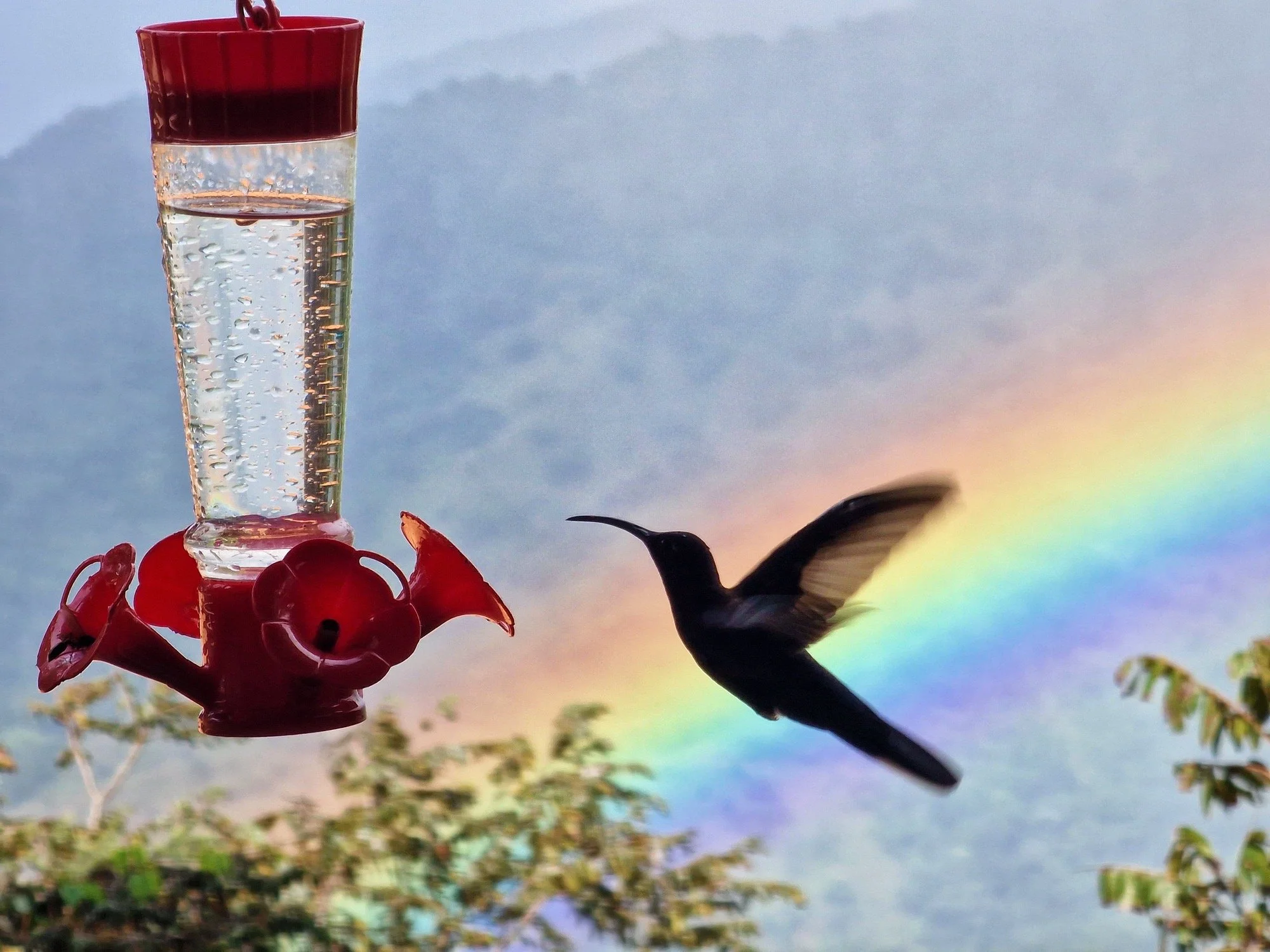
Few birds capture the imagination quite like hummingbirds. They seem to ignore the laws of nature, hovering effortlessly in front of flowers before vanishing in a flash of emerald, sapphire, violet, ruby, or gold. They are among the smallest birds on Earth, yet they undertake astonishing migrations, defend territories with fearless determination, and play an essential role in keeping tropical forests alive. In Panama, hummingbirds are everywhere. From the hot Caribbean lowlands to misty cloud forests thousands of meters above sea level, these tiny birds are among the country's greatest natural treasures.
Panama is home to more than 55 species of hummingbirds, an incredible number for such a small country. This remarkable diversity exists because Panama forms a biological bridge between North and South America while also containing rainforests, mangroves, cloud forests, dry forests, and mountain habitats within relatively short distances. Different hummingbird species specialize in different elevations, flowers, and ecosystems, meaning that every journey through Panama offers the possibility of discovering entirely new species.
One of the finest places to experience these aerial jewels is the cloud forest surrounding Lost and Found Hostel. Feeders placed around the property attract hummingbirds throughout the day, often allowing guests to observe several species from only a few feet away while enjoying breakfast or relaxing on the deck. Unlike many wildlife encounters that require patience and luck, hummingbirds at Lost and Found are dependable visitors. Throughout the day they dart between flowers and feeders, constantly entertaining guests with breathtaking displays of speed, agility, and brilliant iridescent colours. For many backpackers it becomes one of the most memorable wildlife experiences of their entire trip through Panama.
Why Hummingbirds Are So Extraordinary
Everything about hummingbirds pushes the limits of biology.
They are the only birds capable of true hovering flight. Unlike other birds that glide or briefly suspend themselves in the air, hummingbirds remain perfectly stationary by beating their wings in a figure-eight motion. Depending on the species, they can flap their wings anywhere from 50 to over 80 times every second. The blur you see is simply too fast for the human eye to follow.
Their flight abilities do not stop there. They can fly sideways, backwards, vertically upward, and even upside down for brief moments. Their flying skills are more similar to tiny helicopters than traditional birds.
Their hearts are equally astonishing. A resting hummingbird already has an incredibly fast heartbeat, but during flight the heart may beat well over 1,000 times every minute. To fuel this incredible metabolism they must constantly consume nectar, tiny insects, and spiders throughout the day.
Because their metabolism is so extreme, many hummingbirds enter a deep sleep called torpor every night. During torpor their body temperature falls dramatically, their breathing slows, and their heart rate drops to conserve precious energy until sunrise.
Colours That Are Not Really Colours
One of the greatest surprises about hummingbirds is that many of their brilliant colours are not actually pigments.
Instead, microscopic structures within their feathers reflect and bend light. This means a hummingbird that appears brilliant emerald green from one angle may suddenly become completely black from another before flashing electric blue as it turns again.
This explains why photographers often struggle to capture their true beauty. The colours seem to change every second depending on the lighting and viewing angle.
Tiny Birds With Giant Personalities
Although hummingbirds weigh only a few grams, they possess enormous confidence.
Many species aggressively chase birds many times their own size. They routinely drive away tanagers, orioles, toucans, and even hawks that venture too close to their feeding territory.
Watching hummingbirds at a feeder is often like watching aerial dogfights. Tiny birds zip after one another at breathtaking speeds, producing high-pitched buzzing sounds as they fiercely defend access to nectar.
Amazing Hummingbirds You May See in Panama
Panama's hummingbird list includes an astonishing variety of shapes and colours.
The White-necked Jacobin is among the country's easiest species to recognize, with its brilliant blue head, snowy white belly, and bold white wing patches.
The Rufous-tailed Hummingbird is one of the most common hummingbirds throughout much of Panama. Its gleaming green body and bright cinnamon tail make it a favourite visitor to gardens and feeders.
The Long-billed Hermit possesses a dramatically curved bill perfectly adapted for feeding from long tubular flowers hidden beneath rainforest vegetation.
The Stripe-throated Hermit looks entirely different from the jewel-like hummingbirds many people imagine. Browns and creams replace dazzling metallic colours, providing excellent camouflage among rainforest leaves.
The spectacular Green-crowned Brilliant truly lives up to its name with rich emerald plumage and glittering iridescence that shines in the cloud forest sunlight.
The tiny Scintillant Hummingbird, one of the world's smallest birds, somehow manages to survive despite weighing only a few grams.
The magnificent Violet Sabrewing, among the largest hummingbirds found in Panama's highlands, glows deep purple in the right light and often dominates smaller hummingbirds around feeders.
Other wonderful species include the Purple-crowned Fairy, White-vented Plumeleteer, Violet-bellied Hummingbird, Snowy-bellied Hummingbird, Blue-chested Hummingbird, Bronze-tailed Plumeleteer, Garden Emerald, Snowcap, Volcano Hummingbird, Magenta-throated Woodstar, Talamanca Hummingbird, and dozens more depending on where you travel in the country.
Why Cloud Forests Are Hummingbird Paradise
Cloud forests provide nearly perfect hummingbird habitat.
Moisture drifting through the forest allows flowers to bloom almost continuously throughout the year. This dependable nectar supply supports many species living side by side.
The constantly cool temperatures reduce water stress for plants, allowing an astonishing diversity of flowering shrubs, vines, orchids, bromeliads, and epiphytes to thrive. Every flowering plant represents another feeding opportunity for hummingbirds.
Around Lost and Found Hostel, guests frequently discover that they hardly need to leave the restaurant or viewing decks before spotting hummingbirds darting among nearby flowers and feeders. Morning and late afternoon are especially magical as multiple species arrive in rapid succession, sometimes only centimetres from observers.
Pollinators of the Rainforest
Without hummingbirds, many rainforest plants simply could not reproduce.
As they push their heads into flowers searching for nectar, pollen sticks to their feathers and bills. When they visit another flower, that pollen is transferred, allowing fertilization.
Many tropical flowers have evolved specifically for hummingbirds. Their long tubular shapes, bright red or orange colours, and abundant nectar are all perfectly designed for these tiny flying pollinators.
Every hummingbird visiting a flower is quietly helping maintain the incredible biodiversity that makes Panama famous.
Incredible Facts That Most People Never Know
Many hummingbirds have tongues that extend far beyond their bills, functioning more like tiny nectar pumps than drinking straws.
Some species remember hundreds of individual flowers and know approximately how long each flower takes to refill with nectar.
Their brains are proportionally among the largest of any bird, giving them remarkable memory for food locations.
Despite their delicate appearance, hummingbirds are surprisingly long-lived. Some individuals survive well over ten years in the wild.
Many North American hummingbirds migrate all the way to Central America, including Panama, crossing enormous distances despite weighing less than a coin.
Some hummingbirds travel nonstop across the Gulf of Mexico during migration, an astonishing journey for such tiny creatures.
Watching Hummingbirds at Lost and Found Hostel
For bird lovers, photographers, and anyone who simply appreciates nature, the hummingbird feeders at Lost and Found Hostel provide an unforgettable experience.
Guests often find themselves sitting for hours with a cup of coffee, mesmerized as hummingbirds arrive every few minutes. Some hover directly in front of people before moving to a feeder, while others perch quietly on nearby branches where their extraordinary colours become visible in the shifting cloud forest light.
Unlike many wildlife encounters where animals remain hidden deep inside the jungle, hummingbirds willingly come to you. Even visitors with no previous interest in birds quickly become fascinated as they witness aerial battles, dazzling courtship displays, and tiny birds performing flight manoeuvres that seem almost impossible.
Because the hostel sits within Panama's beautiful cloud forest, surrounded by native flowering plants and rich natural habitat, hummingbirds are not occasional visitors but an everyday part of life. Whether you are beginning a hike, finishing dinner, or simply relaxing after exploring the trails, there is an excellent chance that one of these living jewels will appear nearby.
For countless travellers, the hummingbird feeders become one of the defining memories of their stay. The experience perfectly captures what makes Panama so extraordinary: extraordinary biodiversity, close encounters with wildlife, and the chance to appreciate some of the most remarkable birds on Earth from the comfort of a peaceful mountain hostel.