
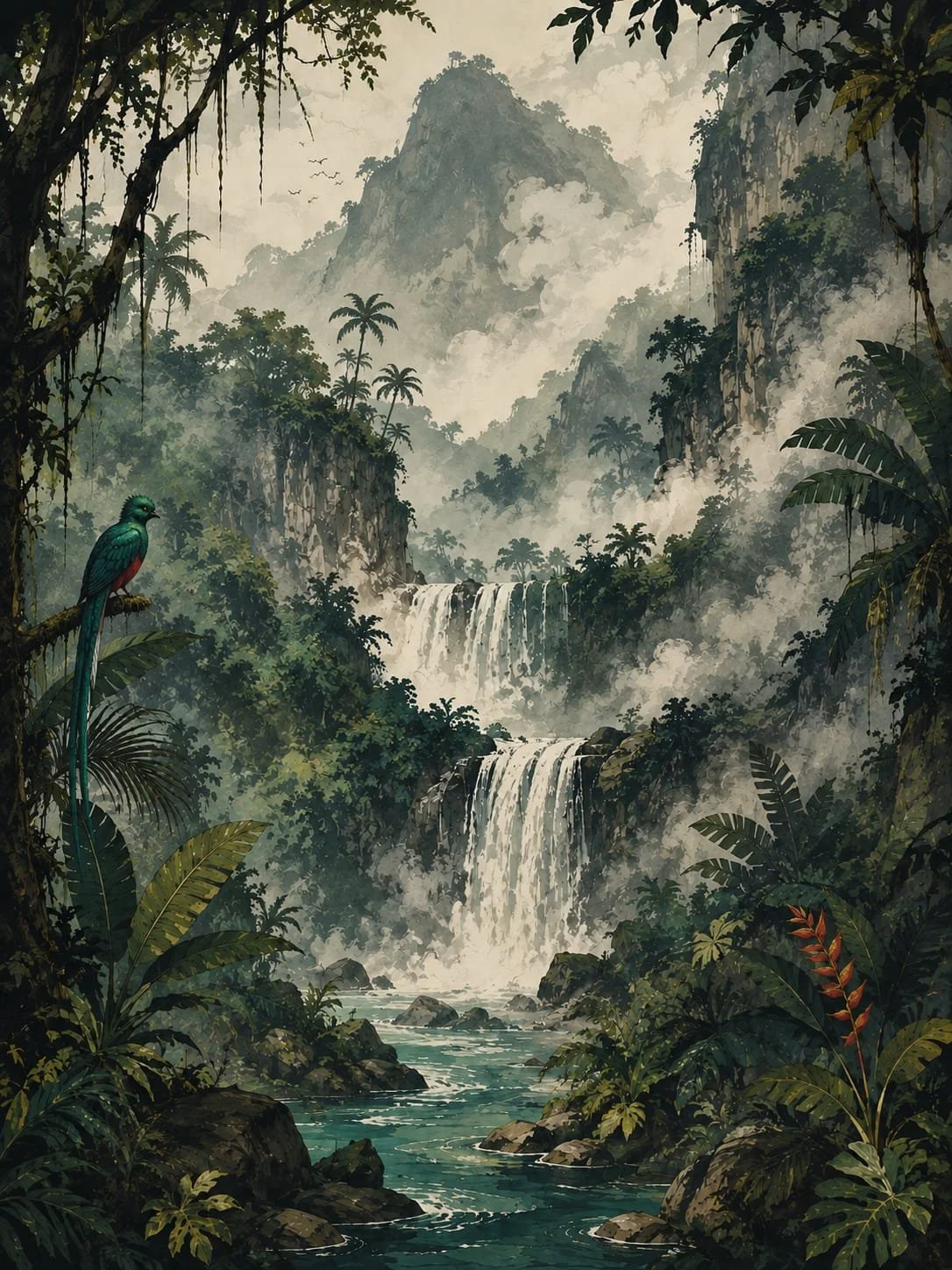
When most people imagine Panama, they picture Caribbean beaches, tropical rainforests, warm ocean water and humid afternoons. They imagine sandals, shorts and a T-shirt. And for much of the country, that is exactly right.
Then you climb into the mountains.
Suddenly Panama can feel like an entirely different country.
In Boquete, Volcán, Cerro Punta and the surrounding highlands of Chiriquí, the tropical heat gives way to cool mornings, comfortable afternoons, cloudy mountain weather and evenings when you may genuinely want a sweater. It is one of the great surprises for travelers who arrive expecting Panama to be hot everywhere.
Boquete sits at roughly 3,700 feet (1,130 metres) above sea level, while Volcán is around 4,570 feet (1,390 metres) and Cerro Punta climbs to approximately 6,630 feet (2,020 metres).
That elevation makes an enormous difference.
---
Boquete: Panama's Famous "Eternal Spring"
Boquete's climate is one of the reasons the town became so popular with visitors. Instead of the relentless tropical heat experienced at lower elevations, Boquete has a much more comfortable mountain climate.
Long-term climate data from WeatherSpark puts typical daytime highs in Boquete around 21–24°C (70–75°F) depending on the month, with typical nighttime lows around 13–15°C (56–59°F).
That means a typical Boquete day can feel wonderfully mild.
You might wake up in the morning and find yourself reaching for a light jacket. By late morning, the temperature has become comfortable enough for hiking in a T-shirt. Around midday, particularly when the sun comes out, it can actually feel quite warm. Then clouds roll over the mountains, a breeze develops, rain arrives and the temperature drops again.
And after sunset, the mountains take over.
A temperature in the mid-teens Celsius may not sound particularly cold to someone accustomed to Canadian winters, but after spending weeks in tropical Panama, 15°C can feel surprisingly chilly.
This is especially noticeable when you're sitting outside in the evening.
---
What Does a Boquete Day Actually Feel Like?
Imagine waking up at 7:00 in the morning.
The air is cool and fresh. The mountains are covered in mist, and the surrounding vegetation is dripping with moisture. You might want a sweater while drinking your morning coffee.
By 9:00 or 10:00, things have warmed considerably.
By midday, you could be hiking comfortably in a T-shirt, especially when the sun breaks through the clouds.
Then the weather can change.
Clouds move through the mountains. A light drizzle begins. The temperature drops. The landscape becomes misty and atmospheric.
This is one of the defining characteristics of the highlands. The weather isn't necessarily simply "cold." It constantly moves between cool, warm, cloudy, rainy and breezy.
That's why the mountains can feel so different from Panama's lowlands.
---
Don't Be Fooled by the Word "Tropical"
One of the funniest experiences for first-time visitors to Boquete is realizing that Panama doesn't automatically mean hot.
You can be standing in the same country where Panama City is experiencing temperatures around 30°C and then find yourself in a mountain town where the afternoon is sitting around 22°C.
And then you go even higher.
Cerro Punta is an entirely different experience.
The higher you climb into the mountains, the more pronounced the cool conditions become. WeatherSpark estimates Cerro Punta's typical temperature range at roughly 8–19°C (46–66°F) throughout the year, with temperatures rarely exceeding about 21°C or falling below roughly 6°C.
That is a remarkably cool climate for a country only about nine degrees north of the equator.
---
Volcán: Cooler, Open and Mountainous
The town of Volcán sits higher than Boquete, at around 1,390 metres, and its climate reflects that elevation.
The landscape around Volcán is also more open in many areas, with farmland, mountain slopes and enormous views toward the highlands.
Mornings can be particularly beautiful.
You can have cool air, enormous mountain views and clouds drifting around Volcán Barú. The sun can eventually warm things up, but the general feeling remains much more temperate than the tropical lowlands.
And then comes evening.
This is when the elevation really becomes noticeable.
Once the sun disappears, there is no tropical warmth stored in the atmosphere like you might experience near the coast. The temperature can fall rapidly, and the combination of cool air, wind and humidity can make it feel considerably colder than the thermometer suggests.
Volcán is one of those places where a jacket is genuinely useful in Panama.
---
Cerro Punta: Where Panama Gets Seriously Cool
If Boquete is Panama's comfortable mountain climate, Cerro Punta is where things start feeling genuinely chilly.
At around 2,020 metres, Cerro Punta is high enough to have a very different environment from the tropical lowlands.
The temperatures are extraordinary considering the latitude.
Typical daytime temperatures can hover around 17–19°C, while nights can fall toward 8–10°C, depending on conditions and time of year.
For a visitor coming directly from Panama City's heat, that can feel almost shocking.
You can leave the coast wearing shorts and arrive in Cerro Punta wondering why you didn't bring a proper jacket.
The landscape reflects the climate too. This is one of Panama's great agricultural regions, with cooler conditions supporting crops that would struggle in the hot lowlands.
The highlands can feel almost European in atmosphere at times, except that you're surrounded by tropical mountains.
---
Why Does Panama Get So Cold in the Mountains?
The answer is primarily elevation.
As you climb higher above sea level, air pressure decreases and the atmosphere generally becomes cooler.
A rough rule of thumb used in meteorology is that temperature decreases by approximately 6.5°C for every 1,000 metres of elevation, although the actual temperature gradient varies with weather conditions, humidity and local geography.
That means the difference between sea level and a 1,100-metre mountain town can be several degrees.
Climb another 900 metres toward Cerro Punta and the difference becomes much more dramatic.
This is why Panama can have beaches where you're swimming in warm Caribbean water and, only a relatively short journey away, mountain communities where people are wearing jackets at night.
---
The Strange Experience of Being Cold in Panama
This is one of the great psychological tricks of traveling through Panama.
Your body becomes accustomed to tropical temperatures.
You spend a week or two in places where 28–32°C feels normal.
Then you arrive in Boquete.
The thermometer says 16°C.
Suddenly you're thinking:
"Why is Panama freezing?"
Of course, 16°C isn't actually extremely cold by global standards. But temperature is partly about what your body has become accustomed to.
Someone arriving in Panama from Canada might find Boquete pleasantly cool.
Someone arriving from Bocas del Toro after several weeks of tropical weather might find the same evening surprisingly cold.
That contrast is part of the fun.
---
Daytime Versus Nighttime
The biggest difference visitors notice isn't necessarily the daytime.
It's the evening.
During the day, the mountain sun can be surprisingly powerful. Even when the air temperature is only around 21–23°C, direct sunlight can make it feel considerably warmer.
You might start a hike feeling chilly and end up sweating.
But once the sun goes down, the story changes.
In Boquete, typical nighttime lows are around 13–15°C, while Cerro Punta can drop toward 8–10°C under typical conditions.
That means sitting outside at night in the highlands can require a jacket or sweater.
And if rain or wind arrives, it can feel even cooler.
---
The Mountain Weather Is Part of the Adventure
The cool temperatures aren't the only unusual thing about the highlands.
The weather can change quickly.
A clear morning can become cloudy.
Clouds can roll through the mountains.
Rain can arrive suddenly.
Then the sun can come back out.
The entire landscape changes with the weather.
This is particularly noticeable in the cloud forests. Mist can transform an ordinary trail into something that looks almost mystical, with trees disappearing into clouds and water collecting on leaves.
For hikers, photographers and nature lovers, this constantly changing weather is part of what makes the region so special.
---
And Then There's Lost and Found Hostel
This is also where Lost and Found Hostel has a particularly interesting advantage.
The hostel sits high in the mountains of Chiriquí, at approximately the same general elevation as Boquete, which means it experiences a remarkably similar highland climate.
That means travelers heading to Lost and Found shouldn't expect the hot, humid conditions associated with Panama's lowlands.
Instead, you get the mountain version of Panama.
Cool mornings.
Comfortable afternoons.
Clouds moving through the forest.
Rain showers.
And noticeably cooler evenings.
The exact temperature at any particular moment depends heavily on weather, wind, cloud cover and the immediate microclimate. But because Lost and Found sits at roughly the same elevation as Boquete, the overall temperature range is comparable.
In fact, the hostel's particular location within the forest and mountain landscape can make it feel a little cooler than Boquete itself, particularly when clouds, wind and moisture move through the property.
So if Boquete is famous for its "eternal spring" climate, Lost and Found can feel like a slightly wilder, forested version of the same mountain weather.
---
Why Lost and Found Can Feel Cooler
Altitude isn't the only factor determining temperature.
Local geography matters enormously.
Lost and Found is surrounded by forest and sits within a mountainous environment. The combination of elevation, vegetation, cloud cover, moisture and airflow creates its own microclimate.
Boquete itself is also mountainous, but the town has developed into a larger settlement with roads, buildings and open areas.
At Lost and Found, you're surrounded by forest.
The clouds can move directly through the property.
The vegetation is dense.
The air can feel damp and cool.
And after sunset, there isn't much urban heat around you.
The result is that even when the difference on a thermometer might only be a few degrees, Lost and Found can feel noticeably cooler.
That is part of the character of staying there.
You're not simply sleeping in a hostel in the mountains.
You're sleeping inside a cloud-forest environment.
---
What Should You Pack?
The good news is that you don't need a winter wardrobe.
But you should definitely pack something warm.
For Boquete and Lost and Found, a light jacket, sweater or fleece is extremely useful.
A long-sleeved shirt is also valuable.
If you're traveling higher into the mountains around Volcán and especially Cerro Punta, you'll want to take warmer layers seriously, particularly if you're staying overnight.
Rain protection is equally important.
A waterproof jacket can be much more useful than a heavy coat because mountain weather can combine cool temperatures with rain.
The perfect highland backpacker outfit is therefore not complicated:
T-shirt + light warm layer + rain protection.
You can remove layers when the sun comes out and put them back on when the clouds arrive.
---
Panama's Great Temperature Journey
One of the coolest things about traveling across Panama is that you can experience several completely different climates within a relatively short journey.
You might start your morning in the lowlands around David, where the air is hot and tropical.
Then you climb toward Boquete.
The temperature begins dropping.
The vegetation changes.
Clouds appear.
You reach Boquete and suddenly you're comfortable wearing a sweater.
Continue higher toward Volcán and Cerro Punta and the temperature falls further.
Eventually, you can be standing in an environment where single-digit Celsius temperatures are entirely possible at night.
All while remaining in tropical Panama.
That is one of the country's greatest geographical surprises.
---
A Cool Escape From Panama's Heat
For travelers who have spent time in Panama City, David, Bocas del Toro or the Caribbean coast, the Chiriquí highlands can feel like a completely different vacation.
You can hike without being overwhelmed by heat.
You can sleep without tropical nighttime temperatures.
You can drink coffee in cool mountain air.
You can walk through cloud forests.
You can sit outside in the evening with a jacket.
And you can wake up surrounded by misty mountains.
That's why Boquete and the surrounding highlands are such a refreshing part of a backpacking trip through Panama.
They provide something that is surprisingly rare in a tropical country:
a genuine change of climate without leaving the country.
---
The Perfect Contrast: Tropical Panama and Mountain Panama
Perhaps the most fascinating thing about Panama's highlands isn't simply that they're cool.
It's the contrast.
You can spend one day swimming in warm Caribbean water.
The next day you're walking through a cloud forest.
You can go from shorts and sandals to a fleece jacket within a few hours.
You can leave the humid lowlands and arrive somewhere where the evening air feels crisp.
And then, the following morning, the tropical sun returns.
That variety is what makes Panama such an extraordinary travel destination.
Boquete, Volcán, Cerro Punta and places like Lost and Found demonstrate that Panama isn't just a hot tropical country.
It's a country of microclimates.
The mountains rise high enough to create their own world, and the higher you climb, the more dramatic that transformation becomes.
So when packing for a trip through Panama, don't make the classic mistake of bringing only beach clothes.
Bring a sweater.
You may be very glad you did.