
There are certain sounds in the Panamanian jungle that you never forget. The deep roar of a howler monkey. The strange whistles of frogs after dark. The constant rhythm of insects hidden somewhere in the vegetation. And then, occasionally, from somewhere high above you, comes a bizarre series of sharp, barking notes that almost sounds like the jungle itself is laughing at you.
If you're staying at Lost and Found Hostel in the Fortuna Forest Reserve, there is a good chance that sound will eventually become familiar.
You may not see the bird at first. In fact, you may have absolutely no idea what is making the noise. You'll be walking one of the forest trails, sitting in a hammock, drinking coffee, or simply staring out over the cloud forest when you suddenly hear it: kek-kek-kek-kek-kek! A strange, repetitive, almost mechanical laugh coming from the trees.
Look up.
Way up.
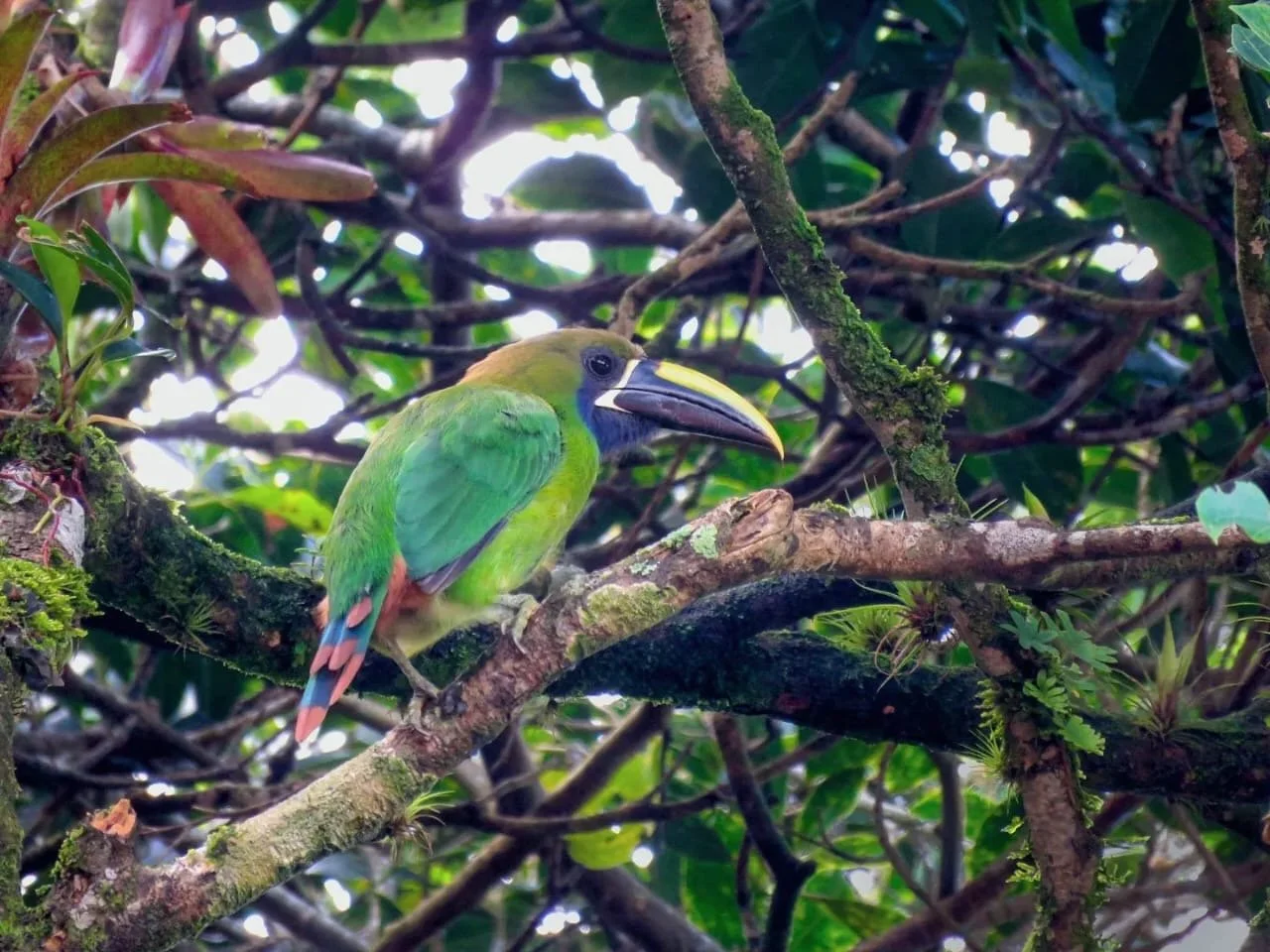
You may be looking for one of Panama's most spectacular mountain birds: the emerald toucanet.
The Northern Emerald-Toucanet is a small relative of the enormous toucans most people associate with the tropics. But don't let the word "small" fool you. These birds are spectacular. Their predominantly emerald-green bodies allow them to disappear remarkably well into the foliage, while flashes of blue, yellow and darker markings can suddenly become visible when the light catches them. They belong to the toucan family, but their lives are much more closely associated with the cool, humid mountain forests. The species is particularly associated with montane forest, where it forages through the canopy and understory.
And this is exactly what makes the Fortuna Forest Reserve such an interesting place to look for them.
The sound comes before the bird
One of the great secrets to finding toucanets is realizing that your ears may be more useful than your eyes.
The Northern Emerald-Toucanet's calls have been described as harsh, staccato, evenly spaced yelps or barking notes, along with lower frog-like croaks and groans.
To someone who has never heard one before, however, the description that often makes the most sense is simply:
It sounds like a bird laughing in the jungle.
Not a beautiful song. Not a gentle chirp. Not the musical whistle you might expect from a tropical bird.
It is stranger than that.
The call seems almost comical, especially when several birds are communicating through the forest. One bird calls from somewhere in the canopy, another answers from farther away, and suddenly you realize that the forest around you is full of invisible birds having a conversation that you cannot quite understand.
And once you learn the sound, you begin to notice them everywhere.
That is one of the wonderful things about staying somewhere like Lost and Found. The forest isn't something you have to drive to visit. It is literally surrounding you. The hostel is located inside the Fortuna Nature Reserve, with a network of forest trails and more than 10 kilometers of hiking routes described by the hostel.
Why Lost and Found is such a good place to listen
Lost and Found isn't simply a hostel next to a forest.
It is a hostel inside the forest.
The property sits in the cloud forests of the Fortuna region, surrounded by dense vegetation, mountain forest and wildlife. Historical ornithological research in the Fortuna Forest Reserve has documented an impressive diversity of birds, while a later analysis reported 299 bird species for the reserve and surrounding study area.
That means you don't necessarily need to wake up at 4 a.m., hire an expensive birding guide and spend the entire day staring through binoculars.
Sometimes you just need to sit still.
This is particularly important with toucanets because their green plumage can make them surprisingly difficult to see. A bird can be sitting only a few trees away while remaining almost completely invisible against leaves, moss and branches.
Then it moves.
A flash of green.
A strange bill.
A burst of sunlight catches its feathers.
And suddenly the bird you've been hearing for five minutes is right there.
For a backpacker, that can be a much more exciting experience than seeing a bird on a checklist. You weren't looking at a bird enclosure. You weren't following a predetermined wildlife tour.
You were simply walking through the jungle when the jungle revealed something to you.
The best strategy: stop walking
If you hear that strange laughing or barking sound around Lost and Found, don't immediately keep walking.
Stop.
This is one of the simplest tricks for seeing forest birds.
Stand still for a minute.
Listen again.
Try to figure out whether the sound is coming from above, behind you, or farther down the trail. Then slowly scan the branches rather than staring at the ground.
Look for movement.
Look for a silhouette.
Look for a flash of green.
And don't just look at the highest trees. Emerald toucanets can forage through both canopy and understory vegetation.
Sometimes you'll see one almost immediately.
Other times you'll hear it repeatedly without ever finding it.
And honestly, that's part of the fun.
The jungle doesn't owe you a photograph.
A bird built for the cloud forest
The environment around Fortuna is very different from the stereotypical image many people have of Panama.
This isn't necessarily the hot, steamy lowland rainforest that travelers imagine when they hear the word "jungle."
The cloud forest can be cool, damp and mysterious. Mist drifts through the trees. Moss covers branches. Bromeliads and orchids grow among the vegetation. Clouds can roll across the mountains and suddenly transform the landscape.
And somewhere in all of this, a bright green toucanet moves through the branches.
The bird's coloration is almost perfectly suited to this environment.
From a distance, green feathers disappear into green leaves.
Then the bird turns its head.
Suddenly you notice the enormous bill.
It hops onto another branch.
You see a flash of blue.
Then it disappears again.
That fleeting quality is one of the reasons encounters with toucanets can be so memorable.
Listen before you look
One of the best ways to experience the wildlife around Lost and Found is to stop thinking of the forest as something you are supposed to see.
Instead, think of it as something you are supposed to listen to.
Sit on the deck in the morning.
Walk slowly along the trails.
Take a hammock and do absolutely nothing for twenty minutes.
Leave your headphones behind.
You might hear birds you don't recognize. You might hear movement in the vegetation. You might hear monkeys somewhere in the distance. You might hear insects buzzing around the trees.
And then suddenly:
Kek-kek-kek-kek-kek!
There it is.
The jungle laugh.
Now you know what you're listening for.
And once you learn that call, the forest changes. You stop simply walking through trees and start paying attention to conversations happening above your head.
That's one of the magical things about birdwatching in Panama. You don't necessarily need to be an expert birder. You don't need a massive camera or expensive binoculars.
You just need curiosity.
And that's the real Lost and Found experience
For many backpackers, the wildlife around Lost and Found becomes almost accidental.
They come because they're traveling between Boquete and Bocas del Toro.
They arrive expecting a cool hostel in the mountains.
Then they discover that their "accommodation" is surrounded by cloud forest.
They wake up to birds.
They walk trails.
They see hummingbirds.
They hear monkeys.
And eventually someone points toward the canopy and says:
"Did you hear that?"
That's when the toucanet hunt begins.
The Fortuna Forest Reserve has long been recognized as an important area for bird diversity, and the hostel's location gives travelers unusually direct access to that environment.
So next time you're at Lost and Found, don't just look for the obvious animals.
Don't only search the trees for monkeys.
Don't only look for sloths.
Don't only wait for something colorful to fly past.
Listen.
Because somewhere above the trail, hidden among the green leaves of the cloud forest, there may be a little emerald bird calling out to another one.
And if you hear what sounds like a tiny, ridiculous jungle laugh echoing through the trees, there's a very good chance that Panama's cloud forest is introducing you to one of its most beautiful residents.
The toucanet.
And once you've heard that laugh, you'll never mistake it for an ordinary bird call again.