
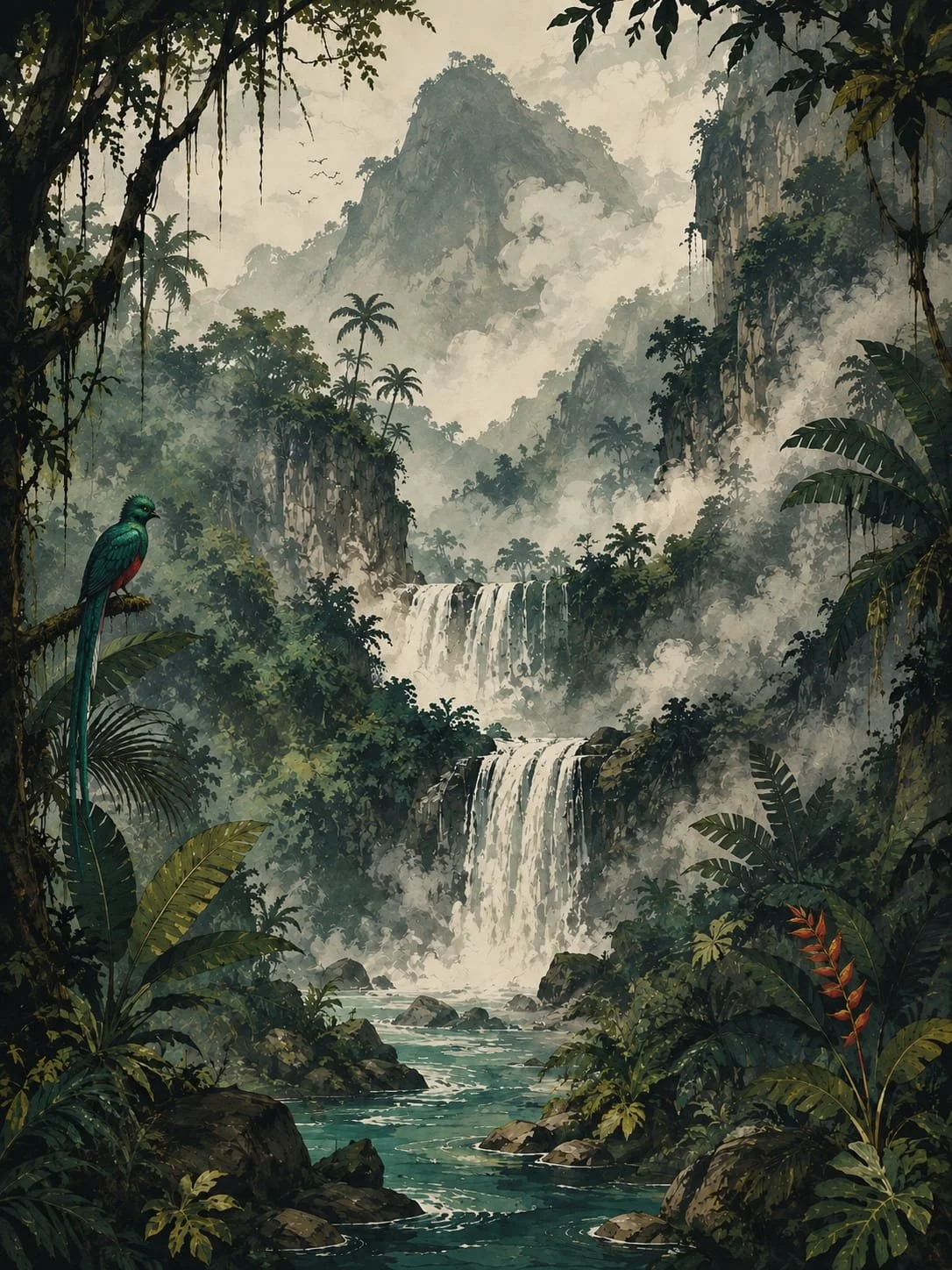
Central America has a reputation for being hot, tropical and green, but there is another side to the region that travelers quickly discover:
It rains. A lot.
For anyone planning a trip through Central America, rainfall can actually be a fascinating part of deciding where to go. The region sits between two enormous oceans, has mountain ranges running through its center, and is heavily influenced by tropical weather systems. The result is an incredible patchwork of rainforests, cloud forests, dry forests, Caribbean jungles and Pacific plains.
But which country is actually the wettest?
And perhaps more importantly for anyone planning a trip to Panama:
Where does Panama rank?
The answer is surprisingly impressive.
🥇 Panama is one of the wettest countries in Central America
If you compare the seven mainland Central American countries by average annual precipitation, Panama is right at the top.
One FAO-based dataset puts Panama at approximately 2,928 millimeters of precipitation per year, essentially tied with Costa Rica at 2,926 mm. Nicaragua follows at about 2,280 mm, while Guatemala, Honduras and El Salvador are generally lower on a national-average basis.
Another long-term regional analysis gives a somewhat different ranking, with Costa Rica averaging about 2,392 mm, Panama 2,641 mm, Nicaragua 2,440 mm and Guatemala 2,759 mm over its historical study period. The important point is that the exact ranking can change depending on the dataset and period used.
So rather than saying "Panama is definitely number one in every climate dataset," the more accurate statement is:
Panama is consistently among the two or three wettest countries in Central America, and in some widely used datasets it ranks number one.
That's pretty remarkable.
And once you start traveling around Panama, it makes perfect sense.
🌧️ So how does Central America stack up?
A rough ranking using the FAO-derived country averages gives us something like this:
🇵🇦 1. Panama
Approximately 2,928 mm/year
🇨🇷 2. Costa Rica
Approximately 2,926 mm/year
🇳🇮 3. Nicaragua
Approximately 2,280 mm/year
🇬🇹 4. Guatemala
Approximately 1,996 mm/year
🇭🇳 5. Honduras
Approximately 1,976 mm/year
🇧🇿 6. Belize
Approximately 1,850 mm/year
🇸🇻 7. El Salvador
Approximately 1,700–1,800 mm/year
These figures should be treated as broad national averages rather than a description of what the weather is like everywhere in each country. Mountains, coastlines, prevailing winds and rain shadows can completely transform rainfall over surprisingly short distances.
And that's especially important in Panama.
🇵🇦 Panama is basically a country of different rain worlds
One of the biggest mistakes a traveler can make is thinking:
"Panama gets 2,900 mm of rain, therefore everywhere in Panama is constantly wet."
Not even close.
Panama's geography creates enormous differences in rainfall.
The Caribbean side tends to be much wetter than the Pacific side. Some parts of the Caribbean coast receive around 3,000 mm or more annually, while parts of the Pacific side have a much more pronounced dry season.
And then you have mountains.
Mountains are extremely important because moist air hits them, rises, cools and produces rain.
That's one reason places such as Bocas del Toro, the Cordillera de Talamanca and parts of Chiriquí can feel dramatically wetter than areas farther east or along the Pacific.
A recent World Bank Panama climate profile gives Bocas del Toro an average annual precipitation of approximately 3,113 mm, with some months averaging around 400 mm or more. Chiriquí also sees extremely heavy rainfall during parts of the wet season, with October averaging more than 500 mm at the referenced location.
And research published in 2025 estimated a station-based average annual precipitation of approximately 3,429 mm for Panama for its study region and period, while also demonstrating how different precipitation datasets can produce significantly different estimates.
So when someone says:
"Panama is wet."
They're really understating it.
🌴 Bocas del Toro: Panama's wet side
If you want to experience Panama at its lushest, the Caribbean side is where things get interesting.
Bocas del Toro is famous for beaches and islands, but the environment around them is incredibly wet.
That rain is part of what creates the intense greenery.
The rainforest isn't green because somebody planted it.
It's green because the climate constantly supplies it with water.
Trees grow everywhere.
Vines climb everything.
Moss appears on surfaces.
Streams and waterfalls become part of the landscape.
And after a heavy tropical rain, the entire forest can seem to come alive.
For travelers who love jungle environments, this is one of Panama's greatest advantages.
☁️ Then there is the cloud forest
Go higher into Panama's mountains and the experience changes again.
Instead of simply having rain falling from the sky, you can find environments where clouds and mist become part of the forest itself.
Places around Boquete and the highlands of Chiriquí are famous for their cooler mountain climate and cloud-forest environments.
The result is completely different from Panama City.
You can leave the tropical heat behind and suddenly find yourself walking through misty forest surrounded by moss-covered trees, orchids, ferns and birds.
And this is where Panama's rainfall becomes something beautiful rather than something you complain about.
☀️ But wait... Panama also has a dry side
This is the part that surprises people.
Panama is extremely wet overall, but some areas can be surprisingly dry.
The central Pacific region sits partly in a rain shadow created by Panama's mountain ranges.
The World Bank's Panama climate profile notes that the country's central Pacific region contains some of its driest areas, while the Caribbean and western regions can receive dramatically more rainfall.
The Azuero Peninsula is particularly famous for its comparatively dry climate.
So you can travel across Panama and experience:
rainforest and cloud forest and tropical dry forest and beach and extremely wet Caribbean jungle
all within one relatively small country.
That's one of the fascinating things about Panama's geography.
🇨🇷 Panama vs. Costa Rica: The great Central American rain battle
If you're wondering which country is wetter, Panama or Costa Rica, you're asking a surprisingly difficult question.
They're extremely close in many datasets.
The FAO-derived figures put Panama at 2,928 mm and Costa Rica at 2,926 mm.
That's essentially a statistical tie.
Other datasets and historical periods can put Costa Rica ahead.
And honestly, trying to declare a single winner misses the bigger point.
Both countries are incredibly wet compared with most of the world.
Costa Rica has enormous wet zones on its Caribbean side and mountainous terrain that produces huge amounts of rainfall.
Panama has the same basic ingredients:
Caribbean moisture.
Pacific moisture.
Mountains.
Tropical temperatures.
And its position near the equator.
The result is a climate where rainforests can thrive.
🇳🇮 Nicaragua is wet too, but has a different personality
Nicaragua comes next in the broad national averages, at roughly 2,280 mm per year in the FAO-derived ranking.
But again, averages hide the story.
The eastern Caribbean side of Nicaragua can be extraordinarily wet, while areas around the Pacific side can have a much more pronounced dry season.
This is a recurring Central American theme:
The Caribbean side tends to be dramatically wetter than the Pacific side.
The mountains sitting between the two sides help create these differences.
🇬🇹 Guatemala is a fascinating exception
Guatemala can look surprisingly high on some historical precipitation comparisons.
One regional study actually found Guatemala had an average of approximately 2,759 mm, higher than Panama and Costa Rica during its particular historical period.
That demonstrates why rainfall rankings need to be treated carefully.
Different datasets measure different periods.
Different models produce different estimates.
And national averages can hide huge local differences.
A country can have incredibly wet rainforests and relatively dry highlands at the same time.
So if somebody tells you:
"Country X is number one because Google says so,"
the scientifically honest answer is:
"It depends on the dataset."
🌧️ What does all this mean for travelers?
It means you shouldn't necessarily look at rain as a reason to avoid Panama.
You should look at it as part of the experience.
Panama's rain is one of the reasons the country looks the way it does.
It creates jungles.
It fills rivers.
It feeds waterfalls.
It supports enormous biodiversity.
It creates cloud forests.
It keeps the Caribbean side incredibly lush.
And it helps produce the spectacular landscapes that people travel thousands of kilometers to see.
The trick is understanding when and where the rain happens.
Panama's wet season doesn't mean it necessarily rains continuously from morning until night.
A typical tropical day can be beautiful in the morning, become cloudy around midday, produce a massive afternoon downpour and then clear again.
Sometimes the rain lasts twenty minutes.
Sometimes it lasts three hours.
Sometimes you get a spectacular thunderstorm.
And sometimes you get an entire day of rain.
That's tropical weather.
🌦️ And there's something magical about a Panamanian rainstorm
If you've never experienced a serious tropical downpour in a rainforest, it's worth seeing.
The sky suddenly turns dark.
The wind changes.
You hear the first drops hitting the leaves.
Then suddenly...
BOOM.
The rain arrives.
And it can be absolutely enormous.
The sound of thousands of drops hitting leaves simultaneously is almost deafening.
Streams that looked insignificant an hour earlier suddenly become rushing rivers.
The smell of wet earth fills the air.
Then, eventually, the storm passes.
Birds start calling again.
The forest starts moving.
And you realize that the rain wasn't interrupting the jungle.
The rain was the jungle.
🇵🇦 So where does Panama REALLY sit?
If you're looking for a simple answer:
Panama is at or very near the top of the Central American rainfall rankings.
Depending on the dataset and time period, Panama can rank first, while other long-term datasets put Costa Rica or Guatemala ahead. But Panama consistently belongs in the region's wettest group.
And geographically, Panama has some truly spectacular wet environments.
Bocas del Toro can receive more than 3,100 mm of rain annually in the World Bank's cited climatology.
Recent station-based research puts Panama's average even higher for its analyzed region, at around 3,429 mm per year.
So if someone tells you:
"Costa Rica is the rainy country."
You can smile and say:
"Panama would like a word."
Because Panama isn't merely somewhere that happens to have a rainy season.
Rain is one of the fundamental forces that created the Panama travelers come to experience.
The jungles.
The mountains.
The waterfalls.
The cloud forests.
The rivers.
The incredible biodiversity.
And those impossibly green landscapes.
So bring a rain jacket.
Keep your camera protected.
Don't trust the blue sky too much.
And when the clouds roll over the mountains and the rain starts pounding the jungle...
embrace it.
You're standing in one of the wettest corners of Central America. 🌧️🇵🇦