
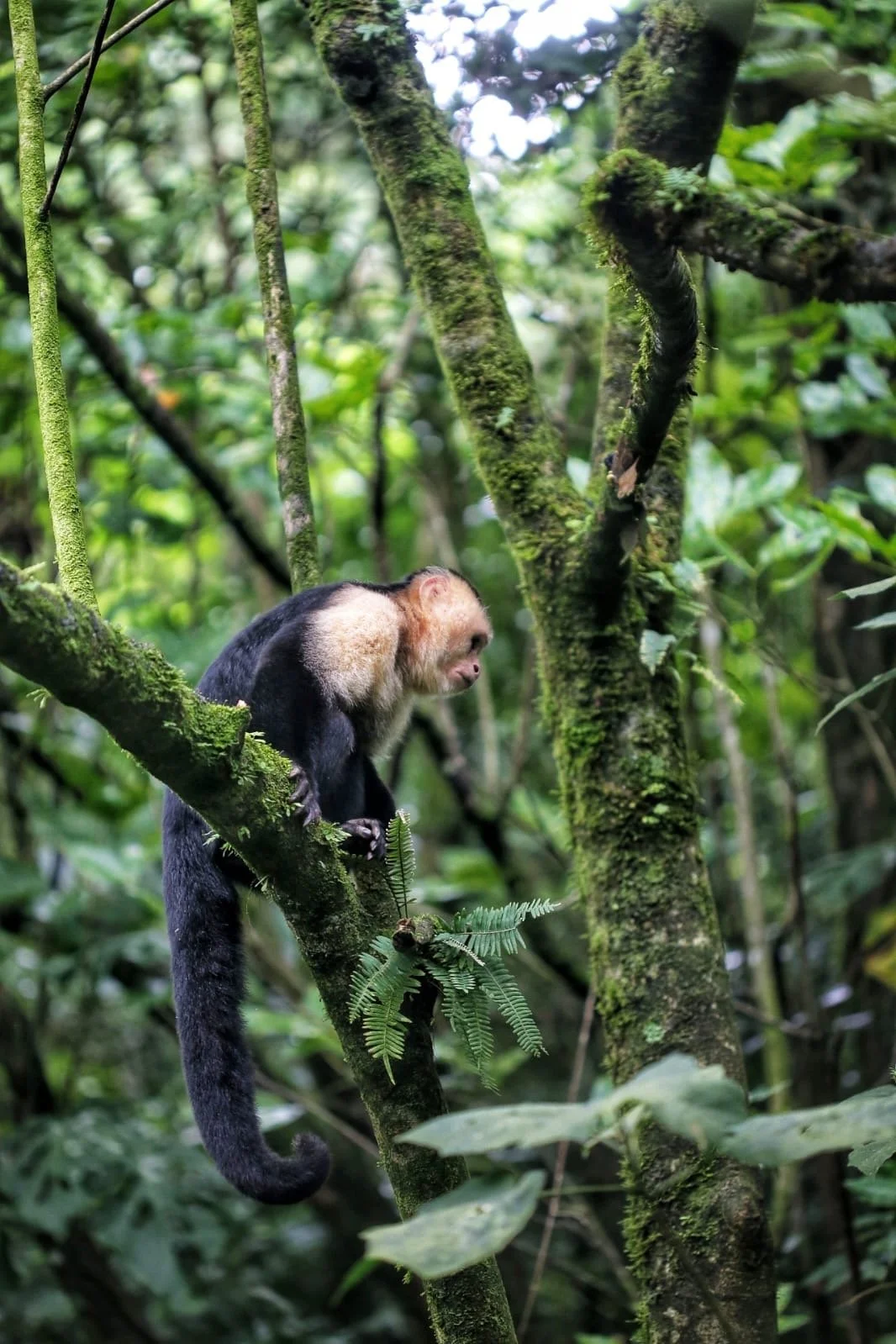
When most travellers think about wildlife in Panama, they imagine sloths hanging from trees, toucans flying overhead, monkeys crashing through the canopy and brightly colored frogs hiding beneath leaves. Almost nobody comes to Panama hoping to see a fly.
And yet, flies are everywhere.
They are on jungle trails, around fruit stands, near rivers, in gardens, around livestock, inside houses, beside restaurants and deep in the rainforest. Some are annoying. Some bite. Some are astonishingly beautiful. Some are almost impossible to recognize as flies. And some are so scientifically useful that researchers in Panama have figured out how to use their stomach contents to discover what mammals are living in the rainforest.
The word "fly" also hides an enormous amount of diversity. Scientifically, the true flies belong to the order Diptera, characterized by having one pair of functional wings and a second pair modified into tiny balancing structures called halteres. There are more than 110,000 described species of true flies worldwide, and Panama's extraordinary tropical biodiversity makes its fly fauna particularly fascinating.
In other words, when you slap a fly away from your lunch in Panama, you may be dealing with one tiny representative of an absolutely enormous biological universe.
The Ordinary House Fly Isn't the Whole Story
The fly that lands on your food is probably the one you notice most.
House flies and related species have become extremely successful around humans because they take advantage of food waste, garbage, animal waste and other organic material. They're opportunists.
But step away from civilization and the fly world changes dramatically.
In the forest, you'll encounter flies that pollinate plants, flies that hunt other insects, flies that live in water during their larval stage, flies that consume decaying material and flies that have evolved extraordinary relationships with other organisms.
Some look like bees.
Some look like wasps.
Some resemble mosquitoes.
Some are enormous.
Some are metallic green or blue.
And some are so bizarre that you'd never guess they belonged to the same enormous group.
The Smithsonian Tropical Research Institute, which has conducted decades of insect research in Panama, describes the country's insect fauna as extraordinarily diverse and continues to study tropical insect biodiversity, behavior and evolution.
The Beautiful Metallic Flies
One of the most spectacular groups you're likely to encounter is the family of blow flies, which includes some wonderfully shiny species.
Forget the dull gray fly sitting on your kitchen window.
Some blow flies can be brilliant metallic blue, green or bronze.
They can look almost like tiny pieces of polished jewelry flying through the forest.
Their larvae are often associated with carrion and other decaying organic material, which gives these flies a rather unpleasant reputation. But ecologically, that lifestyle is incredibly important.
They are part of nature's cleanup crew.
A dead animal doesn't simply disappear.
It enters a complicated ecosystem involving bacteria, fungi, beetles, flies and countless other organisms.
Flies can arrive remarkably quickly and begin the process of decomposition.
And in Panama's warm tropical environment, that process can happen at astonishing speed.
The Fly That Knows What Died in the Forest
This is where Panama's flies become genuinely fascinating.
Scientists working with the Smithsonian Tropical Research Institute discovered that carrion flies can effectively act as flying wildlife detectors.
Carrion flies feed on dead animals, feces and other biological material. While doing so, they ingest DNA from the animals they've encountered.
Researchers in Panama realized they could capture these flies and analyze the DNA inside their digestive systems.
The result?
The flies could reveal which mammals were living in the forest.
At Barro Colorado Island, scientists tested the technique and found that carrion fly DNA could be used to detect more mammal species than researchers could identify simply by walking trails or relying on camera traps.
Think about how incredible that is.
A scientist doesn't necessarily have to photograph a secretive jungle animal.
They can catch a fly.
The fly has already done the detective work.
Panama's Flies Become Little Crime Scene Investigators
Imagine a jaguar walking through the forest at night.
You don't see it.
A camera doesn't see it.
You don't find its tracks.
But somewhere nearby, a carrion fly encounters biological material left behind by an animal.
The fly feeds.
Later, scientists catch that fly.
They examine its gut.
And suddenly, the fly can provide a genetic clue that a particular mammal is present.
It's almost like the forest has its own tiny surveillance system.
Researchers described carrion flies as remarkably effective biological samplers because they move around the environment and encounter material from many different animals.
That makes a creature most people swat away potentially valuable to conservation science.
Then There Are Horse Flies
If you've ever spent time around horses, cattle, wetlands or forest edges in Panama, you've probably encountered another category that gets considerably less love.
Horse flies, members of the family Tabanidae, are powerful flying insects, and females of many species take blood meals.
They can be persistent.
They can be painful.
And some species are surprisingly large.
Panama has a long history of scientific research on Tabanidae. The Smithsonian's collections contain extensive taxonomic work on Neotropical horse flies, including research conducted through the Gorgas Memorial Laboratory in Panama.
If a large fly repeatedly follows you around a trail and seems considerably more interested in you than the flowers are, you may have encountered one.
Sand Flies Are a Completely Different Problem
Then there's a name that can make travellers nervous:
sand flies.
These aren't simply miniature versions of ordinary flies.
Certain sand flies in Panama can transmit Leishmania, parasites responsible for cutaneous leishmaniasis.
Researchers from the Smithsonian Tropical Research Institute and Gorgas Memorial Laboratories surveyed sand flies on Barro Colorado Island and identified 20 species. Two of the species carried Leishmania naiffi.
That doesn't mean every tiny flying insect in Panama is dangerous.
Far from it.
But it does mean travellers hiking through tropical forests should take biting insects seriously.
Repellent, long sleeves and long pants can be particularly useful in forest environments, especially around dawn and dusk. Smithsonian researchers specifically recommended those measures for people visiting lowland tropical forests where leishmaniasis is endemic.
The Black Soldier Fly Is Actually a Hero
Here's another fly that completely destroys the idea that flies are simply pests.
The black soldier fly, Hermetia illucens, looks more like a wasp than the stereotypical house fly.
And Panama is using it for something incredibly useful.
Researchers at the Smithsonian Tropical Research Institute have been breeding black soldier flies to process food scraps.
Their larvae consume organic waste and can help convert it into useful products such as fertilizer, animal feed and potentially extractable oils.
So while one fly is landing on your sandwich, another species may be helping solve a waste-management problem.
Not all flies are the enemy.
Some are basically tiny recycling machines.
Flies Can Be Pollinators Too
This is another side that tourists rarely consider.
Bees get most of the publicity when people talk about pollination, but flies can be important pollinators as well.
Some flowers actually attract flies deliberately by producing odors resembling decaying material.
It sounds disgusting.
From the plant's perspective, it's brilliant.
The fly thinks it has found somewhere to feed or lay eggs.
Instead, it gets covered in pollen and carries that pollen to another flower.
The plant gets pollinated.
The fly gets fooled.
Evolution wins.
The Rainforest Is Basically a Fly Universe
Panama's tropical forests provide an incredible variety of environments for insects.
The forest floor is wet and full of decaying vegetation.
Streams and pools provide aquatic habitats.
Flowers provide nectar.
Fruits provide food.
Dead animals provide carrion.
Dung provides another resource.
The canopy creates an entirely different environment hundreds of feet above the ground.
Every one of these niches can support specialized insects.
And this is why scientists continue discovering new things about Panama's insects.
The Smithsonian Tropical Research Institute has described Panama as an exceptional location for studying tropical biodiversity, with insect sampling in forest canopies suggesting astonishingly high numbers of insect species.
Some Flies Are Masters of Disguise
Walk through a Panamanian garden and you may see an insect hovering over a flower that looks exactly like a bee.
It might actually be a flower fly, also known as a hoverfly.
This is called mimicry.
The fly gains protection because predators may hesitate to attack something that looks like a stinging insect.
There are also robber flies, bee flies and many other groups with bizarre appearances.
The Smithsonian notes that flies are particularly impressive mimics, with groups such as bee flies, flower flies and robber flies evolving appearances that can resemble bees or other insects.
So if you're hiking and see what looks like a tiny bee hovering perfectly still beside a flower, take a closer look.
It might be a fly pretending to be a bee.
The Maggot Is Just a Baby Fly
Perhaps the least glamorous stage of a fly's life is the maggot.
But even maggots are fascinating.
Fly larvae can live in water, rotting plant material, decaying animals and many other environments. Different species have evolved extraordinarily specific diets and lifestyles.
In a tropical environment like Panama, where warmth and moisture accelerate decomposition, fly larvae can play an enormous role in breaking organic matter down.
That pile of dead leaves on the forest floor isn't simply garbage.
It's a biological factory.
And flies are part of the workforce.
Flies Are Everywhere on a Jungle Hike
For travellers, the most noticeable thing about flies is usually simple:
They're persistent.
You may have tiny flies around your face.
Larger flies around animals.
Flies attracted to food.
Biting flies near certain environments.
And countless tiny species you barely notice.
But instead of thinking of all of them as one annoying category, try paying attention.
What does it look like?
Is it metallic?
Does it hover?
Does it bite?
Does it look like a bee?
Is it enormous?
Is it sitting on a flower?
Is it near carrion?
Is it moving around animal dung?
Suddenly the annoying buzzing becomes a wildlife observation opportunity.
And Panama Is One of the Best Places to Do It
Panama has an extraordinary scientific history surrounding insects.
The Smithsonian has maintained a major tropical research presence in the country for more than a century, and its insect collections now contain more than 130,000 specimens. Researchers continue to study insects as fundamental components of tropical ecosystems.
That means Panama isn't merely a place where you happen to encounter lots of bugs.
It is one of the world's great natural laboratories for studying them.
And flies are a huge part of that story.
The Next Time a Fly Annoys You...
Before you immediately reach for the swatter, take a second look.
Maybe it's a metallic blow fly helping recycle a dead animal.
Maybe it's a flower fly pretending to be a bee.
Maybe it's a black soldier fly whose relatives are helping turn food waste into useful products.
Maybe it's a carrion fly carrying the genetic clues of an animal you will never see.
Or maybe it's simply a house fly that really wants your lunch.
That's the beauty of Panama.
The obvious wildlife gets all the attention, but some of the most extraordinary stories are happening at eye level, on leaves, around flowers, beside streams and even inside the stomachs of insects.
In Panama, even the humble fly can turn out to be a scientist, recycler, pollinator, detective or evolutionary masterpiece.
And once you start paying attention to them, you may discover that the buzzing around your head isn't just background noise.
It's an entire world.