
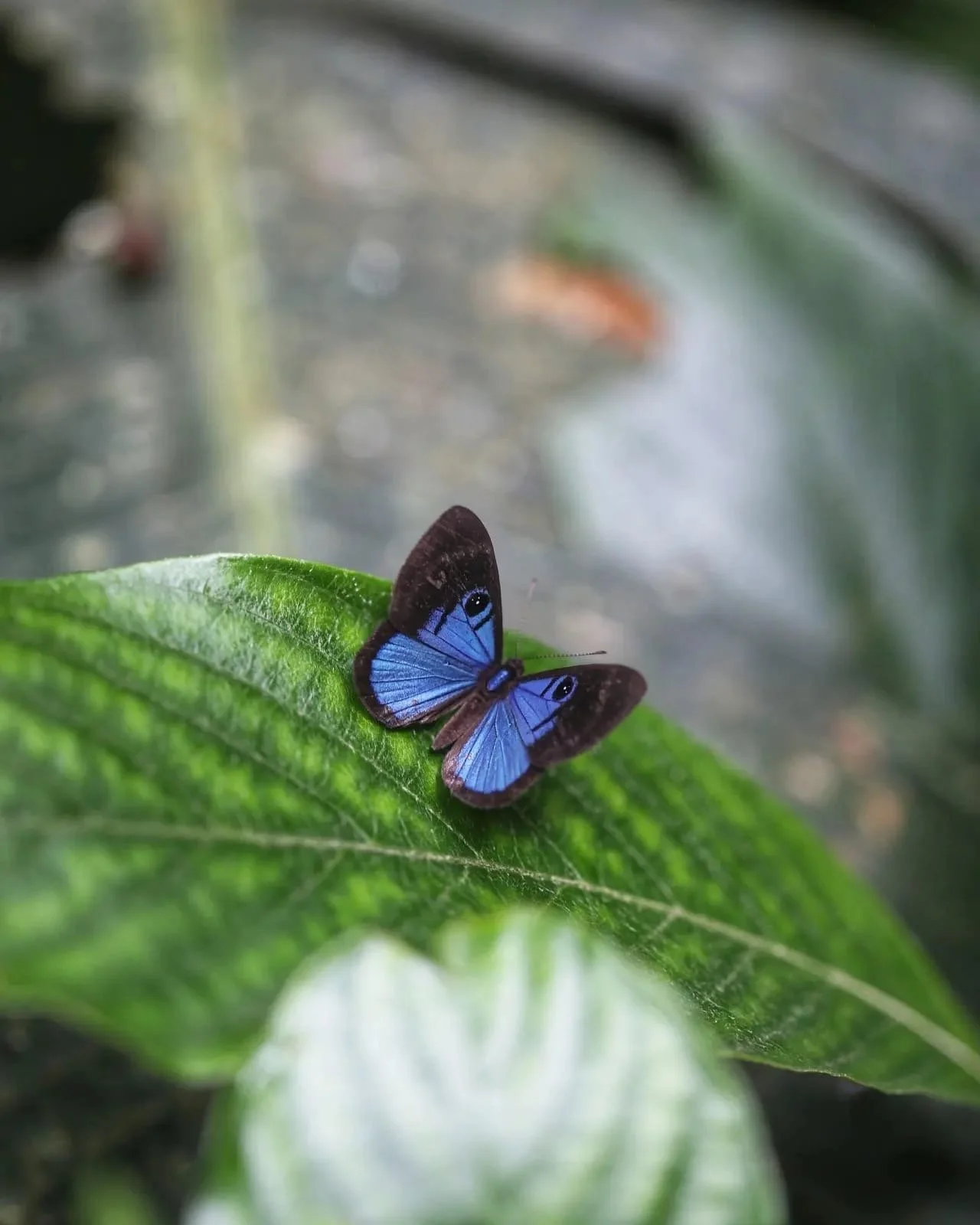
There are moments in Panama when the forest suddenly seems to come alive with magic.
You can be walking along an ordinary jungle trail, thinking about where you're going, watching the leaves and listening to birds, when suddenly something enormous and electric blue flies across the path.
For half a second, the forest disappears.
There is only blue.
Then the butterfly vanishes into the greenery.
You stop.
You turn around.
You wonder if you actually saw it.
A few seconds later, another flash appears farther down the trail.
Welcome to the world of the Blue Morpho.
For many travellers, seeing a Blue Morpho for the first time becomes one of those unexpectedly unforgettable Panama moments. They aren't necessarily looking for butterflies when they arrive. They may be searching for monkeys, sloths, toucans or frogs. Then this enormous blue butterfly suddenly crosses their path and completely steals the show.
Panama is home to several species of Morpho, with Morpho peleides among the most commonly observed. They are particularly associated with forest trails, streams, roadsides and edges of wooded areas.
That Blue Isn't Actually Blue
This is perhaps the coolest thing about the Blue Morpho.
Its incredible color isn't simply blue pigment.
The brilliant metallic appearance comes from the microscopic structure of the scales covering its wings. Those structures interact with light in a way that produces the extraordinary blue we see.
In other words, the butterfly isn't carrying around a bottle of blue paint.
It is using physics.
The tiny structures on its wings reflect particular wavelengths of light toward your eyes, producing that intense blue flash. When the angle changes, the effect changes too. That's why a Morpho can appear brilliantly blue one moment and almost disappear the next.
And photographs often don't quite do them justice.
In person, the blue can look almost artificial.
It is so bright that your brain initially has trouble believing you're looking at a real animal.
And Then It Closes Its Wings
This is where the Morpho becomes even more fascinating.
When its brilliant upper wings aren't visible, the butterfly looks completely different.
The underside is predominantly brown and camouflaged, with eye like markings that help break up its outline and potentially discourage predators.
So the same butterfly has two completely different appearances.
Open its wings and it looks like a piece of glowing tropical sky.
Close them and it can practically disappear into the forest.
That contrast is one of the reasons the Morpho is such an extraordinary example of tropical evolution.
When Are You Most Likely to See Them?
This is the question every traveller eventually asks:
"When do I actually have the best chance of seeing one?"
The answer isn't as simple as naming one particular month because conditions matter enormously.
Morphos are strongly associated with warm, sunny periods, and they become much easier to notice when sunlight reaches the forest.
Late morning through the early afternoon can be particularly productive because the butterflies are warmed by the sun and actively flying. The Lost and Found Hostel's own observations similarly note that Morphos are most active during warmer, sunnier parts of the day, particularly late morning and early afternoon.
And here's the really interesting part.
Rain doesn't necessarily ruin your chances.
In Panama, a rainy morning can turn into a sunny afternoon.
When the clouds break and sunlight floods back into the forest, butterflies can suddenly become much more active. Local observations specifically describe Morphos emerging during sunny periods after rain.
So don't necessarily look at a rainy morning and decide that the jungle is closed for butterflies.
Wait for the sun.
The Best Strategy Isn't to Chase Them
This is one of the biggest mistakes people make.
You see the blue.
You run after it.
It's gone.
You run farther.
Still gone.
You turn around.
Another one flies behind you.
Morphos can be surprisingly frustrating to photograph because their flight can take them quickly along established routes through the forest.
Panama's Smithsonian Naturalist tradition has documented that Morpho butterflies often use particular "aerial trails" while searching for food and mates. If you see one repeatedly passing through a particular area, staying there and watching can actually be more productive than chasing it down the trail.
This is one of the great lessons of jungle wildlife watching:
Stop moving.
Let the forest come to you.
Watch the Openings
If you're walking through dense forest, pay particular attention to places where sunlight breaks through.
Forest edges.
Trail openings.
Riverbanks.
Clearings.
Road edges beside forest.
Sunny patches beneath the canopy.
These transition areas can be excellent places to watch for Morphos. They are often easier to see when they cross open spaces because that brilliant blue contrasts dramatically against the green background.
You might walk through fifty metres of dark forest without seeing anything.
Then you reach a sunny opening.
And suddenly:
FLASH.
Blue.
Gone.
Lost and Found Hostel: When the Jungle Becomes Your Butterfly Trail
One particularly special place to experience this is Lost and Found Hostel, tucked into the forest in Chiriquí between Boquete and Bocas del Toro.
The property is surrounded by cloud forest, jungle vegetation, gardens and its own network of trails, creating exactly the sort of environment where travellers can encounter butterflies without needing to go on a formal wildlife expedition.
Guests have reported seeing Morphos moving through the gardens and forest paths, sometimes appearing unexpectedly while people are simply walking around the property or relaxing outside.
And that's what makes the experience so memorable.
You aren't necessarily sitting in a hide waiting for wildlife.
You're drinking coffee.
You're walking to breakfast.
You're heading down a trail.
You're coming back from a hike.
And suddenly a gigantic blue butterfly floats through the vegetation.
The jungle has provided the entertainment.
The Trails Are Part of the Experience
One of the beautiful things about looking for Morphos at Lost and Found is that you don't necessarily need to dedicate an entire afternoon to butterfly watching.
Just walk.
Slowly.
The same principle applies throughout Panama.
Morphos have been documented along forest trails, streams, roadsides and forest edges, so simply hiking through suitable habitat can produce encounters.
And once you know what that blue flash looks like, you become much better at spotting it.
At first you see a butterfly.
Eventually you start seeing movement.
That little flicker between the leaves.
That strange flash of color in the distance.
The brief reflection of sunlight.
Your eyes become trained to look for it.
Don't Expect Them Every Five Minutes
This is important.
Blue Morphos are spectacular, but they aren't guaranteed on every trail at every hour.
Wildlife doesn't work like an amusement park.
You can walk for an hour and see none.
Then you can encounter several in fifteen minutes.
A bird may suddenly appear.
A monkey may cross overhead.
A Morpho may fly directly toward you.
That's part of the experience.
The uncertainty makes the sighting more exciting.
You aren't ticking a box.
You're having a genuine encounter with something wild.
Why They Seem to Appear and Disappear
The blue color itself contributes to the illusion.
When the wings beat and catch the light, you see that extraordinary flash.
When the butterfly changes direction, closes its wings or moves into shade, the brilliant blue can disappear almost instantly.
This creates the impression that the butterfly is literally switching itself on and off.
One second:
BLUE.
The next:
Nothing.
Then another flash somewhere else.
It can make following one feel like trying to track a piece of light.
The Blue Morpho Is Bigger Than You Expect
Many travellers have seen photographs of Blue Morphos before arriving in Panama, but photographs don't always communicate their scale.
These are not tiny garden butterflies.
Depending on the species, Morphos can have a wingspan approaching 20 centimetres.
When something that large and that blue flies directly across a jungle trail, it gets your attention.
Even people who normally couldn't care less about butterflies stop walking.
They Are Part of a Much Bigger Jungle Story
The Morpho is not simply a beautiful decoration flying around Panama.
It is part of an enormous ecological network.
Butterflies interact with plants throughout their life cycles, and their caterpillars depend on particular host plants. Adults may feed on nectar, fruit, sap and other resources depending on the species.
And their presence tells you something about the forest.
A jungle full of butterflies isn't just visually spectacular.
It represents an ecosystem with plants, flowers, fruits, fungi, insects, birds and countless other organisms interacting with one another.
The butterfly is simply one of the most spectacular pieces you happen to notice.
And Then There Is the Caterpillar
If you ever see a Morpho caterpillar, don't expect it to look anything like the adult.
The transformation is almost absurd.
You go from a strange caterpillar to one of the most spectacular butterflies in the tropical Americas.
The caterpillar stage is primarily about eating and growing.
Then comes the chrysalis.
Inside, an extraordinary biological transformation takes place.
Eventually, the adult emerges, waits for its wings to expand and harden, and takes its first flight.
That brilliant blue butterfly crossing your trail is therefore the final chapter of an extraordinary process that began as a tiny egg.
Panama Is an Incredible Place for Butterfly Watching
One reason Panama is so rewarding for wildlife lovers is the sheer variety of habitats packed into a relatively small country.
Lowland rainforest.
Cloud forest.
Mountain valleys.
Rivers.
Coasts.
Mangroves.
Gardens.
Agricultural landscapes.
Each creates opportunities for different species.
Panama has an exceptionally rich butterfly fauna, with more than 1,000 species documented and estimates sometimes considerably higher depending on classification and counting methods.
And while the Blue Morpho gets most of the attention, once you start watching butterflies you'll quickly discover that it is only the beginning.
There are swallowtails.
Heliconias.
Skippers.
Leafwings.
Satyrs.
Metalmarks.
And countless tiny species you may never have noticed before.
The Morpho simply gets you looking.
The Best Part Is the Surprise
Maybe you're walking the trail at Lost and Found.
Maybe you're hiking near Boquete.
Maybe you're beside a river.
Maybe you're simply walking along a forest road somewhere in Panama.
You aren't expecting anything.
Then something enormous flashes across your vision.
Electric blue.
For a second, it looks almost like a bird.
Then you realize what you've seen.
A Blue Morpho.
You stop.
The forest becomes quiet again.
You wait.
Maybe it comes back.
Maybe it doesn't.
But you've seen it.
And that's enough.
Because the Blue Morpho isn't really something you go to Panama to collect from a checklist.
It's something you experience.
A flash of impossible color in a green jungle.
A reminder that nature doesn't need to manufacture spectacle.
It simply creates it.
So when you're hiking in Panama, especially through forest trails around places like Lost and Found Hostel, keep your eyes open.
Walk slowly.
Look toward sunny clearings.
Pay attention after the rain when the sun returns.
And if you see that first electric blue flash, don't chase it.
Stop.
Watch.
Wait.
There is a good chance that somewhere along that same invisible aerial highway through the forest, your Blue Morpho will come back around.
And when it does, for just a few seconds, the jungle will belong to you and that impossible blue butterfly.