
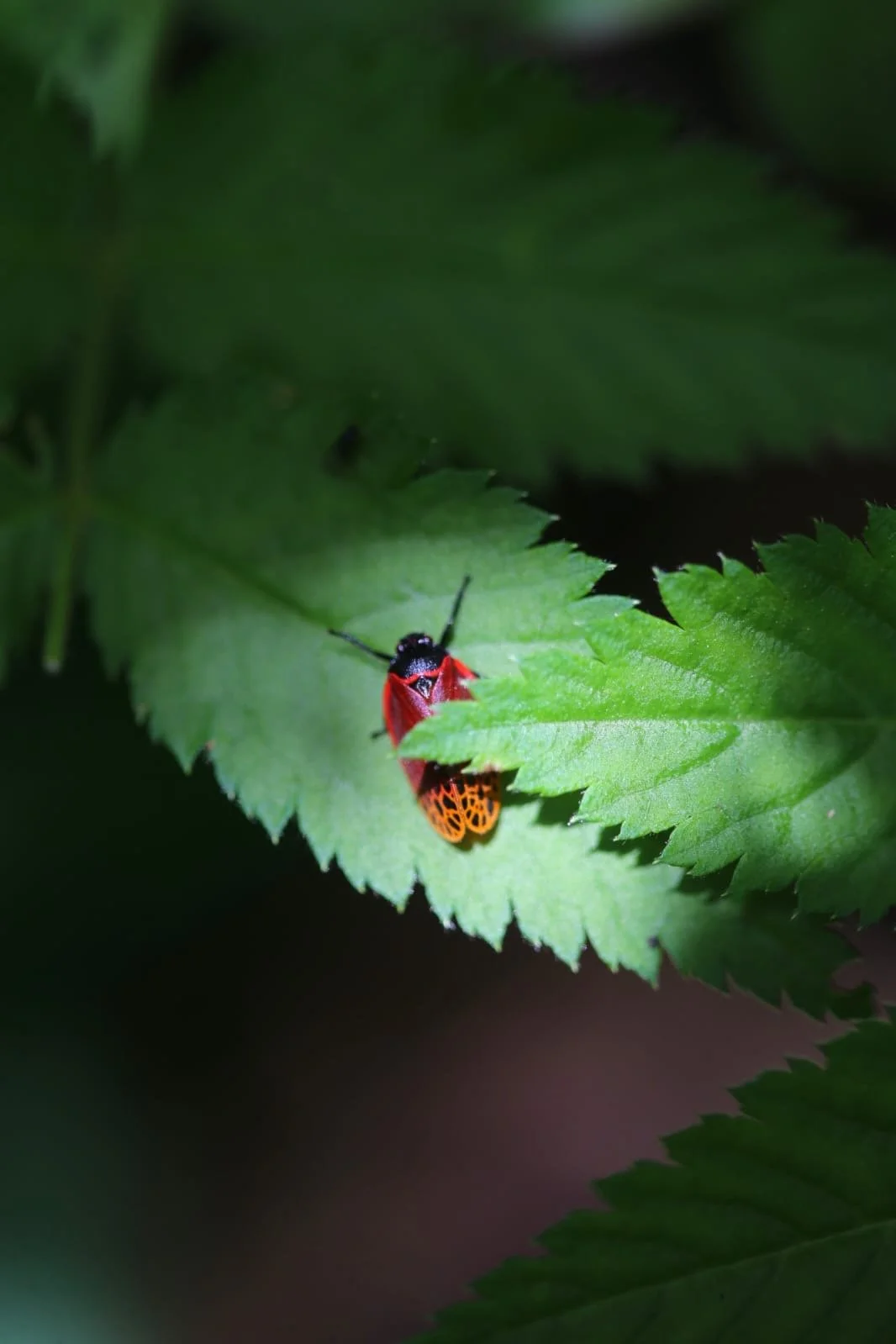
Panama is famous for its jungles, beaches, monkeys, sloths, toucans, frogs and spectacular scenery. But there is another side to the country's wildlife that becomes impossible to ignore once you start traveling around: the bugs.
And Panama does not do bugs halfway.
This is a tropical country where the insects can be enormous, brilliantly colored, unbelievably loud, spectacularly ugly, surprisingly beautiful and occasionally capable of making you reconsider sleeping outdoors altogether. Panama has more than 245 species of mosquitoes, and researchers continue to document an extraordinary variety of other insects throughout the country.
So if you're backpacking through Panama, particularly if you're staying in hostels, hiking through forests, visiting islands, camping, swimming in rivers or simply leaving your bedroom window open, you are effectively entering an enormous free insect zoo.
You don't need a ticket.
You don't even need to want to go.
The exhibits will come to you.
And some of them can fly.
The Mosquito: Panama's Tiny Little Criminal
Let's start with the insect everyone already knows.
The mosquito.
You will probably meet one before you meet a monkey.
Possibly before you meet your hostel roommate.
And unlike the monkey, the mosquito is interested in you for deeply personal reasons.
Panama's mosquito diversity is enormous, with more than 245 species recorded. Some are harmless to humans, while others can transmit diseases. Researchers at the Smithsonian Tropical Research Institute have studied mosquitoes in Panama for more than a century, including species such as the Yellow Fever Mosquito and Asian Tiger Mosquito.
The Yellow Fever Mosquito is particularly well adapted to living around people and can breed in surprisingly ordinary containers holding water. The Asian Tiger Mosquito has also established itself in Panama and can breed in small water-holding containers.
So that innocent bucket sitting behind your hostel?
Potential mosquito real estate.
That discarded tire collecting rainwater?
Five-star mosquito condominium.
That flowerpot saucer?
Apparently premium beachfront property.
The mosquito is basically the ultimate backpacking parasite because it doesn't need a rainforest.
It just needs you, some water and an opportunity to ruin your evening.
The Army Ant: When the Forest Starts Moving
Then there are Army Ants, and these are on an entirely different level.
Imagine walking through a Panamanian forest and noticing that the ground appears to be moving.
Then you realize the ground isn't moving.
The ants are.
Army ants can travel in enormous columns and swarms, hunting other insects, spiders and even small vertebrates. Smithsonian researchers in Panama have documented swarms containing astonishing numbers of ants, with some colonies numbering up to around 200,000 individuals.
They don't sit around waiting for dinner.
They go looking for it.
And when they find something edible, they can overwhelm it with sheer numbers.
This is one of those moments when the jungle suddenly stops feeling like a peaceful place for hiking and starts feeling like nature has activated a military operation.
The good news is that Army Ants aren't wandering around Panama specifically hunting backpackers.
You're not the target.
You're simply standing in the way.
And if you see an enormous moving column crossing the trail, the correct response is generally to admire it rather than stick your hand into it and discover what happens.
The Bullet Ant: An Insect With an Extremely Honest Name
Then there is the Bullet Ant.
Even if you've never seen one, the name already provides enough information.
This is not called the "Slightly Uncomfortable Ant."
It is not the "Tiny Little Pinch Ant."
It is the Bullet Ant.
Its sting is famously painful, and it is one of the insects that has contributed to the mythology surrounding tropical rainforest exploration.
Seeing one can actually be fascinating because these are large, impressive ants. But there is absolutely no reason to conduct your own scientific experiment by allowing one to sting you.
You don't need to know exactly how painful it is.
The internet has already done the research for you.
The Giant Cockroach: The Backpacker's Inevitable Roommate
Of course, we cannot discuss Panama without mentioning Cockroaches.
You are not leaving Panama without seeing one.
It might be tiny.
It might be large.
It might be enormous.
It might be in the bathroom.
It might be outside your hostel.
It might be underneath a table.
And there is always the possibility that it will choose the worst possible moment to reveal itself.
Panama has a surprisingly diverse cockroach fauna. A University of Panama study compiled 156 species, showing that the country has far more cockroach diversity than the average traveler would ever suspect.
Some are closely associated with human buildings.
Others are forest inhabitants.
And some are so spectacularly large that your first reaction will probably be less "What species is that?" and more:
"WHY DOES IT HAVE WINGS?"
The answer, unfortunately, is that some do.
Welcome to Panama.
The Tarantula: Basically a Furry Nightmare With Legs
Tarantulas are another classic tropical encounter.
They look terrifying.
They are furry.
They have eight legs.
They have fangs.
And some are enormous.
But here's the important part: seeing one doesn't mean it wants anything to do with you.
Most tarantulas would much rather retreat than confront a human.
The problem is that humans are terrible at remaining calm when an enormous spider unexpectedly appears beside their shoe.
Especially at night.
Especially when you're wearing flip-flops.
Especially when someone says:
"Don't move."
That sentence has never made anyone feel better.
The Wandering Spider: Don't Touch That Spider
Panama also has Wandering Spiders, a group famous for their defensive behavior and medically significant venom.
These are not spiders you want to pick up for a photograph.
The problem with tropical wildlife is that some animals look spectacular precisely because they have evolved ways of surviving predators.
A good rule for Panama is therefore extremely simple:
If you don't know what it is, don't touch it.
You don't need to poke the spider.
You don't need to put your finger next to it for scale.
And you definitely don't need to let it crawl onto your backpack because you think it would make a fantastic Instagram photograph.
Take the picture from a sensible distance.
Your fingers will appreciate the decision.
The Golden Silk Spider: Beautiful, Huge and Completely Unbothered
Not every spider encounter is terrifying.
The Golden Silk Spider can be spectacular.
Its enormous webs can stretch across gaps in vegetation, and the spider itself can look almost prehistoric when viewed up close.
The web is particularly impressive because of its golden coloration.
You may walk directly into one.
This is a rite of passage.
There is no graceful way to walk into a giant spider web.
You immediately perform an involuntary dance while shouting something that would not be appropriate in a nature documentary.
Then you spend the next five minutes wondering whether the spider is still on you.
It probably isn't.
But you're going to check anyway.
The Assassin Bug: Pretty Name, Terrible Career Choice
Assassin Bugs sound like something invented by a twelve-year-old designing a video game.
Unfortunately, they're real.
They're predatory insects that use piercing mouthparts to capture other insects.
Some members of this group are also medically important because certain species can transmit parasites responsible for Chagas disease.
That doesn't mean every Assassin Bug you see is dangerous.
It does mean they're another reason why you shouldn't casually collect strange insects and keep them in your hostel room.
Panama's insect fauna includes representatives of the assassin bug family, along with an enormous variety of other true bugs.
The Praying Mantis: The Calm Serial Killer
Praying Mantises are probably among the easiest insects to admire.
They look elegant.
They move slowly.
They seem almost peaceful.
And then you remember what they actually do.
They're predators.
A mantis can sit completely still for ages and then suddenly launch its front legs at another insect with astonishing speed.
The contrast is hilarious.
One moment you are looking at what appears to be a polite little green insect.
The next moment it has grabbed something and is eating it.
Nature doesn't waste time with unnecessary manners.
The Stick Insect: The Insect That Doesn't Want You to Know It Exists
Stick Insects are one of Panama's greatest practical jokes.
They look like sticks.
Not approximately like sticks.
Like sticks.
You can stare directly at one and still fail to recognize it.
Panama's tropical forests contain numerous species of stick insects and other insects that rely heavily on camouflage. Local biodiversity surveys regularly document them alongside mantises, katydids, beetles and other insects.
The problem is that once you discover stick insects, you begin looking at every stick suspiciously.
Suddenly the forest becomes a conspiracy.
Is that a branch?
Is that a twig?
Is that another twig?
Wait.
The twig has legs.
The Katydid: The Soundtrack of the Jungle
Katydids are responsible for some of the most extraordinary nighttime sounds in tropical forests.
If you've ever been sitting outside at night in Panama and heard an insect making an unbelievably loud mechanical chirping noise, there is a good chance that a katydid or another orthopteran is involved.
They can be surprisingly large.
And when you finally find the creature responsible for the sound, you may wonder how something that small produced such an enormous noise.
This is one of the great experiences of traveling through Panama.
During the day, the rainforest looks alive.
At night, it sounds alive.
The Cicada: Nature's Alarm System
Then there are Cicadas.
You may not notice them until they start screaming.
And when they do, you will wonder whether someone has installed an electrical alarm system in the trees.
Cicadas are famous for their loud calls, produced by specialized structures on their bodies.
One tree can sound like a machine.
An entire forest can become deafening.
The strange thing is that the insects themselves can be surprisingly difficult to find.
You hear them.
You look up.
Nothing.
You walk around.
Still nothing.
The sound continues.
Eventually you realize the rainforest has been playing hide-and-seek with you for twenty minutes.
The Rhinoceros Beetle: A Tank With Wings
Rhinoceros Beetles are among the insects that make tropical travel feel like you're exploring another planet.
They're large, powerful and often equipped with impressive horns.
They look less like ordinary beetles and more like tiny armored vehicles.
You may find one crawling around on the ground at night or attracted to lights.
They're not interested in attacking backpackers.
They're simply getting on with beetle business.
And beetle business is apparently becoming enormous, armored and vaguely intimidating.
The Hercules Beetle: When a Beetle Becomes Ridiculous
And then you potentially encounter the Hercules Beetle.
The name is appropriate.
These beetles can become enormous, and males can possess spectacular horns.
Seeing one in person is one of those moments when you stop thinking of insects as tiny little creatures and realize that tropical ecosystems can produce some genuinely gigantic arthropods.
A Hercules Beetle isn't something you casually brush off your shoulder.
You stop.
You stare.
You take approximately 700 photographs.
Then you call someone over.
Then they take another 700 photographs.
Congratulations.
You have become an insect photographer.
The Rhinoceros Beetle vs. Your Backpack
There is also something deeply amusing about the difference between how tourists imagine jungle wildlife and what they actually encounter.
You imagine:
Jaguar.
Reality:
Beetle the size of a small aircraft carrier lands on your backpack.
You imagine:
Sloth.
Reality:
Something with approximately 400 legs appears beside your shower.
You imagine:
Toucan.
Reality:
A mosquito has located your ankle.
This is Panama.
The Leafcutter Ant: Tiny Farmers With Serious Work Ethic
Leafcutter Ants are among the most fascinating insects you can encounter.
You may see them carrying pieces of leaves that appear absurdly large compared with their bodies.
They aren't eating the leaves directly.
They use plant material as part of a remarkable farming system, cultivating fungi that serve as food for the colony.
In other words, while humans were figuring out agriculture, leafcutter ants were already running sophisticated underground farms.
You are looking at an insect carrying a piece of leaf several times its own body size.
And you're standing there with a backpack complaining about the hill.
The ants aren't impressed.
The Fire Ant: Small, Angry and Everywhere You Don't Want It
Fire Ants are another insect travelers should respect.
They're small enough to overlook but can deliver painful stings.
The danger isn't their size.
It's their attitude.
You can accidentally step near a colony and suddenly discover that hundreds of tiny insects have very strong opinions about your ankles.
This is why sitting directly on the ground in tropical environments isn't always the brilliant idea it initially seems.
The jungle floor has residents.
You are visiting.
The Sweat Bee: Congratulations, You're Lunch
Sweat Bees have a wonderfully disgusting name because it tells you exactly what some of them are interested in.
Human sweat.
If you're hiking through Panama in hot weather, you may occasionally notice tiny bees landing on your skin.
They're not necessarily trying to attack you.
They're interested in the salts and moisture associated with sweat.
Unfortunately, knowing this doesn't make the experience feel better.
You're standing in a beautiful rainforest thinking:
"What a magical moment."
And there are tiny bees drinking your armpit.
Nature is beautiful.
Nature is also disgusting.
The Bullet Ant's Much Smaller Cousin
Panama has an enormous variety of ants beyond the famous species.
There are Trap Jaw Ants, Leafcutter Ants, Army Ants, Fire Ants, Bullet Ants, Carpenter Ants and many others.
Some are predators.
Some farm fungi.
Some defend colonies with painful stings.
Some move through the forest in enormous armies.
Others are so small that you won't notice them until they're already inside your food.
The Smithsonian Tropical Research Institute has documented fascinating ant behavior throughout Panama, including research on individual species and large army ant swarms.
Ants are not background scenery in Panama.
They're one of the major forces shaping the forest floor.
The Giant Water Bug: Don't Underestimate the Pond
Then there are Giant Water Bugs.
These aquatic predators can look absolutely bizarre.
They live in freshwater environments and use powerful front legs to capture prey.
They're a reminder that even a perfectly innocent looking pond can contain things you probably don't want to grab with your bare hands.
Panama has countless rivers, streams, ponds and wetlands.
So don't assume that because something is floating quietly on the surface, it is harmless.
The tropics have a habit of making everything more complicated than it looks.
The Dragonfly: The One Insect You Can Actually Cheer For
After everything else on this list, Dragonflies are wonderfully refreshing.
They're beautiful.
They're fast.
They're incredible aerial predators.
And they eat other insects.
Watching one hunt over a river or pond is one of the genuinely spectacular insect experiences you can have in Panama.
They can hover, accelerate rapidly and change direction with extraordinary precision.
They're basically fighter jets with transparent wings.
And unlike the mosquito, they're on your side.
If you see a dragonfly hunting around your hostel, you can cheer for it.
Go get them.
The Butterfly That Makes You Forget About Everything Else
And then, of course, Panama has Butterflies.
Millions of them.
Okay, perhaps not literally millions every time you walk outside, but the diversity is extraordinary.
The country has an enormous variety of butterflies and moths, from brilliantly colored species to enormous moths that look like they belong in a fantasy film.
A traveler can spend an entire day focusing on birds and mammals and completely miss the incredible world flying around at eye level.
Some butterflies are almost impossibly bright.
Others disappear against leaves.
Some species mimic other insects or animals.
And then there are moths that look like they have been painted by someone who had access to colors that don't exist.
The Moths: The Weirdest Ones Often Come Out at Night
Moths deserve their own category.
If you walk around Panama at night with lights nearby, prepare yourself.
You may see tiny moths.
You may see enormous moths.
You may see moths that look like leaves.
You may see moths that look like birds.
You may see something so bizarre that you spend twenty minutes trying to work out which direction is the front.
Nighttime is when the insect world becomes particularly strange.
The Smithsonian has documented enormous diversity among Panama's moths and other nocturnal insects, and travelers regularly record large numbers of insect species during visits to places such as Chiriquí and the Panama Canal region.
The Real Panama Wildlife Checklist
Most travelers arrive with a checklist.
Monkey.
Sloth.
Toucan.
Frog.
Crocodile.
Maybe a snake.
But if you're staying in Panama for long enough, you should probably make a second checklist.
The Bug Bingo Card.
☐ Mosquito
☐ Giant cockroach
☐ Flying cockroach
☐ Tarantula
☐ Golden Silk Spider
☐ Army Ants
☐ Bullet Ant
☐ Leafcutter Ant
☐ Fire Ant
☐ Stick Insect
☐ Praying Mantis
☐ Katydid
☐ Cicada
☐ Rhinoceros Beetle
☐ Hercules Beetle
☐ Giant Water Bug
☐ Dragonfly
☐ Huge moth
☐ Beautiful butterfly
☐ Something you absolutely cannot identify
And the ultimate achievement:
☐ An insect lands on you and you don't immediately panic
That last one may take the entire trip.
The Important Thing to Remember
The vast majority of Panama's insects are not interested in you.
They're interested in eating plants, hunting other insects, finding mates, reproducing, decomposing things, collecting nectar, living underground or generally carrying on with their extremely busy insect lives.
The problem is that you're walking through their neighborhood.
Sometimes that means something lands on your shirt.
Sometimes something flies into your room.
Sometimes you discover a spider beside your shoe.
Sometimes you walk through an invisible web.
And occasionally you encounter an insect so strange that you stand there wondering whether evolution was simply experimenting.
That's part of the experience.
Panama isn't a sanitized nature documentary where every animal appears at exactly the right distance and looks beautiful in perfect morning light.
It's wet, loud, humid, crawling, buzzing, biting and spectacularly alive.
There will be moments when the rainforest smells incredible.
There will be moments when it smells like something died.
There will be butterflies floating through sunlight.
There will be ants carrying entire leaves.
There will be cicadas screaming from trees.
There will be beetles that look like armored tanks.
There will be spiders you would rather admire from across the room.
And yes, there will almost certainly be a cockroach.
Probably at the worst possible moment.
But that's the point.
The bugs aren't a side effect of Panama's wilderness. They are a huge part of it.
And once you stop seeing every strange insect as something disgusting that needs to be killed and start looking at them as wildlife, Panama becomes an even more fascinating place.
Just don't put your shoes on without checking them first.
That's where the romance with nature ends.