
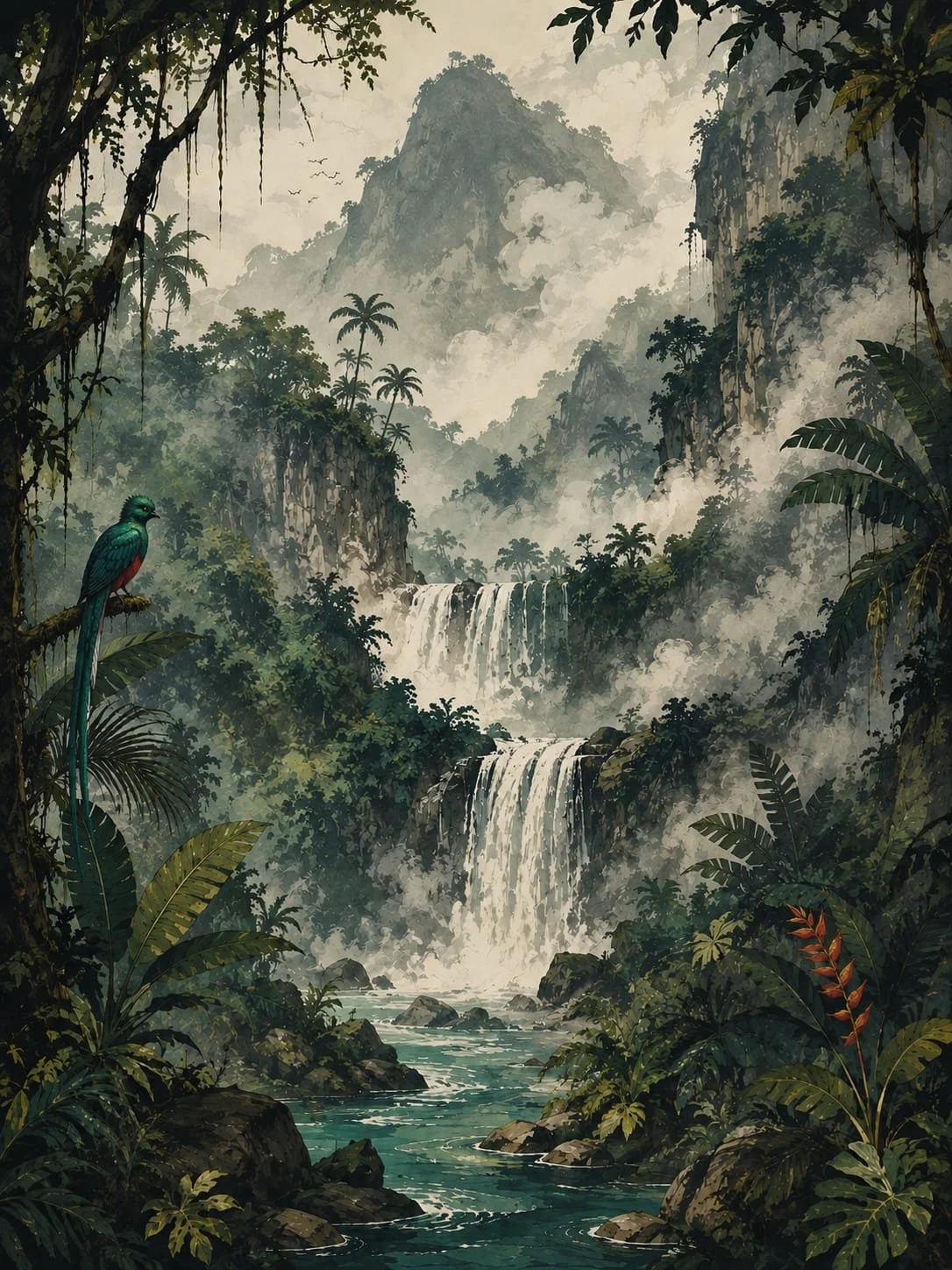
There are birds you notice immediately, and then there are birds that seem to materialize from the forest.
Trogons belong firmly in the second category.
They can sit motionless in the canopy while monkeys crash through the branches, toucans call from nearby trees and insects buzz around them. Then, just as you're beginning to wonder whether you imagined the flash of color, the bird suddenly launches itself into the forest and disappears.
Panama is an extraordinary country for encountering these strange and beautiful birds. The country's 2025 bird list recognizes ten species in the trogon family, including the Golden-headed Quetzal and Resplendent Quetzal alongside eight species of trogon.
But the true magic of Panamanian trogons isn't simply how colorful they are.
It's how secretive they can be.
A bird that looks almost too colorful to be real
Male trogons can be spectacular.
Depending on the species, you can encounter combinations of emerald green, metallic blue, violet, crimson red, black and brilliant white. Their bellies can glow red through the darkness of the forest, while their backs blend surprisingly well with the vegetation.
This creates an extraordinary visual trick.
From one angle, a trogon can almost disappear.
From another, sunlight catches its feathers and suddenly the bird looks like a piece of living jewelry.
And then there's the tail.
Many species have beautifully patterned tails that provide some of their most distinctive markings. When a trogon turns around on its perch, the underside of the tail can reveal an intricate pattern of stripes, spots or contrasting colors.
It is almost as though the bird has been designed to reward anyone patient enough to keep watching.
Panama has an impressive variety
One of the great things about Panama is that there isn't simply one generic "Panamanian trogon."
There are several species occupying different parts of the country.
Among those listed for Panama are the Slaty-tailed Trogon, Black-tailed Trogon, White-tailed Trogon, Baird's Trogon, Gartered Trogon, Graceful Black-throated Trogon and Collared Trogon, as well as the Lattice-tailed Trogon.
That diversity means that a trip focused on finding trogons can become a surprisingly serious wildlife challenge.
You aren't simply looking for a trogon.
You're trying to figure out which one you've just seen.
The Slaty-tailed Trogon
The Slaty-tailed Trogon is one of the classic rainforest trogons of Panama.
It has the dramatic red belly and richly colored upper body that make trogons so memorable, combined with a distinctive slate-colored tail.
It is also one of the birds that makes rainforest birding so addictive.
You may walk along a trail thinking the forest is relatively quiet. Then your guide stops.
He points upward.
At first you see nothing.
Then you notice the shape of a bird sitting completely still among the branches.
Suddenly the rainforest seems to contain an entirely different layer of life that you hadn't noticed before.
The Slaty-tailed Trogon is particularly associated with humid forest and is among the species for which Panama's central rainforest is famous.
The Gartered Trogon
The Gartered Trogon is another beautiful member of Panama's trogon family.
It has an especially striking combination of colors, with males showing a vivid red belly contrasted against darker upperparts and a greenish head and back.
One of the fascinating things about trogons is that their colors don't necessarily make them easy to find.
The forest is full of green.
Leaves reflect sunlight.
Branches overlap.
Shadows constantly move.
A brilliantly colored bird can still disappear remarkably effectively when it remains motionless several meters above your head.
Black-throated Trogons
The Black-throated Trogon adds another variation to Panama's collection.
It is particularly interesting because it can be found in the same general rainforest environments where birdwatchers search for other trogons.
The famous Pipeline Road in central Panama is particularly well known for trogons. Birding guides report that Slaty-tailed, Gartered and Black-throated Trogons are among the more commonly encountered species there, while on an exceptionally good day several additional species can be found.
This is one of the reasons Pipeline Road has developed such a legendary reputation among birdwatchers.
You aren't simply walking through a forest.
You're walking through an enormous natural birdwatching arena.
They are remarkably patient hunters
Trogons are primarily insect and fruit eaters, and their hunting style can be surprisingly calm.
Instead of constantly flying around searching for prey, they often perch quietly and watch.
Then comes the sudden movement.
A bird launches from its branch, catches an insect or other food item, and returns to a perch.
The contrast is extraordinary.
Ninety percent of the time: nothing happens.
Then, for one second, everything happens at once.
That behavior is one reason binoculars are so useful when looking for them. A bird that appears completely motionless to the naked eye may reveal itself as a spectacularly colored animal once you get a good view.
Their stillness is part of their camouflage
It seems strange that an animal with such vivid colors could be difficult to see.
But movement is often more important than color when it comes to detecting animals in a rainforest.
The canopy is constantly moving.
Leaves shake.
Branches sway.
Light flickers.
Birds, insects and mammals move through the vegetation.
A stationary trogon can therefore become surprisingly difficult to distinguish from the background.
Then it turns its head.
That's often all it takes.
You suddenly realize that what looked like an ordinary dark shape on a branch has a bright red belly and an emerald-green head.
The females tell a different story
Another fascinating feature is the difference between males and females.
In several trogon species, males are dramatically more colorful while females tend to have browner, more subdued plumage.
It makes evolutionary sense.
The male's brilliant colors can play a role in courtship and display, while the more understated female can benefit from being less conspicuous while nesting.
This gives the forest two very different versions of the same bird.
The male can look like a jewel.
The female can look almost like part of the tree.
Trogons and the rainforest are inseparable
Trogons are strongly associated with forests, and their presence is therefore much more than simply a treat for birdwatchers.
They are part of the intricate food web of the tropical forest.
They consume fruits and help participate in the movement of seeds through the ecosystem, while their predation on insects connects them to another enormous component of rainforest biodiversity.
Their lives are tied to the trees.
And that makes seeing one in a healthy forest particularly meaningful.
Where should you look for them?
For travelers, central Panama is one of the easiest places to start.
The Pipeline Road, within the Soberanía National Park area, is famous for its bird diversity and particularly for trogons. It runs through a mixture of old-growth and secondary forest, wetlands and streams, creating a remarkable range of habitats.
But the story doesn't end around Panama City.
The forests of Chiriquí, the Caribbean side, Darién and other parts of the country provide very different opportunities for encountering forest birds.
Panama's extraordinary geographical position helps explain this diversity. The country forms a bridge between North and South America, allowing species from different biogeographical regions to overlap.
The result is an astonishingly rich bird fauna, current checklists contain more than 1,000 bird species.
Trogons are just one particularly beautiful piece of that puzzle.
The best way to find a trogon
Don't walk through the jungle expecting a trogon to announce itself.
Instead, slow down.
Look into the middle and upper levels of the forest.
Listen for unfamiliar bird calls.
Watch for a flash of color.
And most importantly, scan horizontal branches.
Trogons frequently perch quietly rather than constantly moving through the canopy. A good pair of binoculars can turn a seemingly empty tree into a scene packed with details.
Early mornings are particularly rewarding for birdwatching because the forest is alive with calls and activity.
And patience matters.
You might walk for an hour and see nothing.
Then you stop beside a tree.
You look up.
And there it is.
A perfectly still bird with a crimson belly and jewel-like feathers, sitting in the shadows as if it has been waiting for you to notice.
The strange magic of the trogon
Perhaps that's what makes trogons so fascinating.
The quetzal gets the mythology. The toucan gets the enormous bill. The hummingbirds get the speed.
Trogons have something different.
Mystery.
They are beautiful without constantly showing themselves.
They are colorful without being obvious.
They are relatively quiet, patient and almost ghostlike in the rainforest.
And when one finally appears, it can transform an ordinary walk through Panama's jungle into something you'll remember for years.
You aren't just looking at a colorful bird.
You're looking at one of the rainforest's hidden residents, an animal that may have been sitting above the trail the entire time, watching you walk underneath without ever giving itself away.
In Panama, sometimes the most spectacular wildlife isn't the wildlife that comes looking for you. It's the wildlife you have to learn how to see.