
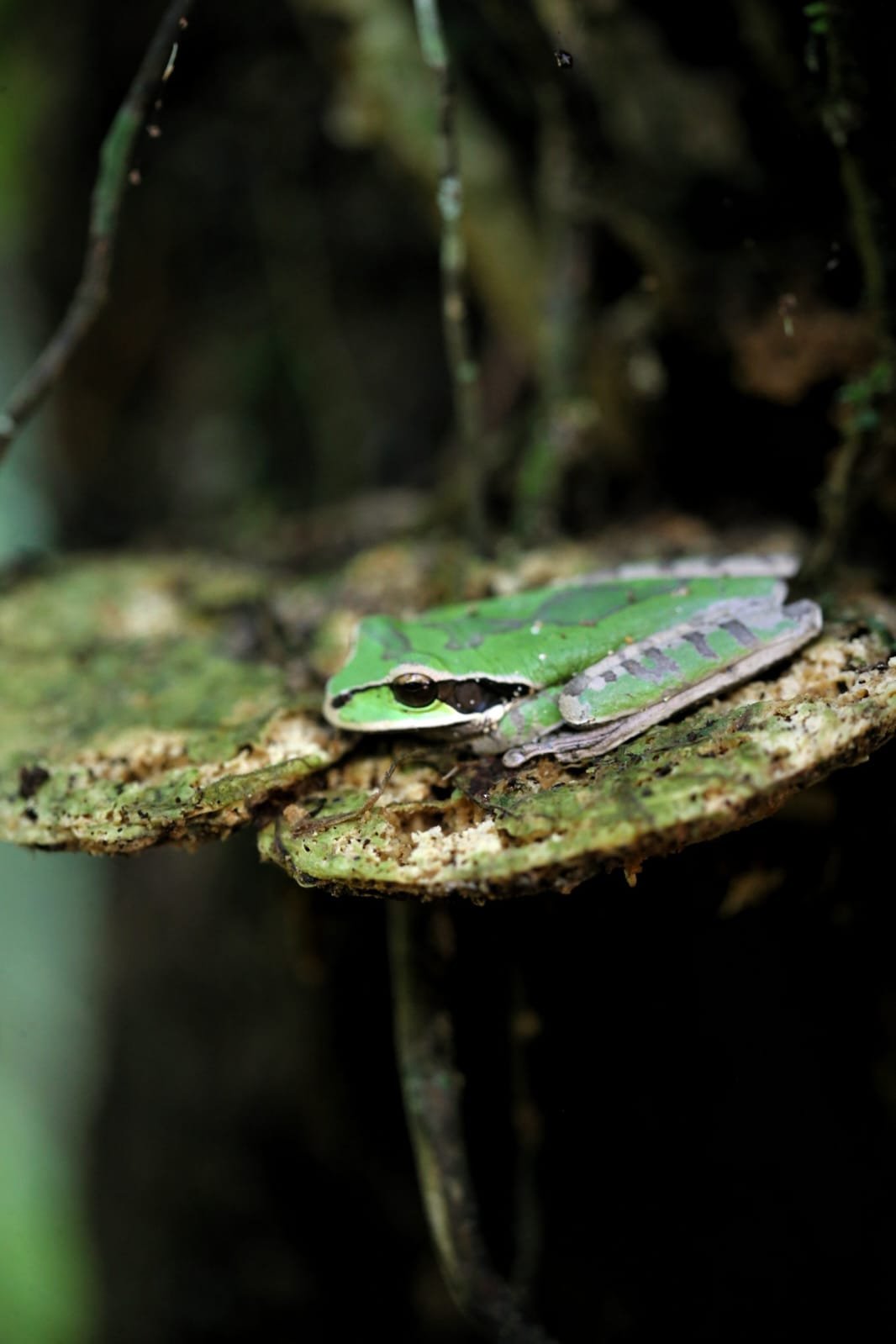
There are few ecosystems in Panama that feel quite as strange as a mangrove forest. At first glance, a mangrove swamp can look like a tangled collection of muddy water, exposed roots and trees growing in places where trees seemingly should not be able to survive. But spend a little time around one and another world begins to reveal itself. Fish move between the roots, crabs disappear into the mud, birds hunt from the branches and the incoming tide slowly transforms the entire landscape.
Mangroves are some of Panama's most important coastal ecosystems, and they are far more than simply trees growing beside the ocean. They form a living bridge between terrestrial forests, rivers, estuaries, beaches, coral reefs and the open sea. Panama's position between the Caribbean and Pacific gives it an extraordinary variety of coastal habitats, and the country has the most extensive mangrove forests in Central America, with 12 different mangrove species recorded along its Atlantic and Pacific coasts.
A Forest That Lives in Salt Water
The first thing that makes mangroves fascinating is simply where they grow.
Most trees would struggle enormously if their roots were regularly flooded with salty seawater. Mangroves have evolved a collection of remarkable adaptations that allow them to live precisely where land and ocean collide. Their roots can tolerate flooding, their tissues have mechanisms for dealing with salt, and some species have specialized roots that emerge above the mud to obtain oxygen.
The famous red mangrove, Rhizophora mangle, is particularly recognizable because of its strange prop roots. Instead of simply growing down into the ground like the roots of an ordinary tree, these roots descend from the trunk and branches, creating a complicated wooden framework above the water.
Walk through a red mangrove forest at low tide and it can feel almost prehistoric.
The roots resemble stilts holding the forest above the mud. Small channels of water wind between them. Barnacles and oysters cling to submerged surfaces. Tiny fish disappear into shadows, while crabs patrol the exposed mud.
The mangrove has essentially created its own underwater apartment complex.
Panama's Mangroves Are Remarkably Diverse
Panama is home to several important mangrove types, including red, black and white mangroves, as well as other specialized species. Panama's aquatic resources authority identifies five major mangrove genera occurring along the country's Caribbean and Pacific coasts: Rhizophora, Avicennia, Pelliciera, Laguncularia and Conocarpus.
This diversity is one reason Panama is so interesting for anyone fascinated by tropical ecology.
The Pacific and Caribbean sides of the country are not identical. Different combinations of rainfall, tides, sediment, freshwater input and coastal geography create different environments for mangroves.
The Pacific coast in particular contains enormous areas of mangrove habitat. Important concentrations occur around the Gulf of San Miguel, the Gulf of Panama and the Gulf of Chiriquí. On the Caribbean side, one of the most significant concentrations occurs around the Chiriquí Lagoon in Bocas del Toro.
That means mangroves aren't some isolated curiosity in one corner of Panama. They are woven into the country's coastline.
The Gulf of Chiriquí: Mangroves, Islands and the Pacific
For travelers exploring western Panama, the mangrove forests around the Gulf of Chiriquí are particularly fascinating.
The Gulf contains an enormous mixture of islands, beaches, rivers, estuaries, mudflats, coral habitats and mangrove forests. It is one of those places where the boundaries between land and sea become difficult to define.
A boat traveling through the region can pass from open Pacific water into narrow channels surrounded by mangroves within minutes.
Suddenly the landscape changes.
The waves disappear. The water becomes calmer. The boat moves slowly between walls of vegetation, and the exposed roots create hundreds of hiding places for aquatic animals.
For travelers visiting places around the gulf, mangrove excursions can therefore offer a completely different experience from simply visiting a beach.
Bocas del Toro's Remarkable Mangrove World
The Caribbean side has its own extraordinary mangrove environments, particularly around Bocas del Toro.
The mangroves of the Bocas del Toro archipelago are particularly interesting because they can exist surprisingly close to coral reefs. Smithsonian researchers have documented coral communities growing several meters into mangrove forests in parts of Bocas del Toro, an unusual relationship between two ecosystems that are normally separated.
This is one of the reasons Bocas is so fascinating.
You can have rainforest, mangroves, seagrass, coral reefs and open Caribbean water all within a relatively small geographic area.
And these ecosystems aren't isolated from one another.
They exchange nutrients, animals and energy.
A young fish might spend part of its life among mangrove roots before moving toward a reef. Birds may feed in the mangroves and return to surrounding forests. Nutrients produced in one ecosystem can eventually influence another.
The coastline functions less like a collection of separate habitats and more like one enormous interconnected machine.
Mangroves Are Nurseries for the Ocean
Perhaps the most important ecological role of mangroves is hidden beneath the surface.
Mangrove roots create exceptionally complex underwater habitats. Young fish, shrimp and other marine animals can hide among them, where the maze of roots provides protection from larger predators.
This is why mangroves are often described as nurseries.
A juvenile fish doesn't necessarily want to spend its early life swimming across an exposed reef or open ocean. A dense mangrove forest provides countless places to hide.
Crabs, shrimp, mollusks, worms, barnacles and other organisms also live on or around mangrove roots. The result is an extremely productive food web.
Eventually many of these animals leave the mangrove environment and become part of larger marine ecosystems.
This means that when you look at a mangrove forest, you aren't just looking at a forest.
You're looking at part of the infrastructure that helps support Panama's coastal fisheries.
The Secret Life Above the Water
Mangroves aren't only important underwater.
Their branches become habitat for an enormous variety of terrestrial animals.
Birds use them for feeding, resting and nesting. Insects live among the leaves and bark. Reptiles can move through the branches. Mammals may use them as pathways between coastal habitats.
And because mangroves often grow beside mudflats and shallow water, they are particularly attractive to birds.
Egrets, herons, ibises, kingfishers, terns and many other coastal birds can be encountered around mangrove environments.
The Smithsonian has even documented recovering mangrove habitat near Panama City attracting species such as great egrets, American white ibises and royal terns, demonstrating how valuable these environments can be for birdwatching.
For anyone interested in wildlife, a mangrove forest can therefore be surprisingly rewarding.
You simply have to slow down.
The Mangrove Hummingbird
One of Panama's most remarkable mangrove-associated birds is the mangrove hummingbird, Amazilia boucardi.
This small hummingbird is closely associated with mangrove habitat and preferentially feeds on the nectar of the Pacific mangrove, Pelliciera rhizophorae. The species is considered vulnerable and has a restricted distribution along the Pacific coast of Central and South America.
It is a perfect example of how specialized tropical wildlife can become.
A mangrove isn't simply a generic forest that happens to contain wildlife. Particular animals can become closely connected to particular plants and ecological conditions.
Remove the habitat and you don't simply remove some trees.
You can remove an entire network of relationships.
Mangroves Are Natural Coastal Defenses
There is another reason Panama desperately needs its mangroves: they protect the coast.
Mangrove forests can reduce erosion and help absorb the energy associated with waves and coastal storms. Their dense root systems stabilize sediments and hold coastlines together.
Imagine a coastline without vegetation.
Waves repeatedly attack the shore, currents move sediment and storms can push enormous quantities of water inland.
Now put a thick wall of mangrove forest between the ocean and the land.
The forest doesn't make the ocean harmless, but it can dramatically change the way water and sediment move through the coastal environment.
This is one reason mangroves are increasingly viewed as natural coastal infrastructure rather than useless swamp.
Panama's Blue Carbon Superpower
Perhaps the most fascinating modern discovery about mangroves concerns something you cannot see.
Carbon.
Mangroves are extraordinarily effective at storing carbon. Carbon is captured through photosynthesis and can become locked into vegetation and, importantly, the waterlogged sediments beneath the forest.
This is known as blue carbon.
Smithsonian researchers working in Panama have been studying the country's mangrove carbon stocks and found that tropical mangrove ecosystems can store substantially more carbon than comparable terrestrial forests.
That makes a mangrove forest something much more important than a collection of coastal trees.
It is also a giant natural carbon storage system.
The mud beneath your feet can contain carbon that has accumulated over long periods of time.
When mangrove forests are destroyed and their soils are disturbed or exposed, some of that stored carbon can eventually return to the atmosphere.
Protecting mangroves therefore has benefits that extend far beyond the coastline.
Panama Has Lost a Huge Amount of Mangrove
Unfortunately, Panama's mangrove story isn't entirely positive.
The country has lost substantial mangrove coverage over the decades.
The Smithsonian reported that Panama lost almost half of its mangroves between 1972 and 2021, with urban expansion and conversion to agricultural land identified as major causes.
Panama's aquatic resources authority likewise reports a major reduction in mangrove area compared with historical figures.
The reasons are easy to understand.
Coastal land is valuable.
People want roads, cities, agriculture, tourism infrastructure, ports and housing.
A mangrove swamp can look like empty land waiting to be developed.
Ecologically, however, it is anything but empty.
It is a functioning ecosystem that has taken decades or centuries to develop.
Climate Change Adds Another Challenge
Mangroves are tough, but they aren't invincible.
They depend upon a delicate combination of water, sediment, salinity and freshwater.
Changes in rainfall can therefore have major consequences.
During the severe 2015–2016 El Niño event, Panama experienced an exceptionally serious drought. Smithsonian researchers investigating mangrove dieback around Panama City found evidence pointing toward prolonged drought as a major factor, particularly affecting black mangroves.
This is an important reminder that climate change doesn't necessarily destroy an ecosystem in one dramatic event.
Sometimes the damage comes through subtle changes in rainfall, temperature, sea level, salinity and freshwater availability.
A forest that has evolved to live on the boundary between two worlds has to respond to changes on both sides.
Even the Ancient History of Panama Contains Mangroves
Perhaps one of the strangest mangrove stories in Panama is millions of years old.
Scientists discovered fossilized remains of a mangrove forest on Barro Colorado Island dating back approximately 22 million years.
The ancient forest was buried by volcanic material, preserving its wood and providing scientists with an extraordinary glimpse into Panama's coastal ecosystems during the Early Miocene. Researchers identified a previously unknown fossil mangrove species and estimated that the ancient trees averaged around 25 meters in height, with some reaching approximately 40 meters.
Think about that the next time you see a mangrove in Panama.
Mangroves aren't some recent accident of the modern coastline.
They have been part of the region's ecological story for millions of years.
Mangroves and Panama's Wildlife
One of the best things about mangroves is the sheer variety of animals they connect.
Fish move through their underwater roots.
Crabs excavate burrows in the mud.
Birds hunt along the edges.
Insects occupy the leaves.
Mollusks attach themselves to submerged roots.
Reptiles move through channels and vegetation.
And larger marine animals may use nearby waters that are influenced by mangrove ecosystems.
This creates a remarkable transition zone.
The forest isn't quite terrestrial.
The ocean isn't quite marine.
It is something in between.
And that transitional nature is precisely what makes mangroves so productive.
How to Experience Mangroves in Panama
For travelers, one of the best ways to experience a mangrove forest is from the water.
Kayaking is particularly rewarding because it allows you to move quietly through narrow channels without the noise of an engine.
A small boat can also take you deeper into larger mangrove systems.
The best approach is to go slowly.
Mangroves aren't necessarily an ecosystem where spectacular wildlife appears on command. Their magic is often hidden in the details.
Look at the roots.
Watch the water.
Search for tiny fish.
Look for crabs moving across the mud.
Scan branches for birds.
Listen for movement.
At high tide, many roots disappear beneath the water. At low tide, an entirely different landscape emerges.
Experiencing the same mangrove forest at different tidal stages can almost feel like visiting two different places.
A Paradise for Birdwatchers
Mangroves deserve special attention from birdwatchers.
The combination of shallow water, mudflats, trees and abundant aquatic life creates excellent feeding opportunities.
Migratory and resident birds can gather around these environments, and the open edges make it easier to spot some species than inside dense rainforest.
For photographers, mangroves are also fascinating.
The reflections of trees in calm water, silhouettes at sunrise and birds standing among exposed roots can produce spectacular scenes.
But perhaps the best part is that you don't need an expensive expedition to appreciate them.
Some of Panama's mangrove environments are surprisingly accessible.
Why Mangroves Matter to Backpackers
If you're traveling through Panama on a budget, it can be tempting to focus only on famous beaches, waterfalls, volcanoes and rainforest hikes.
But mangroves offer a completely different side of the country.
And experiencing them doesn't necessarily require an expensive luxury tour.
Depending on where you are, local boats, inexpensive kayaking opportunities, public coastal areas and community-based excursions can provide access to mangrove ecosystems.
The important thing is to understand what you're looking at.
A cheap boat ride through a mangrove channel can become a fascinating wildlife experience when you realize that every tangled root is potentially hiding a fish, crab, mollusk or other organism.
Suddenly the "swamp" isn't a swamp anymore.
It's a city.
Just one built out of roots.
The Forest Between Two Worlds
Perhaps the best way to understand Panama's mangroves is to stop thinking of them as forests that happen to grow near the ocean.
They are forests created by the relationship between land and sea.
They tolerate salt.
They survive flooding.
They trap sediment.
They protect coastlines.
They store enormous amounts of carbon.
They provide nurseries for marine life.
They support birds and terrestrial wildlife.
They connect rivers to oceans and forests to reefs.
And in places such as Bocas del Toro, they can even exist in remarkably close association with coral ecosystems.
That is what makes Panama's mangroves so fascinating.
They occupy one of the most difficult environments imaginable for a tree, yet they have turned that difficulty into an advantage.
Their tangled roots create habitat.
Their mud stores carbon.
Their branches become homes.
Their forests become nurseries.
And their presence helps hold the coastline together.
Panama is famous around the world for its canal, tropical rainforest, islands and beaches. But running quietly along its enormous coastline is another world that is just as remarkable.
The mangrove forest is Panama's living frontier between jungle and ocean, a place where the tide becomes the architect, the roots become underwater cities, and the mud beneath your feet becomes one of the planet's most important natural carbon vaults.