
Panama is one of the most extraordinary countries in the world for birdwatching. Despite its relatively small size, the country contains an incredible variety of ecosystems, from Caribbean lowlands and tropical rainforests to cloud forests and high mountain ranges. Among all these birds, one of the strangest and most mysterious is the Bare-necked Umbrellabird.
With its jet black feathers, enormous crest and bright red throat, the male looks almost prehistoric. It is one of those birds that seems too unusual to be real. Yet deep in the mountain forests of western Panama, this remarkable species can still be found.
A bird that looks like it belongs in a fantasy movie
The name "Umbrellabird" comes from the extraordinary crest on the male's head. When raised, the crest creates a large rounded shape that resembles an open umbrella.
But the crest is only part of the spectacle.
The male also has a distinctive bare throat that can become strikingly red. Against its glossy black plumage, the contrast is spectacular. Females are considerably less dramatic, with a smaller crest and generally less conspicuous appearance.
The Bare-necked Umbrellabird is a large bird, reaching roughly 45 centimeters in length. Its unusual appearance makes it one of the most memorable birds a visitor could encounter in Panama's forests.
A bird of the mountains
The Bare-necked Umbrellabird has a relatively restricted distribution in Central America. In Panama, it is particularly associated with the western part of the country, including Chiriquí and Bocas del Toro, with important habitat extending through the mountains of the Talamanca range.
One of the most important areas for the species is the La Amistad International Park, an enormous protected mountain ecosystem shared by Panama and Costa Rica.
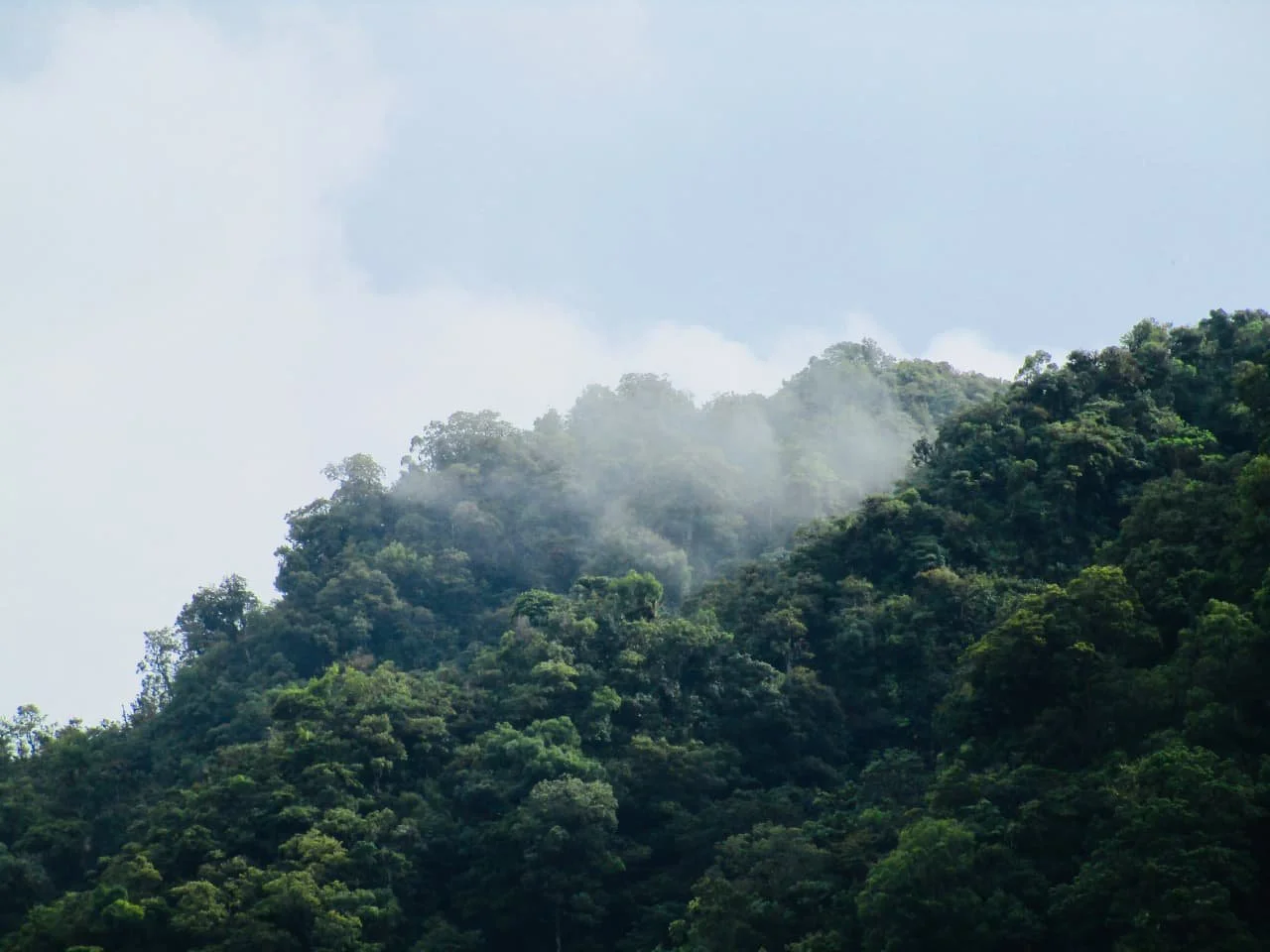
These forests are very different from the hot tropical lowlands many visitors imagine when they think of Panama. Higher elevations can be cool, misty and constantly damp. Giant trees are covered with mosses, orchids and epiphytes, while clouds drift through the forest canopy.
It is exactly this kind of remote mountain environment that provides habitat for some of Central America's rarest birds.
Why seeing one is so special
Finding an Umbrellabird is not like spotting a colorful toucan sitting beside a road.
These birds are elusive and usually associated with mature forest. They spend much of their time in vegetation where they can be surprisingly difficult to see despite their size.
A birdwatcher may hear movement overhead or catch a brief glimpse of black feathers disappearing behind leaves. Sometimes the bird can remain hidden only a few meters away.
Patience is therefore essential.
Early morning is often one of the best times to explore the forest. The air is cooler, birds are active and the forest is filled with calls and movement. Experienced guides can make an enormous difference because they know the habitat, recognize the calls and understand where particular birds are likely to appear.
A fruit lover of the rainforest
The Umbrellabird is primarily a fruit eater. This makes it an important participant in the life of the forest.
Fruit eating birds do much more than simply find food. As they move through the forest and consume fruits, they can transport seeds from one location to another. The seeds eventually pass through the digestive system and can be deposited far from the original tree.
In this way, birds contribute to the natural regeneration of tropical forests.
Protecting an Umbrellabird therefore means protecting much more than a single unusual species. It means protecting the mature forest ecosystem on which countless plants and animals depend.
A species facing serious challenges
The Bare-necked Umbrellabird is considered threatened by habitat loss and forest fragmentation. Its relatively restricted range makes the preservation of remaining forests particularly important.
When large areas of mature forest are divided into smaller isolated patches, species that depend on extensive continuous habitat can become increasingly vulnerable.
This is one reason protected areas in western Panama are so valuable. Places such as La Amistad and other mountain forest reserves provide important refuges for birds that cannot easily survive in heavily disturbed landscapes.
The survival of the Umbrellabird is ultimately tied to the survival of the forests themselves.
A hidden treasure of Chiriquí
For travelers exploring Chiriquí, the possibility of encountering an Umbrellabird adds another dimension to the region.
People come to Chiriquí for its mountains, coffee, waterfalls, hiking trails and spectacular scenery. But above the trails and deep inside the forest canopy is another world filled with extraordinary wildlife.
The same forests that shelter the Umbrellabird can also contain hummingbirds, toucans, tanagers, motmots and countless other species.
You may walk for hours without seeing the bird you came looking for. Then, suddenly, a large black shape appears high in the trees. The enormous crest rises, the red throat becomes visible and for a few seconds you are looking at one of the strangest birds in Central America.
Then it disappears back into the forest.
One of Panama's most extraordinary birds
The Bare-necked Umbrellabird is a perfect example of why Panama's forests are so special. It is unusual, elusive and highly adapted to a very specific environment.
It also represents something larger than simply an interesting bird. Its existence depends on ancient mountain forests, healthy ecosystems and the preservation of wild areas in western Panama.
For anyone fascinated by nature, seeing one would be an unforgettable experience. And even if you never manage to spot one, knowing that this extraordinary creature is moving quietly through the cloud forests above Chiriquí makes those forests seem even more mysterious.
The Umbrellabird is not simply another bird of Panama. It is one of the country's great hidden treasures, a spectacular symbol of the wild and little explored mountain forests that still survive in the western part of the country.