
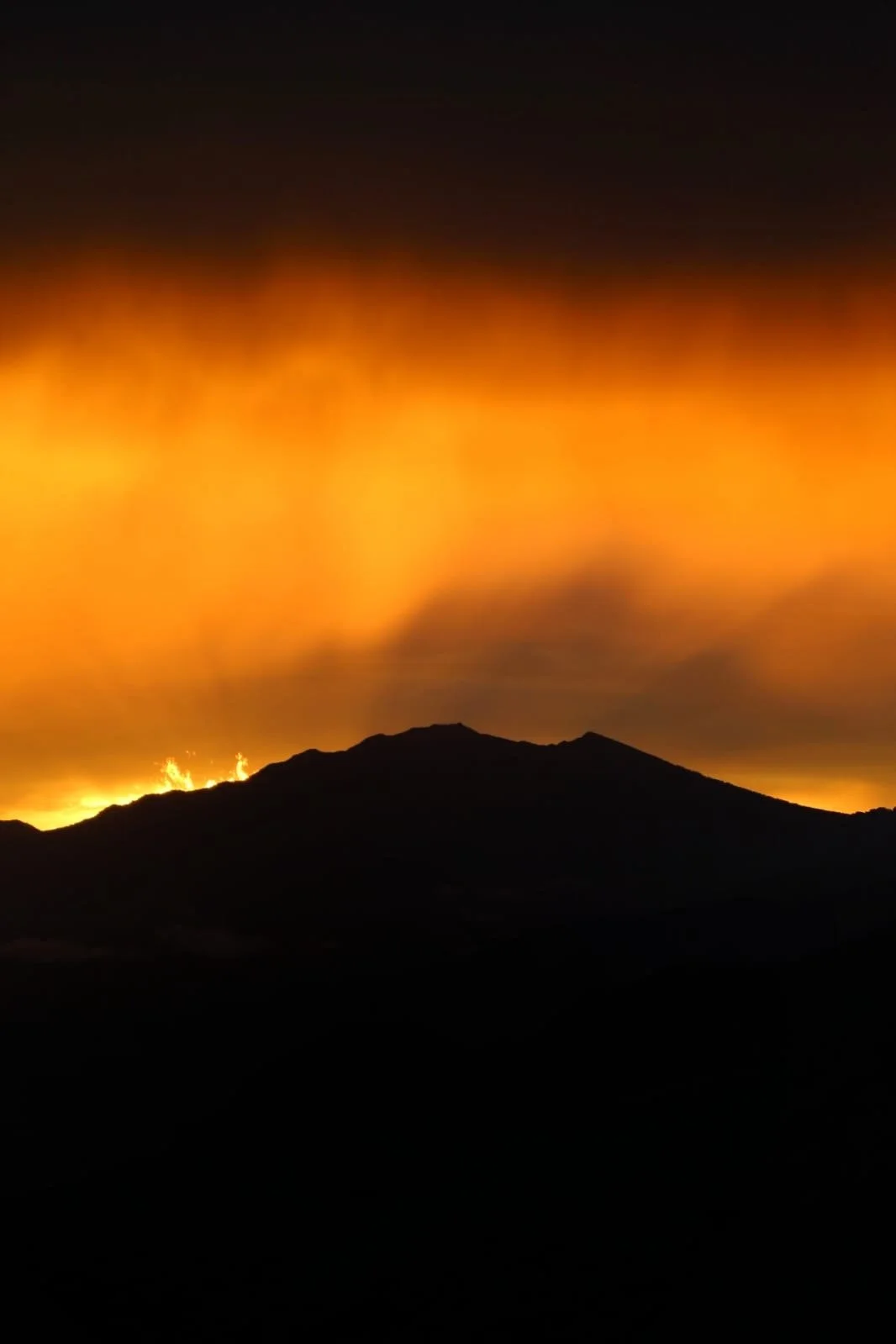
Rising dramatically above western Panama, Volcán Barú is one of the most remarkable geological features in the country. At approximately 3,474 meters above sea level, it is the highest point in Panama and dominates the landscape around Boquete, Volcán and the surrounding highlands. From its upper slopes, on exceptionally clear days, it is famously possible to see both the Pacific Ocean and the Caribbean Sea, making the summit one of the most spectacular viewpoints in Central America.
But behind the beautiful forests, farms and hiking trails is a much more powerful story. Barú is not simply an extinct mountain. It is classified as a Holocene volcano, meaning that it has erupted within roughly the last 12,000 years. The Smithsonian Global Volcanism Program currently lists its most recent eruption at approximately 1550 CE, plus or minus about 10 years.
That makes Barú a fascinating combination of beauty and geological uncertainty: a volcano that has been quiet for centuries, but one that scientists still consider potentially active.
How Volcán Barú Was Born
Volcán Barú exists because Panama sits within an extraordinarily complicated geological region. Western Panama forms part of the Central America Volcanic Arc, a zone associated with the subduction of tectonic plates beneath the region. Over immense periods of time, magma generated deep beneath the Earth's surface rose toward the surface, producing volcanic activity and gradually constructing the enormous volcanic edifice we see today.
Barú is a composite volcano, also called a stratovolcano. These volcanoes are constructed over many episodes of volcanic activity, with layers of lava, ash and other volcanic materials accumulating over time.
The mountain we see today is therefore not the result of one enormous eruption. It is the product of a long geological history involving repeated eruptions, lava flows, explosive activity, erosion and collapse.
The result is a huge volcanic landscape covered today by forests, agricultural areas and high altitude ecosystems.
A Much More Active Past Than the Mountain Suggests
One of the most fascinating things about Barú is that its present appearance can be deceptive.
If you stand in Boquete and look toward the mountain, it appears peaceful. The slopes are covered in vegetation. Birds move through the forests. Farmers cultivate the surrounding land. Tourists climb the summit before sunrise.
There is little obvious evidence that this mountain has ever erupted.
Geologically, however, the story is very different.
The Smithsonian's Global Volcanism Program lists eight confirmed eruptive periods for Barú. These include activity around 1270 BCE, 260 CE, 710 CE, 1130 CE, 1340 CE and approximately 1550 CE, although some dates have substantial uncertainty.
This tells us something extremely important.
Barú has not simply had one ancient eruption and then disappeared from the geological record. It has experienced repeated eruptions during the Holocene.
The Last Eruption
The most recent known eruption occurred around 1550 CE, according to the Smithsonian Global Volcanism Program. The United States Geological Survey describes Barú as having experienced four eruptive episodes during approximately the last 1,600 years, with the most recent eruption occurring roughly 400 to 500 years ago.
The exact nature and size of the most recent eruption are subjects of geological investigation. Much of the evidence comes from volcanic deposits preserved around the mountain, rather than from written observations.
That is important because 1550 was long before modern volcanology.
There were no seismometers around Barú.
There were no satellites monitoring the mountain.
There were no modern volcanic observatories recording its behavior.
Scientists therefore have to reconstruct its history by examining layers of ash, lava, rock and other volcanic deposits.
The Evidence Hidden in the Landscape
Volcanoes leave behind clues.
A lava flow may cool into solid rock and remain visible thousands of years later. An explosive eruption can spread ash over large areas. A volcanic collapse can dramatically reshape an entire mountain.
Geologists can date these materials using techniques including radiocarbon dating and other geological methods.
This is how scientists have reconstructed Barú's eruptive history even though nobody alive today has witnessed an eruption.
The Smithsonian database identifies several prehistoric eruptions using radiocarbon dating and other evidence.
In other words, the mountain itself is effectively an enormous geological archive.
Every layer tells part of the story.
Barú Is Not Extinct
This is perhaps the most important distinction when discussing the volcano.
Barú should not simply be described as an extinct volcano.
The Smithsonian classifies it among Panama's Holocene volcanoes, and the USGS describes it as a potentially active volcano.
Scientists are careful with the terminology because volcanoes can remain quiet for very long periods. A volcano does not necessarily have to erupt every few decades, or even every few centuries, to remain capable of future activity.
The absence of an eruption during human memory does not automatically mean that the volcanic system has died.
In fact, the Smithsonian specifically warns that defining a volcano as "active" based only on recent human observations can be misleading because dormant intervals can last hundreds or thousands of years.
Barú is therefore best thought of as a quiet or dormant volcano with the potential for future activity, rather than a volcano that has been permanently extinguished.
So How Active Is Volcán Barú Today?
This is where the story becomes particularly interesting.
Barú is not currently erupting.
There is no evidence from the sources consulted of an ongoing eruption or an immediate eruption crisis. Its last known eruption was approximately five centuries ago.
However, the volcano is not considered geologically dead.
The USGS notes that Barú has experienced seismic activity, including several seismic swarms during the twentieth century and another notable swarm in 2006. These events are reminders that the region remains tectonically active.
A seismic swarm does not automatically mean that an eruption is about to happen. Earthquakes can have many causes, and interpreting volcanic earthquakes requires careful monitoring and geological knowledge.
But their existence is one reason scientists continue to take Barú seriously.
Why the 2006 Earthquakes Matter
The 2006 seismic swarm is particularly interesting because it demonstrated that the geological system around Barú is not completely silent.
When earthquakes occur beneath or near volcanoes, scientists investigate characteristics such as their depth, frequency, location and pattern.
Some earthquake sequences can be associated with movement of magma or volcanic fluids. Others are purely tectonic.
Without additional evidence, an earthquake swarm cannot be interpreted as proof that magma is rising toward the surface.
This is why volcanologists rely on multiple types of monitoring rather than simply counting earthquakes.
What Would Scientists Look For Before an Eruption?
If Barú were beginning to move toward an eruption, scientists would look for a combination of warning signs.
These could include increasing earthquake activity, changes in the depth and character of seismic events, deformation of the volcanic structure, changes in gases released from the ground and other geophysical or geological signals.
Importantly, one unusual measurement would not necessarily mean an eruption was coming.
Scientists look for patterns.
A volcano beginning to awaken may produce several changes simultaneously.
Modern volcano monitoring is therefore much more sophisticated than simply asking whether a volcano is shaking.
The Mountain's Shape Also Tells a Story
Barú has experienced enormous geological forces over its lifetime.
The USGS describes features associated with collapse and volcanic activity on the mountain, including a large collapse scar and a summit area containing volcanic domes.
Large volcanic collapses are among the most powerful processes associated with stratovolcanoes.
When part of a volcanic mountain becomes unstable, enormous quantities of rock can move downhill extremely rapidly.
This is one reason volcano hazard assessments examine not only eruptions themselves but also the possibility of landslides and volcanic flank collapse.
Why the Volcano Is Important for Boquete
The existence of Barú has profoundly influenced the surrounding landscape.
The volcanic soils and highland climate have helped create conditions that are particularly favorable for agriculture. The region around Boquete is famous for coffee production, and the mountain's slopes have become one of Panama's most celebrated agricultural landscapes.
The same volcano that represents a potential geological hazard has also helped create the environmental conditions that make the region economically valuable.
This is one of the fundamental relationships between humans and volcanoes around the world.
Volcanoes can destroy landscapes.
They can also create them.
A Mountain of Extraordinary Biodiversity
Barú is also ecologically fascinating because altitude creates dramatically different environments as you climb.
The lower slopes contain tropical vegetation, while higher elevations become cooler and increasingly cloud covered. Near the summit, conditions can feel surprisingly cold compared with the tropical lowlands of Panama.
The mountain's forests provide habitat for an extraordinary variety of birds and other wildlife.
One of the most famous inhabitants is the resplendent quetzal, which is associated with the high elevation cloud forests around the Barú region.
This means that Barú is simultaneously a geological monument and a biological one.
The volcano created the terrain.
The climate shaped the forests.
The forests created habitat.
And humans have adapted to the landscape through agriculture and tourism.
Climbing Barú
For adventurous travelers, the volcano is also one of Panama's ultimate hiking destinations.
The climb to the summit is physically demanding because of the enormous elevation gain and distance involved. Conditions can change dramatically as you ascend.
At lower elevations, you may begin surrounded by relatively warm tropical vegetation.
Higher up, temperatures fall.
Clouds can roll across the mountain.
Wind can become intense.
And near the summit, conditions can feel nothing like the Panama most visitors imagine.
The famous reward is the possibility of seeing both oceans from the summit when atmospheric conditions are exceptionally clear.
That view is one of the great natural experiences in Panama.
The Sleeping Giant
There is something psychologically fascinating about hiking up Barú.
For most of the journey, it simply looks like a beautiful mountain.
But once you understand its history, every rock becomes more interesting.
You are walking across a volcanic structure that has erupted repeatedly during the last several thousand years.
You are climbing a mountain that experienced its most recent known eruption around 1550.
You are standing in a region where scientists have recorded modern seismic activity.
And yet today the slopes are green, peaceful and full of life.
That contrast is what makes Barú so compelling.
Should People Be Worried?
For visitors and residents, the most reasonable conclusion is neither to ignore Barú nor to fear it unnecessarily.
There is no indication from the sources reviewed that Barú is currently erupting or that an eruption is imminent.
At the same time, geological evidence clearly shows that it has erupted repeatedly during the Holocene and that scientists consider it potentially active.
The appropriate response is therefore monitoring and preparedness rather than panic.
Volcanoes operate on geological timescales that are difficult for humans to understand. A volcano can remain quiet for hundreds of years and still retain the ability to erupt.
The Smithsonian's broader volcanology guidance emphasizes that reliable eruption forecasting is difficult and that even excellent monitoring does not normally allow scientists to predict an eruption far in advance with certainty.
Barú's Fascinating Future
Perhaps the most intriguing question about Volcán Barú is not what it is doing today, but what it might do in the future.
Nobody can responsibly give a date for its next eruption.
It could remain quiet for many more centuries.
Or geological activity could eventually increase.
What scientists can say with much greater confidence is that Barú has demonstrated the ability to erupt repeatedly in the recent geological past.
That makes it one of Panama's most important volcanoes to understand and monitor.
Volcán Barú is therefore much more than Panama's highest mountain. It is a living geological record, a source of fertile landscapes, a refuge for highland wildlife, a spectacular hiking destination and a reminder that beneath the peaceful forests of western Panama, the Earth's geological forces are still present.
Today, Barú is quiet.
But quiet does not necessarily mean extinct.
And that is exactly what makes the magnificent mountain rising above Chiriquí so fascinating.