
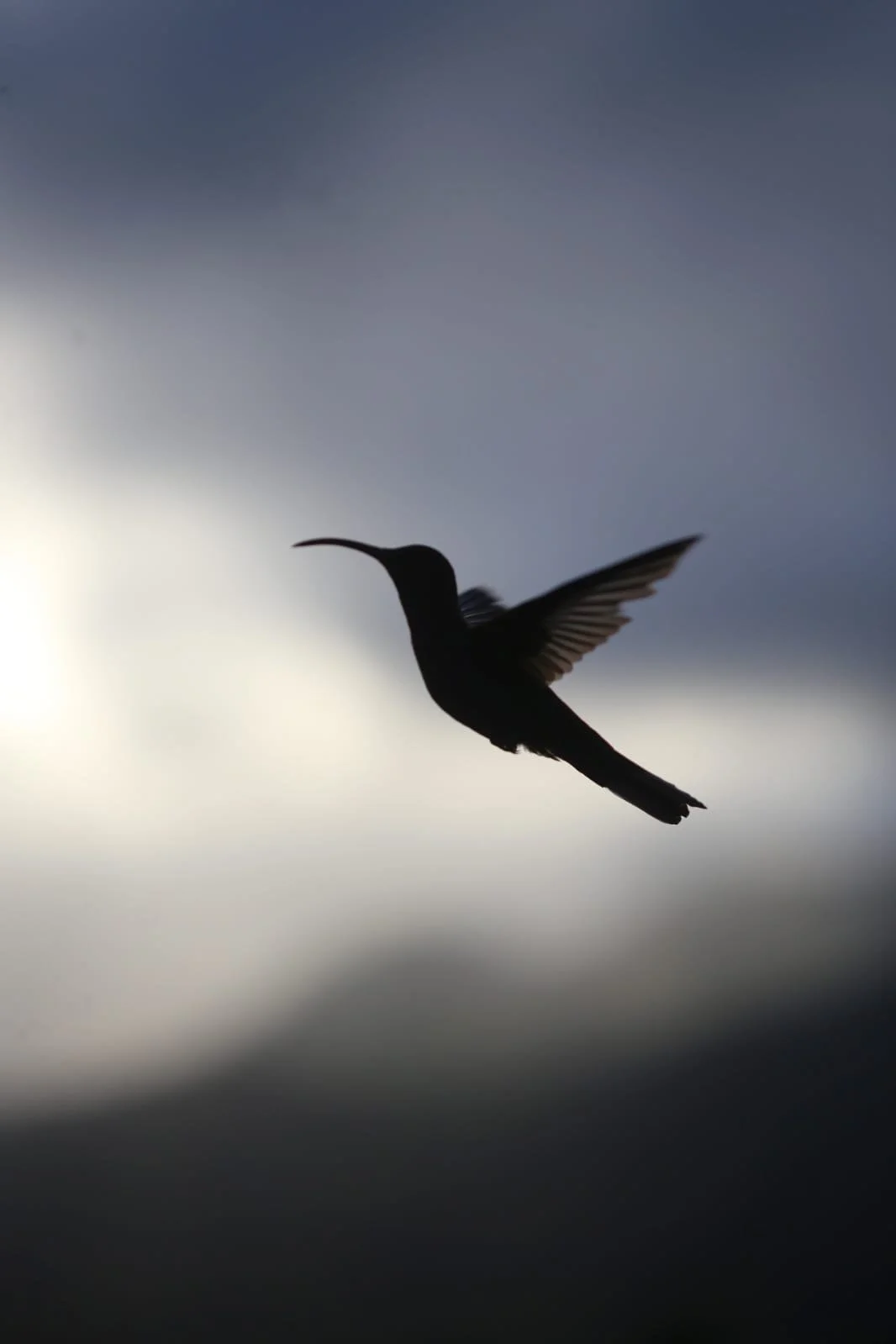
There are hummingbirds in Panama that look like tiny flying jewels, flashing emerald green, turquoise, ruby red and brilliant blue as they dart between flowers, but then there is the Violet Sabrewing, Campylopterus hemileucurus, a hummingbird that seems to have completely ignored the usual rules about how small a hummingbird is supposed to be. This is one of the largest and most impressive hummingbirds found in Panama, and when you see one for the first time, its size can be almost as surprising as its color. With its substantial body, broad powerful wings, thick slightly curved bill and spectacular violet purple plumage, the Violet Sabrewing looks almost like a miniature tropical bird of prey compared with some of the tiny hummingbirds flying around it. It is a bird that can make even someone who has never considered themselves a birdwatcher suddenly stop what they are doing and say, “What the heck is that?” The species is found from southern Mexico through Central America into western Panama, and Panama’s humid mountain forests provide some of the perfect habitat for these extraordinary birds. For travelers exploring the mountains of Chiriquí and the cloud forests between Boquete and Bocas del Toro, the Violet Sabrewing can be one of the most memorable birds they encounter. And there is a particularly wonderful place to see one: the feeders at Lost and Found Hostel, where Violet Sabrewings are very frequent visitors. Guests staying at the hostel have the unusual opportunity to see this spectacular cloud forest hummingbird coming right to the feeders, sometimes allowing people to observe it at remarkably close range without having to spend hours searching through the forest.
When the sunlight hits the feathers
The male Violet Sabrewing is the real showstopper. When you first see him in the darker understory of the cloud forest, he can almost appear black or very dark purple. Then he turns slightly and sunlight catches the feathers, and suddenly the entire bird seems to explode with color. Deep violet, purple and blue appear across his body in an extraordinary display of iridescence. This is one of the great tricks of hummingbird feathers. Their colors aren't simply painted onto the feathers with ordinary pigments. Microscopic structures within the feathers interact with light and produce the shimmering colors that can change dramatically depending on the angle from which you see the bird. That means a Violet Sabrewing can look almost black one moment and brilliantly purple the next. You don't necessarily need a colorful bird; you need the right light. In the cloud forests of Panama, where sunlight constantly filters through leaves, mist and vegetation, those moments can be particularly spectacular. A male hovering beside a feeder with the sun catching his violet feathers can look almost unreal, as though somebody has digitally enhanced the bird.
The females have a very different appearance
The female Violet Sabrewing is considerably more subdued in appearance, which is common among many hummingbird species. While the male is famous for his spectacular violet plumage, females are predominantly green above and grayish underneath, with violet coloration around the throat and the characteristic white areas toward the outer portions of the tail. This difference can sometimes confuse people watching the feeders for the first time. You may see a magnificent purple bird and assume every Violet Sabrewing must look like that, only to see another bird arrive that appears considerably greener and less dramatic. Once you learn the differences, however, it becomes much easier to recognize them. Watching males and females around the feeders also gives visitors a chance to appreciate that identifying birds isn't always simply about spotting one color. Size, shape, bill structure, tail markings, behavior and flight style can all help identify a species.
Why is it called a Sabrewing?
The name Sabrewing is wonderfully appropriate, even though these birds obviously don't have little swords attached to their wings. The name refers to the unusual structure of the wings, particularly the enlarged shafts of some of the outer primary feathers in males. Watch a Violet Sabrewing flying aggressively around a feeder and the name suddenly seems even more appropriate. Unlike some of the delicate looking hummingbirds that zip around like insects, this bird has a powerful, almost muscular style of flight. It can hover with tremendous strength, accelerate rapidly and make sharp changes in direction. It can also perch calmly on a branch and survey the area as though it owns the entire forest. Around a busy feeder, that impression isn't entirely wrong. Violet Sabrewings can be formidable competitors, and their size gives them an advantage over many of the smaller hummingbirds sharing the same food sources.
Sometimes you hear it before you see it
One of the interesting things about the Violet Sabrewing is that its size can make its flight surprisingly noticeable. The wings produce a deeper, stronger buzzing sound than the tiny hummingbirds many people are accustomed to seeing. In a quiet cloud forest, that sound can actually provide a clue that something large is approaching. You might hear the buzzing before you know where it is coming from. Then, suddenly, a large hummingbird appears in front of a flower or feeder, hovers for a few seconds, grabs some nectar and disappears. It can happen incredibly quickly. This is part of what makes hummingbird watching so addictive. You can be sitting quietly and looking at nothing in particular when a bird suddenly appears from nowhere, performs an incredible aerial maneuver and vanishes back into the vegetation before you've even had time to reach for your camera.
A bird of Panama's mountain forests
Violet Sabrewings are strongly associated with humid forests, forest edges and mountain environments, and western Panama provides some exceptional habitat. Their distribution extends through Central America into western Panama, and they are particularly associated with areas where moisture, vegetation and flowering plants are abundant. The mountains of Chiriquí are especially fascinating because elevation changes the environment dramatically over relatively short distances. As you climb, temperatures fall, clouds become more common, vegetation changes and completely different communities of plants and animals appear. The Violet Sabrewing is one of the birds that takes advantage of these rich mountain environments. This is one reason birdwatching around Chiriquí can be so rewarding. You aren't simply looking at one forest. You can move through an entire series of ecological zones, each with its own collection of birds, insects, plants and other wildlife.
Why cloud forests are hummingbird paradise
Panama's cloud forests are almost perfectly designed for hummingbirds. They contain abundant flowering plants, constant moisture, dense vegetation, forest edges, vines, bromeliads and countless other plants that provide nectar and shelter. Because the climate changes with elevation and different plants flower at different times, hummingbirds can often find food throughout the year. For a bird that burns enormous amounts of energy simply staying alive and flying, this is essential. The cloud forest is therefore much more than a beautiful backdrop for the Violet Sabrewing. It is its supermarket, shelter, breeding ground and home. When you stand in a Panamanian cloud forest and watch a Violet Sabrewing moving from flower to flower, you're watching a relationship that has evolved over countless generations between the bird and the plants around it.
Nectar isn't the whole story
Like other hummingbirds, the Violet Sabrewing depends heavily on nectar for energy, but it isn't simply drinking sugar water all day. Hummingbirds also eat insects and other tiny arthropods, which provide important protein and nutrients. Violet Sabrewings have been documented taking arthropods from vegetation and spider webs, and this behavior becomes particularly important when adults are raising young. Nectar provides the enormous amount of energy these birds need for their active lifestyle, but growing chicks require protein. That means the beautiful purple bird you see hovering around a flower is also a tiny predator, actively searching the vegetation for small insects and other creatures. This is one of the reasons hummingbirds are much more fascinating than their jewel like appearance might initially suggest. They aren't simply decorative visitors to flowers. They are active predators, pollinators and important parts of the forest food web.
Yes, hummingbirds eat spiders and insects
It can be difficult to imagine such a beautiful bird as a predator, but hummingbirds can be surprisingly tough little hunters. Violet Sabrewings can take small insects and other arthropods from vegetation and even make use of spider webs as places to find prey. The bird that you just watched delicately drinking from a flower may moments later be searching leaves for tiny insects. This combination of nectar feeding and insect hunting allows hummingbirds to obtain both energy and protein. It also means that their ecological role is much larger than simply moving pollen between flowers. They participate in several different parts of the forest food chain and help connect plants, insects and other animals in a remarkably complicated ecosystem.
The heavyweight at the feeder
Anyone who spends time around hummingbird feeders quickly discovers that hummingbirds can have enormous personalities. They may be tiny, but they can be extremely territorial and aggressive. A feeder can become the center of a miniature aerial battlefield. The Violet Sabrewing is particularly entertaining because its large body gives it a considerable advantage over many of the smaller hummingbirds. When a large Violet Sabrewing arrives at a feeding station, smaller hummingbirds will often move away. You can almost imagine the conversation: a tiny hummingbird arrives, settles down for breakfast and begins feeding peacefully, then a huge purple bird suddenly appears. The little hummingbird takes one look and seems to say, “Nope.” It disappears, and the Violet Sabrewing takes over. Watching this happen at Lost and Found Hostel can be especially entertaining because the feeders provide repeated opportunities to observe these interactions. Eventually you begin to recognize that you're not just watching different species of hummingbirds; you're watching a miniature community with territories, rivalries, favorite perches and very strong opinions about who gets access to the food.
Hummingbird aerial warfare
When two hummingbirds decide to challenge each other, the encounter can be astonishing. One bird may dive toward another, both accelerate rapidly, twist through the air and disappear behind the vegetation before reappearing several seconds later. The entire confrontation may last only moments. Violet Sabrewings can be particularly impressive because of their size and power. Their flight looks more substantial than that of some of the smaller hummingbirds, and watching a large male chase another bird through the cloud forest can give you a completely different appreciation for just how athletic these animals are. Of course, trying to photograph such an encounter is another matter entirely. You may take dozens of photographs and discover that every single one contains either a blurry purple streak or an empty branch. This is simply part of the sport of hummingbird photography.
Violet Sabrewings at Lost and Found Hostel
One of the most exciting things about the Violet Sabrewing for travelers staying at Lost and Found Hostel is that you don't necessarily have to go on a serious birding expedition to find one. The hostel is surrounded by the extraordinary mountain forest environment of the Fortuna area, and its feeders attract a variety of hummingbirds, including Violet Sabrewings that are very frequent visitors. This makes the bird particularly accessible to guests. You might be sitting outside having breakfast, drinking coffee, talking with other travelers or preparing for one of the trails when suddenly a large purple hummingbird appears at the feeder. Everyone stops. Someone reaches for a phone. Someone else grabs a camera. The bird may stay for only a short time before disappearing, but it often returns. This is one of the great advantages of observing wildlife around a well situated forest hostel. You don't necessarily have to chase the wildlife. Sometimes the wildlife comes to you. At Lost and Found, a simple morning beside the feeders can turn into an impromptu birdwatching session, and for many travelers that first close encounter with a Violet Sabrewing becomes one of their favorite memories of Panama.
A dream bird for photographers
The Violet Sabrewing is an exceptional photography subject because it combines several characteristics that photographers love. It is large enough to track more easily than some of the tiny hummingbirds, its male has spectacular iridescent coloration, it frequently visits feeders and it can return repeatedly to the same area. The biggest challenge is getting the light right. If the male is facing away from the light, his feathers can appear dark. Then he turns his head or body slightly and suddenly the violet coloration explodes. A photographer can spend hours trying to capture that exact moment. The feeders at Lost and Found provide an advantage because you can observe the birds repeatedly and learn their behavior. You may begin to notice which perch a particular bird prefers, how long it usually stays, when it tends to arrive and how it reacts when another hummingbird approaches. That familiarity can make the difference between simply taking a photograph of a hummingbird and capturing a truly spectacular portrait.
Morning in the cloud forest
Early morning around a Panamanian cloud forest is particularly magical. Mist hangs between the trees, moisture covers the vegetation, birds begin calling and the first sunlight slowly works its way through the forest. Hummingbirds become active as the day begins, and the feeders can become an excellent place to sit quietly and observe. There is something wonderfully peaceful about watching a Violet Sabrewing in these conditions. The forest is still waking up, the air is cool and humid and suddenly this enormous violet hummingbird appears against a background of green vegetation. It hovers for a moment, catches the light, feeds and disappears. It is exactly the kind of experience that reminds you why Panama is such an extraordinary destination for wildlife lovers.
The Violet Sabrewing in the mist
Seeing a Violet Sabrewing in mist can be particularly beautiful. The deep violet plumage contrasts dramatically with the green moss, ferns, bromeliads and wet vegetation of the cloud forest. The environment can almost look prehistoric, while the hummingbird looks like a jewel that has somehow come to life. Then the bird takes off and reminds you that you're watching one of the most sophisticated flying machines evolution has produced. Hummingbirds can hover, fly backward, stop suddenly and change direction with extraordinary precision. The Violet Sabrewing accomplishes all of this while carrying a relatively large hummingbird body through dense mountain vegetation. Watching one closely makes it easy to understand why hummingbirds have fascinated people for centuries.
The physics of hovering
Hummingbird flight is extraordinary. Their wings don't simply move up and down like the wings of a conventional bird. They generate lift through a highly specialized motion that allows them to remain suspended in the air while feeding. They can also fly backward, something most birds cannot do, and they can make extremely rapid changes in direction. Their bodies are designed around this demanding lifestyle. Their muscles, wings, hearts and metabolisms all work together to support a level of activity that would be impossible for most other birds. Watching a Violet Sabrewing hover motionless in front of a flower for several seconds is therefore much more than a pretty sight. You're watching a highly specialized flying animal performing one of nature's most remarkable feats.
An enormous metabolism in a relatively small body
Hummingbirds have extraordinarily high energy requirements. Hovering consumes enormous amounts of energy, and their hearts can beat incredibly rapidly. Their metabolism is among the highest of warm blooded animals. This explains why nectar rich habitats are so important. A Violet Sabrewing can't simply find one flower and live there all day. It needs a constant supply of energy, which means moving through the forest and taking advantage of different flowering plants and other food sources. This also helps explain why feeders can be so attractive. A reliable source of high energy food can become extremely valuable territory, and hummingbirds quickly learn where those resources are located.
They are pollinators
Every time a Violet Sabrewing visits a flower, it can pick up pollen on its bill and feathers. When it visits another flower, some of that pollen can be transferred. The bird receives nectar and the plant gets assistance with reproduction. This is one of the great ecological relationships of the tropical forest. The hummingbird is not simply taking something from the plant; it is participating in a mutually beneficial relationship. The next time you see a Violet Sabrewing hovering beside a flower, remember that you are watching a tiny part of a much larger process that helps maintain the forest. Flower becomes food, the bird carries pollen, another flower receives it and new plants eventually grow. A hummingbird can therefore help shape the very forest that provides it with food.
The secret life of the nest
Despite their impressive size and powerful appearance, Violet Sabrewings build remarkably small nests. The female creates a cup shaped nest using soft plant material and fibers, and spider silk can help bind the structure together. The finished nest is tiny compared with the adult bird. This is another fascinating contradiction of hummingbird biology. At the feeder, a Violet Sabrewing can look powerful and imposing, chasing smaller birds away from valuable food. Somewhere nearby, however, a female may be carefully tending a tiny little nest hidden among vegetation. The chicks begin life incredibly small and vulnerable and depend completely on their mother for food and protection.
Raising the young
The female takes the major responsibility for incubation and raising the young. Once the chicks hatch, they require frequent feeding and careful attention. The mother has to provide them with the nutrients necessary for rapid growth, including protein from insects and other small prey. Eventually, the chicks develop feathers, strengthen their wings and begin practicing the movements that will allow them to leave the nest. The transformation is astonishing. Something that begins life as a tiny, helpless chick eventually becomes a fully functioning flying machine capable of hovering, accelerating, hunting and navigating the complex environment of a tropical forest.
They aren't long distance migrants
Despite the impressive movements of the Violet Sabrewing, these birds are not long distance migrants in the way that some other birds are. They are generally considered mostly sedentary, although individuals can move to lower elevations after breeding and may make local movements in response to seasonal conditions and food availability. This is important for birdwatchers in Panama because the Violet Sabrewing you see around a mountain forest may not simply be passing through on its