
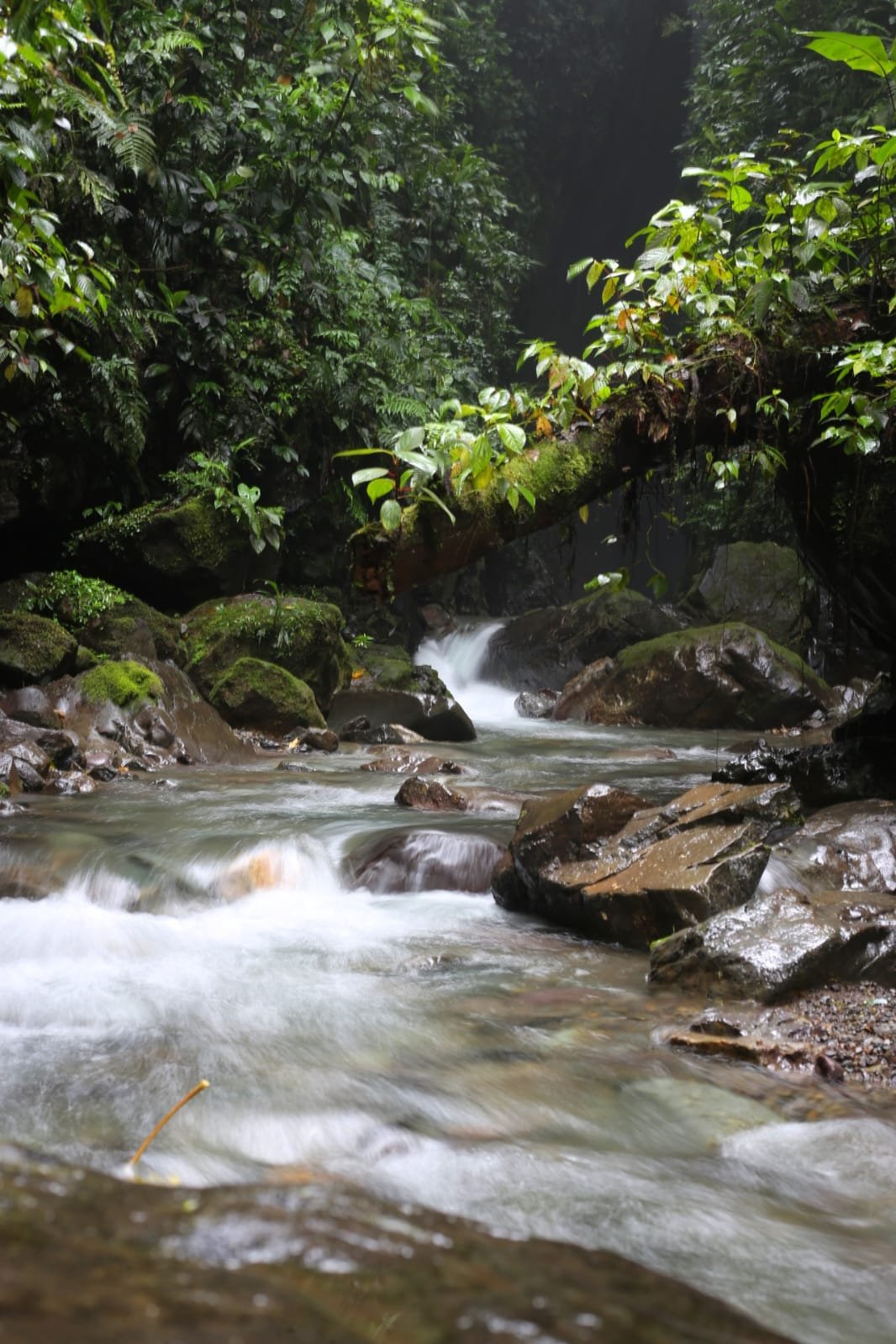
There are hostels that are simply places to sleep, and then there are hostels that become destinations in their own right. Lost and Found Hostel belongs firmly in the second category. Hidden in the cloud forests of Chiriquí, in Panama's Fortuna Forest Reserve near Valle de Hornito, it is the kind of place that can completely change the rhythm of a backpacking trip. Instead of arriving at a hostel in the middle of a city, walking down a busy street, checking into a building and immediately wondering what to do next, you arrive at a place where the journey into the forest is already part of the experience. The hostel describes itself as Panama's only hike in hostel located inside a forest reserve, and its setting is genuinely unusual: mountain forest, enormous views across the Hornito Valley, trails, wildlife and the distinctive atmosphere of a cloud forest.
That location is what makes Lost and Found so compelling for backpackers traveling between Panama's major destinations. It sits along the road between the mountain region around Boquete and the Caribbean side of the country, making it a natural place to break up the journey rather than simply treating the trip between Chiriquí and Bocas del Toro as transportation time. But calling it merely a convenient stop dramatically undersells the experience. Lost and Found is the sort of place where you can arrive intending to stay one night and discover that you have accidentally found one of the most memorable chapters of your Panama trip. The hostel combines hiking, wildlife, waterfalls, viewpoints, social activities, communal meals, games and the simple pleasure of sitting in a hammock while the surrounding forest does what forests do. Current Hostelworld listings show the property with exceptionally strong guest ratings, including particularly high marks for atmosphere, staff, security and location.
A Hostel Where the Journey Begins Before You Even Reach the Door
The first thing that makes Lost and Found different is that it doesn't feel like a conventional roadside accommodation. You are going into the forest. That seemingly simple detail changes the psychology of the entire experience. The moment you leave the main road and make your way toward the property, the landscape begins taking over. Traffic becomes less important. The sounds of the forest become more noticeable. The mountain environment starts feeling much more immediate. You aren't simply checking into a hostel; you're entering a setting.
This is particularly appealing to backpackers because the journey itself becomes part of the story. There is something inherently memorable about telling someone back home that you stayed in a hostel in the middle of a Panamanian cloud forest and had to walk into it rather than simply pulling up outside a conventional hotel. It creates a sense of separation from ordinary travel. The hostel's own description emphasizes exactly this unusual identity, describing it as a hike in jungle hostel located within the Fortuna Forest Reserve.
And that physical separation has another advantage: once you're there, distractions fall away. You aren't surrounded by a huge commercial district. You aren't stepping outside into a city of traffic and advertisements. You are in nature. For a backpacker who has spent days moving between buses, airports, boats and busy tourist areas, that can be incredibly refreshing.
The Cloud Forest Is the Main Attraction
The hostel itself is fascinating, but the greatest luxury at Lost and Found isn't something built by humans. It is the forest.
The Fortuna area is part of one of the great mountain ecosystems of western Panama, and the cloud forest environment gives the entire property a different character from tropical lowland destinations such as Bocas del Toro. The air, vegetation, mist, mountains and wildlife create an atmosphere that can feel almost cinematic. Instead of the obvious tropical postcard of palm trees and turquoise Caribbean water, you get another side of Panama: moss, enormous trees, dripping vegetation, clouds moving through mountains, birds moving through the canopy and sudden glimpses across valleys.
The official activity guide encourages guests to spend time simply enjoying the view, watching clouds and hummingbirds from hammocks, as well as exploring the network of trails around the property.
This is an important part of understanding Lost and Found. You don't necessarily have to spend every minute doing something. The environment itself provides an experience.
You can hike for several hours and return exhausted.
Or you can sit in a hammock and watch the clouds.
Both are legitimate ways to spend a day.
The View of Volcán Barú
One of the property's great visual features is its mountain panorama, including views toward Volcán Barú. Hostelworld specifically highlights the mountain scenery as part of the setting.
This is the kind of view that becomes particularly impressive when the weather changes. Cloud forests are dynamic environments. A mountain can be clearly visible one moment and disappear behind clouds the next. Sunlight can break through after rain. Mist can roll across the valley. The landscape can look completely different at breakfast than it does in the afternoon.
That unpredictability makes the view more interesting than a static postcard.
You don't simply look at the mountain.
You watch the mountain change.
And if you're willing to slow down, you'll probably notice that the clouds are constantly moving, the light is constantly changing and the forest is full of activity that you might miss if you're rushing toward your next scheduled excursion.
The Hammocks: One of the Most Important Attractions
It might sound funny to describe hammocks as a major attraction, but at Lost and Found they are almost part of the philosophy of the place.
The official activity page specifically mentions the property's 25 hammocks and encourages guests to use them for watching sunsets and clouds.
And this is where the hostel experience becomes different from an ordinary adventure itinerary.
Backpacking can become exhausting.
You wake up.
Pack.
Catch a bus.
Find another bus.
Check in.
Walk around.
Take photographs.
Find food.
Plan tomorrow.
Repeat.
Eventually you need somewhere that gives you permission to stop.
Lost and Found does that naturally.
You can hike all morning, eat lunch, find a hammock and simply disappear into the view for a while.
There is no achievement attached to it.
No bucket list.
No itinerary.
Just being there.
The Hiking Trails: The Hostel Becomes Your Trailhead
One of the biggest reasons adventurous backpackers should consider Lost and Found is that you don't necessarily need to organize an elaborate excursion just to experience nature. The property has trails and access to the surrounding forest environment, allowing guests to explore on foot.
This changes the relationship between accommodation and adventure.
At many hostels, you sleep there and then leave to find the adventure.
At Lost and Found, you wake up inside the adventure.
The forest is around you.
The trails begin from the property.
The wildlife is part of the surroundings.
And the landscape is visible before you even start walking.
The result is a wonderful feeling of independence. You can wake up, grab breakfast, put on appropriate hiking gear and start exploring without having to spend the morning arranging an elaborate transfer.
Wildlife Is Everywhere
For nature lovers, this is one of the most compelling aspects of Lost and Found.
The Fortuna region is rich in wildlife, and guests frequently mention the feeling of being surrounded by nature. Reviews describe abundant wildlife and specifically mention experiences involving hummingbirds and monkeys around the property.
But wildlife watching in a place like this requires the right mindset.
You don't arrive expecting animals to perform for you.
You walk slowly.
You listen.
You look into the canopy.
You watch branches.
You notice movement.
You wait.
A hummingbird can appear for seconds and disappear.
A monkey may move through the trees.
A bird may call from somewhere you cannot see.
A sloth may be hidden above you.
The reward is not guaranteed, and that is exactly what makes the moment special when it happens.
The Hummingbirds
The hummingbirds deserve special attention because they can become part of the everyday atmosphere around the hostel.
Imagine sitting with your breakfast or coffee while tiny birds flash through the vegetation around you.
This is one of those experiences that sounds ordinary until you realize how different it feels from everyday life.
You aren't sitting in front of a screen watching a nature documentary.
You're sitting in the forest.
The hummingbirds are actually there.
And you're close enough to simply watch.
That is one of the most underrated pleasures of staying somewhere immersed in nature.
The Treasure Hunt
Then Lost and Found introduces something completely different: the Indiana Jones style treasure hunt.
The official activity list describes the Indiana Jones Treasure Hunt as one of the experiences available to guests.
This is a brilliant addition because it gives the hostel a playful side.
A lot of adventure travel can become overly serious. Everything becomes about hiking times, elevation, maps, distances and photographs.
A treasure hunt brings back the feeling of exploration for the sake of exploration.
You follow clues.
You work things out.
You explore.
You make mistakes.
You laugh.
And because hostels naturally bring strangers together, activities like this can become an easy way to meet other travelers.
Instead of awkwardly asking someone where they're from, you can simply end up solving a clue together.
And suddenly you've made a friend.
Waterfall Adventures
Water is another major part of the Lost and Found experience.
The official activity guide lists excursions to Celestine Waterfall and opportunities to swim and explore.
This is where the hostel becomes particularly attractive for backpackers who want an active day without needing a major expedition.
The combination of jungle and freshwater is quintessentially Panamanian.
You hike through vegetation.
You hear the water before seeing it.
The forest opens.
A waterfall appears.
And suddenly you're standing somewhere that feels completely different from the road you left earlier.
The experience is especially satisfying after hiking because you have physically earned the transition from trail to water.
Gualaca River Canyon
The hostel's activity program also highlights the Gualaca River Canyon as a place where guests can swim or picnic.
This provides another example of the variety surrounding the hostel.
The adventure isn't restricted to one trail or one waterfall.
There are rivers.
Canyons.
Mountains.
Forest.
Waterfalls.
Views.
And the hostel acts as a base from which to experience them.
For backpackers traveling through Panama, that makes Lost and Found a particularly efficient stop because several different types of outdoor experiences can be concentrated into one stay.
Yoga With a View
Not every activity needs to be about adrenaline.
Lost and Found also offers yoga with the mountain scenery as a backdrop.
That fits surprisingly well with the personality of the property.
Adventure and mindfulness aren't opposites.
You can spend the morning hiking through the forest and later slow down with yoga while clouds move across the mountains.
That balance is one of the hostel's greatest strengths.
It isn't simply trying to make guests constantly do things.
It gives them opportunities to explore, socialize and also relax.
The Labyrinth
Another unusual feature is the full size labyrinth listed among the hostel's activities.
It is exactly the sort of quirky feature that makes Lost and Found feel like Lost and Found rather than a generic jungle lodge.
You arrive expecting beds and hiking trails.
Then you discover a labyrinth.
That's part of the charm.
The property has a slightly unconventional personality, and backpackers tend to remember places with personality.
Horseback Riding
For travelers interested in seeing the mountains from another perspective, horseback riding is also listed as an available activity.
This adds another layer to the experience because the surrounding landscape isn't something you have to experience from only one mode of transportation.
You can walk it.
Ride through it.
Look across it from the hostel.
Swim in its rivers.
And explore its waterfalls.
That variety is exactly what makes the area such a strong adventure stop.
The Jungle Lounge Bar and the Social Atmosphere
Perhaps the biggest surprise for first time visitors is that Lost and Found isn't simply a nature retreat.
It is social.
The official activity guide describes the Jungle Lounge Bar as a place to meet people and dance, while Hostelworld reviews repeatedly highlight the property's atmosphere and communal experience.
This is one of the hostel's defining characteristics.
You can spend the afternoon completely surrounded by nature and then return to a social environment where travelers are talking, playing games and sharing stories.
That contrast is fantastic for backpacking.
You get the jungle without isolation.
You get social life without needing a city.
You get adventure without sacrificing the opportunity to meet people.
Family Dinner and the Art of Making Friends
One of the most consistently praised aspects of recent guest reviews is the communal meal experience. Hostelworld's review summary specifically mentions family dinners and guests describe them as an easy way to meet other people.
This matters enormously for solo backpackers.
One of the hardest parts of traveling alone isn't physically traveling alone.
It's eating alone.
You can be perfectly comfortable hiking alone but suddenly feel awkward sitting at a table by yourself in the evening.
A communal dinner solves that.
You sit down.
Other travelers sit down.
Conversation begins.
Someone asks where you came from.
Someone else asks where you're going next.
Someone has just come from Bocas.
Another person is heading toward Boquete.
Someone wants to visit Santa Catalina.
Someone knows about a waterfall.
And suddenly your entire Panama itinerary is being rewritten over dinner.
That is classic hostel culture at its best.
The Retro Backpacker Spirit
There is also something refreshingly old school about Lost and Found.
Modern travel increasingly revolves around polished boutique hostels, digital nomad workspaces, carefully designed interiors and social-media-friendly aesthetics.
Lost and Found's appeal is different.
It feels like a place where the experience matters more than perfection.
The forest matters.
The people matter.
The activities matter.
The view matters.
The stories matter.
And that gives it a personality that many modern travelers find increasingly difficult to find.
A recent hostel review from an 18 to 24 year old traveler described it as a must do in Panama, praising the staff, activities and communal dinner.
That is significant because it captures something essential about the property: it doesn't simply provide accommodation for backpackers.
It creates opportunities for backpacking culture to happen.
A Place Where You Can Actually Disconnect
There is another reason Lost and Found works so well in a Panama itinerary: it provides a natural break from digital travel.
When you're constantly moving, your phone becomes your navigation system, translator, camera, booking platform, map and entertainment device.
Eventually you need a break.
The cloud forest provides one.
You can sit in a hammock.
Watch birds.
Talk to another traveler.
Play a game.
Go hiking.
Look at the mountains.
Listen to rain.
And suddenly your phone feels less important.
That is an increasingly rare luxury.
The Food and Communal Experience
Food is another important part of hostel culture, and Lost and Found's official activity information describes breakfasts, lunches and dinners, with an emphasis on homemade meals and nutritious options.
The communal nature of meals matters just as much as the food itself.
Backpacking is partly about eating.
But it is also about eating together.
Some of the best travel conversations happen over plates of food when nobody has anywhere else to be.
And for travelers who eat plant based, vegetarian or vegan diets, the hostel's food approach can make life easier. Current Hostelworld information notes that vegetarian options are available.
Why Lost and Found Fits Perfectly Between Boquete and Bocas
One of the smartest reasons to include Lost and Found is its position within the broader Panama backpacking circuit.
Think about a classic route.
Panama City.
Then perhaps the mountains.
Then the Caribbean.
If you travel directly between the major destinations, it can feel like you're simply checking boxes.
But Lost and Found gives that journey a completely different middle chapter.
You go from the city to the mountains.
Then deeper into the cloud forest.
Then onward toward Bocas del Toro.
The transition becomes part of the trip.
Instead of:
Panama City → Bocas
you can create something much more interesting:
Panama City → mountain adventure → Lost and Found → cloud forest → Bocas del Toro
Suddenly the journey has texture.
Why One Night Might Not Be Enough
Technically, you can stay for one night.
But the nature of the place makes one night feel short.
You need time to arrive.
You need time to explore.
You need time for an activity.
You need time to meet people.
You need time to experience the evening.
And you need time simply to sit around.
That's why a couple of nights can make considerably more sense for travelers who want to experience the property rather than simply sleep there.
The danger is that you'll want to stay longer.
That is a very real backpacker problem.
The People Are Part of the Attraction
The forest is incredible.
The views are incredible.
The activities are memorable.
But ask many experienced backpackers what they remember most about hostels and the answer is usually the people.
Lost and Found is particularly well designed for this.
Communal meals.
A social bar.
Group activities.
Shared trails.
Adventure excursions.
Common spaces.
These all create natural opportunities for interaction.
You don't have to force yourself into conversations.
The environment does much of the work.
It Is a Great Place for Solo Travelers
For a solo backpacker, this can be especially valuable.
Arriving somewhere remote can sometimes be intimidating because you're wondering whether you'll be isolated.
Lost and Found flips that equation.
You're physically surrounded by wilderness but socially surrounded by travelers.
That combination is unusual.
You can go hiking alone if you want solitude.
You can join an activity if you want company.
You can sit in a hammock if you want peace.
You can join dinner if you want conversation.
You can spend the evening socializing.
The choice remains yours.
It Is Also Great for Friends
If you're traveling with friends, Lost and Found offers something different from simply staying in another hostel together.
The environment gives you things to do.
You can hike together.
Try the treasure hunt.
Visit waterfalls.
Explore the forest.
Play games.
Watch the sunset.
And then meet other travelers at dinner.
Your group can maintain its own identity while still becoming part of the larger hostel community.
The Rain Is Part of the Experience
If you're lucky, you might get perfect weather.
If you're really lucky, you might get rain.
That sounds strange until you've spent time in a cloud forest.
Rain transforms the environment.
The vegetation becomes saturated.
Clouds move through the mountains.
Water runs through the forest.
The sound becomes enormous.
And the entire hostel can feel like a shelter inside a living ecosystem.
Instead of thinking:
“It's raining, what can we do?”
you start thinking:
“This is what the cloud forest sounds like.”
That's a very different travel mindset.
The Sunset
Eventually, evening arrives.
The mountains change color.
The clouds shift.
The forest becomes darker.
People return from hikes.
The hammocks fill.
Dinner approaches.
Conversation gets louder.
And the hostel transitions from outdoor adventure to social evening.
This is one of the moments that makes Lost and Found work so well.
The day has a rhythm.
Morning: nature.
Afternoon: adventure.
Evening: community.
Night: stories.
It feels almost like a miniature backpacker village hidden in the mountains.
Why Lost and Found Is More Than a Hostel
The easiest way to understand Lost and Found is to stop thinking of it as accommodation.
It is a base camp.
A jungle lodge.
A social hub.
A trailhead.
A wildlife viewing area.
A mountain retreat.
A meeting place for travelers.
And a place where Panama's geography becomes part of everyday life.
That is why it has developed such a strong reputation among travelers. Current Hostelworld listings show hundreds of reviews and very high overall ratings, while the reviews repeatedly mention the location, staff, atmosphere, nature and social experience.
The Backpacker Memory You Don't Expect
Maybe the most interesting thing about Lost and Found is that you might arrive thinking your favorite Panama experience will be somewhere else.
Maybe you think it will be Bocas.
Maybe Coiba.
Maybe Volcán Barú.
Maybe the Panama Canal.
Maybe a Pacific beach.
And then you spend a couple of days in the cloud forest.
You hike.
You meet people.
You eat together.
You watch hummingbirds.
You sit in a hammock.
You look across the valley.
You get caught in rain.
You laugh with strangers.
You do something ridiculous during the treasure hunt.
You watch the clouds disappear across the mountains.
And suddenly the hostel itself becomes one of the stories you tell when you get home.
That is the real magic.
Why It Belongs on a Panama Backpacking Route
Panama has an incredible collection of famous destinations, but the best backpacking trips aren't always about visiting the most famous places.
They're about finding places that connect those destinations together.
Lost and Found does exactly that.
It connects the mountain world with the Caribbean route.
It connects adventure with social travel.
It connects wilderness with hostel culture.
It connects hiking with relaxation.
It connects strangers with one another.
And it gives backpackers something that is increasingly difficult to find: a place with an actual personality.
You aren't staying in a generic building.
You're staying in the forest.
You're not simply booking a bed.
You're booking access to an environment.
You're not simply looking for somewhere to sleep between Boquete and Bocas.
You're stepping into a completely different chapter of your Panama adventure.
And perhaps that's why Lost and Found has developed such a devoted following among backpackers.
It doesn't try to be everything.
It doesn't need to.
It takes one extraordinary idea and commits to it:
Put travelers in the cloud forest, surround them with nature, give them things to explore, and create enough social energy that strangers can become friends.
That formula is remarkably simple.
And remarkably effective.
For the backpacker who wants Panama to be more than beaches, nightlife and ticking destinations off a list, Lost and Found offers something genuinely different.
It is adventure without needing to be extreme.
It is social without being a city.
It is nature without requiring you to disappear completely from civilization.
It is relaxation without boredom.
It is a place where you can spend the morning chasing waterfalls, the afternoon watching hummingbirds, the evening eating with strangers and the night looking out across the mountains.
That is what makes Lost and Found Hostel such a special stop on the Panama backpacking route: the hostel isn't merely somewhere you stay while experiencing Panama. The hostel itself becomes one of the experiences.
And for a backpacker traveling through Panama, that can be the difference between remembering where you slept and remembering where you lived for a few unforgettable days.