
If you are planning a trip to Panama during the rainy season, there is one mistake you should avoid immediately: thinking that “rainy season” means the same thing everywhere.
It absolutely does not.
Panama is a remarkably small country, but its mountain spine divides the weather into dramatically different worlds. You can wake up to brilliant sunshine on the Pacific coast, drive into clouds and mist in the mountains, and eventually arrive in Bocas del Toro to discover that it is raining sideways. Or you can have exactly the opposite experience.
The official rainy season generally runs from May through November, with the Pacific side usually seeing its heaviest rainfall around September and October. But the Caribbean side, including Bocas del Toro, follows a completely different pattern and receives rain throughout much of the year.
And here is the secret: rainy season can actually be one of the most interesting times to travel around Panama.
The country becomes intensely green. Rivers become powerful. Waterfalls explode into life. The forests seem louder. Wildlife becomes easier to encounter in some places. Prices can be lower. Hostels become more social. And when the sun comes out after a huge tropical downpour, the entire country can look like somebody turned up the saturation on reality.
You just have to understand which Panama you are visiting.
---
The first thing to understand: Panama does not have one rainy season
On the Pacific side, including Panama City and much of the Pacific coast, the pattern is relatively straightforward. Rainy season generally begins around May and continues into November. The wettest period is usually around September and October, while July and August can bring a temporary reduction in rainfall known locally as the veranillo, or little summer.
Then there is the Caribbean.
Bocas del Toro does not simply switch from “dry” to “wet” like the Pacific coast. The Caribbean receives substantial rainfall throughout the year, although there are periods that tend to be relatively drier. In fact, historical climate research describes much of the Caribbean coastal zone from Bocas toward Colón as having no true dry season.
And then there are the mountains.
The mountains have their own personality. Elevation cools things down, clouds gather around ridges, and rainfall can be very localized. One valley can be reasonably pleasant while another is getting absolutely hammered.
This is why checking “Panama weather” before your trip isn't particularly useful.
You need to check where in Panama.
---
The Pacific: Rainy season with a schedule
If you are travelling around the Pacific side, rainy season is often much less intimidating than people imagine.
The classic pattern is something like this:
You wake up.
The sky is blue.
You have breakfast.
You go exploring.
You hike, swim, surf, visit a waterfall, wander around town or head to the beach.
Then sometime in the afternoon, the sky starts looking suspicious.
A distant rumble appears.
The wind changes.
And suddenly Panama drops approximately an entire swimming pool on the landscape.
Then, sometimes surprisingly quickly, it stops.
This afternoon storm pattern is particularly characteristic of the Pacific side. Panama's meteorological authorities describe Pacific rainy season rainfall as moderate to strong, frequently accompanied by thunderstorms, particularly during the afternoon.
The important thing for travellers is that rain does not necessarily mean you lose the whole day.
In fact, experienced travellers often work around it.
Do your outdoor activities in the morning. Have lunch. When the rain arrives, slow down. Read a book. Have a coffee. Meet people at your hostel. Take a long lunch. Then see what happens.
Sometimes an hour later the sun is back.
Sometimes it isn't.
Welcome to the tropics.
---
And then there are the Pacific beaches
Places such as Santa Catalina, the Azuero Peninsula and other Pacific destinations have a much more pronounced wet and dry season than Bocas.
During dry season, the Pacific can become spectacularly dry and sunny.
During rainy season, the landscape changes completely.
The hills turn green. Streams and waterfalls become more impressive. The forests look alive. The beaches can be wonderfully quiet.
And for travellers who don't need fourteen consecutive days of Instagram-perfect sunshine, there can be something fantastic about it.
A rainy afternoon on the Pacific coast can be almost theatrical.
Dark clouds roll over the mountains.
The ocean becomes silver.
Palm trees bend in the wind.
Thunder starts echoing across the hills.
And then the rain arrives like someone opened a giant tap.
It can be spectacular.
---
The mountains: completely different again
Now head upward.
This is where Panama gets really interesting.
Places such as Boquete, Volcán, Cerro Punta and the mountains around Chiriquí can be significantly cooler than the lowlands. The elevation also creates its own weather patterns.
Instead of simply getting a hot tropical downpour, you may find yourself walking through mist.
Clouds can settle over the mountains.
A trail can disappear into fog.
You may hear birds calling from somewhere you cannot see.
Everything becomes wet, green and intensely alive.
And then, five minutes later, you might emerge into sunlight.
This is one of the great pleasures of mountain travel during the wet season.
The rain doesn't necessarily make the mountains unattractive.
It makes them look like mountains.
The forests become unbelievably lush, moss becomes brighter, streams swell and waterfalls become dramatically more powerful.
For hikers, photographers, birdwatchers and people who actually enjoy being in nature rather than simply looking at it through a hotel window, this can be a fantastic time to visit.
The Chiriquí highlands still follow the broader Pacific seasonal pattern, but their elevation and geography produce much wetter and cooler conditions than the lowlands.
---
The mountains also require a little more preparation
This is where you need to take rainy season seriously.
A beautiful mountain trail can become a muddy mountain trail surprisingly quickly.
Rocks become slippery.
Streams rise.
Trails can become difficult.
Shoes that are fantastic on dry dirt can suddenly become completely useless.
So bring footwear with decent grip, a lightweight rain jacket and something waterproof for your phone and electronics.
And don't make the classic mistake of leaving your rain jacket in your backpack because the morning is sunny.
In Panama, the morning sunshine is sometimes just the opening act.
---
Lost and Found country: where rain becomes part of the adventure
If you are travelling between Boquete and Bocas del Toro, the mountainous interior is particularly interesting during rainy season.
This is where you really see what Panama's tropical environment is capable of.
The forests become incredibly dense and green. Rivers are fuller. Waterfalls become louder. Mist hangs around the ridges.
And the whole landscape starts looking less like a postcard and more like a proper jungle.
This is also why people sometimes misunderstand a jungle hostel.
Rain doesn't mean there is nothing to do.
Quite the opposite.
A tropical forest after rain can be one of the best times to explore it.
The air cools down. Everything smells incredible. Birds become active. Water rushes through the forest. And when the clouds finally break, the mountains can suddenly appear through the mist.
It is a completely different experience from visiting in the bright, dry-season sunshine.
---
Bocas del Toro: throw your Pacific weather expectations out the window
Then you arrive in Bocas.
And the rules change.
Bocas del Toro is on the Caribbean side of Panama, and the Caribbean does not follow the same neat December to April dry season that characterizes much of the Pacific side. Rain can occur at any time of year.
This is one of the biggest surprises for first-time visitors.
Someone may tell you:
> “It's rainy season in Panama.”
And you might imagine that Bocas is going to be permanently wet.
Not necessarily.
But you also shouldn't arrive expecting four months of uninterrupted Caribbean sunshine.
Bocas is much more unpredictable.
You can have brilliant sunshine, followed by rain, followed by sunshine again.
You can have a glorious morning and a biblical afternoon.
You can have a cloudy day that suddenly produces two hours of beautiful sunshine.
And occasionally you can have rain that seems determined to prove that roofs are merely decorative.
That is Bocas.
---
Bocas has its own little weather tricks
Interestingly, Bocas can have relatively drier periods during parts of the year that are wetter elsewhere in Panama. September and October are often identified as a relatively favorable window in Bocas compared with the Pacific's wettest period, although rain is always possible.
This is one of the reasons Panama is such an interesting country for travel.
The Pacific can be having its wettest months while Bocas is enjoying one of its better periods.
That means a rainy-season trip doesn't necessarily mean choosing between “rain everywhere” and “don't go.”
You can actually move around the country and experience different weather systems.
---
But what about the famous Bocas boat trips?
This is where weather matters more.
Bocas is an archipelago.
You are not simply walking from one part of town to another. Many activities depend on boats.
And when the wind picks up and the Caribbean gets rough, conditions on the water can change considerably.
A little rain is one thing.
A tropical downpour with wind and rough water is another.
Boat trips, snorkeling, island hopping and beach excursions are therefore more weather dependent than simply walking around Bocas town.
The good news is that the weather can change quickly.
So if you wake up and the sky looks perfect, go.
Don't spend three hours drinking coffee while waiting for the perfect moment.
The Caribbean has no obligation to provide one.
---
The strangest thing about travelling Panama in rainy season
You can sometimes experience completely different weather in the same day.
Imagine leaving the Pacific side in sunshine.
You climb into the mountains.
The temperature drops.
Clouds appear.
You drive through mist and rain.
Then you descend toward the Caribbean.
Suddenly it is hot again.
And somewhere beyond the mountains, the Caribbean is doing whatever the Caribbean feels like doing that day.
Panama's geography is responsible for much of this.
The mountain range running through the country acts as a giant atmospheric barrier, intercepting moisture moving across the country. The result is a dramatic rainfall difference between the Caribbean and Pacific sides.
For such a small country, Panama has an astonishing number of microclimates.
---
Rainy season is also when Panama turns ridiculously green
This is probably the biggest reason not to automatically avoid rainy season.
Visit Panama in the dry season and you get beautiful weather.
Visit during rainy season and you get the jungle.
Trees explode with leaves.
Vines grow aggressively.
Moss covers rocks.
Waterfalls become enormous.
Small streams become proper rivers.
The mountains become intensely green.
And the entire country seems to have been washed.
The difference can be particularly dramatic around the mountains.
The same trail that looks dry and tropical during the dry season can look almost prehistoric after weeks of rain.
If you love photography, wildlife, hiking, waterfalls and rainforest, there is a very good argument for deliberately experiencing Panama during its wet months.
---
Wildlife can become part of the rainy-season experience
Rain also changes animal behavior.
You are in a tropical ecosystem that doesn't shut down because it rains.
Insects become abundant.
Bird activity can be excellent.
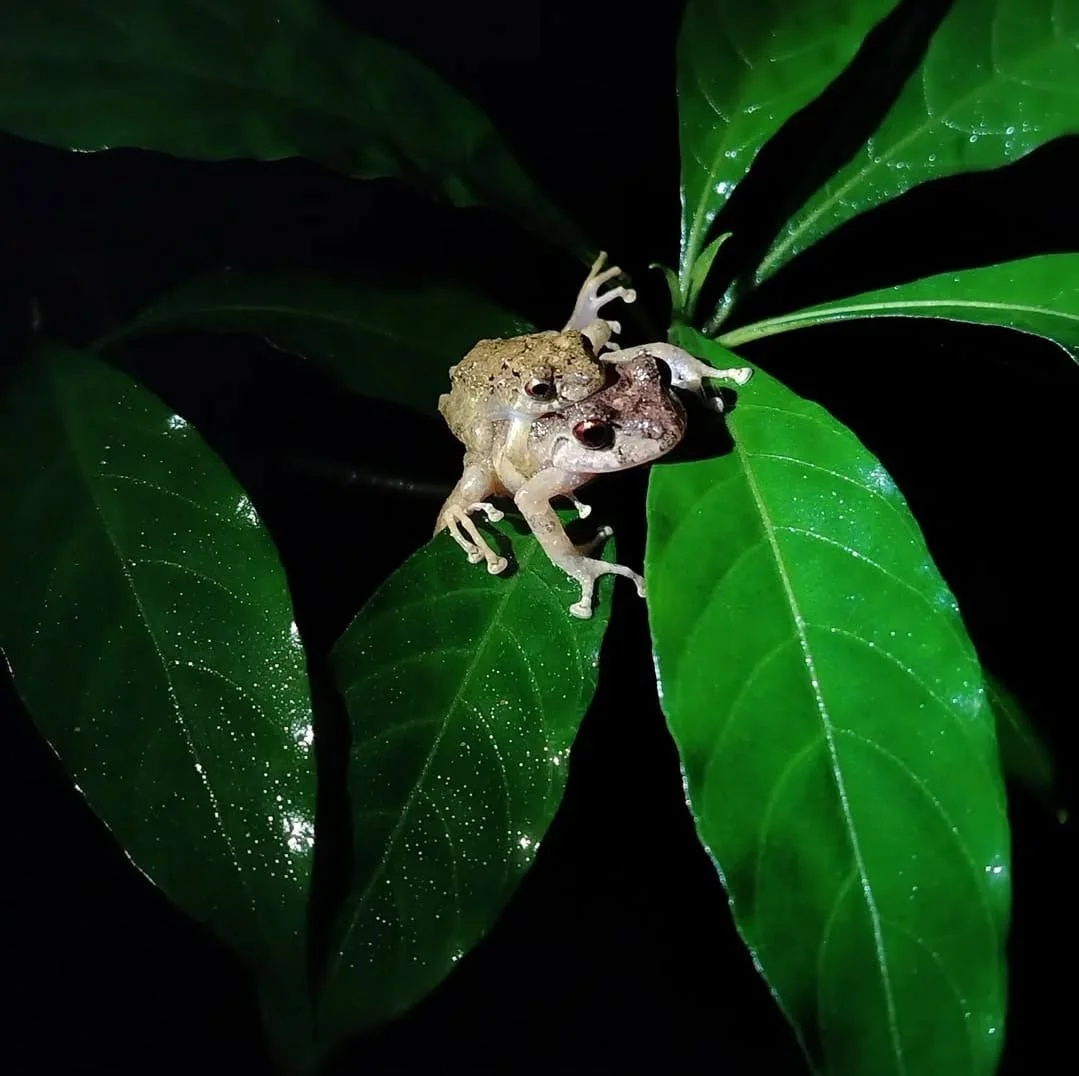
Frogs love it.
Streams become active.
The forest becomes noisy.
And after dark, the wet season can feel particularly alive.
You may hear things moving through the vegetation without ever seeing them.
That is one of the wonderful frustrations of rainforest travel.
The jungle doesn't owe you a photograph.
Sometimes you get a spectacular wildlife encounter.
Sometimes you get a frog.
Sometimes you get a leaf.
And sometimes the leaf turns out to be an insect.
---
What should you actually pack?
You don't need to arrive looking like you're preparing for an expedition to Antarctica.
But a few things make rainy-season Panama dramatically easier.
A lightweight rain jacket is worth its weight in gold.
Quick-drying clothes are much better than heavy cotton.
A waterproof phone pouch is an excellent idea.
A small dry bag is useful for boat trips and hiking.
Good sandals or shoes with grip are valuable.
And don't bring your finest collection of white clothing.
Panama's mud has ambitions.
---
Should you avoid Panama during rainy season?
Absolutely not.
Unless your entire dream vacation consists of lying on a beach from sunrise to sunset for fourteen consecutive days without seeing a cloud.
If that is your plan, the Pacific dry season is your friend.
But if you want adventure?
Rainy season can be brilliant.
You simply have to travel differently.
Wake up earlier.
Keep your schedule flexible.
Put the big outdoor activity near the beginning of the day when possible.
Don't panic when you see clouds.
Don't assume a rainy morning means a rainy afternoon.
And don't schedule every minute of your trip as though Panama's weather department has signed a contract guaranteeing sunshine.
It hasn't.
---
So which part of Panama is best in rainy season?
The Pacific:
Expect a defined rainy season, often with sunny mornings and heavier afternoon storms. September and October are generally among the wettest months.
The mountains:
Expect cooler temperatures, mist, sudden showers, lush forests and much more dramatic waterfalls. Conditions can change rapidly because of elevation and local geography.
Bocas del Toro:
Forget the idea of a conventional dry season. Rain can happen at any time, but there are periods that tend to be relatively drier, including around February to April and another favorable window often occurring around September and October.
And perhaps the most important piece of advice is this:
Don't judge Panama's rainy season by the weather outside your hotel window at 8 AM.
Panama is a country of mountains, two oceans, rainforest and wildly different microclimates. The weather can change by the hour and by the side of the mountain.
Sometimes the rain ruins your plans.
Sometimes it changes your plans.
And sometimes you are standing beneath a waterfall in a jungle that has turned impossibly green, listening to rain hammer the leaves above your head, thinking:
This is exactly why I came to Panama.