
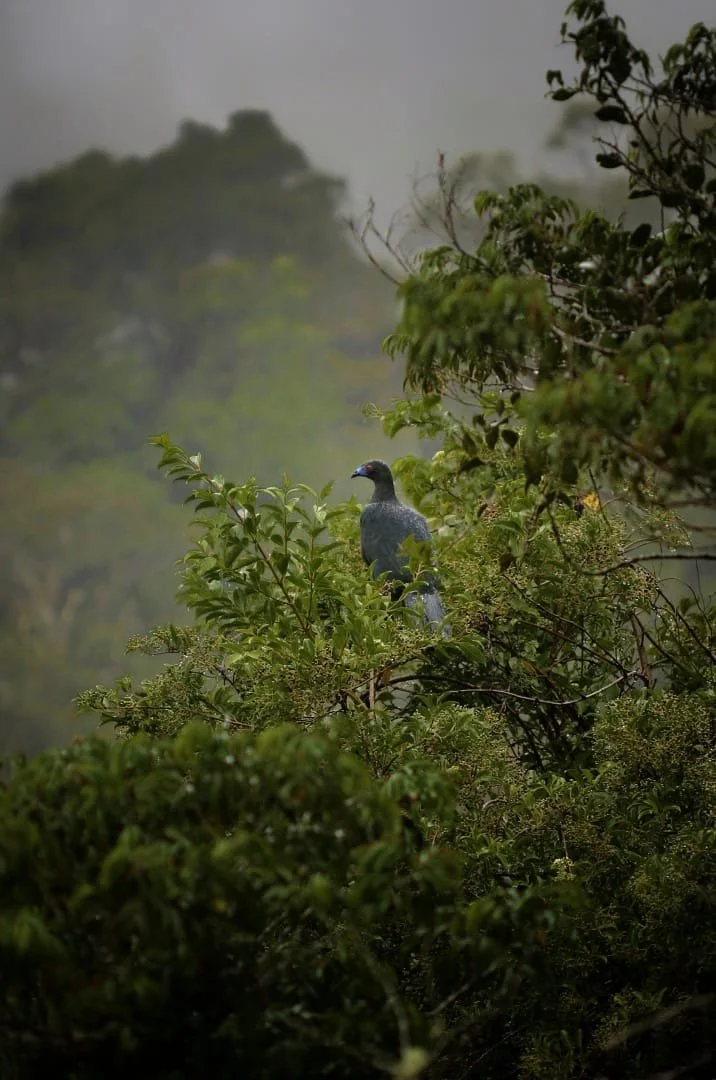
Deep in the cloud forests of western Panama lives a bird that can be surprisingly difficult to spot, despite being far from small.
The Black Guan, Chamaepetes unicolor, is a large, elegant forest bird with almost entirely black plumage, striking red eyes, reddish legs and patches of blue skin around its face. It has the appearance of something that belongs in an ancient tropical forest, which is fitting because that is exactly where it lives.
And if you want to see one in Panama, Lost and Found Hostel is one of the best places to base yourself for the search.
The hostel sits high in the mountains of Chiriquí, inside the Fortuna Forest Reserve, surrounded by the kind of mature cloud forest that these birds need. You don't have to drive for hours from a city and then join a huge birdwatching tour. You can wake up at Lost and Found, walk onto the trails and start looking.
And that's when the fun begins.
A giant that prefers to keep a low profile
The Black Guan is an impressive bird, but it isn't particularly interested in becoming famous.
You won't usually see one sitting dramatically on a telephone wire beside a highway.
These birds are associated with dense mountain forests, where they can move quietly through vegetation and forage on fruits, seeds and other plant material.
They are also remarkably good at disappearing.
A black bird in a dark cloud forest can blend into shadows surprisingly well. You may hear movement before you actually see anything.
A branch moves.
Leaves rustle.
Something walks through the vegetation.
You stop.
Nothing.
You take another step.
There it is.
A large black bird staring back at you with brilliant red eyes.
And then, just as quickly, it can disappear into the forest.
Those eyes give it away
The first thing many people notice is the eyes.
The Black Guan's red eyes stand out dramatically against its dark plumage. There is also bare bluish skin around the face, creating an unusual combination of black, red and blue.
It is a beautiful example of how wildlife doesn't need to be covered in bright tropical colours to be spectacular.
Toucans have the enormous bill.
Hummingbirds have the outrageous colours.
Parrots seem to have been designed by someone who had access to every paint in the hardware store.
The Black Guan took a different approach.
Black feathers. Red eyes. Done.
And somehow it looks incredibly cool.
A bird of the highlands
The Black Guan has a relatively restricted natural range, occurring in Costa Rica and western Panama.
In Panama, it is particularly associated with the mountainous regions of Chiriquí and Bocas del Toro, including the forests around Fortuna.
That makes the location of Lost and Found Hostel particularly special for birdwatchers.
You are already in the habitat.
The forest surrounding the hostel isn't somewhere you have to visit as a day trip.
It is where you are staying.
You can walk out in the morning and begin exploring almost immediately.
And while you're searching for the Black Guan, there is an excellent chance that you will encounter plenty of other wildlife along the way.
The forest is full of distractions
This is actually one of the problems with birdwatching at Lost and Found.
There is simply too much going on.
You might be walking down a trail looking for a Black Guan when suddenly a troop of white faced monkeys appears.
Then you notice a hummingbird hovering beside a feeder.
Then something moves in the leaves.
Then you spot a sloth.
Then a huge butterfly flies across the trail.
Then somebody shouts that they've seen something else.
Your Black Guan mission has officially become a general wildlife expedition.
This is what makes the area so fascinating.
You never quite know what is going to appear next.
Why Lost and Found is such a great place to search
Lost and Found Hostel isn't simply located near the forest.
The hostel is surrounded by it.
The property sits in the Fortuna Forest Reserve in the mountains above Hornito, with forest trails and extensive natural habitat around the hostel.
That makes it particularly attractive to travelers who want their wildlife experience to start the moment they step outside.
There is no need to spend half the day getting to a national park before you begin looking for birds.
You can grab a coffee, head down a trail and start watching.
Early morning is especially rewarding because the forest is coming alive.
Birds are moving.
Insects are active.
The air is cooler.
Mist can hang among the trees.
And the forest can feel almost prehistoric.
It is exactly the sort of environment where you start to understand why people become obsessed with birdwatching.
Look up, but don't forget to look down
When people go looking for tropical birds, they naturally spend most of their time staring into the canopy.
That's understandable.
There are birds everywhere.
But Black Guans can spend considerable time lower down, moving through vegetation and foraging.
So don't just scan the treetops.
Watch the trail.
Watch the bushes.
Listen for movement.
And occasionally stop walking altogether.
This is one of the best tricks for seeing wildlife at Lost and Found.
The moment you stop making noise, the forest seems to become much louder.
Suddenly you hear insects buzzing, birds calling and leaves moving.
And sometimes something much larger is moving through those leaves.
A species worth protecting
The Black Guan's restricted distribution makes protecting its forest habitat particularly important.
Like many tropical forest species, it has faced pressure from habitat loss and hunting.
Large, continuous areas of forest provide the food, shelter and breeding habitat these birds require.
This is one reason protected areas such as the Fortuna Forest Reserve are so valuable.
A cloud forest isn't simply a pretty backdrop for vacation photographs.
It is an entire living ecosystem.
The trees support insects.
The insects support birds.
The plants provide food.
The forest provides shelter.
And somewhere among all of it is a large black bird quietly going about its day.
The ultimate cloud forest treasure hunt
Seeing a Black Guan isn't guaranteed.
That's actually part of what makes the experience exciting.
If every visitor was guaranteed to see one at exactly 8:17 AM beside the same tree, it would be less like wildlife watching and more like visiting a zoo.
Instead, you have to search.
You have to pay attention.
You have to accept that you might walk several kilometres and see absolutely nothing unusual.
And then, on the way back, when you've stopped looking, one suddenly appears.
That is wildlife.
And those unexpected encounters are often the ones you remember for years.
Stay where the birds are
For anyone interested in Panama's cloud forest birds, Lost and Found Hostel is an exceptional base for exploring the Fortuna area.
You have mountain forest, trails, waterfalls, rivers and an extraordinary variety of wildlife surrounding you.
And among all those creatures, the Black Guan is one of the most impressive.
A large, dark, almost mysterious bird with brilliant red eyes, quietly moving through the cloud forest.
You may not see one every time you walk outside.
But keep your eyes open.
Walk slowly.
Listen carefully.
And don't spend the entire hike staring at your phone.
Because somewhere in the forest around Lost and Found, one of these magnificent birds could be standing only a few metres away, watching you long before you realize it is there.
The cloud forest has plenty of colourful characters. But sometimes the most spectacular one is the giant dressed entirely in black.