
Panama and Costa Rica sit next to each other on the narrow spine of Central America, both blessed with volcanic mountains, tropical rain, cool highlands and conditions that happen to be almost ridiculously good for growing coffee. Cross the border, however, and you can find yourself drinking two coffees that feel surprisingly different.
This isn't simply a competition between two countries trying to produce the "best" coffee. They have developed different personalities. Costa Rica has built an extraordinary reputation for clean, bright and balanced coffees, while Panama has become almost synonymous with the spectacular floral character of its Geisha coffees. Both countries produce much more than these stereotypes, but they provide a fascinating starting point for understanding the difference.
They start with almost the same recipe
The similarities are remarkable.
Both countries have mountainous coffee regions where elevation, volcanic soils, rainfall and cooler temperatures help coffee cherries develop slowly. Both have a strong Arabica tradition and generations of farmers who have learned that tiny differences in altitude, microclimate, variety and processing can change what eventually appears in your cup.
But coffee is a little like grapes. Two vineyards can be separated by only a few hundred kilometers and still produce dramatically different wines.
The same thing happens here.
Panama's major specialty coffee regions are concentrated particularly in the highlands of Chiriquí, including Boquete, Volcán and Renacimiento. Costa Rica has a much broader collection of coffee growing regions, including famous areas such as Tarrazú, the Central Valley, West Valley, Brunca and Orosi.
So although the two countries share the same general tropical mountain environment, they have developed their own coffee identities.
Costa Rica: the coffee that knows exactly what it wants to be
Costa Rican coffee is often associated with clarity, brightness, sweetness and balance.
Imagine a cup with lively acidity, citrus, caramel, brown sugar, chocolate or fruit characteristics. It can have enough brightness to wake you up before the caffeine even gets involved, but enough sweetness and body to remain extremely approachable.
One of Costa Rica's fascinating contributions to specialty coffee is the honey process.
Despite the name, no bees are required.
In honey processing, the coffee cherry is removed from the bean but some of the sticky fruit mucilage is left on the bean while it dries. This can contribute sweetness and body while maintaining some of the clarity associated with washed coffee. Costa Rica became particularly well known for the development and use of this processing approach through its network of small processing mills.
This gives Costa Rican coffee an interesting middle ground. It can be clean and bright without necessarily becoming delicate.
There is often a satisfying sense of structure to it.
Panama: where coffee starts getting weird
Then there is Panama.
Panama certainly produces conventional varieties such as Caturra, Catuai, Typica, Bourbon and others. But internationally, one variety has completely changed the country's coffee identity:
Geisha.
And Geisha doesn't necessarily taste like what people imagine coffee should taste like.
Instead of simply chocolate, nuts and roasted flavors, an exceptional Panamanian Geisha can produce intensely floral aromas, jasmine, bergamot, citrus, peach, tropical fruit and a remarkably tea-like character. Scientific research into Panamanian Geisha has also found measurable sensory differences between production regions, showing that even Geisha grown in different parts of Panama can express different characteristics.
This is where Panama's coffee story gets almost bizarre.
You can drink a cup of coffee that smells more like a flower garden than a coffee shop.
And that's one reason Panama's finest coffees have become so valuable.
The strange journey of Geisha
There is a wonderful irony in Panama's coffee history.
Geisha didn't originate in Panama.
The variety originated in Ethiopia and eventually made its way through Costa Rica before becoming famous in Panama. It was planted in Panama decades ago, but it wasn't initially treated as some magical treasure. Its low productivity and unusual growth characteristics weren't particularly attractive to farmers looking for efficiency.
Then came the moment that changed everything.
In the early 2000s, Panamanian producers began demonstrating just how extraordinary the variety could taste under the right conditions. Its spectacular performance in the Best of Panama competition helped turn Geisha into one of the most coveted coffees on the planet.
Suddenly, Panama wasn't merely another Central American coffee producer.
It had a coffee that could make professional tasters stop talking.
Costa Rica helped bring Geisha to Panama
And here's the really interesting part.
Costa Rica is part of the Geisha story too.
The variety passed through Costa Rica before becoming famous in Panama, and Costa Rican producers have also grown Geisha themselves. In other words, Panama's most famous coffee has a connection to its neighbor that makes the rivalry considerably more interesting.
Costa Rica didn't simply produce its own coffee while Panama developed something completely separate.
The coffee histories overlap.
It's almost like two neighboring countries receiving the same musical instrument and eventually developing completely different styles of music with it.
Panama's coffee can be extraordinarily expensive
This is probably the biggest difference most travelers notice.
You can find excellent coffee from both countries without spending a fortune, but Panama's rarest specialty coffees occupy a completely different price category.
The reason isn't simply that somebody decided to put a ridiculous price tag on a bag.
Some of Panama's most celebrated Geisha coffees are produced in tiny lots, require intensive harvesting and processing, and are sold through specialty auctions where international buyers compete for the rarest coffees.
One recent scientific review notes that a Panamanian Geisha micro lot sold for more than $10,000 per kilogram at auction.
That doesn't mean a normal cup of coffee in Panama costs anything remotely close to that.
It means the very top of Panama's coffee pyramid is an entirely different world.
You could drink an ordinary coffee in Panama for very little money and, theoretically, walk into a specialty café and encounter a coffee made from beans whose underlying auction value is astonishingly high.
Costa Rica has its own coffee magic
It would be a mistake, however, to turn this into "Panama has Geisha, therefore Panama has better coffee."
Coffee doesn't work that way.
Costa Rica has developed an extraordinarily sophisticated specialty coffee industry of its own. Its micro mills allow individual producers to exercise much greater control over processing, and its different growing regions can produce distinctive coffees.
A beautiful Costa Rican coffee can be sweet, bright, juicy, clean and incredibly complex without needing to be an exotic Geisha.
In fact, one of the pleasures of Costa Rican coffee is precisely that it can be spectacular without feeling like a science experiment.
It can simply be an exceptionally good cup of coffee.
The personality difference
If you had to describe the two countries as people, without pretending that every coffee follows the stereotype, the difference might look something like this:
Costa Rica walks into the room confidently, orders a coffee and gets everything right.
Panama walks into the room carrying a flower, a peach, a tea cup and possibly a laboratory notebook.
Costa Rican specialty coffee often emphasizes balance, sweetness, structure and clarity.
Panamanian specialty coffee, particularly exceptional Geisha, can emphasize aroma, florality, exotic fruit and extraordinary separation of flavors.
Neither description applies to every coffee from either country. Variety, altitude, processing, roasting and brewing can completely change the experience. But the contrast is useful when trying coffees from the two origins side by side.
And then there is the jungle
There is something particularly enjoyable about drinking these coffees in their countries of origin.
In Costa Rica, you can be surrounded by lush mountain scenery and coffee plantations, with tropical birds calling from the trees while the coffee growing around you eventually ends up in your cup.
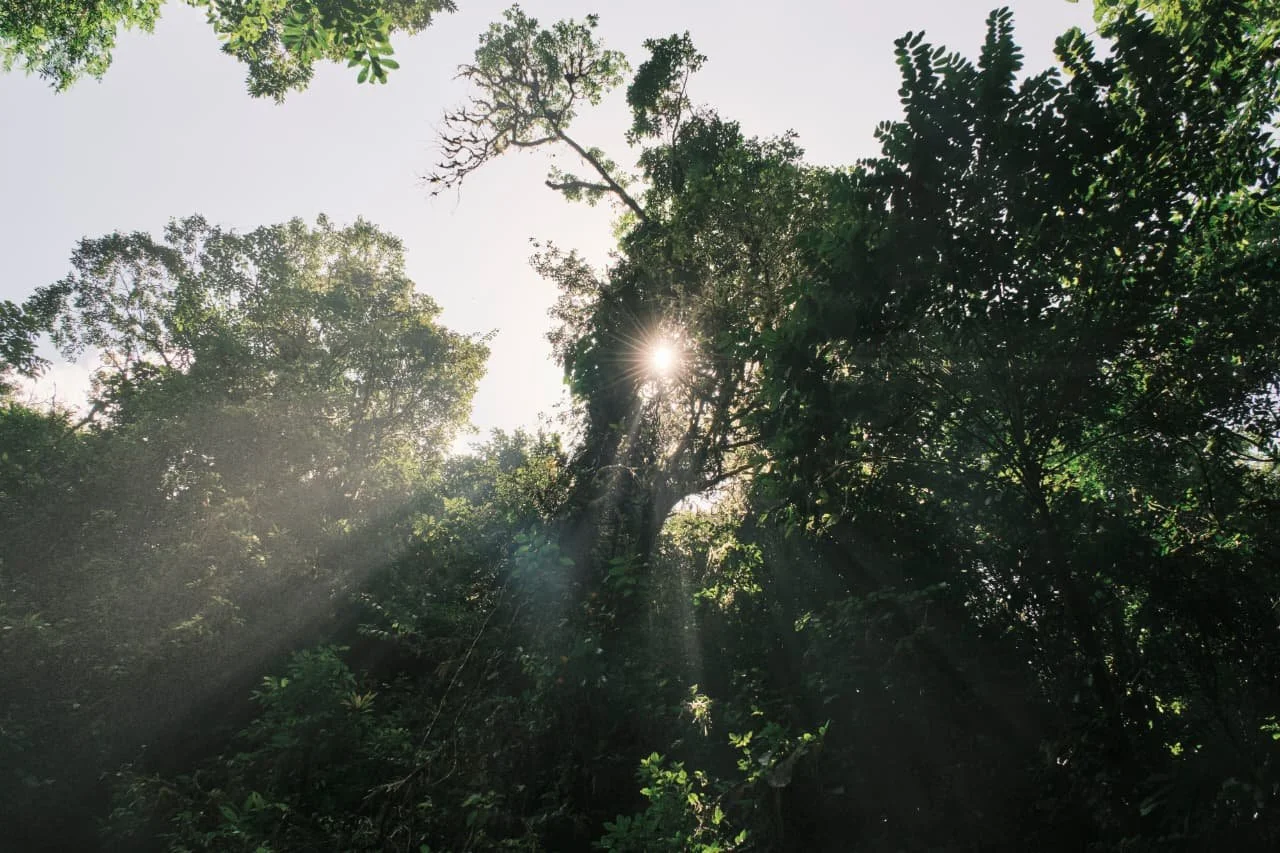
In Panama, particularly around the highlands of Chiriquí, the experience can feel almost surreal. Coffee farms climb into misty mountain landscapes around Volcán Barú, and some of the world's most expensive coffee is being produced in tiny agricultural pockets surrounded by rainforest.
The contrast is fascinating.
These aren't industrial coffee landscapes where endless rows of identical plants stretch to the horizon.
Much of the magic comes from microclimates.
A small change in elevation, exposure, rainfall, temperature or soil can alter the character of the coffee. Research on Panamanian Geisha has even found sensory differences between different production zones within Panama itself.
Which one should you drink?
The most interesting answer is: drink both.
Try a clean Costa Rican coffee and pay attention to its acidity, sweetness and structure.
Then try a Panamanian coffee from Boquete or Volcán.
Then, if you get the opportunity, try a genuine high quality Panamanian Geisha.
Don't gulp them down.
Let them cool slightly.
Smell them before drinking.
Notice what happens as the temperature changes.
You may discover that the Costa Rican coffee reminds you of what you always wanted coffee to taste like, while the Panamanian Geisha makes you wonder whether someone accidentally poured a cup of tea, fruit juice and flowers into your coffee mug.
And that is perhaps the most fascinating thing about these two neighboring coffee countries.
Costa Rica shows how extraordinary a beautifully balanced coffee can become. Panama shows how strange and spectacular coffee can become when farmers push variety, altitude, processing and terroir to their limits.
They share mountains, volcanoes, rain and Arabica.
But somewhere between the Costa Rican border and the highlands of Chiriquí, coffee takes a completely different turn.