
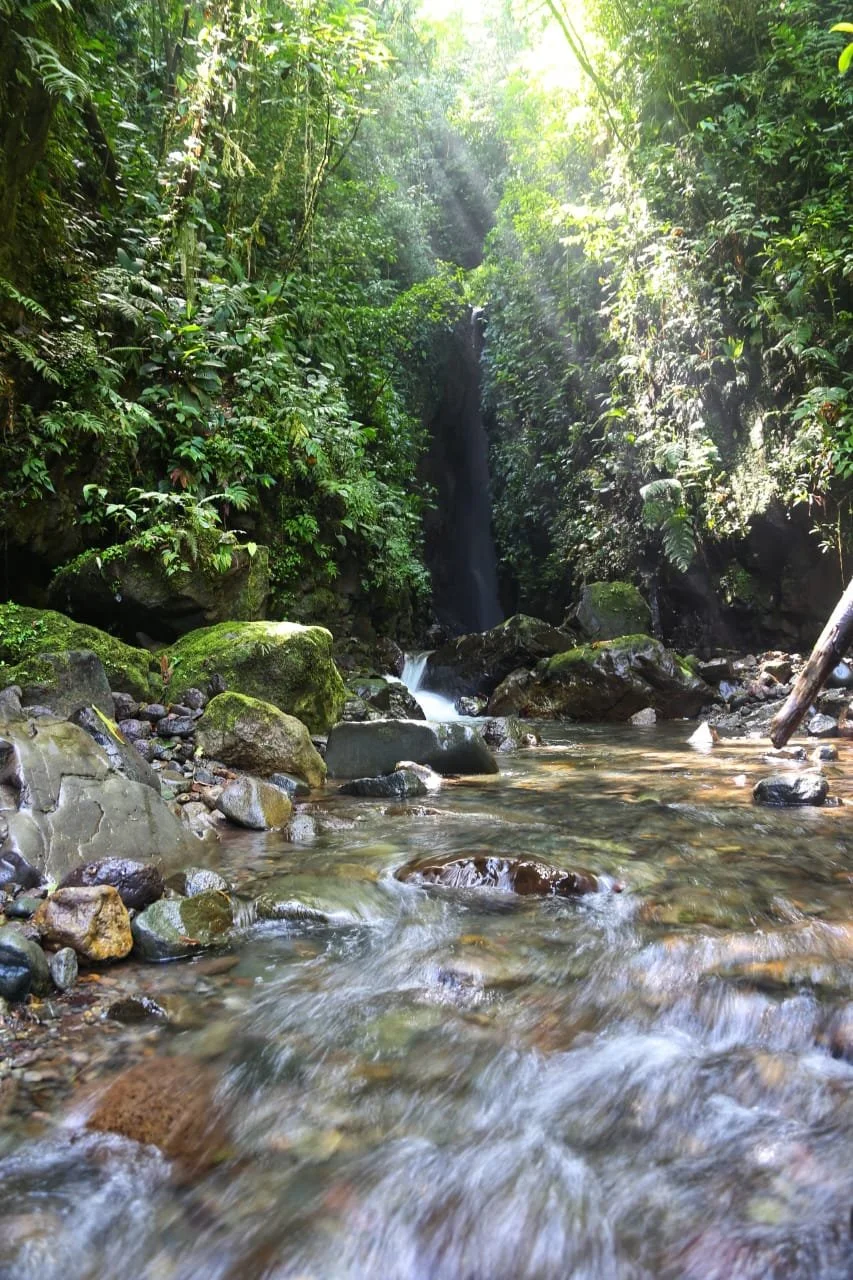
There are few things that feel more authentically Panamanian than jumping into a clear mountain river after hiking through the jungle. Forget the hotel swimming pool. In Panama, some of the best places to cool down are natural swimming holes surrounded by enormous trees, moss covered rocks, waterfalls, birds, butterflies and jungle sounds. You can spend an hour sitting in a river pool watching the water pour over rocks, then climb out, dry yourself on a warm stone and realize that you are swimming in exactly the same water that was flowing through the mountains long before anyone built a road nearby.
For travelers, river swimming can be one of the great pleasures of exploring Panama. Rivers run through the mountains of Chiriquí, Veraguas, Coclé, Panama and other parts of the country, and many have spectacular swimming holes, cascades and waterfalls. Around places such as Boquete, Gualaca, Santa Fe and the forests of Chiriquí, finding a beautiful river can become an adventure in itself. But there is an important difference between swimming in a hotel pool and swimming in a tropical river: the river is completely in charge.
That is what makes it so exciting, and also what makes a little common sense extremely important.
The water can look completely innocent
One of the biggest mistakes people make with rivers is judging them entirely by appearance. A river can look like a peaceful, shallow stream while having a surprisingly powerful current underneath. Water flowing over rocks can create underwater channels and currents that are difficult to see from the surface. Even relatively shallow moving water can knock someone off their feet, particularly if the bottom is slippery. The U.S. National Park Service warns that currents can remain powerful even when the surface appears calm and that river bottoms can contain slippery rocks, unexpected depth changes and places where swimmers can become trapped.
This is particularly relevant in Panama because mountain rivers can change character quickly after rain. You might be standing beside a beautiful clear pool in the morning and return later to find that the water is brown, fast and dramatically higher.
And here is something many visitors don't realize: it doesn't necessarily have to be raining where you are.
Rain falling farther upstream can eventually arrive at the swimming area. A river drains an entire landscape, not just the patch of sky directly above your head. Panama's mountains can receive enormous amounts of rain, and water levels can change surprisingly quickly.
Panama's firefighters specifically warn that rivers can experience sudden rises even when there is no rain at the swimming location.
The rainy season changes everything
Panama's rainy season is not a reason to avoid rivers altogether. In fact, waterfalls can become spectacular and the rainforest becomes incredibly lush. But rain should make you more observant.
After substantial rainfall, the water may become cloudy or brown because of sediment, and the current may become considerably stronger. Rocks that were previously exposed can disappear beneath the water. Swimming holes that looked harmless yesterday may suddenly have stronger circulation, floating branches or debris.
This is one of those situations where local knowledge is incredibly valuable. If you are staying at a hostel, lodge or guesthouse near a river, ask people who actually live in the area what the river is doing. A local who has watched the same river for years may know that a particular swimming hole becomes dangerous after heavy rain or that a certain waterfall should never be approached from above.
The Canadian government also recommends consulting residents and tour operators about local water hazards and following warnings from authorities when participating in water activities in Panama.
Waterfalls are beautiful, but they deserve respect
Waterfalls are probably the most irresistible part of river swimming in Panama. There is something almost impossible to resist about standing underneath a tropical waterfall while cold mountain water pounds onto your shoulders.
But waterfalls also create some of the biggest hazards.
The area immediately above a waterfall can be deceptive. A small section of fast moving water may look like something you could easily walk through, but once you lose your footing, the current can carry you toward the edge. Wet rocks can also be extraordinarily slippery.
Never assume that because you can see someone else sitting near the edge of a waterfall, the location is automatically safe. Conditions change with water levels, and one person's comfort level is not necessarily evidence of safety.
Jumping from rocks is another classic river mistake. You cannot reliably judge underwater depth simply by looking at the surface. Rocks, submerged branches and uneven bottoms may be invisible from above. Panama's travel health guidance specifically warns against diving into shallow or unknown water.
The safest rule is simple: never jump or dive into water when you don't know exactly what is underneath you.
Watch the rocks
Panama's rivers are full of beautiful smooth stones, which are also excellent at making people fall over.
Algae, moss and constant water movement can turn rocks into natural banana peels. Even people who are excellent swimmers can have trouble staying upright when walking across a riverbed.
Water shoes or sturdy sandals with good grip can make a big difference. Flip flops are particularly useless when you're trying to scramble over wet rocks. Bare feet can also leave you vulnerable to cuts from sharp stones or hidden objects.
And don't assume that deeper water is necessarily safer. Sometimes the safest place to sit is a shallow area where you have good footing. Other times, a deep pool is perfectly calm while a seemingly harmless shallow section has a strong current flowing over it.
The trick is learning to read the river rather than simply looking for the deepest or prettiest pool.
Don't underestimate cold mountain water
Panama is hot, but not every river is warm.
Mountain streams can be surprisingly cold, particularly in higher elevations and shaded cloud forest areas. After hiking for an hour in tropical heat, jumping into cold water can feel fantastic, but prolonged exposure can eventually become uncomfortable or dangerous.
This is another reason not to assume that being a strong swimmer means you can handle every river. Cold water can affect strength and coordination, particularly if you're tired from a long hike.
Fortunately, most recreational river swimming in Panama isn't about spending hours swimming continuously. It's usually more about floating, sitting in pools, cooling off and enjoying the surroundings.
And that is arguably the better way to do it.
Never swim alone
This may be the least exciting piece of advice, but it is one of the most important.
A river is not a swimming pool, and rescue can be difficult. Some remote swimming holes have no lifeguards, poor mobile phone coverage and no easy road access. If something goes wrong, you may be much farther from help than you realize.
Panama's fire department recommends avoiding swimming alone, particularly in rivers where currents can be unpredictable.
There is also a psychological advantage to having other people around. Someone standing on the bank may notice a problem before the person in the water does. If you are exploring a more remote river or canyon, having an experienced guide or someone familiar with the location can be particularly valuable.
Alcohol and rivers are a terrible combination
This deserves its own paragraph because it is one of the easiest mistakes for backpackers to make.
A cold beer beside a tropical river sounds fantastic. A cold beer while swimming in a tropical river is considerably less fantastic.
Alcohol affects coordination, judgment and reaction time, all of which matter when you're dealing with currents, slippery rocks and uneven riverbeds. Panama's firefighters specifically advise against drinking alcohol before or during swimming because it increases the risk of accidents.
Have the beer afterward.
The river will still be there.
There is also a health side to natural swimming
Clear mountain water looks incredibly clean, but clear does not necessarily mean sterile.
Natural rivers can contain microorganisms originating from humans or animals. Heavy rain can wash contaminants into waterways, and certain bacterial infections can be associated with freshwater exposure.
One particular concern in tropical environments is leptospirosis, a bacterial infection transmitted through water or soil contaminated with urine from infected animals. The CDC specifically identifies swimming and wading in rivers, streams and other freshwater as possible exposure activities and advises avoiding potentially contaminated water, particularly after flooding or heavy rainfall.
That doesn't mean you should look at every Panamanian river and imagine it is contaminated. It means you should understand that natural water is different from treated swimming-pool water.
If you have open cuts, scrapes or fresh wounds, covering them with a waterproof dressing or avoiding questionable freshwater altogether is sensible. The CDC also recommends avoiding swallowing untreated natural water.
If a river looks unusually dirty, smells bad, has obvious sewage contamination or has recently experienced flooding, find another place to swim.
The jungle itself is part of the experience
One of the best things about river swimming in Panama is that the swimming is often only half the experience.
You might hike through dense forest to reach the water. Along the way you may hear howler monkeys in the distance, see white faced capuchins moving through the canopy, spot brightly colored frogs, watch butterflies crossing the trail or hear birds calling from somewhere you can't quite locate.
Then you arrive at the river and everything changes.
The temperature drops. The sound of the water drowns out the road. You find a rock in the shade and sit down. Maybe there is a waterfall nearby. Maybe the river disappears around a bend into the forest. Maybe you are completely alone except for the birds.
This is one of the reasons river swimming can feel much more memorable than visiting a conventional tourist attraction. There isn't necessarily a ticket booth, a souvenir shop or a perfectly manicured path. Sometimes there is simply a trail, a river and a beautiful place to sit.
Look upstream before getting in
This is one of the simplest habits you can develop.
Before entering a river, look upstream.
Check the water. Look at its speed. Look for floating branches, debris or sudden changes in color. Look at the banks. Check whether the water level appears to be rising.
Then look downstream.
Where would the current take you if you lost your footing?
Is there a waterfall? A narrow canyon? Large rocks? Fallen trees?
Thinking about these things for thirty seconds can completely change how you approach a swimming hole.
If the water suddenly becomes muddy or begins carrying branches and debris, get out and move away from the riverbank. Don't wait until the water is already dangerously high.
A recent example illustrates just how seriously this should be taken. In August 2026, Panama's Ministry of Environment temporarily closed areas of Chagres National Park because of increased river flow and warned people not to enter, swim, navigate or remain along the riverbanks because of the risk of rising water and sudden currents.
The best river swimming is often slow
There is a temptation when traveling to turn every natural attraction into an activity. Swim as far as possible. Jump from the highest rock. Climb the waterfall. Race your friends downstream.
You don't have to.
Some of the best river experiences are remarkably lazy.
Find a calm pool. Sit on a rock. Let the water flow around your legs. Float for a few minutes if the conditions are genuinely safe. Listen to the jungle. Watch insects skating across the surface. Look for fish. Have a conversation with the people you are traveling with.
It doesn't need to become an extreme sport.
In fact, the people who have spent the most time around these rivers often seem to have exactly the opposite attitude. They know where the water is safe, where it isn't, when the river changes and when it is better simply to sit on the bank and enjoy the view.
River swimming is one of Panama's great pleasures
For a traveler, swimming in a Panamanian river can become one of those memories that stays with you long after the trip is over. Maybe it is the freezing water after a sweaty jungle hike. Maybe it is sitting beneath a waterfall surrounded by rainforest. Maybe it is discovering a swimming hole that seems completely hidden from the rest of the world.
But the best river experiences happen when you respect the fact that you are entering a wild environment rather than a swimming pool.
Check the weather. Ask locals about conditions. Avoid rivers after heavy rain when conditions are questionable. Never underestimate currents. Don't dive into unknown water. Be careful on wet rocks. Don't swim alone. Skip the alcohol until afterward. Keep open wounds protected and avoid swallowing untreated water. And if authorities or local experts tell you that a river is unsafe, believe them.
The goal isn't to be afraid of Panama's rivers. Quite the opposite.
The goal is to understand them well enough to enjoy them.
Because when the conditions are right, there are few better feelings in Panama than finishing a hot jungle hike, hearing rushing water ahead of you, stepping into a cool natural pool and realizing that for the next hour, this is your swimming pool.