
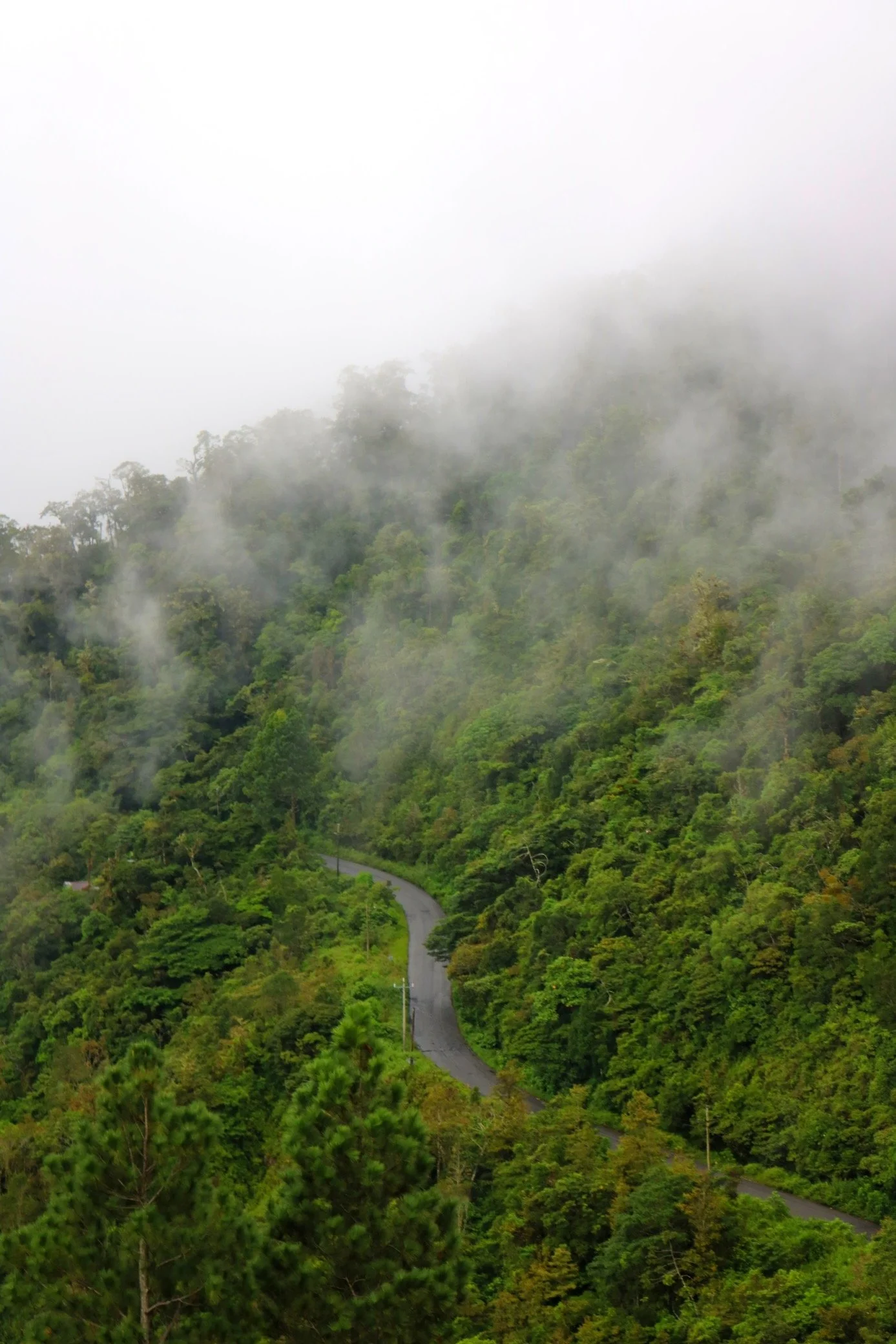
Hidden deep in the mountains of Coclé, Parque Nacional General de División Omar Torrijos Herrera is one of Panama's most fascinating protected areas for anyone interested in nature, wildlife and adventure. Covering roughly 25,000 hectares around the mountains of Cerro Marta and Cerro Peña Blanca, the park protects an enormous section of the Central Cordillera. It is a place where tropical forests gradually become cooler and wetter as you climb, eventually creating the misty, mysterious environment of cloud forest. For someone hiking toward the famous remains of Omar Torrijos' aircraft, the plane itself may be the historical attraction, but the living world surrounding it is arguably even more impressive. The farther you travel into the park, the more you begin to understand just how much life can exist inside a Panamanian mountain forest. The park contains several different types of forest, including tropical moist forest, tropical very moist forest and premontane forests, creating a remarkable variety of habitats within a relatively compact mountainous region. The elevation, constant moisture and isolation have helped create an environment where plants, birds, mammals, reptiles, amphibians and insects can thrive. It is the kind of place where you can walk along a trail for hours and constantly discover something new, provided you slow down enough to actually look.
One of the first things that captures your attention is the vegetation. The forests contain large native trees including guayacán, cedar, roble, níspero, Inga and copé, along with countless other species that create the layers of the forest. These trees aren't simply scenery; they are the foundation of an enormous ecosystem. Their trunks and branches support orchids, bromeliads, mosses, ferns and other epiphytes, while their flowers, fruits and seeds provide food for birds, mammals and insects. Some of the most spectacular plants are growing nowhere near the ground. Look up into the canopy and you can find entire gardens growing on the branches of other trees. Orchids cling to trunks and branches, bromeliads collect water in their leaves and mosses cover the surfaces of trees in thick green carpets. One particularly special plant associated with the park is Peristeria elata, the famous Holy Ghost Orchid, which is also Panama's national flower. The humid mountain environment is perfect for orchids and other epiphytes, and this is one of the reasons the forest can look almost impossibly lush. A tree that appears to be a single organism from a distance may actually be supporting dozens of different species, turning the forest into a complicated vertical ecosystem.
The tree ferns are another unforgettable part of the landscape. With their tall trunks and enormous fronds, they can make sections of the forest look almost prehistoric. Tree ferns belong to ancient plant lineages and their appearance fits perfectly into the mysterious atmosphere of Cerro Marta. Along with them are plants such as Zamia, another ancient lineage that can look completely out of place to someone accustomed to ordinary tropical vegetation. Walking through the misty forest surrounded by tree ferns, moss and enormous leaves can genuinely feel like stepping into another period of Earth's history. The higher sections of the park can become particularly atmospheric when clouds settle over the mountains. The air becomes cooler, the vegetation becomes covered in moisture and the forest floor becomes increasingly soft and muddy. Every surface seems to have something growing on it. It is one of those environments where you quickly realize that Panama's tropical forests aren't simply forests filled with trees; they are complicated worlds built in layers, from the soil all the way to the highest branches.
The birdlife makes the park even more remarkable. The White tipped Sicklebill hummingbird is recognized as the park's symbolic bird, and its unusual curved bill is one of the most distinctive sights a birdwatcher could hope to encounter. It is one of many hummingbirds that can be found in Panama's mountain forests, where flowering plants provide an almost continuous supply of nectar. Hummingbirds are not merely beautiful creatures to photograph; they are important pollinators, moving pollen between flowers as they travel through the forest. The park also supports toucans, parrots, oropendolas, swifts and a tremendous variety of smaller forest birds. Among the species associated with the area are Black Guan, Red fronted Parrotlet, Chiriqui Quail Dove, Sooty faced Finch, Ruddy Treerunner, Black crowned Pittasoma, Silvery fronted Tapaculo, Black faced Solitaire and Golden browed Chlorophonia. The Three wattled Bellbird is another particularly interesting species recorded from the region and is considered Vulnerable. For a serious birdwatcher, this means that a hike toward Cerro Marta can turn into a full day of birding without even trying. Instead of simply walking from one destination to another, you can stop every few minutes to listen to calls coming from the canopy, search the branches for movement or watch a hummingbird suddenly appear beside a flower before disappearing just as quickly.
The mammals of the park are perhaps even more exciting because several of Panama's most impressive species are associated with this protected landscape. The park is home to an extraordinary collection of mammals, including tapirs, deer, peccaries, agoutis and various wild cats. Jaguars are among the most spectacular animals associated with the park, although seeing one would be an extremely rare and fortunate event. A healthy jaguar population requires large areas of connected forest and an abundance of prey, so the presence of these predators illustrates how important large protected areas such as this one can be. Smaller wild cats, including animals known locally as tigrillos and manigordos, are also part of the ecosystem. These cats are incredibly secretive and mostly active when people aren't around, meaning that hikers are much more likely to find tracks or other evidence than actually see one. In recent years, camera traps have been used to monitor wildlife in the park, giving conservationists an opportunity to discover what is moving through the forest even when the animals themselves remain hidden. There is something particularly exciting about walking through a forest knowing that an animal you will probably never see may have passed along the same trail only hours earlier.
The Baird's tapir is another spectacular resident of Panama's forests and one of the most important mammals you could hope to encounter. These enormous animals have a strange, almost prehistoric appearance, with a flexible snout, heavy body and distinctive black and white coloration. Tapirs are generally secretive and often active at night, so they are difficult to observe, but they play an extremely important role in the ecosystem. They consume large amounts of vegetation and help disperse seeds throughout the forest, effectively helping to plant future generations of trees. Peccaries perform another important role, moving through the forest in groups and feeding on a variety of plants, fruits and other foods. Agoutis are smaller but equally fascinating. These large rodents spend much of their time searching for fallen fruit and seeds and are particularly important seed dispersers. Some seeds are carried away and buried, and those forgotten seeds can eventually grow into new trees. In other words, when you see an agouti disappearing into the vegetation, you aren't simply watching a strange looking tropical rodent. You're watching one of the forest's gardeners at work.
The amphibians are another reason the park is so biologically important. The constant moisture of the mountain environment provides ideal conditions for frogs and salamanders, including glass frogs and other species associated with Panama's cloud forests. The region is particularly important for amphibian conservation, and species such as the salamander Bolitoglossa copia are considered Critically Endangered. These animals are incredibly sensitive to changes in their environment, making their presence an important indicator of forest health. After rain, the forest can become a completely different world. Frogs begin calling from streams and vegetation, tiny amphibians emerge from beneath leaves and the wet forest floor becomes alive with movement. This is one of the reasons night walks in tropical mountain forests can be so fascinating. During the day, many creatures remain hidden, but once darkness arrives, an entirely different community becomes active.
Of course, a tropical forest wouldn't be complete without reptiles, and Omar Torrijos National Park has its share of them. Boa constrictors, coral snakes and fer de lance, known locally as the culebra equis, are among the snakes associated with the park. Seeing a snake is never guaranteed, and most snakes will do everything possible to avoid people, but hikers should remember that they are walking through genuine wilderness. Watching where you put your feet and hands is particularly important when moving through thick vegetation, stepping over fallen trees or reaching toward rocks and branches. The correct approach is to admire wildlife without disturbing it. A snake disappearing into the vegetation is a successful wildlife encounter, even if you only see it for a few seconds. The same principle applies to every animal in the park. The goal isn't to chase wildlife or force an encounter. It is to be quiet enough that the forest eventually reveals something to you.
And then there is the enormous world of insects and other small creatures that most visitors barely notice. Butterflies, beetles, ants, spiders, katydids, moths and countless other insects are essential components of the ecosystem. They pollinate plants, break down dead vegetation, provide food for birds and amphibians and form the foundation of numerous food chains. In a tropical forest, something as ordinary as a rotting log can be an entire ecosystem. Pull back your attention from the spectacular animals and you start seeing life everywhere. A leaf may have been eaten by a caterpillar. A flower may be covered with tiny pollinating insects. A spider may have built a web between two plants. Ants may be moving in organized lines across the trail. The forest is never really quiet and never really empty. Even when you don't see a large mammal or colorful bird, thousands of smaller organisms are constantly working around you.
Perhaps the most fascinating thing about Omar Torrijos National Park is the way all of these organisms are connected. The enormous trees provide shelter and food for birds and mammals. The orchids and other flowering plants depend on pollinators. Hummingbirds move pollen between flowers. Agoutis and tapirs spread seeds. Insects provide food for birds and frogs. Predators such as wild cats help regulate populations of other animals. Fallen trees eventually become habitat for insects and fungi and return nutrients to the soil. Nothing exists completely by itself. The forest is a gigantic network in which almost every species has a role, whether it is obvious to a visitor or not.
This makes hiking toward the wreckage of Omar Torrijos' plane an unusually rewarding experience. The aircraft is an extraordinary piece of Panamanian history, but the forest surrounding it tells an equally important story about Panama's natural heritage. As you climb through the park, the landscape changes from rural areas into increasingly dense forest and eventually into misty mountain vegetation. You may hear a hummingbird before you see it, discover a frog beside a stream, notice an unfamiliar orchid growing high in a tree or find tracks in the mud belonging to an animal that passed through during the night. You might never see a jaguar, tapir or wild cat, but knowing they inhabit the same protected forest gives the mountain a sense of wildness that is difficult to find elsewhere.
The greatest attraction of Omar Torrijos National Park may therefore not be one particular species or even the famous aircraft wreckage. It is the feeling of entering a living world that has been developing for thousands and thousands of years. The plane represents one moment in Panama's recent history, frozen in the forest since 1981. The trees, orchids, hummingbirds, frogs, mammals and countless smaller organisms represent something much older and constantly changing. When you hike through this park, you are walking through both stories at the same time. You can stand beside a piece of modern Panamanian history and then look up to see an orchid flowering in a tree, hear a bird calling through the mist or watch a hummingbird disappear into the forest. The wreckage may be what brings you to Cerro Marta, but the extraordinary flora and fauna are what make you realize that the real treasure is the jungle itself.