
Panama is one of those countries that can be surprisingly difficult to understand geographically. Look at it on a map and it appears like a thin strip of land connecting North America and South America. It is easy to assume that it must be tiny. Then you actually travel around Panama and discover that getting from one side of the country to the other can involve hours of buses, mountain roads, ferries, tropical forests, islands and completely different climates.
So exactly how big is Panama?
Panama covers approximately 75,400 square kilometres of land. That makes it a relatively small country by world standards, but it is considerably larger than many travellers imagine.
To put that into perspective, Panama is roughly similar in total area to South Carolina, slightly smaller than Ireland, and considerably smaller than countries such as Costa Rica, Nicaragua and Honduras.
But area alone doesn't really explain Panama.
The shape of the country is what makes it interesting.
Panama is long and narrow
Panama stretches roughly 770 kilometres from west to east, although the exact measurement depends on where you measure it.
It is shaped almost like a curved, irregular bridge between Costa Rica and Colombia.
The Pacific Ocean is on one side.
The Caribbean Sea is on the other.
The country becomes narrower in some places and considerably wider in others, with mountains running through much of its interior.
This means that Panama has an enormous amount of coastline relative to its land area.
And then things get even more complicated because Panama has more than 1,000 islands.
So although the country itself is not enormous, its geography is remarkably complicated.
Panama compared with other countries
A useful way to understand Panama is to compare it with familiar places.
Panama is approximately:
75,400 km²
Ireland is approximately:
70,000 km²
South Carolina is approximately:
83,000 km²
Portugal is approximately:
92,000 km²
Austria is approximately:
84,000 km²
Costa Rica is approximately:
51,000 km²
So Panama is not a microscopic country.
It is actually quite substantial when you are travelling around it.
You could fit Costa Rica inside Panama with room left over, although the exact comparison depends on whether you are comparing total area or land area.
Why Panama can feel much larger
The biggest reason Panama feels bigger than its numbers suggest is the terrain.
If Panama were a flat rectangle with enormous highways running straight across it, you could cross it relatively quickly.
It isn't.
You have mountains.
Rainforests.
Rivers.
Cloud forests.
Wetlands.
Remote islands.
Coastal communities.
And roads that sometimes seem to have been designed by someone who looked at a perfectly good mountain and thought, "Let's put a road up that."
The Pan American Highway makes travelling through much of the country relatively straightforward, but once you leave the major routes, travel times can increase dramatically.
A destination might look close on a map and still take hours to reach.
The mountains make a huge difference
Panama is crossed by mountain ranges and highlands, particularly along the western side of the country.
This is why destinations such as Boquete can feel like another country compared with Panama City.
You can leave the tropical heat of the lowlands and climb into cooler mountain air within a relatively short distance.
The highlands around Chiriquí contain some of the country's highest terrain, including Volcán Barú, Panama's highest mountain at approximately 3,475 metres.
That is an enormous elevation change for a country that isn't particularly large.
It also helps explain why Panama has such a surprising variety of ecosystems.
Panama has two very different coasts
One of Panama's greatest geographical advantages is that it has both a Caribbean and a Pacific coast.
And they don't feel the same.
The Caribbean side includes destinations such as Bocas del Toro, with tropical islands, beaches, coral reefs and a very different atmosphere from the Pacific.
The Pacific coast is generally much more extensive and includes destinations such as Santa Catalina, Playa Venao and the Pearl Islands.
The Pacific also has enormous tidal variation in many areas, which can dramatically change the appearance of beaches and coastal landscapes.
You can therefore travel across Panama and experience completely different coastal environments without travelling enormous distances.
Panama's jungle is a huge part of the country
A large portion of Panama remains covered by forests.
This is one reason the country feels so wild once you leave the major cities.
The Darién in eastern Panama is particularly famous for its immense wilderness.
The Darién is not simply another tourist attraction. It is one of the most remote and biologically important areas in Central America, with dense tropical forests, rivers and extremely difficult terrain.
Then there are protected areas scattered throughout the country.
You can go from modern skyscrapers in Panama City to rainforest surprisingly quickly.
That contrast is one of the strangest things about Panama.
Panama City gives a misleading impression
If you arrive in Panama City by airplane, you might initially think Panama is much more developed and urban than it actually is.
The skyline is enormous.
There are skyscrapers everywhere.
There are shopping malls, highways, modern apartment towers, luxury hotels and enormous commercial areas.
The city can look like a miniature Miami or a tropical version of a major North American city.
Then you travel a few hours away and suddenly you're surrounded by mountains, jungle, rivers and tiny communities.
Panama City is therefore a very poor representation of the physical size and character of the entire country.
It is the country's economic centre, but geographically it is only one small part of Panama.
You can go from the Caribbean to the Pacific
One of the most fascinating things about Panama's geography is how close the two oceans actually are.
The famous Panama Canal crosses the country from the Pacific to the Caribbean side.
At its narrowest, the distance between the two coastlines is only around 80 kilometres.
That is one of the reasons the location became so strategically important.
For centuries, people understood that Panama was essentially the natural shortcut between two enormous bodies of water.
Today the Panama Canal makes that geographical fact obvious to the entire world.
The Canal is not the whole country
Because Panama is so strongly associated with the canal, some people have an oddly distorted image of the country.
They imagine a narrow strip of land with a canal running through it and Panama City sitting beside the water.
But there is an enormous amount of Panama outside the canal zone.
There are mountains, cloud forests, Caribbean islands, Pacific beaches, coffee growing regions, indigenous territories, enormous national parks, cattle country, rainforest and remote jungle.
The canal is incredibly important, but it occupies only a tiny portion of the country's total area.
Panama's islands make it even bigger from a traveler's perspective
Then there are the islands.
The country has hundreds upon hundreds of them, ranging from tiny uninhabited islands to places where people live year round.
The Bocas del Toro archipelago alone can make Panama feel considerably larger than it appears on a map.
You can spend days travelling between islands, beaches, villages and reefs.
Then there is Guna Yala, with its famous collection of tiny Caribbean islands and turquoise water.
On the Pacific side, there are the Pearl Islands and numerous smaller islands.
So when you think about the size of Panama, don't just think about the 75,000 or so square kilometres of land.
Think about all that coastline and all those islands.
The population is concentrated in relatively small areas
Panama has a population of roughly 4.5 million people, and they are not distributed evenly throughout the country.
A huge percentage of the population is concentrated around Panama City and the surrounding metropolitan area.
Once you travel away from the capital, population density can drop dramatically.
This is one reason Panama can feel surprisingly empty.
You can be in a major international city in the morning and later the same day be walking through rainforest where the loudest thing you hear is an insect, bird or monkey.
Chiriquí is a good example
Chiriquí Province is a particularly good illustration of how much variety Panama packs into a relatively small country.
You have David down in the warmer lowlands.
You have the mountains around Boquete.
You have Volcán and the highlands.
You have coffee plantations.
You have rivers.
You have forests.
You have Pacific beaches further south.
And toward the north you can eventually reach the Caribbean side and the Bocas del Toro region.
That is an extraordinary amount of geographical variety for one part of a relatively small country.
For backpackers travelling between Boquete and Bocas del Toro, the journey itself becomes part of the adventure.
The journey is often more important than the distance
This is probably the biggest lesson about travelling in Panama.
Don't judge a journey by kilometres alone.
A destination that is 100 kilometres away isn't necessarily a quick trip.
Mountain roads, traffic, weather, road conditions, transfers and local buses can all affect travel time.
This is particularly important if you are trying to connect several destinations in a short vacation.
Panama may look small enough to cross in an afternoon.
Sometimes it is.
Sometimes your map will tell you that you're practically there while your bus driver appears to have other plans.
From Panama City to the jungle
One of the country's greatest advantages for travellers is how quickly you can escape the urban environment.
From Panama City you can reach rainforest, rivers and smaller communities without having to spend an entire day travelling.
Head further west and the landscape gradually changes.
The urban environment gives way to farmland, hills, forests and eventually the mountains of central and western Panama.
Continue toward Chiriquí and the landscape becomes increasingly mountainous.
Then you can head toward Bocas del Toro and suddenly you're back in Caribbean territory.
It is almost like several countries have been compressed into one.
Why Panama is perfect for a road trip
Panama's size is actually one of the reasons it works so well as a travel destination.
It is large enough to provide enormous variety but small enough that you can realistically see several completely different regions during one trip.
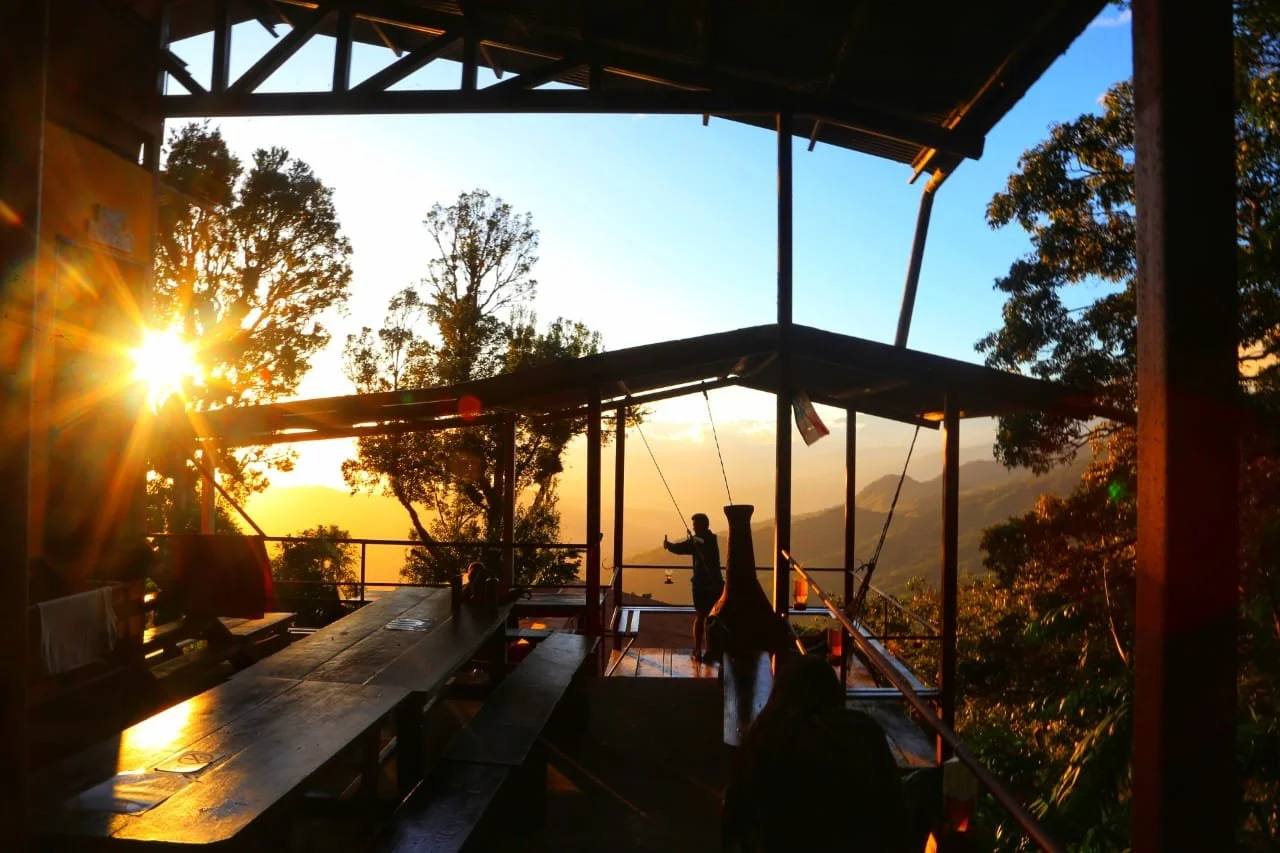
A traveller could begin in Panama City, head into the mountains around El Valle, continue toward Santa Catalina, travel through Chiriquí and Boquete, stop in the Fortuna Forest Reserve around Lost and Found Hostel, and then continue toward Bocas del Toro.
That itinerary covers dramatically different environments without requiring international flights between every destination.
You can go from skyscrapers to jungle.
Jungle to cloud forest.
Cloud forest to Caribbean islands.
And all within one country.
So how big is Panama really?
On paper, Panama is about 75,400 square kilometres.
That makes it smaller than many countries people routinely travel through, but considerably larger than the mental picture many people have when they first hear the word Panama.
The trick is that Panama's geographical diversity is much larger than its physical size suggests.
There are two oceans, enormous forests, high mountains, tropical islands, rivers, wetlands, cities, farms and remote wilderness packed into a relatively narrow country.
And because the population is heavily concentrated around a few areas, huge parts of Panama can feel genuinely wild.
That is why you can spend breakfast surrounded by skyscrapers in Panama City and, before the day is over, be sitting in a hammock listening to insects in a cloud forest.
Panama isn't enormous.
But it is big enough to keep surprising you.
And for a backpacker, that might actually be the perfect size.