
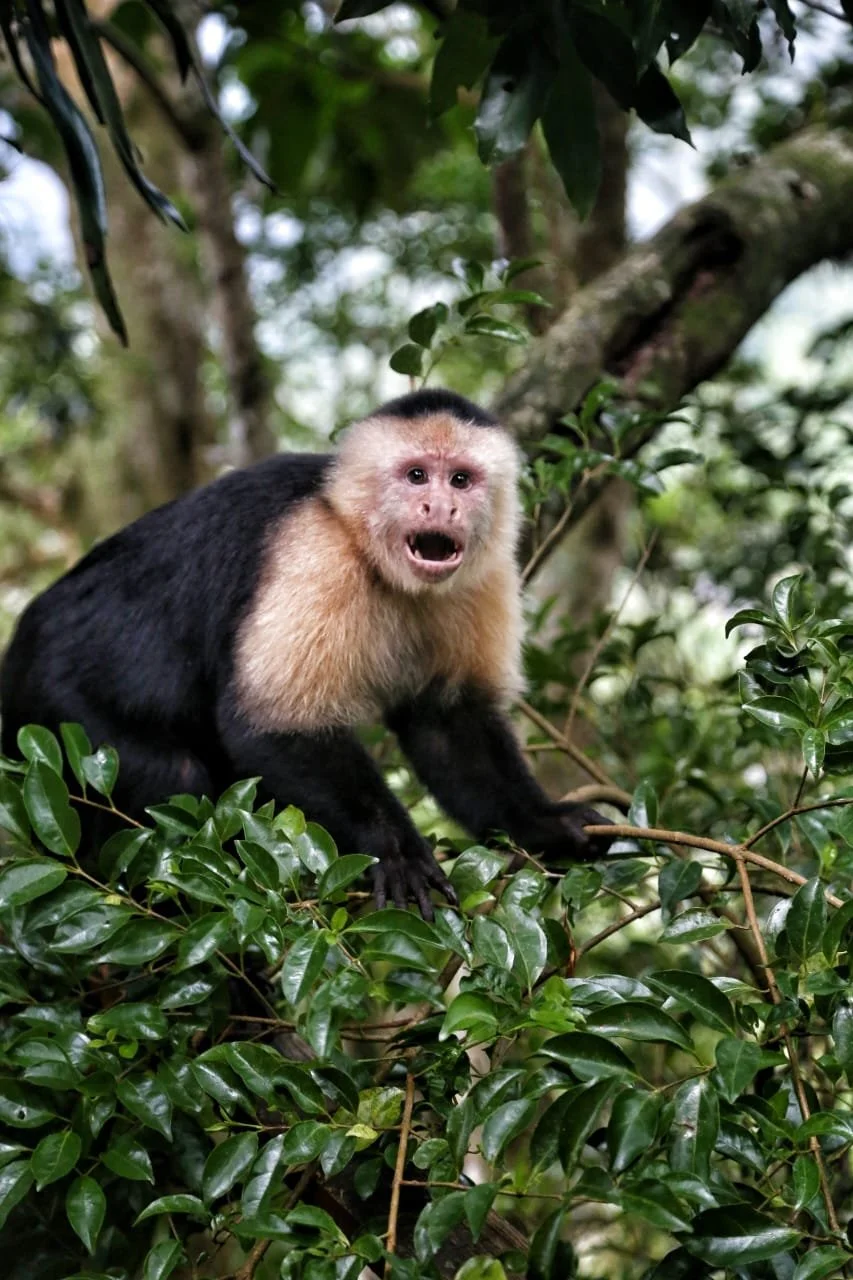
If you are travelling through Panama, especially around the forests, islands and national parks, there is a good chance you will eventually encounter one of the country’s most entertaining residents: the white faced capuchin monkey. With their expressive faces, dark bodies, pale cheeks and almost human looking hands, they can seem remarkably familiar. A troop moving through the trees can stop a hiking trail completely, with visitors standing underneath watching the monkeys swing, climb, investigate branches and occasionally stare right back at the humans.
White faced capuchins are among the most commonly encountered monkeys in Panama. They are highly intelligent, adaptable animals that live in groups and spend much of their lives moving through the forest canopy. They eat an enormous variety of foods, including fruit, seeds, insects, flowers, eggs and other small food items. Their intelligence is one of the reasons they are so fascinating to watch, but it is also one of the reasons people should be particularly careful about interacting with them.
Are white faced monkeys dangerous?
Generally, no. A healthy wild white faced capuchin that is behaving normally is not looking for a fight with tourists. In fact, most wild monkeys would much rather keep their distance from people. They may watch you closely, make vocalizations, move through the trees above you or occasionally come closer out of curiosity, but this is very different from being aggressive.
The important distinction is that a monkey is still a wild animal. It is not a dog, a pet or an attraction that exists for human entertainment. Even a relatively small capuchin has sharp teeth and strong hands, and any wild animal can react defensively if it feels threatened, trapped or provoked.
The safest way to enjoy them is surprisingly simple: look, photograph and keep your distance.
The biggest mistake is feeding them
Feeding wild monkeys might seem harmless. Someone has a banana, a piece of bread or a snack, a monkey approaches and everyone gets an amusing photograph. Unfortunately, that five second interaction can create much bigger problems.
Monkeys are extremely good at learning. If a capuchin discovers that approaching humans results in food, it can quickly begin associating people with meals. Eventually, it may stop behaving like a completely wild animal and start actively seeking out tourists.
That can lead to monkeys approaching backpacks, grabbing food, climbing onto people or becoming aggressive when food is not provided. What looks like a cute encounter can therefore contribute to a dangerous habit.
There is another problem: human food is not necessarily appropriate food for monkeys. Their natural diet is complicated and varies throughout the year. Processed snacks, sweets and other foods brought by tourists can alter their diet and behaviour.
And once a wild monkey becomes accustomed to being fed, it is the monkey that ultimately pays the price. Animals that become too comfortable around humans can become a nuisance, get injured, be removed from an area or develop increasingly confrontational behaviour.
Don't tease them either
There is a second rule that is easy to forget when you are standing underneath a troop of monkeys: don't try to get a reaction.
Don't wave food around. Don't make threatening gestures. Don't chase them for photographs. Don't attempt to touch them. Don't corner a monkey that has come down near a trail. And definitely don't try to grab a baby.
Capuchin troops have their own social structure, communication systems and boundaries. What seems funny to a tourist can be interpreted very differently by an animal that doesn't understand human intentions.
The best monkey encounter is one where the monkey remains a monkey and you remain a tourist.
Why they sometimes come surprisingly close
Seeing a white faced capuchin close to a trail does not necessarily mean that it wants to interact with you. Panama's forests contain plenty of places where wildlife and people cross paths, particularly around popular hiking trails, parks and areas where food has historically been available.
Capuchins are also naturally curious and intelligent. They investigate their surroundings constantly, so a human standing quietly on a trail can occasionally become something worth examining.
You might find a monkey sitting on a branch only a few metres away, staring at you as intensely as you are staring at it. That does not mean it is about to attack. It may simply be deciding whether you are interesting, harmless or potentially carrying something edible.
Keep your food packed away and let the monkey make the decision to move on.
Watch the whole troop
One of the great things about seeing white faced capuchins in Panama is that you rarely see just one. They are social animals and live in groups, so while you are watching one monkey in a tree, there may be several others hidden above you.
Listen for movement in the canopy. Branches shaking can reveal monkeys travelling overhead, while vocalizations can tell you that the troop is communicating. Sometimes the first indication that monkeys are nearby is simply a shower of leaves falling from above.
Young capuchins are particularly entertaining because they spend much of their time playing and developing the skills they will eventually need as adults. But again, resist the temptation to get closer. A baby monkey may look irresistibly cute, but its mother and the rest of the troop are never far away.
The best monkey encounter is a natural one
Panama is one of those countries where wildlife encounters can happen without a zoo, cage or organized attraction. You can be walking through the forest and suddenly realize that a troop of white faced capuchins is moving through the canopy above you.
That is part of what makes the experience special.
You haven't bought a ticket to make them perform. You haven't given them food to bring them closer. You have simply happened to enter their world for a few minutes.
Stand quietly. Keep your snacks in your bag. Give them space. Take your photographs without trying to make them pose. Then let them continue through the forest.
White faced monkeys are not Panama's little forest criminals waiting to attack tourists. They are intelligent, social wild animals that normally have very little interest in harming people. The safest and most respectful relationship is also the easiest one: watch them, enjoy them and leave them wild.