
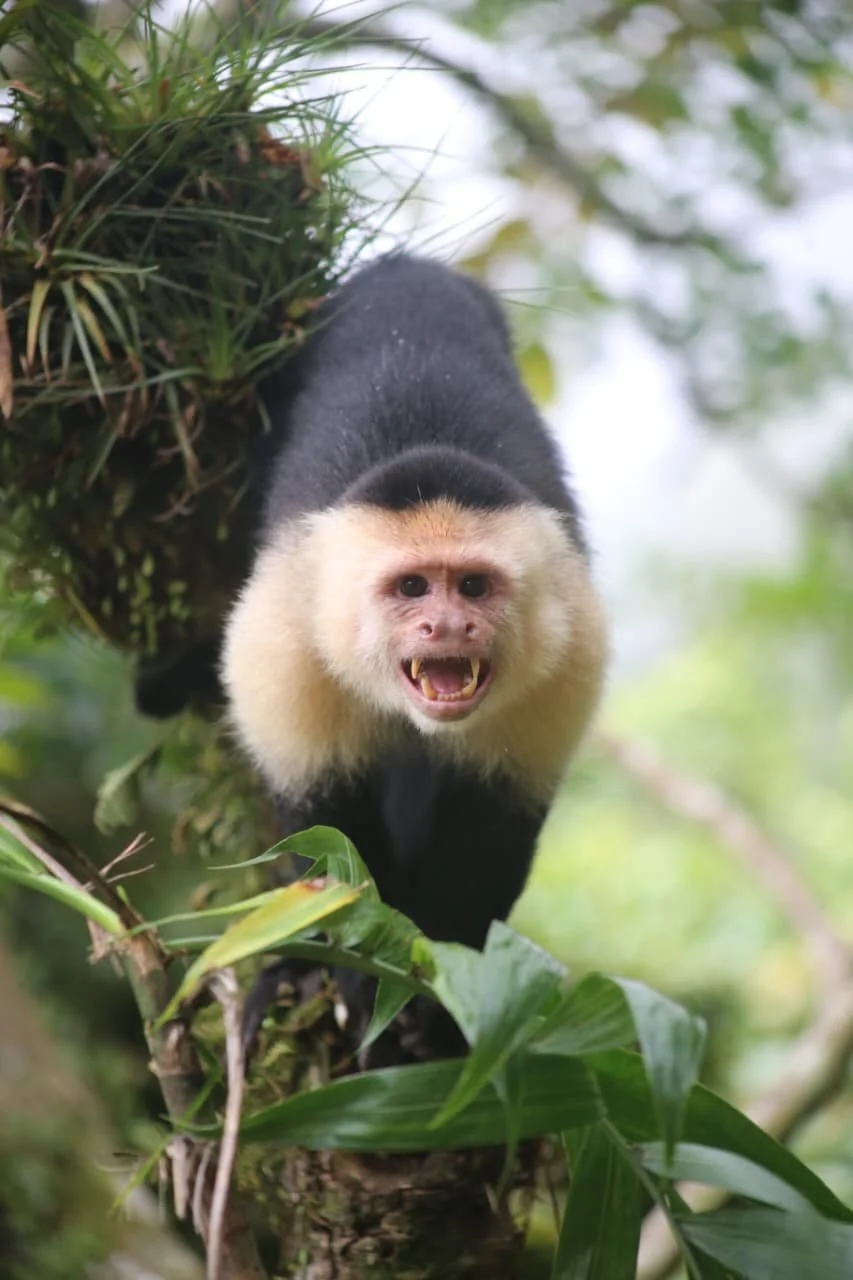
If seeing monkeys in the wild is on your Panama bucket list, you don't necessarily need to book an expensive wildlife tour or travel deep into the jungle. One of the most unexpected places to encounter white faced monkeys is at Lost and Found Hostel, high in the mountains of Chiriquí inside the Fortuna Forest Reserve.
And the best part is that you aren't visiting a zoo or an enclosure. The monkeys are wild.
Lost and Found sits in a huge natural environment surrounded by forest, and white faced capuchins are among the wildlife that can occasionally be seen around the property. For travelers who want a genuine wildlife experience without having to organize a complicated expedition, this makes the hostel an especially interesting stop between Boquete and Bocas del Toro.
Why White Faced Monkeys Are So Fascinating
White faced capuchins are among the most intelligent and entertaining monkeys you can encounter in Panama.
They are highly social animals and usually live in groups. They are also extremely curious, active and adaptable. Watching them move through the forest canopy can be completely different from seeing monkeys sitting quietly in a zoo.
One minute the forest appears empty.
Then you notice movement.
A branch shakes.
Another monkey appears.
Then another.
Suddenly there is an entire family moving through the trees.
They can climb, leap, investigate their surroundings and disappear into the forest with remarkable speed.
You Don't Have to Go Far
This is one of the great advantages of seeing wildlife around Lost and Found.
You don't necessarily need to spend an entire day hiking into remote wilderness.
The property itself is surrounded by forest, and wildlife can sometimes come surprisingly close to the hostel. That means you can keep your eyes open while you're having breakfast, walking between the different areas of the property or simply relaxing outside.
This is a very different experience from going to a wildlife park where you know exactly where the animals are going to be.
At Lost and Found, there is no guarantee.
That's part of the fun.
You have to actually look.
Ask Around
If seeing monkeys is high on your priority list, talk to the people working at the hostel.
Staff and long term residents often know which areas of the property have recently been active with wildlife. Other travelers are also an excellent source of information.
Someone might come back from a walk and say, "There are monkeys over there."
Suddenly half the hostel is looking toward the trees.
This spontaneous aspect is one of the things that makes wildlife encounters at a jungle hostel so memorable.
Bring Your Camera, But Don't Forget Your Eyes
A camera or phone with a decent zoom is useful because monkeys rarely pose conveniently a few metres away.
They are usually moving through trees, often high above you, and the combination of leaves, branches and changing light can make photography challenging.
But don't spend the entire encounter staring at your screen.
Watch the monkeys first.
See how they move.
Listen to the branches.
Look for the smaller animals following the adults.
And then take your photographs.
A slightly blurry photograph of a wild monkey that you actually watched behaving naturally can be much more memorable than a perfect photograph of an animal sitting behind glass.
Look Up!
This sounds obvious, but it is incredibly easy to miss monkeys because tourists naturally look along the trail instead of above it.
White faced capuchins spend plenty of time in the trees, so make a habit of scanning the canopy.
Look for movement.
Look for branches moving when there is no obvious wind.
Listen for calls.
Watch birds suddenly reacting to something moving through the canopy.
The jungle can be remarkably good at hiding animals in plain sight.
Early Morning Can Be Excellent
Getting up early is generally a good strategy for wildlife watching.
The forest is cooler, there is less human activity and many animals are active after sunrise.
This is also when the light can be beautiful for photography.
You don't necessarily need to turn the morning into a serious expedition. Simply having your coffee outside while keeping an eye on the trees can sometimes pay off.
And if you don't see monkeys, you may see something else.
That is the great thing about Lost and Found.
You Might See Much More Than Monkeys
The white faced capuchins are only one piece of the wildlife experience.
The surrounding forest supports an extraordinary variety of animals. Depending on the season, weather and sheer luck, visitors can encounter sloths, agoutis, armadillos, peccaries and a variety of birds.
The area is particularly interesting for birdwatchers, and the property has plenty of opportunities to simply sit and watch what comes through the trees.
There are also plenty of smaller creatures that become interesting once you start paying attention.
Once you begin looking for wildlife, you quickly realize that the jungle is never actually quiet or empty.
The Best Wildlife Experiences Aren't Always Planned
One of the reasons Lost and Found can be such a good place for wildlife watching is that you aren't necessarily following a rigid itinerary.
You might be sitting in a hammock.
You might be walking to breakfast.
You might be talking to another traveler.
And suddenly someone spots a monkey.
That can be more exciting than a scheduled wildlife tour because you genuinely don't know what is going to happen.
The entire hostel can suddenly turn into a wildlife watching group.
Give Them Space
The most important rule is to remember that these are wild animals.
Don't chase them.
Don't try to touch them.
Don't feed them.
Don't call them toward you.
And don't get too close simply to get a better photograph.
Wildlife is most interesting when it is behaving naturally, and the best way to make that happen is to give the animals enough space to ignore you.
If the monkeys decide to continue through the trees without paying attention to you, that's actually a success.
You are watching them in their environment rather than trying to turn them into an attraction.
A Jungle Hostel With an Unexpected Wildlife Bonus
Lost and Found is already an unusual place to stay because of its location between Boquete and Bocas del Toro. But for wildlife lovers, the surrounding forest adds another dimension to the experience.
You don't have to choose between staying somewhere social and seeing wildlife.
You can have both.
Spend the day exploring, come back to the hostel, meet other travelers, grab a drink, relax in a hammock and keep your eyes open.
Then somebody spots a monkey.
That's the kind of wildlife encounter people remember long after their trip is over.
Put Lost and Found on Your Wildlife Route
If your Panama itinerary takes you from Boquete toward Bocas del Toro, Lost and Found makes an interesting stop because it combines accommodation, adventure, social atmosphere and access to a remarkably wild environment.
You may arrive thinking you're simply stopping at a quirky jungle hostel.
You might leave having watched a troop of white faced capuchins moving through the trees above you.
And that's exactly what makes wildlife in Panama so exciting.
You don't always have to go looking for the jungle. Sometimes you just have to stay somewhere where the jungle can find you.