
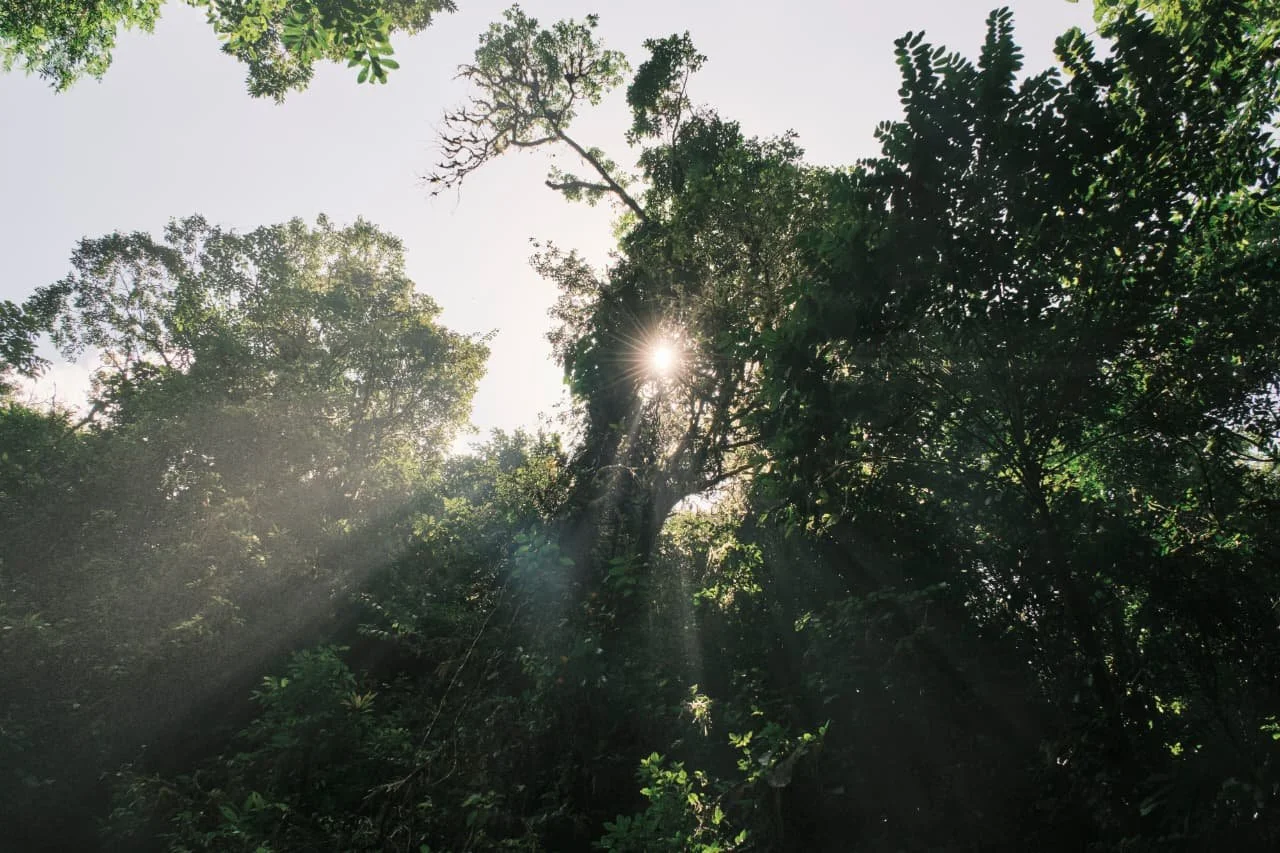
Every year, something extraordinary happens over Panama that most people never notice.
You can be walking through Panama City, sitting on a rooftop, hiking through the forest or looking across the mountains of Chiriquí when suddenly the sky begins to fill with birds. Not a few birds. Thousands. Sometimes tens or hundreds of thousands in a single day.
Hawks, kites and vultures begin circling overhead, riding invisible columns of warm air as they make their way south from North America toward their wintering grounds in Central and South America.
Panama is one of the most important bottlenecks on this incredible journey.
And because the country is only about 50 miles wide at its narrowest point, the geography creates something remarkable: millions of migrating raptors are funneled through a relatively tiny piece of land.
Why Do So Many Raptors Pass Through Panama?
Look at a map of the Americas and the reason becomes obvious.
North America is enormous. South America is enormous. In between them is Central America, which gradually narrows until it becomes the Isthmus of Panama.
For a bird that doesn't particularly want to fly hundreds of kilometers over open ocean, Panama is the perfect highway.
Migrating raptors generally prefer to stay over land because they can use rising columns of warm air called thermals to gain altitude without constantly flapping their wings.
The birds climb inside these invisible elevators of warm air, sometimes reaching impressive heights. Then they glide forward, losing altitude until they find another thermal and begin the process again.
It's an extraordinarily efficient way of traveling hundreds or even thousands of kilometers.
And Panama is right in the middle of the route.
The Great Autumn Exodus
The most spectacular migration occurs during the northern autumn.
Birds that spent their breeding season in Canada and the United States begin heading south as temperatures fall and food becomes harder to find.
In Panama, the main spectacle generally occurs between October and November, although migration movements can begin earlier and continue later. The migration season can extend from roughly August into December depending on the species and the particular route.
Imagine being a small hawk that has spent the summer raising young somewhere in eastern North America.
Now winter is approaching.
You have to travel thousands of kilometers south.
You reach Mexico.
Then Guatemala.
Then Costa Rica.
And eventually you arrive at Panama.
The continent beneath you has narrowed dramatically.
Suddenly, enormous numbers of birds that have been spread across a huge geographic area are being squeezed into the Central American land bridge.
It's nature's version of a funnel.
Millions of Birds in the Sky
The numbers are difficult to comprehend.
Panama Audubon's long-running Raptors Ocean to Ocean project has monitored migrating raptors from the Panama Canal area since 2004.
One of the most remarkable counts came in 2018, when an estimated 2,914,357 migratory raptors were counted over the monitoring area around Cerro Ancón. More than 1.1 million were Turkey Vultures, about 951,000 were Swainson's Hawks and more than 466,000 were Broad-winged Hawks.
And those are just the birds that were counted.
During the first trans-Isthmian count in 2004, observers at nine locations recorded more than 3.1 million migratory raptors during October and the first half of November.
That puts Panama among the truly spectacular places on Earth for watching migrating birds of prey.
The Three Superstars
Three species dominate the migration spectacle.
Turkey Vultures
Turkey Vultures are among the most numerous migrants passing through Panama.
They are masters of efficient flight. Rather than continuously flapping their wings, they soar for long periods, using thermals and other rising air currents to carry them along.
Watching a single Turkey Vulture circling overhead isn't unusual anywhere in Panama.
Watching thousands of them moving south together is something else entirely.
Broad-winged Hawks
Broad-winged Hawks are relatively inconspicuous during their breeding season in North America.
Migration changes everything.
They can gather into enormous concentrations, forming what birdwatchers call kettles.
A kettle is a swirling mass of raptors circling upward inside a thermal. From below, it can look as though someone has released hundreds of birds into a giant invisible tornado.
The birds gain altitude together before peeling away and gliding toward the next thermal.
Swainson's Hawks
Then there are Swainson's Hawks, long-distance travelers whose migration is particularly impressive.
Some travel all the way from North America to southern South America.
That means an individual bird can make an extraordinary journey spanning thousands of kilometers.
And Panama is one of the places where their enormous migration becomes visible on a spectacular scale.
What Is a Kettle?
This might be one of the coolest things about raptor migration.
When dozens, hundreds or even thousands of birds discover the same thermal, they begin circling upward together.
The result is called a kettle.
From the ground, the birds can look almost motionless at first. Then you realize that every individual is climbing higher and higher.
Eventually, the birds reach the top of the thermal.
And then something amazing happens.
The entire group begins to stream away in the same general direction.
They aren't necessarily flapping.
They're gliding.
One moment the sky is filled with circling birds. The next, a long stream of raptors is moving across the horizon.
Then they disappear.
Until the next kettle arrives.
Panama City Has a Front-Row Seat
You don't necessarily have to travel deep into the jungle to witness this phenomenon.
One of Panama's most famous raptor-watching locations is Cerro Ancón, right in Panama City.
It is one of the world's exceptional raptor migration observation sites, with annual counts exceeding one million birds. Panama Audubon considers the Cerro Ancón monitoring location one of only five sites worldwide where migrations of more than a million raptors have been recorded.
Think about that for a moment.
You can be in one of Central America's busiest capital cities and look upward to see one of the greatest wildlife migrations on the planet.
No safari vehicle required.
No jungle expedition.
Just look up.
The Birds Don't Just Fly Straight Through
Weather plays a huge role in the migration.
Raptors depend heavily on favorable air currents, particularly thermals and other forms of lift.
Rain and poor weather can slow or temporarily stop migration. When conditions aren't suitable, birds can gather and wait rather than wasting enormous amounts of energy trying to fly through difficult weather.
This can produce spectacular concentrations when the weather finally improves.
It's one reason why migration isn't simply a matter of saying, "The birds arrive on October 15."
The exact experience can change dramatically from one day to another.
The Journey Doesn't End in Panama
For many of these birds, Panama is only a waypoint.
They continue south into Colombia and beyond.
Some Swainson's Hawks travel as far as Argentina.
The birds are essentially using the entire American continent as a seasonal highway, moving north to breed when conditions are favorable and then returning south when winter arrives.
Panama sits directly in the middle of that enormous annual movement.
The birds crossing the country in October may eventually be thousands of kilometers farther south.
And several months later, many of them will make the journey again in reverse.
The Return Journey
The spectacle isn't exclusively a one-way trip.
Migratory birds eventually need to return north to their breeding grounds.
Spring migration takes place broadly from March into May, although timing varies by species and location.
The northbound migration doesn't necessarily look identical to the autumn movement.
Different weather conditions, wind patterns and routes can influence where birds concentrate.
But the basic story is the same.
The birds that spent the winter in Central or South America begin the enormous journey north.
Some will return to exactly the same general breeding regions where they raised young the previous year.
Why Panama Is So Important
Panama isn't simply a place where birds happen to pass through.
Its geographic position makes it an essential link between two continents.
The country's forests, wetlands, mountains and other habitats also provide places where migrating birds can rest during their journey.
That is important because migration is incredibly demanding.
A bird crossing an entire continent needs energy, favorable weather and safe places to stop.
A small forested area may look insignificant to a person driving past it.
To a migrating bird, it can be a critical rest stop.
A Spectacle Hiding in Plain Sight
Perhaps the strangest thing about Panama's raptor migration is how easy it is to miss.
Millions of birds can pass overhead and most people below will never notice.
There is no sound announcing their arrival.
No ticket booth.
No sign saying "Three Hundred Thousand Hawks Passing Overhead Today."
You simply look up.
And if you've caught the right day, the sky can suddenly come alive.
A few birds become dozens.
Dozens become hundreds.
And then you realize that the tiny dots you've been watching aren't random birds at all.
They're part of a massive, ancient movement connecting the forests of Canada and the United States with the ecosystems of Central and South America.
For birdwatchers, it is one of Panama's greatest natural spectacles.
For everyone else, it's a good reminder that sometimes the most incredible wildlife experience in Panama isn't hiding deep in the jungle.
It's happening directly above your head.