
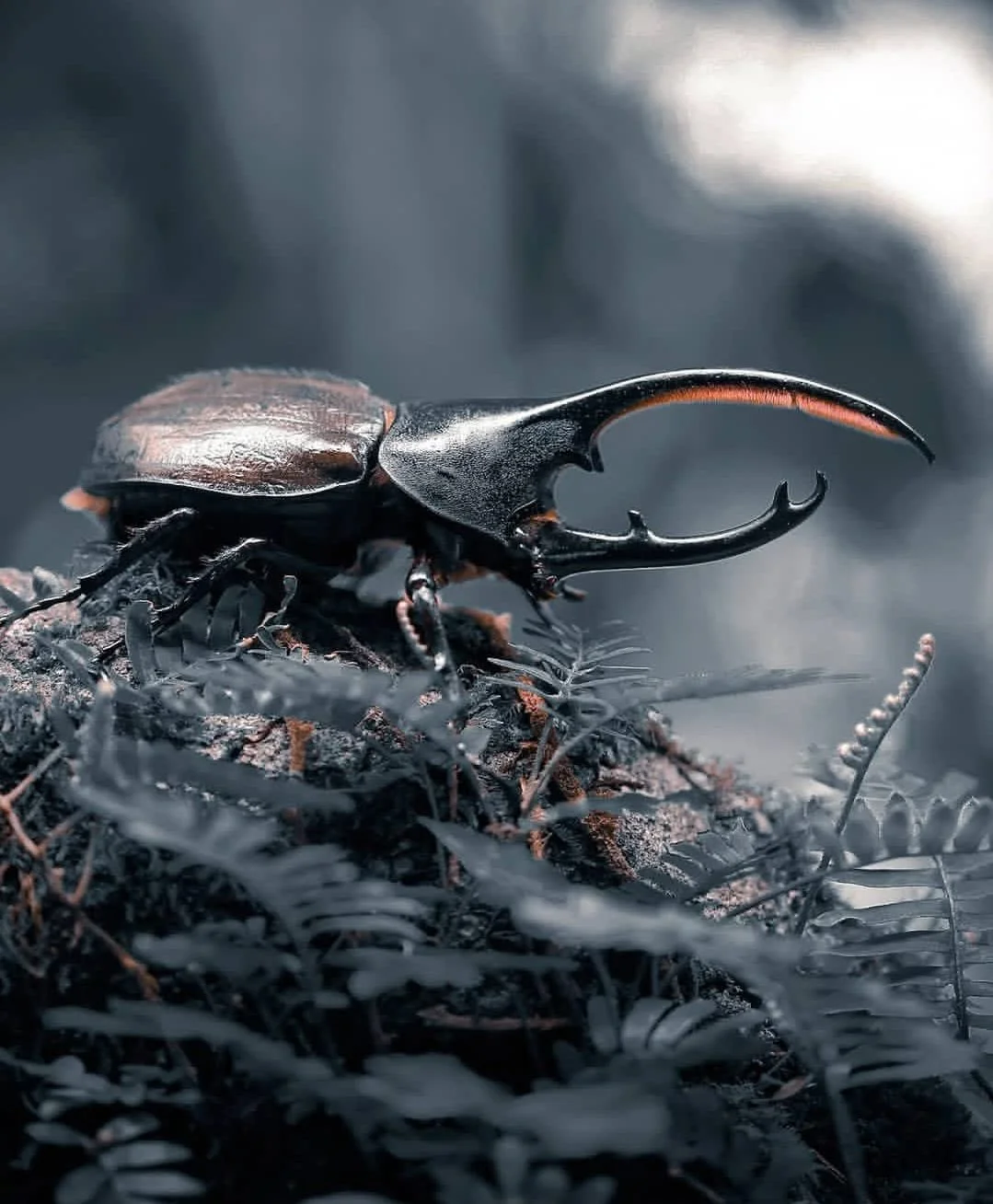
One of the most fascinating things about Panama is that scientists are still finding things here that nobody has ever scientifically documented before. And when I say “new,” I do not necessarily mean that somebody walked into the jungle and found an animal that had never been seen by a human. In many cases, the animal or plant may have been sitting there for thousands or even millions of years. What is new is that scientists have finally collected it, studied it, compared it with related species and realized that it is something previously unknown to science. Panama is particularly good at producing these discoveries because it sits between North and South America, contains two very different coastlines, enormous areas of rainforest and mountains, isolated islands, cloud forests, mangroves and countless tiny habitats.
A great example came in 2026 with a small tree called Clusia nanophylla. Botanists formally described it as a new species after going back to plant specimens that had originally been collected in Panama more than two decades earlier. The species is known only from Panama and was found in the Ngäbe Buglé Indigenous comarca. Even more remarkably, researchers discovered that there were only a few trees remaining at the location where the original specimens had been collected. A species can therefore be completely new to science while already being extremely rare in the wild.
This is one of the reasons botanical collections are so important. A scientist might collect a plant today and initially believe it belongs to a species that is already known. Years later, another researcher may compare the specimen with thousands of others and notice something different. The flowers, leaves, fruit, DNA or other characteristics may reveal that it is actually a completely separate species. In 2024, Smithsonian researchers announced six newly named tree species from Panama and Colombia, including three found only in Panama: Matisia petaquillae, Matisia changuinolana and Matisia aquilarum. One of them, found in Chagres National Park, was given a name connected to the presence of a Harpy Eagle nest in the tree where it was discovered.
And it is not just large, impressive animals and trees that are being discovered. Some of Panama's most recent additions to science are incredibly small. In 2025, researchers described nine new species of microcaddisflies from Panama. Many were collected around the Soná Peninsula and the islands associated with Coiba National Park. With those discoveries, the number of known caddisfly species in Panama reached 544. What is particularly remarkable is how quickly scientists have been adding to that number. Research efforts increased the known number of caddisfly species in the country from 257 in 2015 to more than 500 a decade later.
This gives you an idea of how much of Panama's biodiversity is hiding in plain sight. You can walk through a rainforest and see thousands of insects, plants and fungi without realizing that some of them may represent species that scientists have never formally described. To most people, one tiny brown insect can look exactly like another tiny brown insect. To a specialist who studies a particular family, however, tiny differences can be extremely important.
The waters around Panama are producing discoveries as well. Coiba National Park is particularly interesting because its islands and surrounding marine ecosystems have been relatively understudied compared with many famous tropical destinations. Scientists working around Coiba have discovered numerous new species, including new crustaceans and other marine organisms. In one Smithsonian expedition, researchers described three new genera and a new species of mud shrimp from only a week of collecting. The Smithsonian has reported that more than 75 new species had been identified around Coiba and nearby areas during the preceding decade of research.
The Caribbean side of Panama is producing surprises too. In 2025, scientists described a completely new genus and species of ghost shrimp from the Bocas del Toro Archipelago. The animal was collected from beneath decomposing and overgrown mangrove roots in shallow coastal habitat. It was not some enormous mysterious creature. It was a small crustacean living in the mud beneath mangroves, exactly the sort of animal that most people would walk past without realizing it might be scientifically unique.
Panama's fossils are producing new discoveries as well. In 2025, researchers studying marine fossils from the Miocene age Chagres Formation identified four new species of fossil fish. One was named in honor of Brígida de Gracia, the first Ngäbe marine paleontologist associated with research at the Smithsonian Tropical Research Institute. These discoveries are particularly interesting because they help scientists reconstruct what Panama's oceans looked like millions of years ago, long before the modern country existed in anything resembling its current form.
And then there are discoveries that completely change our understanding of the past. Barro Colorado Island in the Panama Canal is famous today as one of the world's most intensively studied tropical forests, but scientists have also found evidence of an ancient mangrove forest there dating back roughly 22 million years. Imagine standing in the rainforest on Barro Colorado and realizing that the ground beneath your feet contains evidence of a completely different environment from millions of years ago. Panama's geological history is every bit as fascinating as its modern wildlife.
Not every scientific discovery in Panama involves a new species. Sometimes scientists discover something new about an animal that was already known. In 2025, researchers studying White necked Jacobin hummingbirds in Panama noticed something extraordinary about newly hatched chicks. The babies have fluffy feathers on their backs that make them look remarkably like hairy caterpillars. The observation raised questions about whether the strange appearance might help protect the vulnerable chicks from predators. The scientist involved had studied adult White necked Jacobins for years but had not previously focused on the earliest stage of their lives.
Perhaps even more exciting are the discoveries that happen when scientists realize they have not actually lost a species after all. In 2026, researchers announced the rediscovery of four amphibian populations in Panama's mountain forests that had apparently disappeared from those areas for years. Using small automated sound recorders and computer analysis, they detected frogs that traditional surveys had missed. More than 128,000 one minute recordings were collected during the research, and the technology detected species that had gone unheard for years.
That research included Vicente's dart frog, the Boquete rocket frog, the crowned treefrog and the Veragua fringe limbed treefrog. The results are a great reminder that “not seen” does not necessarily mean “gone.” Some tropical animals are incredibly difficult to find. A frog may call for only a short period around dawn or dusk, live high in the forest canopy or become almost impossible to detect during certain conditions. Modern technology is giving scientists new ways to find animals that previously escaped conventional surveys.
Panama's amphibians have another extraordinary story. The Panamanian golden frog disappeared from the wild after the devastating chytrid fungal disease swept through its habitat. Researchers have continued breeding the species in captivity, and in 2026 the Panama Amphibian Rescue and Conservation Project released 100 captive bred golden frogs into the wild as part of a trial studying reintroduction strategies. This is not the discovery of a new species, but it represents another kind of scientific frontier happening in Panama: trying to understand whether species that have disappeared from the wild can eventually return.
The really amazing thing about all of this is that Panama does not have to be unexplored wilderness for discoveries to happen. Some discoveries come from remote islands, caves and mountains, but others come from specimens that have been sitting in scientific collections for decades. Something can literally be collected, placed in a museum or herbarium, and then wait twenty years for somebody to realize exactly what it is.
This is particularly important in a country like Panama because its geography creates enormous biological variety in a very small area. The Caribbean and Pacific sides are different. Lowland rainforest is different from cloud forest. Islands can contain species that are isolated from mainland populations. Rivers create their own ecosystems, while caves, mangroves, beaches, coral reefs and mountain streams each provide completely different environments. Add the country's position as a biological bridge between North and South America and you have an extraordinary recipe for biodiversity.
And there is probably much more waiting to be discovered.
When you walk through a Panamanian rainforest, you are therefore walking through a place that is not scientifically finished. The species lists are not complete. Scientists are still describing new plants, insects, crustaceans, frogs and other organisms. They are still finding fossils that reveal ancient Panama. They are still discovering unexpected behaviors in familiar animals and using new technology to locate species that had apparently disappeared.
That is one of the most exciting things about Panama for anyone interested in nature. You do not have to travel to some distant unexplored continent to experience the feeling of discovery. Panama is a country where scientists are still adding new names to the list of life. And somewhere in the rainforest, on an isolated island, beneath a mangrove root, in a mountain stream or high in the canopy, there could still be something living that science has not officially met yet.