
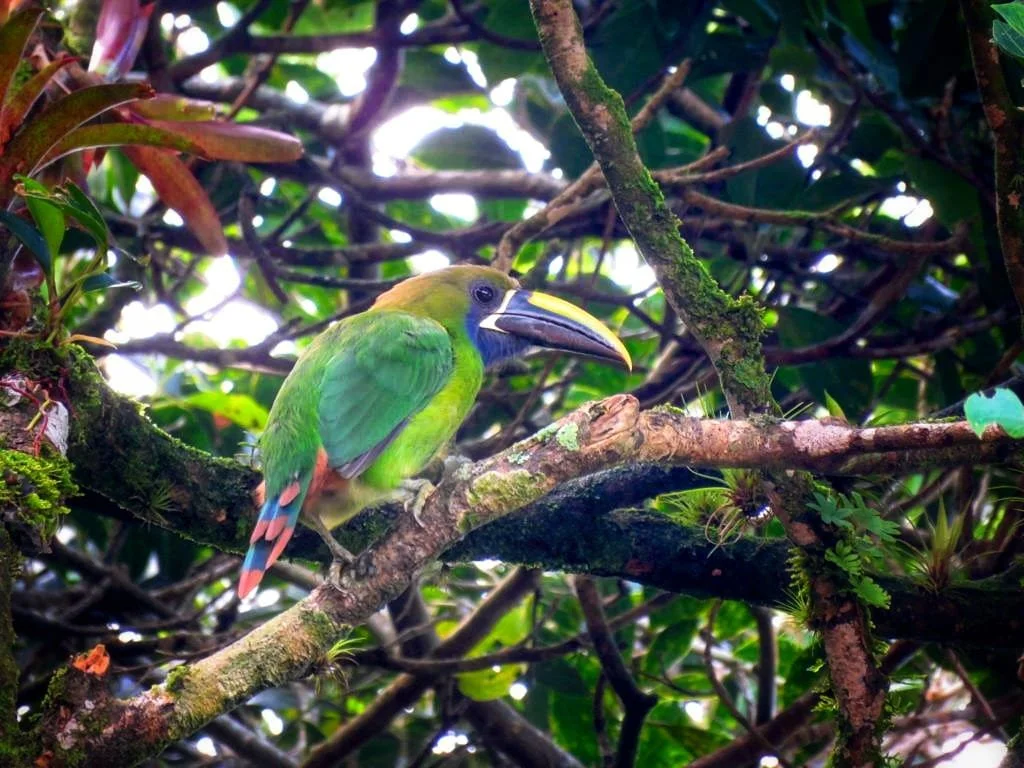
Panama is a surprisingly small country, but when it comes to biodiversity, it is absolutely enormous. Sitting between North and South America, with the Caribbean Sea on one side and the Pacific Ocean on the other, Panama is basically a biological crossroads. Millions of years of species moving between the two continents helped create an extraordinary mixture of animals and plants, while the country’s mountains, rainforests, rivers, mangroves, coral reefs, cloud forests, beaches and islands created countless different places for life to evolve. The Smithsonian Tropical Research Institute describes Panama as having exceptionally high biodiversity and points out that the country has more species of birds and plants than Canada and the United States combined, despite being dramatically smaller.
One of the biggest reasons Panama is so biologically rich is its position as a land bridge. Panama is where North America and South America meet, and for millions of years animals and plants have been moving across this narrow strip of land. Jaguars, monkeys, anteaters, sloths, birds, reptiles, amphibians and countless smaller creatures have all been part of this enormous exchange between continents. The formation of the Isthmus of Panama also separated the Caribbean and Pacific marine environments, creating an incredible evolutionary experiment in which marine species on opposite sides of the country followed different paths. Scientists have even found biological evidence that species were moving through the region millions of years before the final land connection that we commonly associate with the formation of the isthmus.
The result is that you can travel a surprisingly short distance in Panama and encounter completely different ecosystems. The Caribbean coast can be hot, humid and extremely wet, while parts of the Pacific side have a much more pronounced dry season. In the mountains, temperatures drop and cloud forests appear, covered in mosses, orchids, bromeliads and other plants that thrive in cool, damp conditions. Higher elevations around places such as Boquete and Cerro Punta feel completely different from the tropical lowlands. Then there are mangrove forests, rivers, wetlands, dry forests, islands, coral reefs and enormous stretches of rainforest. Panama may look small on a map, but environmentally it is incredibly complicated.
And then there are the animals. Panama is home to several species of monkeys, including howler monkeys, white faced capuchins, spider monkeys and squirrel monkeys. Sloths hang quietly in the trees while agoutis run around the forest floor. Anteaters, armadillos, peccaries, deer and many other mammals occupy different parts of the country. At night, the jungle becomes a completely different world, with kinkajous, olingos, cacomistles, bats, frogs, insects and countless other creatures becoming active. Some animals are obvious and noisy while others can live remarkably close to people without ever being seen.
Birdlife is another huge part of Panama's biodiversity. The country is an important location for both resident tropical birds and migrants moving between North and South America. Toucans, motmots, tanagers, hummingbirds, parrots, trogons, hawks and many other species can be found here. In the mountains, birdwatchers search for spectacular species such as the resplendent quetzal, while lower elevations provide completely different communities of birds. Panama's position means that birdwatching can change dramatically depending on where you are and what habitat you are exploring.
The tiny creatures are where things get truly ridiculous. Panama's forests contain enormous numbers of insects, spiders, beetles, butterflies, moths, ants and other invertebrates. Many are so small that you can walk past them every day without realizing they are there. Scientists studying Panama's tropical forests have found such extraordinary insect diversity that estimates for the number of species living in forest canopies can reach into the millions. Even a single tree can support an astonishing community of insects, fungi, plants and microorganisms.
Butterflies provide one of the easiest ways for visitors to see this diversity. Brilliant blue morphos can suddenly flash across a trail, swallowtails glide through clearings and tiny glasswing butterflies can look almost invisible when they land on vegetation. Panama also has an incredible variety of moths, including some that look more like works of art than insects. And once the sun goes down, the number of things moving around the forest can increase dramatically.
The plant life is just as impressive. Tropical forests are not simply collections of trees. They are complicated vertical ecosystems. Giant trees compete for sunlight high above the ground while vines climb toward the canopy, epiphytes grow on branches, palms occupy the understory and countless smaller plants live in the shade below. Orchids, bromeliads, heliconias, ferns and other plants provide food and shelter for animals. Some plants depend on very specific insects or animals for pollination or seed dispersal, creating relationships that have developed over thousands or even millions of years. The Smithsonian notes that tropical ecosystems are filled with these complex relationships, including famous examples such as figs and the tiny wasps that pollinate them.
Panama's biodiversity doesn't stop when you reach the beach. The country has two enormous coastlines and an extraordinary variety of marine environments. Coral reefs, mangroves, rocky shores, seagrass areas and open ocean all support different communities. The Caribbean and Pacific are surprisingly different from one another, and Panama gives you the unusual opportunity to experience both within a relatively short distance.
Coiba is perhaps one of the most spectacular examples. Coiba National Park protects both terrestrial and marine environments, and its isolation allowed some species to evolve differently from their mainland relatives. The island and surrounding waters support an extraordinary collection of wildlife, including monkeys, agoutis, birds, sharks, rays, sea turtles, dolphins and whales. Its unusual biological history has even earned Coiba comparisons with the Galapagos.
Panama is also famous for frogs. Tropical amphibians are particularly fascinating because many species occupy very specific environments and can be extremely sensitive to changes in their surroundings. Panama has been an important center for amphibian research and conservation, including major efforts to protect endangered frog species. Walk beside a stream after dark and you quickly realize that the rainforest isn't quiet at all. It is filled with calls, chirps, clicks and strange noises coming from animals that you may never actually see.
Perhaps the most fascinating thing about Panama's biodiversity is that you do not necessarily have to travel to a remote national park to experience it. Wildlife can be found surprisingly close to cities, towns, farms, roads and houses. The forests around the Panama Canal have become internationally important research areas, and places such as Barro Colorado Island have been studied by scientists for more than a century. Smithsonian researchers have used Panama to study everything from monkeys and birds to frogs, insects, trees, marine life and even the microscopic organisms that make tropical ecosystems function.
This is what makes traveling through Panama so interesting. You don't always need to be searching for one particular animal. Sometimes the best experience is simply walking through the forest and realizing how much is happening around you. A hummingbird can appear beside your head, a monkey can crash through the canopy, a sloth can be sitting motionless above the trail, a brightly colored frog can be hiding beside a stream and an enormous beetle can suddenly walk across the path. At night, the experience changes again completely.
Panama's biodiversity is also a reminder that the rainforest is much more than a collection of attractive animals. Every species is part of a much larger system. Birds move seeds, insects pollinate plants, fungi break down dead material, predators control populations and trees provide food and shelter for hundreds of other organisms. Remove enough pieces and the entire system can begin to change. Research in Panama has shown why protecting mature forests is particularly important because simply allowing a cleared area to grow back does not immediately recreate the biodiversity of an old tropical forest.
For travelers, this means Panama can be experienced almost like a giant outdoor laboratory. You can explore cloud forests in the mountains, rainforest in the lowlands, Caribbean islands, Pacific beaches, mangroves, rivers and coral reefs, all within one relatively small country. You can go looking for quetzals in the highlands one day and watching monkeys in the rainforest the next. You can snorkel with tropical fish, walk through a jungle filled with birds and insects, then take a nighttime walk and discover an entirely different collection of creatures.
That is the real magic of Panama. Its biodiversity isn't concentrated in one famous park or one particular animal. It is everywhere. It is in the trees above your head, the leaves beside the trail, the river beneath your feet, the insects flying around a light at night and the strange sounds coming from the forest when you cannot see what is making them. Panama is small enough to cross relatively quickly, but biologically it is an enormous world. And once you start paying attention, you realize that almost every corner of the country has something alive, unusual and fascinating waiting to be discovered.