
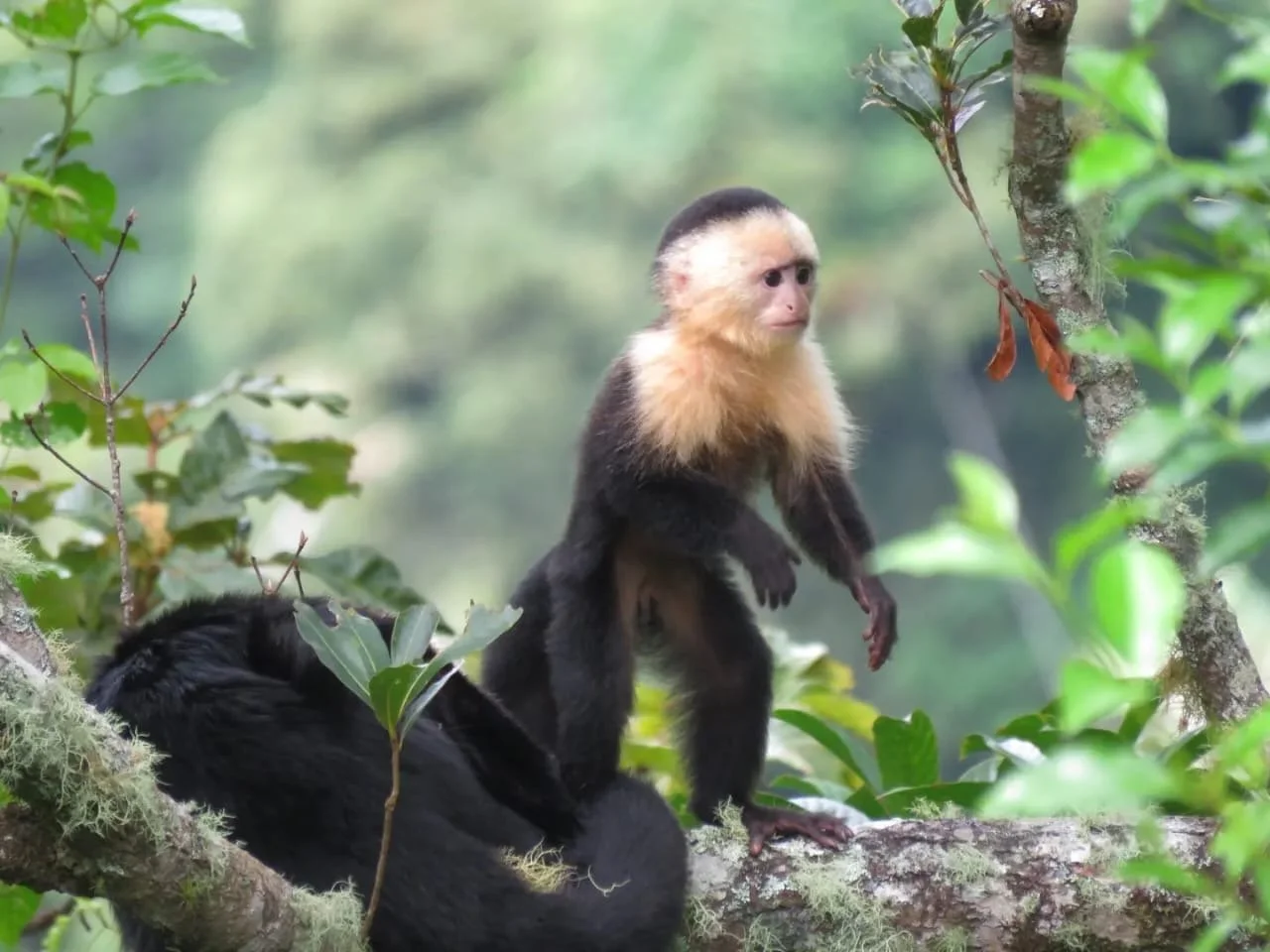
If seeing monkeys in the wild is on your Panama bucket list, you have come to the right country. Panama is one of those places where you can be walking through a rainforest, looking at birds or trying to figure out what just made that strange noise, when suddenly a monkey appears above your head. Sometimes you hear them first. Sometimes you see branches moving. Sometimes you walk directly underneath an entire family without realizing they are there.
The trick to finding monkeys in Panama is understanding that they are not waiting beside the trail for tourists. They live in a three dimensional world above the forest floor, and learning how to watch the canopy is the difference between seeing absolutely nothing and suddenly having an incredible wildlife encounter.
Panama has several species of monkeys, including howler monkeys, white faced capuchins, spider monkeys and squirrel monkeys, with different species occurring in different parts of the country. Some are relatively easy to encounter, while others require considerably more luck, patience and good habitat.
And this is what makes monkey watching in Panama so much fun. You are not guaranteed to see anything.
You have to find them.
Listen for Monkeys Before You Look for Them
The biggest mistake people make when looking for monkeys in Panama is looking at the ground.
Look up.
The tropical forest is essentially a giant apartment building, and monkeys generally live several floors above you. While you are walking along a trail watching where you put your feet, a family of monkeys may be moving through the branches 30 meters above your head.
Howler monkeys are particularly useful because they are not exactly shy about announcing their presence. Their calls are unbelievably loud and can travel enormous distances through the forest. On Jicarón Island in Coiba National Park, researchers say howler monkey calls can carry for almost 5 kilometers.
When you first hear a howler monkey, you might wonder what on earth is happening. It sounds almost like some enormous prehistoric animal is roaring somewhere deep in the jungle.
Then you look up and discover that the source of the noise is a monkey sitting peacefully in a tree.
Once you learn the sound, you suddenly have a huge advantage.
The Secret Is to Stop Walking
Wildlife watching in Panama rewards people who are willing to stop.
It is tempting to walk quickly along a jungle trail because you have somewhere to go. But monkeys are much easier to find if you slow down and spend time in one place.
Find a good clearing.
Stand quietly.
Look into the canopy.
Listen.
Watch the branches.
Look for movement that doesn't match the wind.
A monkey may not immediately appear, but you might notice leaves shaking. Then a branch moves. Then another. Finally, you see a tail.
And then another.
Suddenly you realize that an entire family has been moving through the trees.
This is particularly important in tropical forests because there is so much visual information competing for your attention. There are birds, butterflies, vines, leaves, bromeliads, insects and hundreds of shades of green. Your brain can easily filter out a monkey because it expects to see something obvious.
The monkeys are often anything but obvious.
Soberanía Is a Great Place to Start
If you are staying in Panama City and want to find monkeys without traveling halfway across the country, Soberanía National Park is one of the best places to begin.
The rainforest here is remarkably close to the capital, and the famous Pipeline Road has become internationally known for wildlife watching. The surrounding forest contains an extraordinary variety of birds and mammals, and monkeys are among the animals that can be encountered.
The advantage of Soberanía is that you can combine a Panama City trip with serious rainforest wildlife watching. You do not need to organize an expedition into some remote corner of the country.
You can have breakfast in the city and be walking through tropical rainforest not long afterward.
And if you hear howler monkeys, stop.
There is a very good chance that the forest is trying to tell you where they are.
Pipeline Road Is More Than Just a Road
Pipeline Road is particularly interesting because it passes through forest that has been studied by scientists for decades. The Smithsonian has conducted long term wildlife research in the area, and the surrounding forest has become one of the best known wildlife watching areas in Panama.
For a monkey watcher, the important thing is the combination of mature forest, wildlife and accessibility.
Walk slowly.
Don't spend the entire time staring straight ahead.
Every few minutes, scan the canopy from left to right.
Pay particular attention when you hear birds suddenly becoming noisy or when you hear branches moving overhead.
And don't forget to look behind you.
Wildlife has absolutely no obligation to appear in front of you.
White Faced Capuchins Are Particularly Interesting
White faced capuchin monkeys are among the most fascinating monkeys you can encounter in Panama.
They are intelligent, highly social and extremely curious. They are also remarkably adaptable, which makes them one of the monkeys that visitors have a reasonable chance of encountering in suitable forest.
Capuchins spend considerable time moving through trees but can also come closer to the ground. Their behavior can be much more entertaining to watch than simply seeing a monkey sitting on a branch.
They investigate things.
They search for food.
They interact with each other.
They watch their surroundings.
And they can appear to be almost ridiculously curious about whatever is happening around them.
Scientists have been studying capuchins in Panama for decades. On Barro Colorado Island, researchers have documented their diets, social behavior, movements and even their use of plants and other objects. Capuchins eat a remarkably varied diet that can include fruit, insects, eggs and small animals.
So if you see a capuchin, don't just take one photograph and walk away.
Watch it.
You may be surprised by what happens next.
Panama's Monkeys Can Be Surprisingly Intelligent
One of the reasons monkey watching in Panama is so fascinating is that researchers continue to discover unusual behavior.
Capuchins are famous for their intelligence, but some populations in Panama have taken things to another level.
On Jicarón Island in Coiba National Park, scientists have been studying a population of white faced capuchins that uses stones as tools. Researchers installed camera traps to follow their behavior and discovered something even stranger.
Young male capuchins began carrying baby howler monkeys around on their backs.
Scientists eventually documented 11 infant howler monkeys being carried by young capuchins over a period of 15 months, sometimes for as long as nine days. The behavior appeared to spread between young male capuchins through social learning. Researchers still do not have a definitive explanation for why it happened.
It is one of the strangest monkey stories ever documented in Panama.
And it is a great reminder that when you are watching wildlife, you are not simply watching scenery.
You are watching animals with complicated social lives that scientists themselves do not always fully understand.
Spider Monkeys Are a Different Challenge
If you want to see a spider monkey in Panama, you may need considerably more patience.
Spider monkeys are spectacular animals. Their extremely long arms and prehensile tails allow them to move through the canopy with incredible agility. Watching one travel through the trees can look almost effortless.
But they are not always easy to find.
They are associated with large areas of forest, and populations have declined in many parts of their former range. In central Panama, for example, wild spider monkeys became extremely rare in some areas.
Barro Colorado Island is particularly famous for primate research and has a population of spider monkeys that has been studied by scientists for decades. Smithsonian researchers have used the island to investigate everything from monkey movement to social behavior and feeding patterns.
For a wildlife enthusiast, this makes the area especially interesting.
You are walking through a forest that has been watched by generations of scientists.
There is a good chance that somebody has spent years trying to understand exactly what the monkey you are looking for is doing.
Barro Colorado Island Has an Incredible Monkey History
Barro Colorado Island is one of the most famous research sites in the tropical world, and its monkey story is fascinating.
When the Panama Canal was created, the landscape changed dramatically and the island became isolated by the rising waters. Smithsonian scientists subsequently developed long term research programs there.
Today, the island is associated with some of the longest running tropical forest research projects anywhere.
Researchers have studied monkeys there for decades, including howler monkeys, capuchins and spider monkeys.
This is one of the reasons Panama punches far above its size when it comes to wildlife research.
The country is not just somewhere you can see tropical animals.
It is somewhere scientists have been studying tropical animals for generations.
Chiriquí Is Another Great Region to Explore
If your trip takes you into western Panama, don't forget to look for monkeys there.
Chiriquí has a huge variety of habitats, ranging from lowland tropical forest to mountainous environments. The further you move through the region, the more the landscape changes.
This is particularly useful for wildlife watchers because different habitats support different species.
The trick is not to assume that every monkey will be sitting in the same type of forest.
Some species are associated with lowland forests.
Others are more closely connected with larger areas of mature forest.
And some can be surprisingly adaptable.
If you are staying somewhere surrounded by forest, ask local residents where they regularly hear monkeys. This can be much more useful than simply choosing a random trail from a map.
A local person saying, "You will hear them over there in the morning" can be worth more than an hour of wandering around with binoculars.
Bocas del Toro Is Worth Looking Up Into the Trees
Bocas del Toro is famous for beaches and islands, but it is also a fascinating wildlife destination.
The forests of the region provide habitat for monkeys as well as sloths, tropical birds, reptiles and countless smaller animals.
The western Caribbean side of Panama is particularly interesting because the forests are part of a much larger biological region extending through Central America.
If you are exploring Bocas, don't make the mistake of thinking wildlife watching ends when you reach the beach.
Some of the best encounters happen immediately behind it.
Walk through forest trails.
Listen carefully.
Look into fruiting trees.
Watch for movement.
And if you hear howler monkeys, don't assume they are miles away. Tropical acoustics can make it surprisingly difficult to judge distance.
Coiba Is One of the Most Fascinating Monkey Locations in Panama
Coiba is in a category of its own.
The national park contains islands with remarkable wildlife and has become an important location for scientific research.
Jicarón Island is particularly famous because of the long term study of tool using white faced capuchins.
The discovery of capuchins carrying baby howler monkeys there was not some random tourist observation. It came from years of camera trap research and thousands upon thousands of pieces of recorded footage.
This is what makes Panama so fascinating for wildlife lovers.
You can visit a place where scientists are still discovering behaviors that have never been documented anywhere else.
Imagine spending your morning looking for monkeys and knowing that researchers working in the same country have recently filmed behavior that nobody had ever seen before.
That is pretty exciting.
What Time Is Best for Monkey Watching in Panama?
Early morning is usually a great time to start.
The forest is cooler, the light is better and many animals are active.
Morning is particularly good for people who want to combine monkey watching with birdwatching because the forest can be incredibly active at first light.
Late afternoon can also be productive.
Animals may become active again as temperatures drop.
But there is no magic hour when every monkey suddenly appears.
The most important factor is time.
If you spend 20 minutes in a forest, you might see nothing.
If you spend four hours slowly exploring the same area, you dramatically increase your chances.
Wildlife watching is often less about finding the perfect location and more about giving the animals enough time to reveal themselves.
Bring Binoculars
Binoculars can completely change the experience.
Without them, a monkey 30 meters above you may look like a dark blob between leaves.
With binoculars, suddenly you can see its face.
You can see its hands.
You can see what it is eating.
You can watch other members of the group interacting around it.
A relatively inexpensive pair of binoculars is therefore one of the best pieces of equipment you can bring to Panama if wildlife watching is on your list.
A camera with a good zoom is useful too, but don't become so obsessed with getting the perfect photograph that you forget to actually watch the animal.
Sometimes the best wildlife photograph is the one you never take.
Look for Fruit Trees
One of the smartest ways to find monkeys is to find the food.
Monkeys need to eat, and fruiting trees can become natural wildlife hotspots.
If you see birds repeatedly visiting the same tree, it is worth spending some time watching it.
If fruit is falling onto the ground, look up.
If you hear activity in the canopy, investigate.
Capuchins, spider monkeys and other primates spend considerable time searching for food, and a productive tree can attract multiple species.
You may arrive looking for monkeys and end up watching toucans, parrots, tanagers and other birds feeding in the same tree.
This is one of the wonderful things about rainforest wildlife watching.
You rarely get exactly what you came looking for.
You often get something better.
Learn the Difference Between Monkey Noise and Jungle Noise
The Panama rainforest is noisy.
Very noisy.
Cicadas can sound like electrical equipment.
Birds scream.
Frogs call.
Leaves move.
Branches fall.
Insects buzz.
Something will inevitably make a sound that causes you to freeze and think, "What the hell was that?"
The more time you spend in the forest, the better you become at identifying different sounds.
Eventually you start recognizing howler monkeys before anybody else in your group.
That is when you have graduated from tourist to wildlife nerd.
Welcome to the club.
Never Feed the Monkeys
If a wild monkey approaches you, enjoy the encounter but don't feed it.
Feeding wildlife changes natural behavior and can make animals associate humans with food. It can also create aggressive behavior and put both the animal and future visitors in a difficult situation.
The goal should be to observe wild monkeys behaving naturally.
If a capuchin steals your banana, that is not a feeding strategy.
That is a robbery.
And you are probably going to lose.
Don't Try to Touch Them
A wild monkey sitting nearby can look incredibly friendly.
It isn't your pet.
It is simply tolerating your presence.
Keep your distance and let the monkey decide how close it wants to be.
This is particularly important with capuchins because they are intelligent, curious and confident animals. Their willingness to investigate people should never be confused with domestication.
The best encounter is one where the monkey can carry on with its normal life while you quietly watch.
The Best Monkey Watching in Panama Is Often Completely Unexpected
Perhaps the greatest thing about looking for monkeys in Panama is that you can never completely predict what is going to happen.
You may walk into a rainforest specifically looking for a howler monkey and instead find a family of capuchins.
You may spend hours searching for spider monkeys and see nothing.
You may sit quietly beside a trail and suddenly hear howlers roaring somewhere above you.
You may be standing on a balcony surrounded by jungle when a monkey moves through the trees in front of you.
Or you may spend an entire morning looking for monkeys and discover that the real highlight was a toucan, a sloth, a hummingbird or some completely bizarre insect.
That is wildlife watching.
There are no guarantees.
And that is precisely why it is exciting.
Panama Is an Excellent Country for Monkey Watching
For a relatively small country, Panama offers an incredible variety of opportunities to see wild primates.
You can look for howler monkeys near Panama City.
You can explore Soberanía and Pipeline Road.
You can visit Barro Colorado and learn about decades of tropical primate research.
You can explore the forests of Chiriquí.
You can search the jungles of Bocas del Toro.
And if you get the opportunity to visit Coiba, you are entering one of the most fascinating wildlife areas in the country.
The real secret is simple.
Slow down.
Look up.
Listen.
Watch the branches.
Carry binoculars.
Give yourself time.
And don't assume that because you haven't seen a monkey after 30 minutes that there aren't any around.
There may be five of them sitting directly above you, watching you wonder where all the monkeys went.
And that is probably the most Panamanian monkey watching experience of all.