
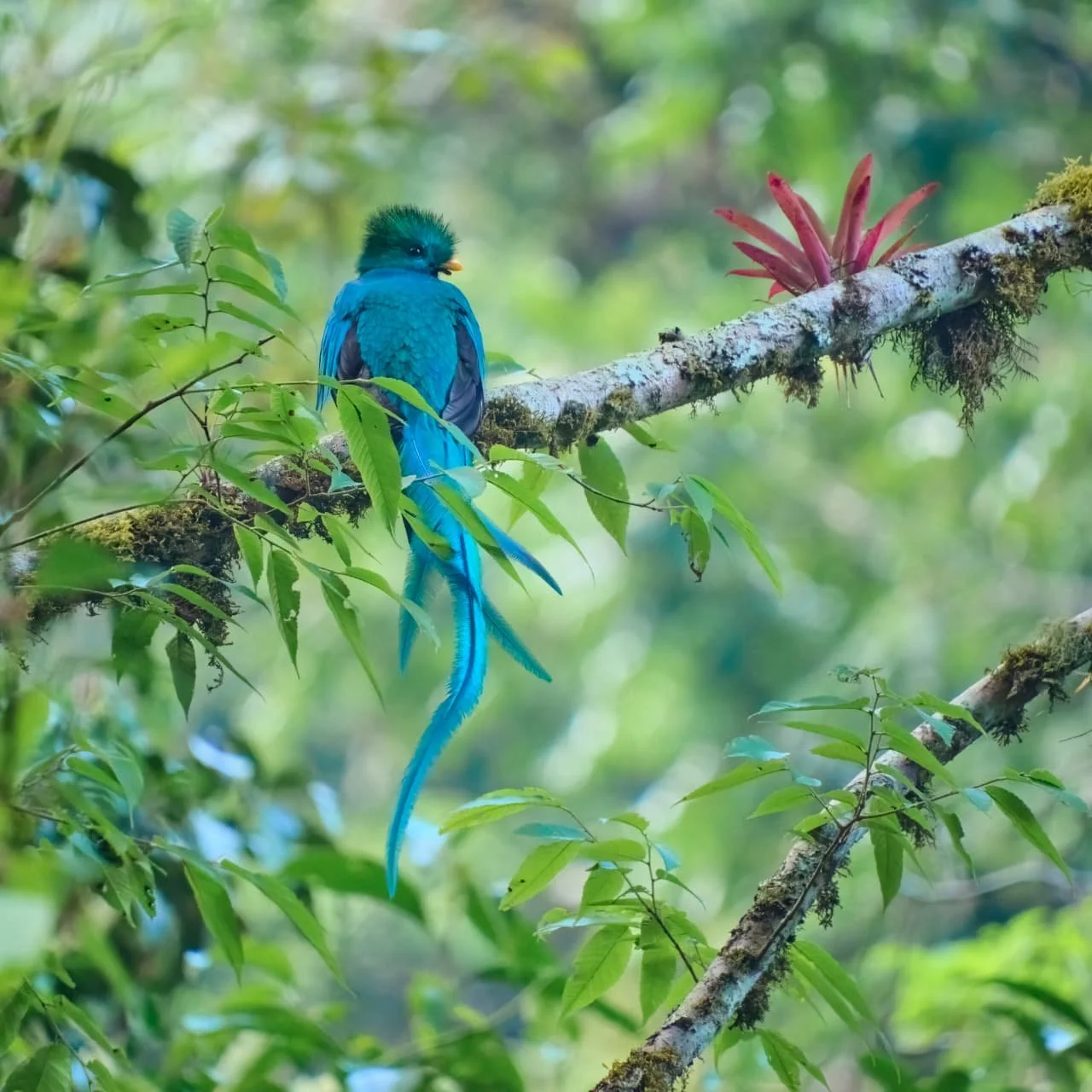
There are countries where you can go birdwatching, and then there is Panama.
For anyone who loves birds, Panama is almost unfair. This tiny country sits between North and South America, has Caribbean and Pacific coastlines, enormous areas of tropical rainforest, cloud forests, mangroves, mountains, wetlands, dry forests and even islands with completely different bird communities. Add one of the most important migration routes in the Western Hemisphere and you have a country where a serious birder can spend weeks looking for new species and still feel like they have barely scratched the surface.
According to Panama's 2025 national bird list, the country has 1,030 recorded bird species, including 177 migratory species. That is an extraordinary number for a country of Panama's size.
And the really crazy thing is that you don't necessarily have to disappear into some impossibly remote jungle to see them.
You can go birdwatching surprisingly close to Panama City.
You can find toucans.
Motmots.
Hummingbirds.
Trogons.
Parrots.
Tanagers.
Antbirds.
Hawks.
Eagles.
Kingfishers.
Woodpeckers.
Herons.
And during migration season, sometimes you can look into the sky and see thousands upon thousands of birds moving over the country.
For a birdwatcher, Panama is not simply a destination.
It is an avian crossroads.
Panama Is Sitting on a Bird Superhighway
The first reason Panama is such an incredible birdwatching destination is geography.
Look at a map.
North America is above you.
South America is below you.
And Panama is the narrow strip of land connecting them.
That means Panama sits directly in the middle of one of the great natural migration routes on Earth.
Audubon describes Panama as a critical point where the flyways of the Americas converge, with millions of migratory shorebirds using the country's wetlands, mudflats and mangroves during their journeys.
Think about what that means.
A bird can spend part of its year thousands of kilometres away in North America and then fly south toward South America.
Panama is in the middle.
For some birds, Panama is a destination.
For others, it is a stopover.
For others, it is a place to spend the winter.
And for some species, it is home all year.
This creates a constantly changing birdwatching experience.
Visit Panama at different times of year and you can experience a different avian cast of characters.
Panama Has More Than 1,000 Bird Species
The number alone is impressive.
More than a thousand species have been recorded in Panama, according to Audubon, while Panama's 2025 official list puts the total at 1,030.
To put that into perspective, you don't need to travel across an entire continent to find dramatically different bird habitats.
Panama itself contains an astonishing range.
There are lowland rainforests.
Cloud forests.
High mountains.
Caribbean islands.
Pacific islands.
Mangrove forests.
Wetlands.
Agricultural landscapes.
Dry forests.
River valleys.
Coastal mudflats.
And urban forests.
That variety is one of the secrets behind Panama's extraordinary bird diversity.
You can change elevation and suddenly the birds change.
You can move from the Pacific to the Caribbean and encounter different communities.
You can walk from open farmland into rainforest and discover an entirely different collection of species.
For birdwatchers, that is addictive.
Panama City Is Actually a Birdwatching Destination
One of the biggest surprises for visitors is that you don't have to escape Panama City to start birdwatching.
Panama City is surrounded by an unusual amount of tropical forest for a major modern capital.
Soberania National Park, Camino de Cruces National Park and other forested areas are remarkably close to the city. Smithsonian researchers have even conducted bird research in and around Panama City because of the remarkable diversity remaining within and around the urban environment.
And then there is Pipeline Road.
If you know anything about birdwatching in Panama, you've probably heard those words.
Pipeline Road is internationally famous.
The road runs through Soberania National Park, and its reputation among birdwatchers is enormous. Panama's Ministry of Environment describes Pipeline Road as one of the most important birdwatching locations in Panama and the Americas.
This isn't some obscure trail that three people and a particularly enthusiastic toucan know about.
Birdwatchers travel internationally specifically to visit this area.
The Famous Pipeline Road
Pipeline Road has achieved almost mythical status among birdwatchers.
And for good reason.
The combination of tropical forest, accessibility, elevation and sheer biodiversity makes the area exceptionally productive for birding.
Smithsonian researchers have been conducting long term bird research along Pipeline Road since the 1970s. A biannual bird census there began in 1977, and the research continues today.
That is extraordinary.
Think about the amount of knowledge accumulated by generations of scientists walking the same forest.
Birds have been counted.
Songs recorded.
Populations monitored.
Changes documented.
Species observed over decades.
Pipeline Road isn't simply somewhere you go with binoculars.
It is also one of the world's great outdoor laboratories for understanding tropical birds.
And there is a fantastic irony here.
You can walk through the forest enjoying birds that scientists have been studying for nearly half a century, while having absolutely no idea that a particular bird is about to appear around the next corner.
That's birdwatching.
You can have a list.
You can have a guide.
You can have expensive binoculars.
The birds haven't read your itinerary.
Panama's Raptors Put on a Spectacular Show
One of the most spectacular bird events in Panama isn't necessarily in the trees.
It's in the sky.
Every year, enormous numbers of raptors migrate through Panama.
Smithsonian researchers estimate that roughly two to three million birds of prey pass through Panama during the autumn migration, making it one of the largest raptor migrations in the world.
Imagine looking upward and seeing the sky filled with hawks.
Not one.
Not ten.
Hundreds.
Sometimes thousands.
These birds use rising columns of warm air called thermals to gain altitude and conserve energy as they travel south.
The migration includes species such as Broad winged Hawks and Swainson's Hawks, among others.
For a birdwatcher, it is one of those experiences that makes you stop talking.
You simply stand there looking up.
And up.
And up.
The Harpy Eagle
Then there is the bird that probably represents Panama better than any other.
The Harpy Eagle.
Panama's national bird is one of the largest and most spectacular eagles in the world.
It is powerful, bizarre looking and almost prehistoric.
A mature Harpy Eagle can look less like a bird from your backyard and more like something that escaped from a dinosaur exhibit.
Seeing one in the wild is a serious bucket list experience.
Harpy Eagles require extensive forest habitat and are considered an important symbol of Panama's remaining wild landscapes. BirdLife International identifies the species as one of the important birds associated with Panama's forests and conservation landscape.
You may not casually encounter a Harpy Eagle while walking around Panama City.
That's part of the point.
The birds that are easiest to see aren't always the birds that make Panama famous.
The country gives birdwatchers the possibility of finding species ranging from tiny hummingbirds to one of the world's most formidable eagles.
Toucans Are Almost Too Perfect
If you've never seen a toucan in the wild, Panama is a fantastic place to change that.
Toucans are almost comically designed.
Huge colourful bill.
Bright body.
Ridiculous proportions.
They look like somebody designed them specifically to appear in a tropical travel advertisement.
Panama has several toucan species, including the spectacular Keel billed Toucan and Chestnut mandibled Toucan.
And one of the great pleasures of birdwatching in Panama is that you don't necessarily have to spend all day searching for them.
Sometimes you hear them first.
Then you scan the canopy.
And there it is.
A giant bill sticking out from the leaves.
Then another.
And suddenly you are standing underneath a tree full of toucans wondering why you ever spent money on a zoo ticket.
Hummingbirds Turn Birdwatching Into a Completely Different Sport
Hummingbirds are another reason Panama is such a fantastic birdwatching destination.
They are tiny.
Fast.
Ridiculously colourful.
And almost impossible to ignore when one appears a few feet away.
Panama has an impressive variety of hummingbirds, and the country's different elevations and habitats provide opportunities to see different species.
In the highlands around Boquete and Volcan, hummingbird watching can become particularly spectacular.
In the lowlands, other species dominate.
And because hummingbirds are often attracted to flowering plants and feeders, they can sometimes be easier for beginners to observe than some of the more secretive forest birds.
This makes them perfect for someone who is just discovering birdwatching.
You don't need to be able to identify 500 species.
You can simply stand there and think:
What the hell was that tiny helicopter?
Quetzals and the Panama Highlands
If toucans are the comedians of the bird world, quetzals are the celebrities.
The Resplendent Quetzal is one of the most sought after birds in Central America.
Panama isn't necessarily as famous for quetzals as neighbouring Costa Rica or Guatemala, but the highlands of western Panama provide important habitat for high elevation birds.
The Talamanca mountain range, including the areas around Chiriqui and La Amistad International Park, is particularly important for montane bird diversity.
This is where birdwatching in Panama changes character.
Instead of sweating through lowland jungle, you can find yourself in cool, misty cloud forest.
The vegetation changes.
The bird calls change.
And the species change.
Suddenly you are looking for birds that have adapted to life in the mountains.
The Caribbean Side Adds Another Dimension
Then you have the Caribbean.
Bocas del Toro and the surrounding islands provide another completely different birdwatching environment.
There are coastal species.
Island species.
Forest species.
Seabirds.
Waterbirds.
And migratory birds.
Bocas is particularly interesting because island environments can produce unusual evolutionary patterns. Researchers studying manakins in the region have found fascinating examples of hybridization and evolutionary interactions among closely related bird populations.
This is the sort of thing that makes Panama fascinating for serious birders.
You aren't just collecting species.
You are looking at evolution happening in real ecosystems.
Panama Is Fantastic for Shorebird Watching
Birdwatching doesn't mean staring into trees all day.
Panama's coastal environments are extremely important for shorebirds.
Panama Bay is particularly significant.
Audubon reports that Panama Bay supports around one third of the world's population of Western Sandpipers and one fifth of the world's Semipalmated Plovers, along with many other migratory shorebirds.
That is an extraordinary ecological statistic.
Imagine seeing a flock of birds on a mudflat and realizing that you are looking at a significant portion of a global population.
Other shorebirds recorded in Panama include Ruddy Turnstones, Marbled Godwits, Black bellied Plovers, American Oystercatchers and Black Skimmers.
For birdwatchers interested in migration, Panama's coastline is therefore just as important as its rainforest.
Panama Is a Birdwatching Country for Beginners and Experts
One of the best things about birdwatching in Panama is that you don't need to be an expert.
If you're a beginner, you can simply start noticing.
What is that bird?
Why is that one making that noise?
Why does that hummingbird have a purple throat?
Why are those birds following the army ants?
What is that giant black bird flying overhead?
Every question becomes an excuse to learn something.
But Panama also has enough biodiversity to keep experienced birders busy for years.
This is a country where serious birdwatchers can travel specifically to increase their life lists.
And because Panama has so many habitats packed into a relatively small area, you can potentially see an astonishing variety of birds without spending days travelling between destinations.
Birdwatching in Panama Is About Listening
There is something else that makes tropical birdwatching different.
You often hear the bird before you see it.
The forest can be completely green.
You look up.
Nothing.
Then you hear a strange call.
You stop.
Another call comes from somewhere behind you.
Then another.
You realize the forest isn't quiet at all.
It's full of birds.
You simply can't see them.
This is where birdwatching becomes much more than looking at colourful animals.
You learn sounds.
You learn movement.
You learn habitat.
You learn which trees are fruiting.
You learn what different species are likely to eat.
Eventually you can walk into a forest and know that something interesting is nearby without seeing it.
That's when you stop being someone who simply enjoys birds and start becoming a birder.
You Don't Need Huge Equipment
You can spend an astonishing amount of money on birdwatching equipment.
You don't have to.
A decent pair of binoculars can completely transform your experience.
A field guide or bird identification app helps.
A camera is optional.
A telescope is wonderful in the right circumstances but certainly not essential.
And patience is free.
In fact, patience may be the most important piece of equipment you own.
Sit quietly.
Listen.
Look.
Wait.
The bird will often appear eventually.
Or it won't.
That's birdwatching.
Why Panama May Be the Perfect Country for Birdwatching
The biggest reason Panama is such a fantastic birdwatching destination is that everything comes together here.
Geography brings the continents together.
Migration brings millions of birds through.
Mountains create different climates and habitats.
Two oceans create coastal ecosystems.
Rainforests support enormous numbers of tropical species.
Cloud forests provide habitat for highland specialists.
Mangroves support shorebirds.
Islands create evolutionary laboratories.
And protected areas preserve much of this biodiversity.
Then there is the sheer accessibility.
You can be in a modern capital city in the morning and watching tropical birds in a rainforest shortly afterward.
You can visit Soberania and Pipeline Road.
You can explore the Panama Canal watershed.
You can travel into the Chiriqui highlands.
You can explore Caribbean forests.
You can visit Pacific wetlands.
You can search for hummingbirds.
You can look for toucans.
You can scan the sky for migrating raptors.
You can sit beside a mangrove looking for shorebirds.
And every location offers something different.
Panama Isn't Just a Place to See Birds
This is perhaps the most important point.
Panama is not simply good for birdwatching because it has a long list of species.
It is good because birds are everywhere.
They are part of the landscape.
They are part of the forests.
They are part of the mountains.
They are part of the coastline.
They are part of the migration story connecting North and South America.
And they are part of Panama's identity as one of the great biological crossroads of the planet.
The next time you're in Panama, don't just look at the jungle.
Look into it.
Listen.
Look into the canopy.
Check the power lines.
Watch the sky.
Look around flowering trees.
Check the shoreline.
Pay attention to that strange call coming from somewhere behind you.
You might see a hummingbird.
You might find a motmot.
You might see a toucan sitting on a branch.
You might see a hawk soaring overhead.
And if you're exceptionally lucky, you might see something that makes every birdwatcher within earshot immediately stop what they're doing.
Because that's the wonderful thing about birdwatching in Panama.
You never really know what is going to appear next.
And in a country with more than 1,000 recorded bird species, that's a pretty exciting way to start every morning.