
For travelers moving through western Panama, wildlife sightings often become the stories that outlast the itinerary itself. At Lost and Found Hostel, that storytelling starts almost immediately. The hostel sits within a living cloud-forest corridor, so encounters don’t feel staged or scheduled. Animals appear in the margins of everyday moments — on a trail to breakfast, during a slow afternoon walk, or while leaning on a railing watching mist slide through the valley. It’s the kind of place where observation becomes instinctive rather than intentional.
What distinguishes the experience here is proximity. In many parts of Panama, wildlife viewing requires early departures, guides, or long excursions into protected areas. Here, the forest overlaps with where you sleep, eat, and wander. Guests often realize they’re paying more attention — listening for movement, scanning branches, noticing color — simply because the environment encourages it. Even travelers who didn’t come specifically for nature leave talking about what they saw.
Daytime encounters in the canopy and along the trails
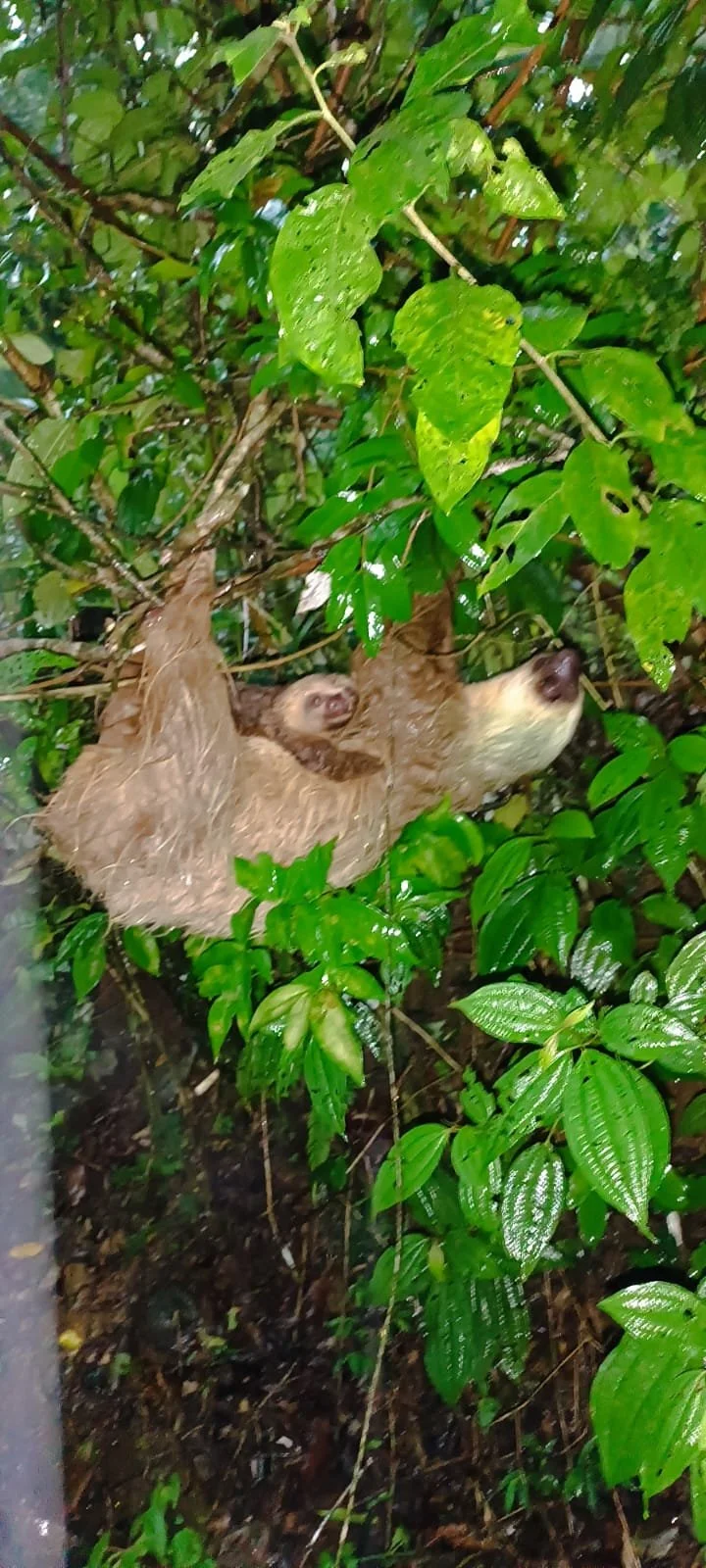
Sloths are among the most quietly celebrated sightings. They rarely draw attention to themselves, so spotting one feels like a small triumph of patience. Their slow, deliberate movement through the canopy gives visitors a sense of the forest’s unhurried rhythm. White-faced monkeys — often called white-faced capuchins — bring the opposite energy. They move in coordinated groups, alert and curious, sometimes pausing to observe observers. Their expressive faces and agile movement make them one of the most memorable daytime encounters.
Lower to the ground, the forest reveals different personalities. Armadillos occasionally appear along paths or near the edges of clearings, their armor catching faint light as they move methodically through leaf litter. Butterflies contribute flashes of color that feel almost theatrical. The big blue morpho is especially striking; its wings appear intensely blue in flight, then almost vanish when closed. In the world of insects, few creatures generate more excitement than the golden beetle. Its metallic shell reflects light like polished metal, giving it an almost jewel-like presence.
Birdlife adds constant background activity. Even when individual species remain unseen, movement in the canopy keeps attention upward. The combination of birds, insects, and mammals creates a layered environment where something is always happening if you slow down enough to notice.
Night safari discoveries and nocturnal specialists
After sunset, the forest transitions into a different world. Guided night walks reveal creatures that remain hidden during daylight hours. Tarantulas are among the most frequently spotted, often seen positioned along trunks or near burrow entrances. Snakes emerge under cooler nighttime conditions, their movement more fluid and visible in the subdued light of headlamps.
The canopy becomes especially active after dark. Kinkajous, olingos, and cacomistles — all nocturnal tree-dwellers — sometimes appear as shadowy shapes moving through branches. Their presence reinforces how vertical the ecosystem truly is. Owls add an auditory dimension to the experience. Their calls carry across the valley before a careful beam of light reveals their outline perched among leaves.
These night safaris don’t feel like performances; they feel like brief glimpses into a system that continues whether humans are present or not. That authenticity is part of what travelers remember most.
Rare sightings and the sense of a living forest
Some encounters fall into the realm of travel folklore — not guaranteed, but credible enough to circulate among guests. A number of visitors over the years have reported spotting ocelots moving quietly through dense vegetation. Even more rarely, there have been accounts of pumas passing through the broader area. These sightings are uncommon, yet their possibility changes how people perceive the landscape. The forest feels less like scenery and more like habitat in the fullest sense.
That perception shapes how guests move through the environment. Awareness increases. Steps become quieter. Attention widens. Wildlife viewing becomes less about finding specific animals and more about recognizing signs of presence — tracks, sounds, movement, subtle shifts in behavior among other species.
Why wildlife feels especially accessible here
Part of what makes the hostel stand out for wildlife observation is how seamlessly it fits into travel routes. Backpackers moving between Bocas del Toro and Boquete often break their journey here, and many arrive expecting only a restful pause. Instead, they find themselves in one of the most active ecological corridors they’ll experience in Panama. Because the environment is intact and lightly developed, animals move naturally through it rather than around it.
Another factor is pace. Without the distractions of urban environments or crowded attractions, attention naturally redirects outward. People walk slower. They linger longer. That change alone dramatically increases the likelihood of noticing wildlife.
Social dynamics also play a role. Guests share sightings, point things out, and compare experiences. One person’s observation often becomes a group experience. Over time, those shared moments build a collective awareness that enhances everyone’s chances of seeing something remarkable.
A reputation shaped by experience rather than promotion
Among travelers who compare wildlife encounters across Panama, this location repeatedly comes up as the place where biodiversity felt most immediate. Not necessarily because it guarantees rare species, but because encounters happen in ordinary moments. The forest doesn’t wait for scheduled viewing times; it overlaps with daily life.
That overlap explains why stories from here tend to be vivid and specific. Someone remembers a sloth shifting position at sunrise. Another recalls watching white-faced monkeys navigate branches with precise coordination. Someone else describes the reflective shimmer of a golden beetle in filtered light. These are not curated experiences; they are remembered observations.
For travelers crossing between the Caribbean and Pacific sides of Panama, the hostel becomes more than a convenient midpoint. It becomes the place where the country’s wildlife feels tangible, immediate, and undeniably present. The memory of that presence often lingers long after the journey continues.